Topic Headquarters
Calcutta as a Lived System
Streets, transport, food, weather, work, class, memory, civic absurdity, and one impossible footpath: a guided route through Calcutta as people actually negotiate it.
Calcutta is not a list of monuments. It is a system that begins negotiating with you before breakfast. Water arrives or does not. Tea establishes a small republic at the corner. A bus conductor discovers more capacity inside the human skeleton than anatomy textbooks admit. Hawkers, pedestrians, motorbikes, dogs, drains, schoolchildren, and parked cars revise the footpath by the minute. Heat presses differently on a worker outdoors, a family under tin, and someone able to close a glass door and switch on an air conditioner.
These pages approach the city through those negotiations. Food is biology, class, river, market, and memory before it becomes cuisine. Public space is livelihood for one person and obstruction for another. A traffic light turns destitution into an intimate encounter. Wet-bulb temperature explains part of a summer that civic endurance alone cannot solve. School photographs, old neighbourhoods, migration, and return show how a city persists inside the body even when its streets and moral vocabulary change.
The voice is affectionate without becoming promotional and angry without pretending every failure is uniquely Bengali. Calcutta can be absurd, cruel, funny, learned, exhausted, generous, vain, and structurally dangerous in the same afternoon. Begin with one life shaped by the city, continue through transport and appetite, then read the harder arguments about work, weather, class, and memory. When prose becomes insufficient, try to cross one procedurally hostile neighbourhood in the footpath simulator. The route is fictional; the negotiations will feel familiar.
Best place to start
One useful first door
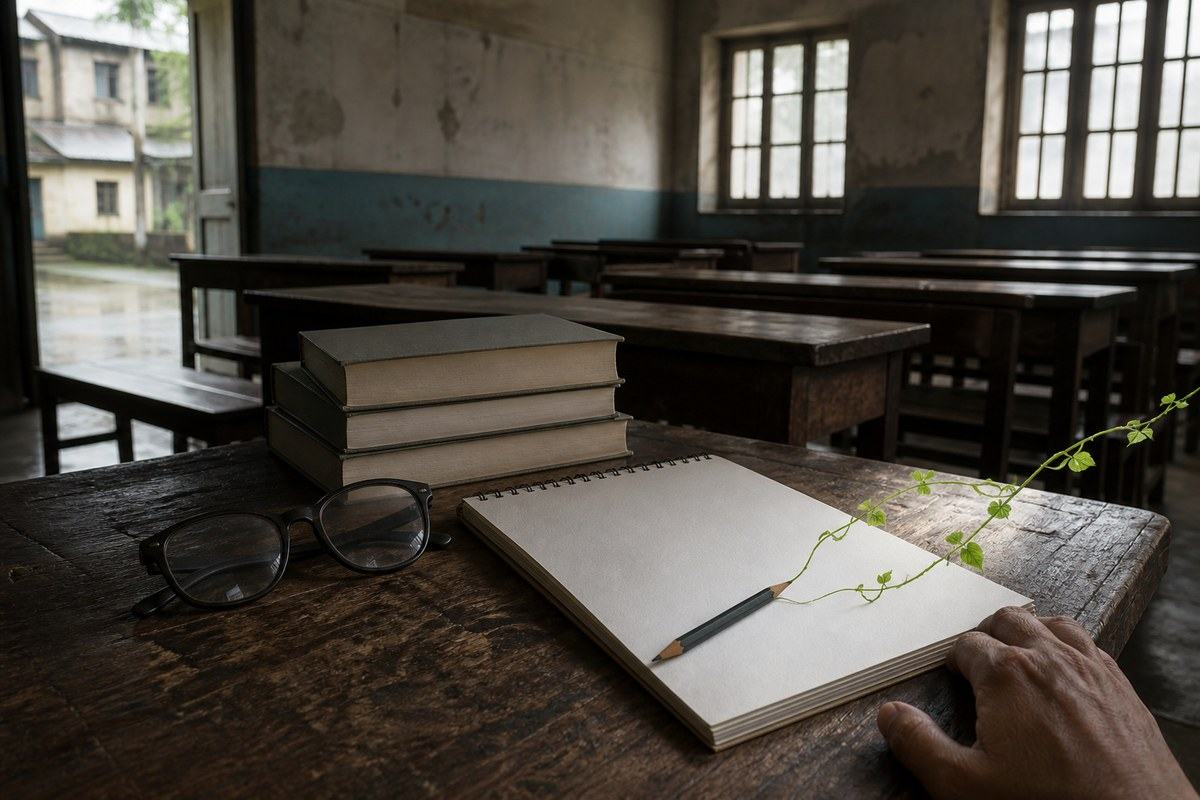
Start here because the city appears through an actual life: school, illness, books, shame, politics, sketches, survival, and the habits that make Calcutta more than a backdrop.
A Calcutta self-portrait stitched from school shame, books, reading, sketches, politics, survival, and the stubborn habit of staying mentally alive.
Three reading paths
These are ordered editorial journeys, not automatic difficulty labels. Follow one route or move between them as your questions change.
Begin here
Beginner path
Enter through ordinary negotiations: tea-stall conversation, a crowded minibus, and the fish that organize Bengali appetite.
- Article CalcuttaOne More Bhaar Cha Before Night Falls
A humid evening portrait of tea stall adda, middle-aged panic, cracked ambition, and the strange comedy of surviving in the forgotten edges of Calcutta.
- Article CalcuttaShouldering the Chips: A Bengali Odyssey Through Calcutta’s Public Transport
A sharp Calcutta commute satire on minibuses, heat, humidity, crowding, irritation, and resentments carried like family heirlooms.
Updated - Article FoodThe Fish Bengalis Eat
A practical field guide to the fish commonly eaten in Kolkata, with Bengali names, English and scientific names, and a hardheaded look at which fish are best for regular eating, which are occasional luxuries, and which are poor bets.
Build context
Intermediate path
Read the street as an economic, civic, and climatic system rather than a collection of colourful inconveniences.
- Article Social CommentaryHawkers Are Not Rubbish To Be Swept Before Breakfast
A Calcutta street-level argument against evicting hawkers without real rehabilitation, jobs, dignity, or an honest urban plan.
Updated - Article SocietyThe City That Begs at the Window
Calcutta’s street begging is not a plague of people; it is a public system failure made intimate, theatrical, and impossible to ignore.
Updated - Song ClimateThe Calcutta Summer of 2026
A street-level, India-focused look at why Calcutta’s 2026 summer is not merely hot, but structurally dangerous: humidity, labor, housing, health surveillance, and the small tyrannies of daily life.
- Article ScienceWet-Bulb, Dry-Bulb, and Kolkata Heat
A practical guide to dry-bulb, wet-bulb, and feels-like temperatures, and why some Kolkata summer days feel especially punishing.
Updated
Go further
Deep-reading path
Move through remembered neighbourhoods, migration and return, then confront an argument about the city's changing moral weather.
- Article EssayThe Lumpy Edge of Bijon Setu
A darkly comic monologue tracing childhood memories of Bijon Setu and South Sinthee through the noise, decay, and absurdity of present-day Calcutta.
Updated - Article PersonalAmerica and Calcutta
A Calcutta man weighs America’s clean insulation against Calcutta’s noisy intimacy and considers how each shaped his sense of home.
Updated - Song CalcuttaThe Zeitgeist of Calcutta Has Changed
A personal essay on Kolkata’s shift from neighbourhood shame to public display, nightlife, religiosity, selfishness, and duplicity.
Updated
Suvro’s contrarian view
The city's disorder is not a personality trait
Calcutta is often romanticized and condemned through the same shortcut: chaos becomes the city's charming, infuriating character. That language turns political choices into weather. A blocked pavement, lethal heat, precarious vending, crowding, and begging are not produced by a mystical Bengali temperament. They emerge from land, work, enforcement, housing, transport, class, and the unequal ability to purchase distance from inconvenience. The city's humour and improvisation are real, but celebrating resilience too quickly can become a polite way of asking the same people to absorb another institutional failure.
Glossary
A small working vocabulary for this subject, defined for the way it appears across this site.
- Adda
- An open-ended Bengali conversation that may mix gossip, argument, politics, memory, jokes, and ideas without needing a productive agenda.
- Bhaar
- A small unglazed clay cup traditionally used for tea, valued partly because the earthy vessel changes the sensory ritual of drinking.
- Hawker
- A street vendor whose livelihood occupies contested public space and is often entangled with licensing, policing, unions, and informal payments.
- Wet-bulb temperature
- A measure combining heat and evaporative cooling that helps explain why humid air can make sweating much less effective.
- Heat action plan
- A public-health plan for warnings, worker protection, cooling, health-system readiness, surveillance, and response during dangerous heat.
- Public space
- Shared urban ground whose actual use is continually negotiated among pedestrians, vendors, vehicles, residents, officials, and people seeking shelter or income.
- Para
- A Bengali neighbourhood understood not only by boundary but by relationships, clubs, shops, gossip, memory, and everyday mutual surveillance.
- Kolkata and Calcutta
- Two names for the same city, carrying different histories, registers, memories, and personal associations; these pages use both according to context and voice.
Frequently asked questions
Is this a travel guide to Kolkata?
No. It may help a visitor understand the city, but it is organized around lived systems rather than attractions. Transport, weather, class, food, public space, memory, and failure matter more here than an itinerary.
Why does the site use both Calcutta and Kolkata?
Both names belong to the city's history and current speech. Individual titles retain their chosen voice, while the headquarters uses Calcutta as its editorial name without treating Kolkata as incorrect.
Where should a reader unfamiliar with the city begin?
Begin with Schooling in Calcutta, then take the beginner path through a tea stall, public transport, and fish. Those pieces establish social texture before the more structural essays on work, public space, and heat.
Why are weather essays central to understanding the city?
Heat and humidity determine sleep, labour, transport, housing, illness, electricity use, and who can afford insulation from discomfort. Weather becomes social structure when exposure and protection are distributed unequally.
Does the footpath game make light of real hardship?
It uses satire, but its obstacles come from genuine negotiations over space, movement, rain, traffic, vending, and infrastructure. The game also provides a static description and accessible controls rather than reducing the city to an unexplained visual joke.
Are these essays nostalgic for an older Calcutta?
Memory is present, but the route does not claim that the past was clean or just. Several pieces explicitly question neighbourhood shame, hierarchy, exclusion, civic neglect, and the temptation to turn remembered intimacy into moral superiority.
Recently updated material
Automatically ordered by each resource’s declared update date, with publication date used only when no update is recorded.
- Article EssayCalcutta and the Pyramid Scaffold
- Article Raw ScienceThe Unsleeping Attractor: On Ungovernable AI and the Beautiful, Horrifying Mathematics of What We Cannot ControlUpdated
- Article CalcuttaThe Sound of Calcutta at 3 AM: A Taxonomy of Night NoisesUpdated
- Article EssayDread and the Metastatic MindUpdated
- Article SatireAsymptotic Doom of the Orgasm CoffinUpdated
- Article EssayRakhi and the Currency of OblivionUpdated
Browse all material
The complete published collection currently assigned to this headquarters: 57 resources.
- Article EssayCalcutta and the Pyramid Scaffold
- Article Raw ScienceThe Unsleeping Attractor: On Ungovernable AI and the Beautiful, Horrifying Mathematics of What We Cannot ControlUpdated
- Article CalcuttaThe Sound of Calcutta at 3 AM: A Taxonomy of Night NoisesUpdated
- Article EssayDread and the Metastatic MindUpdated
- Article SatireAsymptotic Doom of the Orgasm CoffinUpdated
- Article EssayRakhi and the Currency of OblivionUpdated
- Article SatireThe Zamindars Are Not DeadUpdated
- Article Personal EssayEntropy and the Thermodynamics of Lonely Bastards
- Article Mental HealthA Mediocre Manifesto of Managed Mediocrity
- Article Mental HealthMorbid NappingUpdated
- Article SatireThe Doldrums of the Carcass
- Game GamesLudo & Saap-LudoUpdated 20–90+ min play read
- Article SatireThe Foam at the Corner
- Article EssayThe Sacred Circle-Jerk of Model Version Numbers
- Article EssayThe Akathisiac Anxiety of a Camouflaged Nobody
- Article EssayThe Monopoly of the Powerful
- Article Personal EssayBipolar Hope and the Coming Chorus of Pretensions
- Article Personal EssayUmbra and Penumbra
- Article EssayThe Drowning Prophet
- Article Mental HealthRain Palimpsest
- Article EssayThe Accelerating Velocity of Obsolescence
- Article EssayThe Complacent Loser and the Texture of Survival
- Article Raw ScienceHydrocephalus of the Tap
- Article Personal EssayThe Great Meme Reset and My Colon: A Bipolar Monologue from the Bowels of Calcutta
- Article SatireTwerky Vishnu From Vapor
- Article Calcutta ChroniclesMonsoon, Monotony, and the Malignant Prostate of Providence
- Game GamesKagojer Dana: A Paper Plane Through CalcuttaUpdated 6–10 min play read
- Game GamesCalcutta Footpath Simulator: Ekdom Side Diye JaanUpdated 3–7 min play read
- Article EssayThe Lumpy Edge of Bijon SetuUpdated
- Article Personal EssayThe Vermicular ParliamentUpdated
- Article Personal EssayThe Great Unemployment of the Soul
- Article Personal EssayAfter America, Before NothingUpdated
- Story Short FictionThe Corridor of Wind
- Story Short FictionMoon Without Skin
- Article Social CommentaryHawkers Are Not Rubbish To Be Swept Before BreakfastUpdated
- Article ScienceWet-Bulb, Dry-Bulb, and Kolkata HeatUpdated
- Article SatireBengali Tintin In The Republic Of GarbageUpdated
- Article CalcuttaThe Classification and Variety of Rotting People in CalcuttaUpdated
- Article Personal EssayOne Life, No Rehearsal, No Refund CounterUpdated
- Song ClimateThe Calcutta Summer of 2026
- Song CalcuttaThe Zeitgeist of Calcutta Has ChangedUpdated
- Article LifeThe Geography of Contentment
- Article Calcutta LifeClay Stoves, Hormuz, and the Price of Breath in Calcutta
- Article CalcuttaMaybe the Body Is Not BrokenUpdated
- Article CalcuttaOne More Bhaar Cha Before Night Falls
- Article Personal EssayWhy 2026 Is Still the 21st CenturyUpdated
- Article PersonalThe Bengali Hikikomori and the Shrinking Map of His LifeUpdated
- Article PersonalThe Empty Room Inside LonelinessUpdated
- Article Personal EssayThe Kolkata Bat Waiting for a BusUpdated
- Article SocietyThe City That Begs at the WindowUpdated
- Article PersonalThe Barebones Lifeboat: America, Calcutta, and the Price of Staying AfloatUpdated
- Article FoodThe Fish Bengalis Eat
- Article CalcuttaThe Aromatics of StagnationUpdated
- Article CalcuttaMindfulness?Updated
- Article PersonalAmerica and CalcuttaUpdated
- Article CalcuttaShouldering the Chips: A Bengali Odyssey Through Calcutta’s Public TransportUpdated
- Article PersonalSchooling in CalcuttaUpdated
Related Topic Headquarters
Sketches, Drawing, and the Visual Mind
A guided route through Suvro Ghosh's sketches, visual thinking, grotesque figures, art history, pixels, and experiments in drawing with code.
Explore topicSongs, Synthetic Music, and the Work of Listening
Listen across Bengali, English, and Hindi collections, then follow the harder questions of songwriting, synthetic music, authorship, attention, and trust.
Explore topicBipolar Depression Without the Motivational Poster
Lived experience, early warning signs, rumination, anhedonia, bodily agitation, mathematical models, treatment questions, and the systems surrounding severe depression.
Explore topic