America and Calcutta
Uses the speech voice supplied by your browser or device.

Acronyms used in this post:
HVAC — Heating, Ventilation, and Air Conditioning; the indoor system that heats, cools, filters, and circulates air.
UPS — Uninterruptible Power Supply; the battery backup box that keeps small devices running when power fails.
ABCD — American-Born Confused Desi; a joking diaspora phrase for children of South Asian immigrants born or raised in America.
H-E-B — A beloved Texas supermarket chain, not a philosophical system, though in Texas it sometimes behaves like one.
CESC — Calcutta Electric Supply Corporation; the electricity provider in much of Kolkata.
America did not first look rich to me. It sounded rich.
That is the trick nobody tells you. Poverty is not only lack of money. Poverty is volume. It is the quarrel outside the window, the horn under the balcony, the inverter crying in the corner, the neighbor’s pressure cooker announcing dal like a military victory, the street dog barking at invisible legislation, the bus grinding its gears with the sorrow of an old harmonium. Then you land in America and suddenly reality has been turned down. Someone has found the great knob on the universe and lowered hiss, clang, smell, crowd, dust, urgency, and human leakage.
The silence feels expensive.
Not peaceful in the ashram sense. Expensive in the supermarket-at-2-a.m. sense. The doors open by themselves. Cold air comes out like a well-paid ghost. The floor shines. The lights are so bright they seem to have personal grievances against darkness. Cereal stands in battalions. Milk waits in chilled trenches. Apples look as if they have been interviewed and selected by a committee. Everything is wrapped, labeled, priced, scanned, dated, and placed at right angles. Even biscuits appear to have a retirement plan.
A man from Calcutta stands there holding a plastic basket and realizes that civilization may be, at least partly, the art of arranging potatoes without shouting.
Then comes the second surprise. The air.
American air, especially indoors, is not air in the old Calcutta sense. It is a product. It has been cooled, dried, filtered, deodorized, circulated, and passed through machinery until it forgets its village origins. It does not enter your lungs with news of drains, frying oil, fish, rain, sweat, diesel, incense, and wet clothes. It enters quietly, like a clerk with a file.
Calcutta air does not enter quietly.
Calcutta air has a personality and wants to discuss several matters. At six in the morning it may smell of wet earth and tea. By eight it has acquired diesel, frying oil, old brick, fish, sweat, damp newspaper, and a lane-side drain that has lost interest in civilization. Somewhere incense is burning, always. We burn incense not only for gods but for mosquitoes, mood, memory, dampness, and the mysterious Bengali belief that smoke can negotiate with the unseen.
Your nose becomes a municipal planner. It divides reality into tolerable zones.
I lived in San Antonio and Austin, and this is where the lazy political cartoon of America must be put in a corner and denied snacks. I met plenty of ordinary Americans, many of them white, suburban, practical people of the H-E-B and Home Depot universe. Later, television and politics would try to sell me a different America, a furious country made entirely of slogans, suspicion, and men who look as if cholesterol has filed a legal claim on their faces.
That was not the America I knew.
The America I knew contained a great deal of everyday decency. Not trumpet-blowing virtue. Not speech-making kindness. Ordinary decency. A colleague giving you a ride when your car dies. A neighbor asking if you are alright and meaning it. Someone holding a door without converting it into moral theater. People who treated you, on most days, like a person before they treated you like a category.
No country is innocent. Let us not be children wearing paper crowns. America has its brutal histories, its loneliness, its racism, its guns, its medical bills that can make a grown man look at a thermometer and calculate bankruptcy. But daily life in America often had a quiet civic grammar. Lanes mattered. Appointments mattered. Receipts mattered. Your complaint received a number. Your number was called. The machine did not love you, but it usually knew you were in the queue.
This is no small thing.
In Calcutta, the queue is often philosophical.
America’s real miracle is insulation. Not freedom. Insulation.
Double-glazed windows. Central air. Carpets. Cars. Suburbs. Doors that shut properly. Walls that reduce other people’s lives to a polite murmur. Even smell is treated as a suspect. Biology has to behave. Sweat must apologize. Cooking must not travel too far. Garbage must vanish. Weather must stay outside unless invited.
The body in America is cushioned, cooled, deodorized, belted, insured, seated, and moved from one controlled box to another controlled box. Apartment to car. Car to office. Office to grocery store. Grocery store to home. A day can pass and your skin barely knows you were alive.
Calcutta offers no such courtesy.
Here the body is always being addressed. Heat taps your neck. Humidity sits on your chest. A bus coughs into your face. A bicycle misses your elbow by the width of a moral argument. A fish seller shouts. A man scratches his belly and gives unsolicited advice about national policy. Two aunties block the lane with the strategic intelligence of a border dispute. A dog sleeps in the middle of the road like a retired judge.
The street is not a corridor. It is a parliament.
Every horn has a sentence. A short beep means, “I exist.” A longer beep means, “I am coming through whether physics agrees or not.” A furious beep means, “Your ancestors made a mistake.” The musical horn of a small goods vehicle sounds like a toy having a nervous breakdown. And somehow, through this committee of engines, elbows, bells, cows, scooters, buses, boys, vendors, and fate, traffic moves.
Not safely. Not elegantly. But it moves.
That is Calcutta’s central method. It works while arguing.
America works by hiding the argument. Wires hide in walls. Pipes hide underground. HVAC hums in ceilings. Apps update while you sleep. Garbage disappears as if swallowed by a civic magician. Water comes. Water goes. Power stays. The city performs competence so regularly that you begin to think competence is natural, like sunrise.
Calcutta cures that fantasy by breakfast.
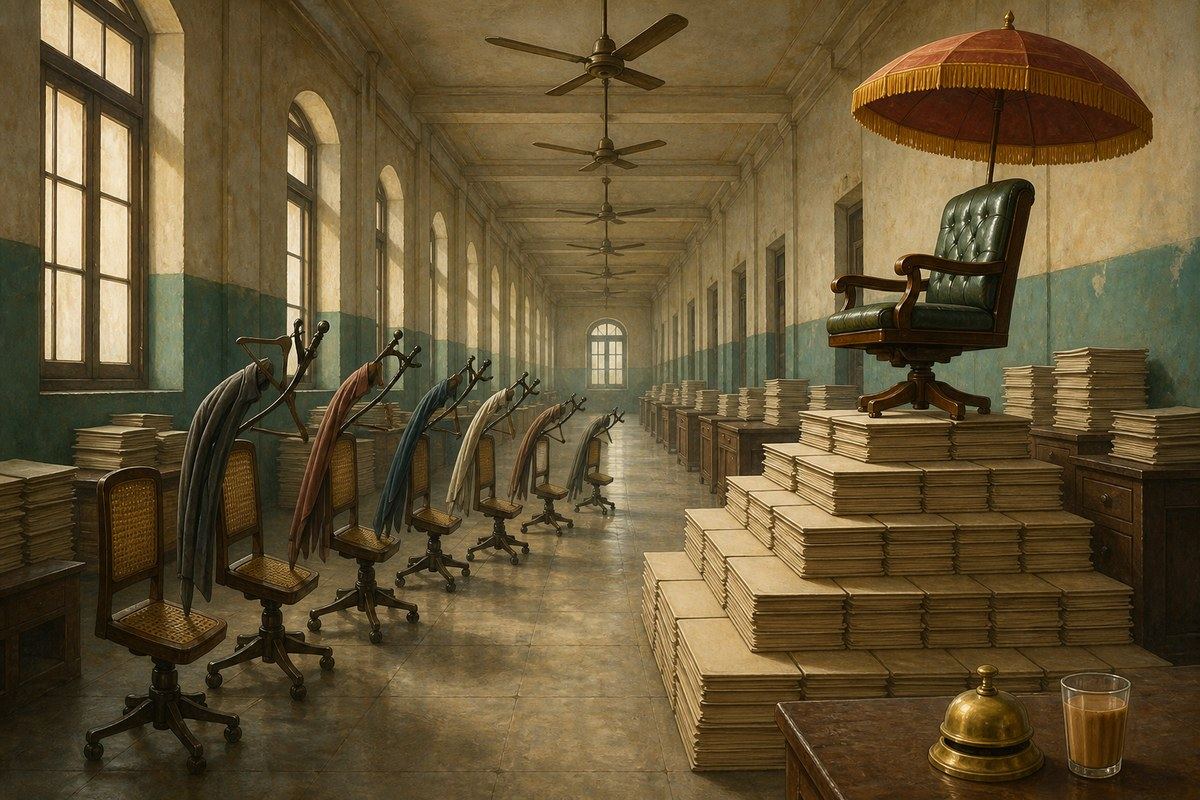
Here the wires hang in public like old black vines. A repairman climbs a pole with the calm of a man negotiating personally with death. The UPS beeps its tiny electronic lament. The generator coughs awake like an asthmatic buffalo. The ceiling fan slows, revives, slows again, as if considering whether democracy has failed. Maintenance is not backstage. It is the show. One man fixes. Two men watch. A third man explains why everyone is doing it wrong. This third man is the true backbone of Bengal.
Still, I must be fair. America’s smoothness has a price.
It can make you lonely with great efficiency.
Privacy is wonderful until it becomes an empty football field. In America, nobody knows where you are going, what you are eating, why you are thin, whether you have married, why you have not married, how much you earn, what your mother thinks, or whether your gas cylinder has arrived. This is heaven for three weeks. Then one evening the apartment becomes too quiet and the refrigerator hum begins to sound like a philosophical accusation.
In Calcutta, privacy is a rumor. Community arrives without invitation. The para knows. The shopkeeper knows. The neighbor knows. The tea stall knows. A stranger on the tram may know by Thursday. You are not alone, but you are also not entirely free. The city holds you like an old relative: affectionately, noisily, and with no understanding of personal space.
This is why Bengalis behave differently abroad.
In Calcutta, a Bengali can be magnificently slippery. He avoids obligations with the smoothness of a fish escaping a bad poem. There are too many relatives, too many neighbors, too many ceremonies, too many eyes. Community is supplied by force. So he dodges it.
In America, the same Bengali suddenly panics in the silence. He starts searching for other Bengalis like a metal filing rushing toward a magnet. Durga Puja committees form. Potlucks bloom. Weekend adda sessions begin as “just tea” and end in arguments about Tagore, Modi, Mamata, school districts, property tax, cholesterol, mutual funds, and whether proper biryani requires potato. A rented school gym becomes, for one weekend, a small emotional republic with folding chairs and committee resentment.
Then come the ABCD children, circling this universe like embarrassed moons.
They want pizza. They pronounce phuchka as if it is a skin condition. They treat shorshe ilish like a coastal dare. They roll their eyes at mishti doi and auntie interrogation. But do not be fooled. The herd instinct enters quietly. In a country built like a cathedral of individualism, immigrant families manufacture small, noisy, overfeeding versions of home. It is not always dignified. It is often overcooked. But it is survival.
Meanwhile, here in my present Calcutta life, the phone throws the world at me before tea. Wars, elections, artificial intelligence, layoffs, cricket, heat alerts, market crashes, miracle cures, celebrity divorces, and one uncle forwarding a video proving that ancient India invented either quantum computing or the pressure cooker. The planet now arrives in the palm before the kettle boils. Yet the local problem remains ancient: will the water come, will the power stay, will the money stretch, will the mind behave today?
This is where America and Calcutta stop being places and become nervous systems.
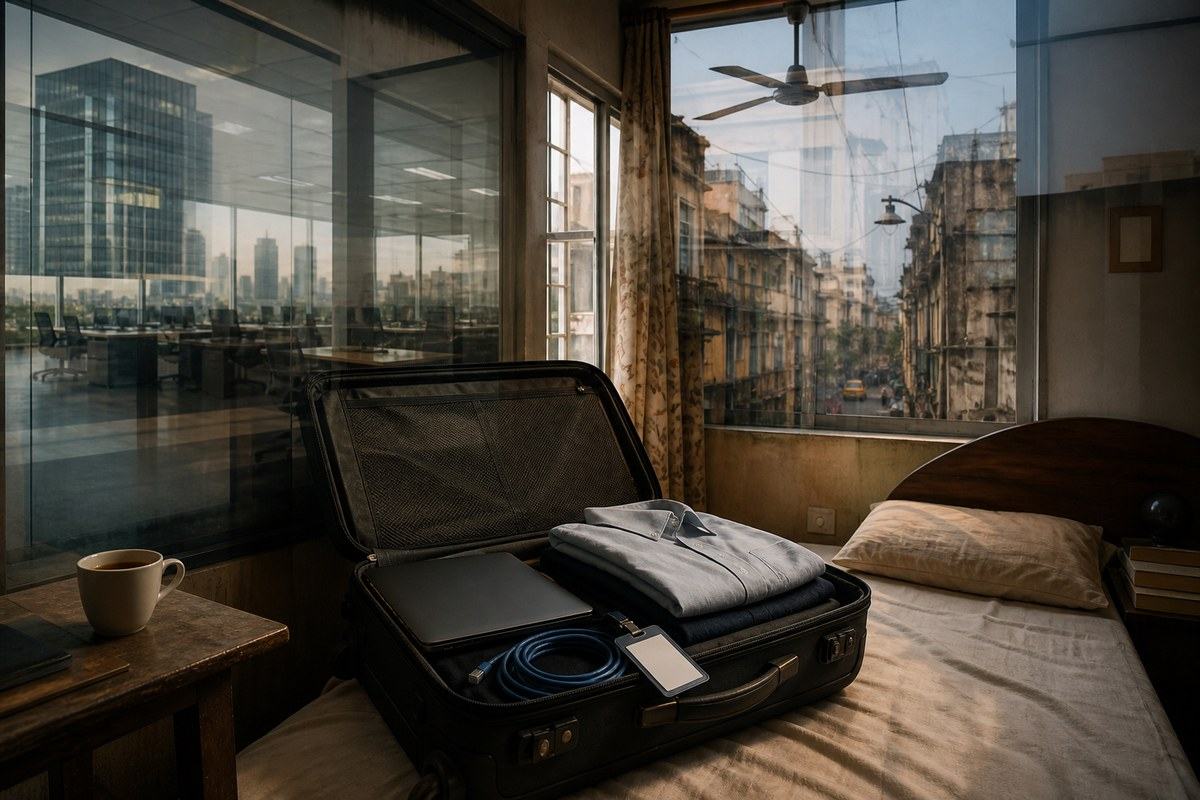
America made my mind quieter. Not happier exactly. Let us not over-sell the brochure. But quieter. The day had fewer ambushes. A plan could remain a plan for more than twenty minutes. I could go to a library, sit under bright lights, open a laptop, and believe for an hour that life was a solvable administrative issue. The thought would begin here and end there. No horn cut it in half. No power cut erased it. No neighbor’s quarrel entered as a subplot. My mind could line up like schoolchildren after morning assembly.
Calcutta makes my mind a bazaar.
A sentence begins. A horn interrupts. A vendor calls. A pressure cooker whistles. Someone upstairs drags furniture with the delicacy of a collapsing bridge. A dog barks. A political procession passes. A child cries. The fan wobbles. The phone pings. The thought loses one slipper, recovers it, then forgets why it left the house.
For a person with bipolar disorder, this matters. Not in a poetic way. Bipolar disorder is not a shawl thrown over genius. It is weather inside the skull. Sometimes dramatic, often boring, frequently humiliating. Irritability, shame, anger, exhaustion, grand plans, broken plans, days when bathing feels like a government project, mornings when tea itself seems to require an engineering degree. People who have never had their mood turn into a feral animal think discipline is a switch. It is not. Some days discipline is a matchstick in the rain.
America, with all its coldness, sometimes gave me fewer matches to light.
Calcutta gives me warmth but also sparks everywhere.
And yet, let us not make America the hero and Calcutta the villain. That would be too easy, and easy things are usually lying.
America reduces friction, but friction is also where much of life lives. The smell of frying luchi. The tea stall debate. The sudden rain. The fish market glittering at dawn with hilsa and rohu like silver evidence. College Street books breathing mildew, ambition, and exam fear. A tram bell. A puja drum. A child flying a kite from a roof that should not technically support philosophy. The city can be tender without warning.
Then it can smell like rot and remind you that tenderness is not a municipal service.
America gave me dignity through systems. Calcutta gives me belonging through interruption. America left me alone. Calcutta refuses to. America made life easier to manage. Calcutta makes life harder to ignore.
Which one is better?
That is the wrong question, but the mind keeps asking it because the mind likes cheap court cases.
The better question is what each place took from me and what each place gave back.
America gave me space, order, air-conditioning, libraries, roads, reliable power, and the lovely illusion that if systems work, perhaps the self can work too. It also gave me loneliness, distance, and a life where one can disappear politely.
Calcutta gave me noise, crowding, heat, dust, failure, improvisation, gossip, cheap tea, familiar language, and the constant reminder that human beings are not designed to live like sealed envelopes. It also gave me exhaustion, irritation, and the feeling that every small task must first wrestle a committee of invisible demons.
Today my life is not Texas-sized. Nothing about it says “spacious,” except perhaps the unpaid future.
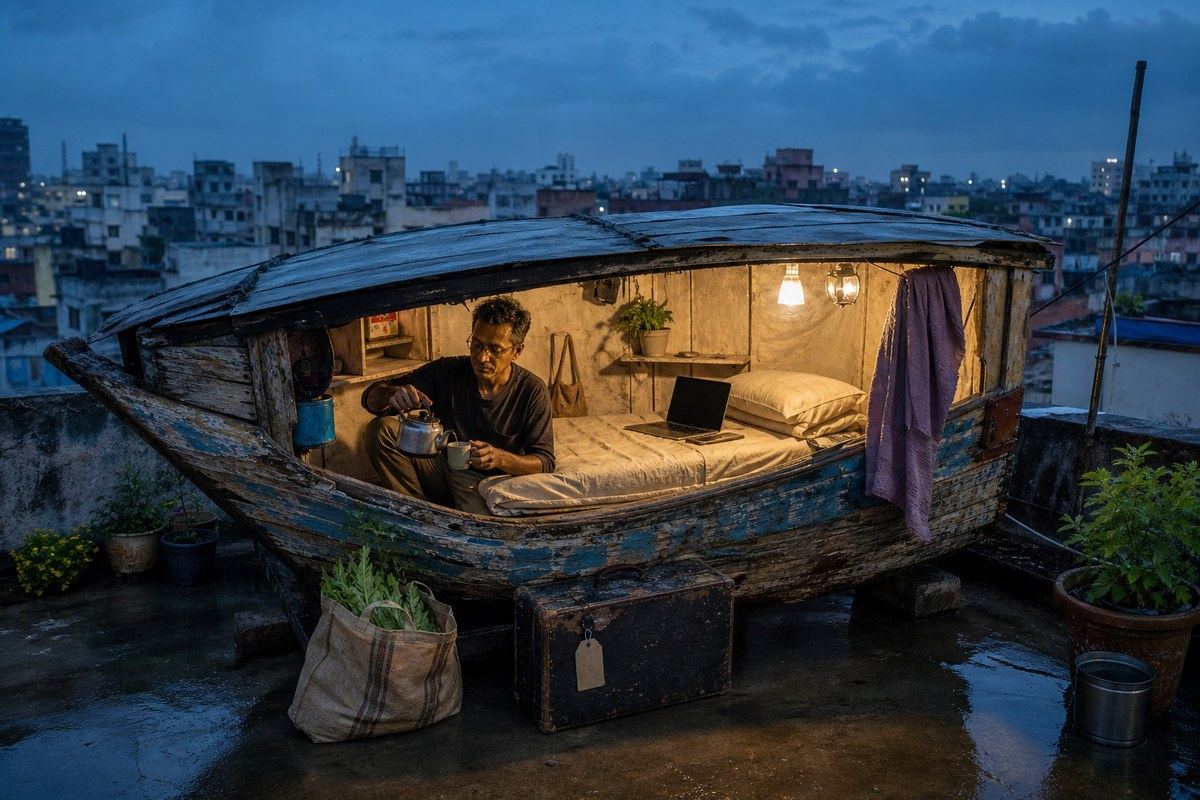
I live in a rented flat in the humble outskirts of South Calcutta, in that lower-middle-class geography where parsimony is not a virtue but weather. A mattress on the floor. A few books that have survived more regimes than some countries. A rice cooker more dependable than most institutions. A kettle. Tea. A water bottle standing near the bed like a night guard. An old laptop. A Samsung tablet glowing in the dark like a small domestic hearth.
There is no grand lifestyle here. No curated minimalism with imported lamps and a podcast voice saying “intentional living.” This is not minimalism. This is arithmetic. This is the life of a 51-year-old single man trying to keep the day from falling off the table.
But there is a strange mercy in the smallness.
When you own little, fewer things shout your name. When you live quietly, fewer people can draft you into their weather. When the room is simple, the mind sometimes stops performing for an imaginary audience. It does not become cured. Nothing so cinematic. But it steadies a little. Like a cracked cup placed carefully on a shelf, not repaired, not new, but not falling.
Outside, Calcutta honks, leaks, fries, bargains, prays, sweats, votes, forwards nonsense, loses power, regains power, and argues with tomorrow.
Inside, I make tea.
Some mornings that is the whole victory.
And perhaps this is why America still lives in me like a cooled room I once entered, while Calcutta lives in me like a lane that knows my name. One gave me silence. One gives me noise. One gave me insulation. One gives me contact. One made me feel temporarily upgraded. The other makes me feel inconveniently alive.
Between them I remain, a Bengali with two weather reports: one in Fahrenheit, one in fever.
Word Cloud
Related reading
Selected by shared topics and section, with closer publication dates breaking ties.