The Ghost as Perception
Uses the speech voice supplied by your browser or device.

Acronyms expanded in this post:
- AI: Artificial Intelligence. software that generates, classifies, predicts, summarizes, or acts on patterns in data.
A ghost is what happens when the mind sees a human shape but cannot find the ordinary machinery that should make it make sense.
That is the useful place to begin, not with chains rattling in a corridor, not with a pale woman floating down a staircase, not with that most overworked department of human imagination, the afterlife, but with perception itself. The ghost is often treated as the vulgar cousin of religion and horror: a drafty superstition wearing a bedsheet. Yet the figure becomes far more interesting when we stop asking whether it is real and begin asking what kind of seeing makes it possible. The ghost is not merely a thing believed in. It is a disturbance in the agreement between body, movement, memory, and causality. It is a human form that refuses to behave like a human form, and this refusal is enough to make the world creak at the joints.
The living announce themselves through effort. A person enters a room by negotiating gravity, friction, balance, hesitation, intent. One foot accepts the future; the other reluctantly leaves the past. Knees bend, shoulders compensate, the head makes tiny corrections like a magistrate revising a bad municipal map. Human movement is a small miracle made boring by repetition. We walk, stumble, lean, climb, turn, stop. We live inside resistance. The ghost, by contrast, is horrifying not because it moves too strangely, but because it moves without paying the usual taxes. It arrives without arrival. It advances without steps. It appears to have position without journey, presence without weight, direction without effort. It is locomotion with the receipts removed.
That missing receipt is where fear enters.
The old ghost story knows this instinctively. A figure glides. A face appears at a window where no ladder could have stood. A body crosses a corridor without the soft inventory of human motion. No footfall. No breath. No convincing reason. The mind is not first frightened by death; it is frightened by broken physics. It has spent its entire animal life learning the grammar of bodies. A tiger springs. A mother turns. A stranger pauses. A crowd flows. The nervous system is, among other things, a devoted reader of motion. It reads intention before words, danger before evidence, recognition before thought. When a figure moves like a person but not through the available rules of personhood, the mind receives a sentence whose nouns are familiar but whose verbs have gone mad.
This is why the ghost is not merely an object of belief. It is a crisis in interpretation.
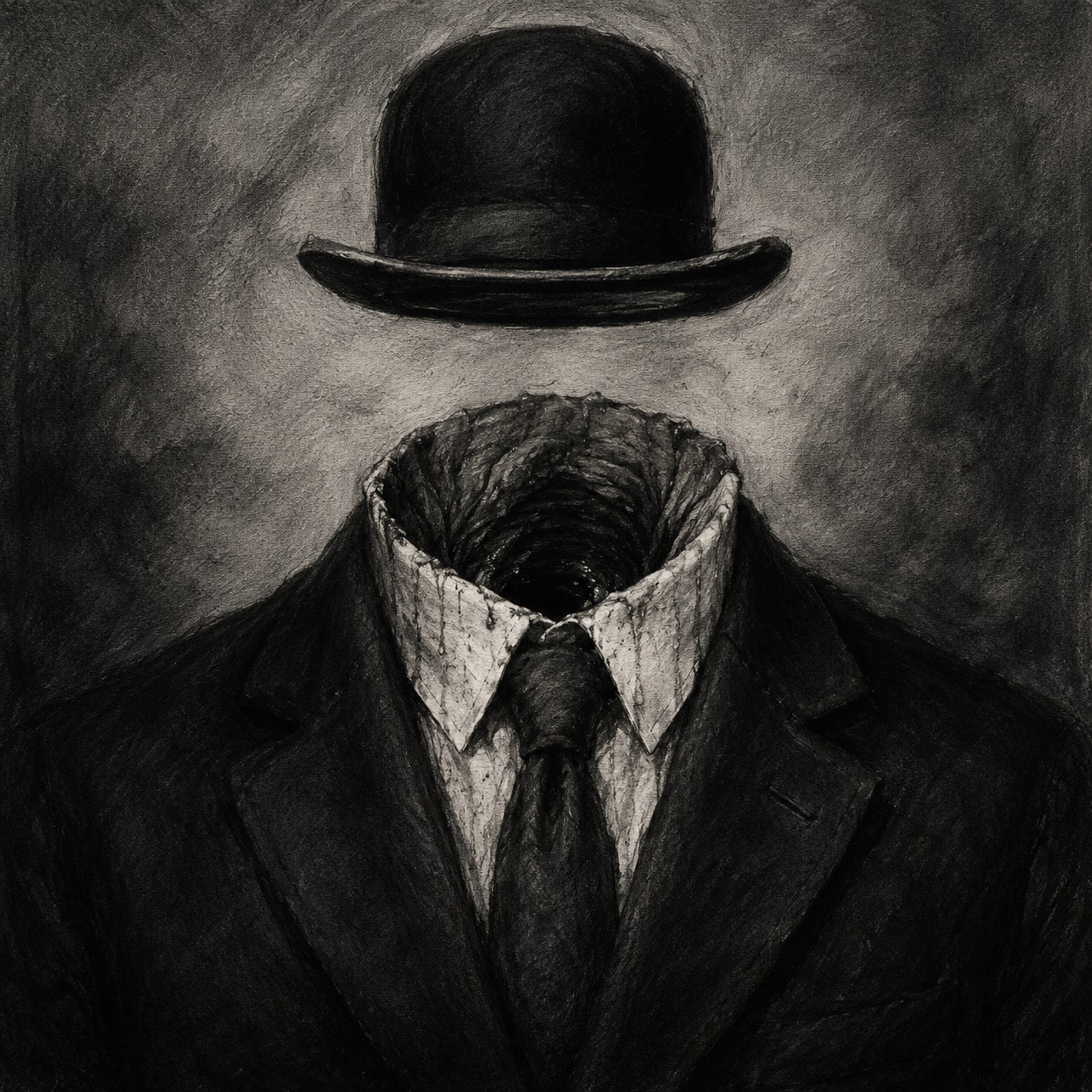
To call it superstition is often accurate, but insufficient. Superstition explains the cultural packaging, not the perceptual event. People do not imagine ghosts as random geometry. They imagine them as almost-human, formerly-human, wrongly-human. The ghost is close enough to recognition to hurt. It carries the grammar of the body but misuses it. It is the torn page of a person. A hand without task. A face without metabolism. A figure whose outline says man, woman, child, ancestor, stranger, but whose behavior refuses the covenant of the living. It is a chapped version of humanity, roughened by time, flaked away from ordinary explanation.
Language stumbles accordingly. We say apparition, presence, shade, spirit, ghost, figure, something. That last word may be the most honest one. Something was there. Something moved. Something stood. Something watched. The word has the magnificent cowardice of a clerk confronted by a god. It names and retreats at the same time. In ordinary life, language is confident because perception has already done the hard work. Chair, dog, door, aunt, bus, crow. But the ghost weakens the naming impulse. It forces language into brackets and hedges. It was like a man. It was some kind of figure. It seemed to hover. It looked as if it knew me. The ghost is what happens when the visible becomes grammatically unstable.
The phrase “once a man” matters. It pulls the ghost away from monster and toward residue. A monster may be alien from the beginning. A ghost carries history like damp in a wall. The ghost was someone, or appears to have been someone, and that former personhood makes the figure philosophically troublesome. It is not merely that the dead return. It is that a category returns after its supporting conditions have vanished. A man is not just a shape. A man is appetite, memory, gait, heat, error, social obligation, digestion, handwriting, irritation, preferred tea, unpaid bills, shoes by the door, the faint smell of hair oil, one thousand embarrassing continuities. Remove the body’s ordinary functions and keep only the outline, and what remains is not simply a soul. It is a question mark in human form.
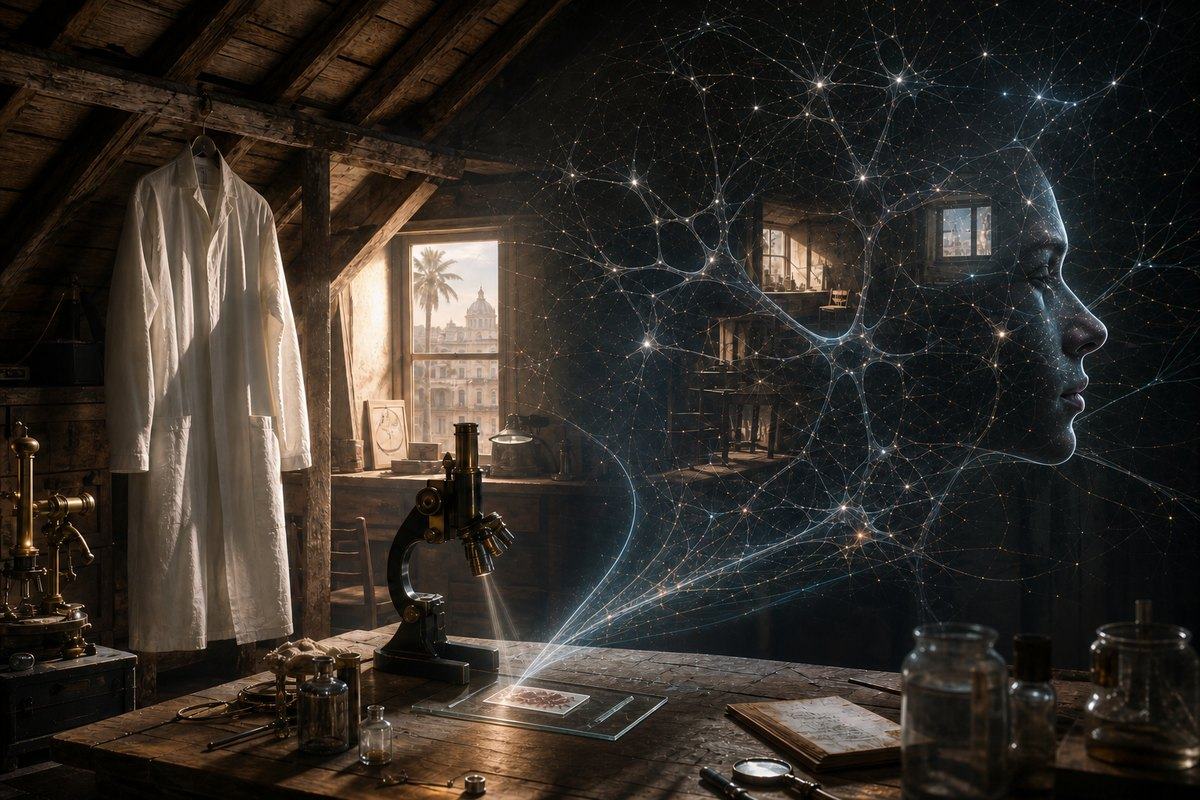
In this sense, the ghost is a study in representational loss. A living person is thick with data. Not data in the cold administrative sense, not the flat little labels with which offices and hospitals and governments flatten us into forms, but lived data: temporal, bodily, relational, atmospheric. The ghost is a compressed and damaged file. It preserves contour but loses context. It keeps appearance but sheds explanation. It resembles the old human being as a smudged photograph resembles an afternoon. Something remains, but too much has been removed. The terror is not absence. It is partial persistence.
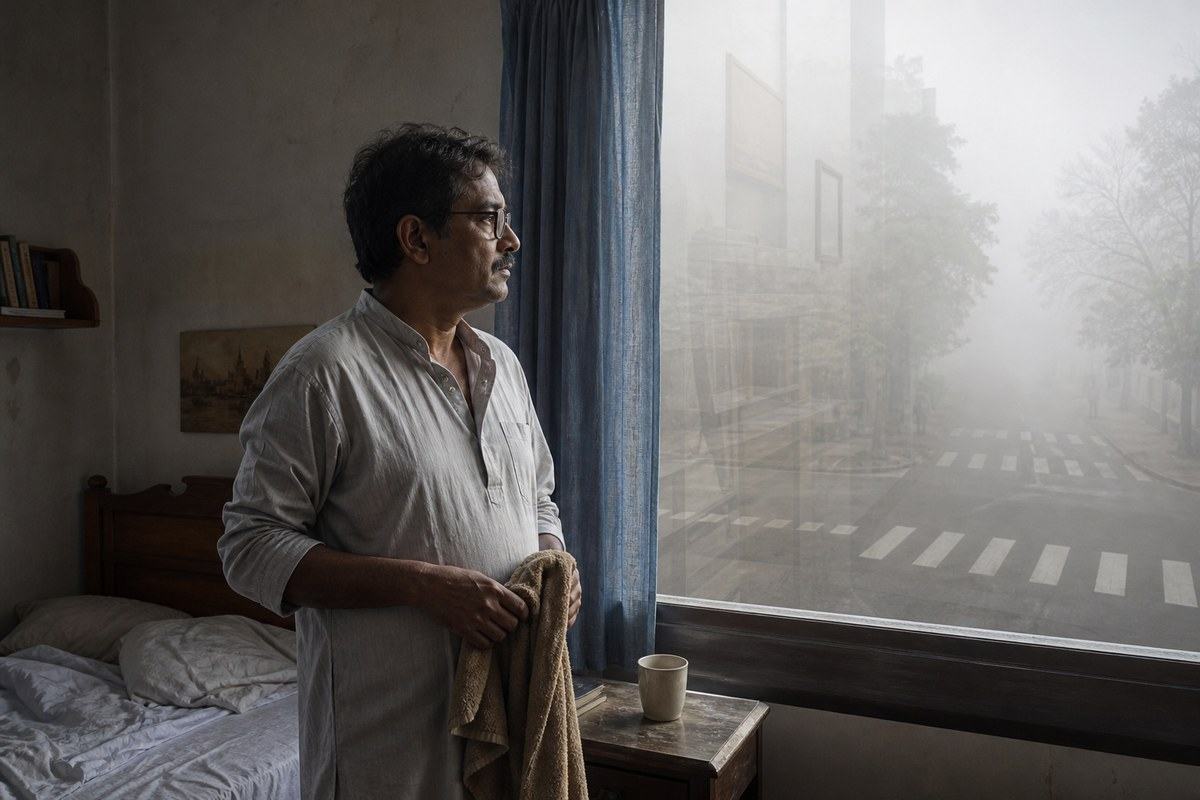
This is also why ghosts so often belong to places. A ghost does not merely exist; it lingers. It stains architecture. A staircase, a courtyard, a railway platform, a long corridor in an old Calcutta house where the plaster has swollen in the monsoon and the ceiling fan turns with the lazy authority of a minor colonial official: such spaces are almost designed for ghosts because they are already full of delayed time. Buildings remember badly but continuously. They keep scratches, drafts, echoes, smells, arrangements of light. A ghost in such a place is not an intruder. It is a local argument between time periods. The present says the room is empty. The past objects.
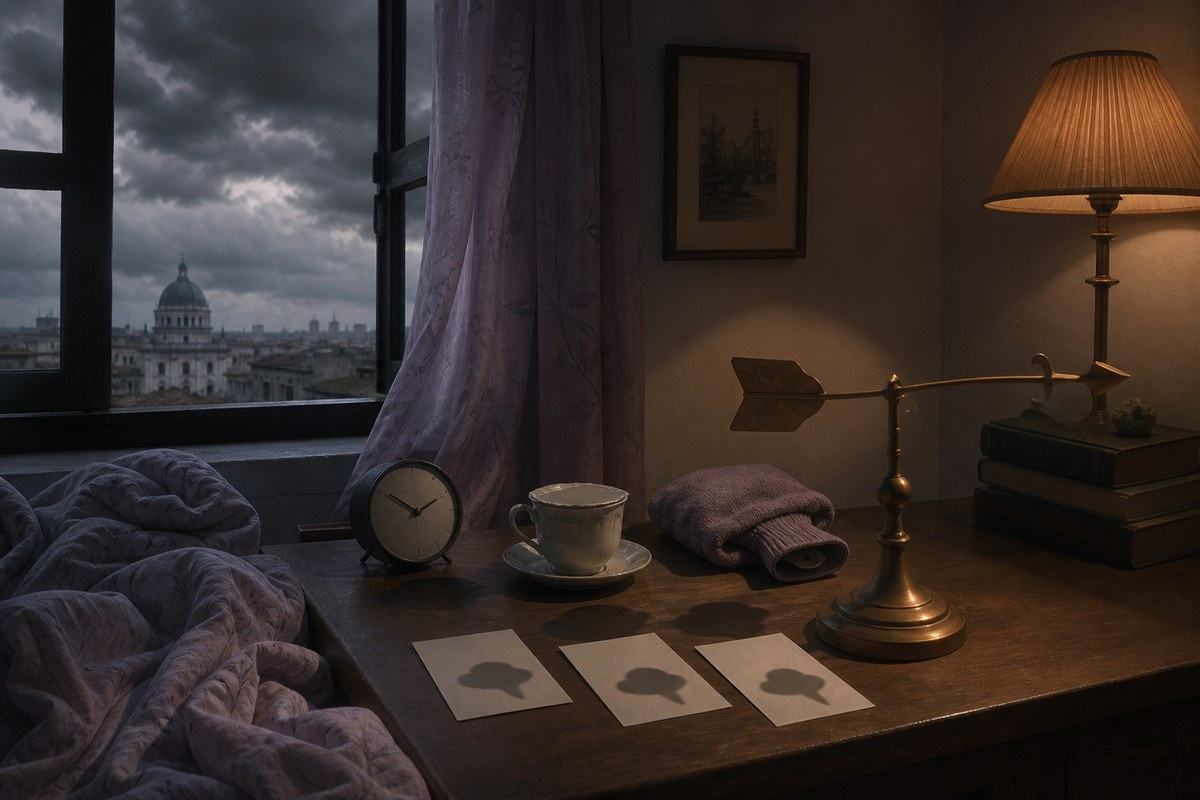
That objection need not be supernatural to be powerful. A person entering a room may perceive movement because shadow, expectation, grief, and architectural ambiguity have entered into a small conspiracy. A hanging cloth shifts. Peripheral vision supplies a body. Memory contributes a face. Fear completes the paperwork. The result may be false and still meaningful. Human perception is not a camera. It is a prediction system, an anxious storyteller, forever trying to guess the world a fraction of a second before the world has fully introduced itself. Most of the time this is useful. It lets us catch a falling glass, dodge a taxi, notice displeasure on a friend’s face before the friend has decided to mention it. But the same machinery can misfire. It can build a person out of poor light and private distress.
The ghost, then, may be understood as damaged perception, but damaged does not mean trivial. A cracked lens still reveals the shape of pressure. Political unhappiness, social dislocation, guilt, bereavement, hunger, loneliness, inherited fear, and the thick fog of old stories can all alter the way the visible world is processed. A society under stress produces ghosts because the mind needs figures for unfinished business. The dead landlord, the wronged widow, the vanished soldier, the betrayed friend, the child who should have grown up: these are not merely characters. They are disturbances that have found a body-shaped metaphor. The ghost gives outline to what institutions, families, and histories refuse to settle.
This is why dismissing ghosts as childish nonsense is too easy. It may be correct at the level of literal ontology and foolish at the level of human meaning. One can reject the supernatural claim and still respect the phenomenon as a human artifact of perception, memory, and moral unease. The ghost asks a fine and irritating question: what must be unresolved in a mind, or a place, or a culture, for absence to become visible?
There is a delicious irony in the skeptical ghost, the rational man trapped inside the very category he once mocked. This figure belongs to comic logic as much as metaphysics. Imagine a man who spent his life dismissing phantoms as nonsense and then discovers, with some bureaucratic inconvenience, that he has become one. He cannot believe in ghosts because his mind is still furnished with the old furniture of disbelief. Yet he is the ghost. The contradiction is almost tender. He is evidence against his own philosophy, and like many men confronted with evidence, he suspects the evidence of bad manners.
Here the ghost becomes more than a frightening figure. It becomes a satire of certainty. The living skeptic believes he stands outside illusion, clean and dry, with the umbrella of reason properly opened. But reason itself depends on stable categories: body and non-body, life and death, matter and memory, perception and hallucination, arrival and departure. The ghost muddies these distinctions. It is not an argument against reason. It is a reminder that reason works only after perception has delivered something it can hold. If perception hands over a shivering, half-human anomaly, reason suddenly has the expression of a customs officer finding a tiger in a suitcase.
The ghost’s self-awareness intensifies the problem. A ghost that does not know it is a ghost belongs to tragedy. A ghost that knows and cannot accept it belongs to philosophy. It observes itself as a contradiction. It is the witness and the evidence, the examiner and the specimen. This double position gives the ghost its peculiar dignity. It is not merely seen by others; it is troubled by its own mode of being. It has become a question it cannot answer.
Locomotion remains the central metaphor because movement is how living creatures declare continuity. To move is to produce a sequence: here, then there, then elsewhere. Movement ties identity to time. The child runs across a courtyard and becomes, moment by moment, the same child in changing positions. The old man crossing a street is slow, but each step insists on persistence. Even stillness in the living is active. A seated person breathes, blinks, shifts, warms the chair, occupies time through tiny negotiations with the body. The ghost short-circuits this. It is present without the visible labor of presence. It does not move through time so much as snag upon it.
That snagging is crucial. The ghost is not simply dead; it is temporally improper. It belongs elsewhere and elsewhen, yet it appears here. Its scandal is not only that it has crossed the boundary between life and death, but that it has violated sequence. The living are condemned to chronology. We proceed, poor creatures, in single file. Breakfast before noon, youth before age, cause before consequence, birth before obituary. The ghost disobeys this queue. It is after and before at once. It is memory with a silhouette. It is the past refusing to remain politely behind us.
Art has always been interested in such refusals because art itself is a sanctioned haunting. A painting keeps a face after the face has died. A poem stores a voice without lungs. A film makes the dead walk nightly at the push of a button. Descriptive art, especially, tries to make one sense behave like another. It asks words to produce sound, still images to produce motion, silence to produce presence. The ghost is therefore not an embarrassment to art but one of its native citizens. It is a figure for representation itself: something absent made strangely present through form.
When art shows a ghost moving without walking, it is not only depicting the supernatural. It is exposing the artificiality of all depiction. Every painted body is already a body without metabolism. Every photographed face is present without being there. Every fictional character is a ghost with better publicity. The difference is that the ghost makes the condition explicit. It says: you were always looking at absences arranged convincingly enough to seem alive.
This is where belief becomes less important than attention. Belief asks whether the ghost exists. Attention asks what the ghost is doing to the field of perception. Belief wants a verdict. Attention notices hesitation, distortion, drift, the small shudder between seeing and naming. A mature reading of the ghost does not have to choose crudely between credulity and contempt. It can say: perhaps no spirit stands there, and still something has appeared. Something in the relation between mind, space, memory, and fear has taken form.
The ghost is an interruption in the arrogance of the visible. It tells us that seeing is not possession. We do not simply open our eyes and receive the world like a parcel from a punctual courier. We construct, infer, correct, suppress, and embellish. We live inside a negotiated reality, usually stable enough to let us boil rice, cross streets, write emails, and recognize our own mothers. But under certain conditions, the negotiation falters. The unseen presses against the seen. Memory leaks into architecture. Fear edits motion. Grief supplies the missing actor. Then a ghost enters.
Or perhaps does not enter. Perhaps it was already there as a possibility in perception, waiting for the right dimness.
This is why the ghost should not be eliminated too quickly from serious thought. It is not merely a primitive error awaiting scientific disposal. It is a compact model of several difficult truths: that perception is active, that movement carries meaning, that memory can behave like matter, that unresolved history seeks form, and that human presence is far stranger than daily routine allows us to admit. The ghost does not need to be literally real to be intellectually real. A mirage is not a lake, but it teaches us something about light, heat, distance, and desire.
To live is to move under constraint. To be a ghost is to persist without the ordinary permissions. That is why the ghost feels both pathetic and alarming. It lacks the equipment of life but retains the demand to be noticed. It cannot fully act, cannot fully leave, cannot fully arrive. It hovers in the margin where categories lose their crispness. Not a person, not a thing, not a memory, not a hallucination, not quite a metaphor, not quite an event. A kind of parenthesis in the sentence of the world.
And perhaps that is its deepest function. The ghost marks the pause where meaning hesitates. In speech, a pause may carry dread, tenderness, anger, or revelation. In life, too, the most important things do not always advance in straight lines. Some hover. Some return. Some stand at the edge of vision until we stop demanding that reality behave like a well-managed ledger.
The ghost asks us to consider that presence may not be the same as substance, that movement may not be the same as life, and that the unseen is not always empty. Sometimes it is merely waiting for perception to make a mistake large enough to become a doorway.
Related Posts
Word Cloud
Related reading
Selected by shared topics and section, with closer publication dates breaking ties.