The Pufferfish Economy

Uses the speech voice supplied by your browser or device.
Acronyms expanded in this post:
- AI: Artificial Intelligence. software that generates, classifies, predicts, summarizes, or acts on patterns in data.
- IT: Information Technology. the practice of building, operating, and supporting computing systems.
Modern consumer life is increasingly built like fugu, the Japanese puffer fish: alluring, prestigious, often genuinely excellent when handled well, and potentially toxic when it is not. The difference is that in the old world, danger usually sat at the edges of life, in the forest, the alley, the battlefield, the operating theater. In modern life, it sits on the shelf, in the app store, in the financing agreement, in the wellness package, in the school brochure, in the insurance clause, in the food label, in the social feed, in the hospital estimate, in the investment product, in the convenience itself.
This is not just an Indian problem. It is not just a Calcutta problem either, though Calcutta, with its habit of stacking beauty and hazard on the same square foot of pavement, makes the lesson unusually vivid. This is now the grammar of modern systems almost everywhere: more choice presented as empowerment, more complexity disguised as freedom, more convenience that works by relocating the burden of discernment onto the user.
That is the real shift.
The danger is no longer merely that bad actors exist. They always did. The danger is that the baseline architecture of ordinary consumption now assumes the consumer will detect hidden risk, compare invisible tradeoffs, interpret technical language, anticipate downstream effects, and notice which part of the thing has been optimized for extraction rather than service. The transaction still looks like a purchase. Functionally, it is often a test.
You are not simply buying food. You are buying a supply chain, a preservation method, an advertising narrative, a set of metabolic consequences, and a labeling regime with selective honesty.
You are not simply buying software. You are buying permissions, lock-in, data capture, recurring dependence, interoperability failure, and terms of service written like a diplomatic treaty between wolves.
You are not simply choosing education, healthcare, transport, media, finance, or housing. You are selecting among systems that are aesthetically polished at the point of entry and structurally evasive at the point of accountability.
That is why so many objects and attractions of modern life behave like puffer fish. They are not intrinsically useless. Quite the opposite. The puffer fish is valuable precisely because it is good enough to tempt you despite the danger. Modern systems work the same way. The risk is bound up with the appeal. If they were merely bad, avoidance would be easy. The problem is that they are often useful, pleasurable, status-bearing, or genuinely necessary, while also requiring a degree of knowledge, skepticism, and operational caution that the average exhausted person does not have time to maintain.
And exhaustion matters.
A society can tolerate complexity only up to the point where complexity exceeds the cognitive budget of ordinary people. After that, what gets called consumer choice becomes a polite fiction. A working person with limited time, finite attention, and incomplete information is not making sovereign, textbook-rational decisions. He is triaging. She is guessing. They are relying on proxies: price, branding, reputation, packaging, social proof, institutional prestige, influencer confidence, neighborhood folklore. Sometimes these proxies work. Often they are exactly what the system has learned to manipulate.
This is why the sensible consumer now resembles, less a cheerful shopper, more a field biologist walking through a marsh while poking things with a stick.
Take food first, because food remains the most intimate theater of modern deception. Industrial food systems are not built primarily to nourish. They are built to preserve, scale, transport, differentiate, addict lightly, satisfy regulators minimally, and produce repeat purchases reliably. Those goals overlap with nourishment only intermittently. The result is an environment full of edible-looking objects whose danger lies not in obvious poison but in slow distortion: excess sodium, hyperpalatability, ultra-processing, misleading health halos, contaminated oils, fraudulent provenance, and portion engineering. The harm is statistical, not theatrical. Which is more effective, because drama alarms people while gradual damage becomes background.
The same logic governs digital life. Platforms appear free or cheap because payment has been denormalized. You do not always pay in money. You pay in data exhaust, behavioral predictability, fragmented attention, algorithmic conditioning, subscription creep, and the steady externalization of your own memory into systems designed to monetize dependence. A sensible user must now understand at least the outlines of platform economics, interface manipulation, dark patterns, recommender systems, privacy asymmetry, and lock-in dynamics. Most people do not. This is not because they are foolish. It is because no civilization can indefinitely increase hidden system complexity while blaming the citizen for not becoming a part-time forensic accountant, data governance specialist, nutrition scientist, legal analyst, and security engineer.
Healthcare is an especially brutal example because the stakes are not just financial inconvenience but bodily consequence. The patient enters looking for treatment and instead encounters coding systems, billing opacity, fragmented records, uneven evidence quality, diagnostic uncertainty, insurer incentives, provider time scarcity, and market language invading the clinic. In such a system, being a sensible consumer means asking the right questions, understanding benefit design, reading exclusions, seeking second opinions, distinguishing evidence-based care from theatrical medicine, and recognizing where credentialed confidence exceeds actual certainty. This is not a small burden. It is a second illness layered atop the first.
Education has drifted the same way. The attractive outer shell is aspiration. The toxin is often hidden in the financing, signaling inflation, weak labor-market alignment, prestige arbitrage, and the conversion of learning into debt-backed credential consumption. A sensible student must assess not only curriculum quality but institutional incentives, opportunity cost, expected earnings variance, financing structure, and whether the degree is functioning as education, gatekeeping, or ornament. Again, the puffer fish problem: the item may indeed contain value, but only if prepared with knowledge and caution. Otherwise the person consuming it is the one consumed, by debt, by misplaced status pursuit, by years.
Calcutta, and cities like it, provide the street-level version of this truth. The city is full of things that reward discernment and punish naivete. A neighborhood eatery may be superb or catastrophic. A cheap electrical repair may save money or invite fire. A school may market English fluency while hollowing out actual learning. A property bargain may come wrapped in title ambiguity, drainage problems, litigation, or a transformer that hums like divine judgment. Yet it would be a mistake to imagine this is a symptom of underdevelopment alone. Wealthier societies merely hide the hazard behind cleaner glass, stronger fonts, better branding, and more expensive lawyers.
Under the floorboards, the truth is that modern capitalism often does not eliminate toxicity. It professionalizes its packaging.
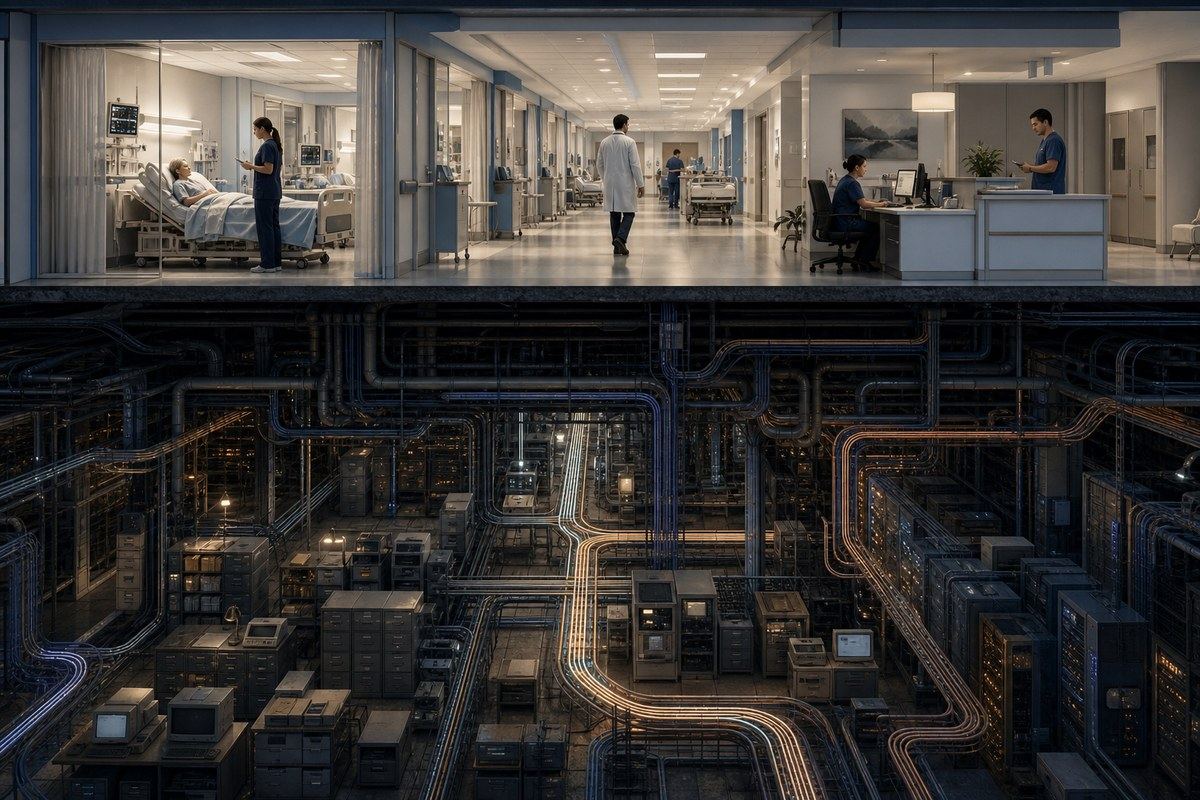
What changed historically is not that goods became more dangerous in some absolute sense. In many ways they became safer. What changed is the location of risk and the style of responsibility. Pre-modern hazards were often visible, physical, local, and customary. Modern hazards are frequently distributed, contractual, biochemical, informational, actuarial, or delayed. They arrive mediated through systems. The consumer meets a polished front end and inherits backend risk. That is the architecture.
More bluntly, many industries now compete not merely by making good products but by making products whose downsides are hard to observe at the moment of purchase.
That is an ugly sentence, but it explains a lot.
It explains why financial products are sold on returns rather than tail risk.
Why apps are sold on convenience rather than surveillance.
Why processed food is sold on taste and time-saving rather than metabolic burden.
Why supplements are sold on possibility rather than evidentiary weakness.
Why housing is sold on aspiration rather than long-term maintenance and infrastructural exposure.
Why political promises are sold on emotional clarity rather than administrative feasibility.
Why status goods are sold on symbolism rather than durability.
In each case the object shines at the point of seduction and blurs at the point of consequence.
The consumer, meanwhile, is told that freedom consists in navigating this maze unaided.
This is nonsense. Markets do not become morally admirable merely because there are many shelves. A shelf with thirty attractive traps is still a trap-rich environment. Choice, by itself, is not protection. Information asymmetry, bounded rationality, and fatigue do not vanish because the packaging is colorful. The old textbook fantasy of the informed consumer assumes time, literacy, comparability, and good-faith disclosure. Real markets often provide fragments of these and call the result liberty.
That is why “buyer beware” has become too small a phrase for the age. It once implied caution at the edge. Now caution is the price of ordinary participation.
The sociological consequence is easy to miss but hard to live with. As systems become more puffer-fish-like, everyday life rewards not just wealth but vigilance. Two people may buy the same category of thing and experience very different outcomes based on whether one understands label games, pricing traps, hidden incentives, maintenance requirements, data privacy settings, or contract language. So inequality is no longer only about who can afford to buy. It is increasingly about who can afford not to be careless. Judgment itself becomes a class advantage.
This is one reason modern life feels predatory even when nobody is visibly lunging at you.
The predation is embedded in the requirement that you continuously interpret. You must read fine print. You must decode marketing. You must distinguish expert consensus from fashionable noise. You must infer whether the low price means efficiency, subsidy, corner-cutting, or deferred harm. You must know when convenience is genuine and when it is just future inconvenience compacted into the present. You must know when a product is merely cheap and when it is cheap in the way rotten scaffolding is cheap.
And yet one should resist the lazy conclusion that the answer is cynicism or wholesale withdrawal. That would be sentimental nonsense in another costume. We live through systems; we do not float above them. The practical question is not how to avoid all puffer fish. The practical question is how to recognize when a domain has become preparation-sensitive, and to behave accordingly.
That requires a different model of citizenship and consumption.
First, sensible consumption begins with accepting that surface quality is now one of the least reliable indicators of underlying quality. Sleek design, prestigious branding, a high price, a low price, premium vocabulary, folk authenticity, scientific language, artisanal theater, bureaucratic formality, social-media enthusiasm: all can be either signal or camouflage. The modern consumer must become less impressed and more inquisitive.
Second, one must distinguish between domains where experimentation is affordable and domains where it is not. Trying an overrated cafe is one thing. Casual experimentation with medical care, personal finance, structural housing decisions, legal documentation, or long-term digital lock-in is another. In high-consequence domains, skepticism should rise faster than excitement.
Third, learn where incentives sit. This is almost always more useful than learning where slogans sit. Ask who profits if you misunderstand the product. Ask who benefits if you delay comparison. Ask who gains when the metrics remain fuzzy. Ask whether the seller is rewarded for long-term performance or short-term conversion. Many mysteries evaporate at once.
Fourth, prefer systems that are legible. Not perfect. Legible. A system that explains itself clearly, exposes costs honestly, allows exit, preserves interoperability, and behaves predictably under stress is almost always safer than a system that dazzles at onboarding and fogs at accountability.
Fifth, understand that in many areas, low price and high sophistication together are a warning. Real efficiency exists, certainly. But miraculous cheapness in a complex system often means that someone, somewhere, is carrying an unpriced burden: labor exploitation, surveillance extraction, regulatory arbitrage, environmental damage, hidden fees, quality collapse, or future lock-in. The bill has not disappeared. It has migrated.
Sixth, treat convenience as a biochemical lure rather than an innocent good. Convenience is wonderful. It is also one of the most powerful solvents of judgment ever invented. Much of modern commerce depends on reducing the pause in which a person might otherwise think. Friction is not always the enemy. Sometimes friction is where discernment lives.
Seventh, recover social intelligence. Historically, people survived marketplaces not only through individual cleverness but through communal knowledge: which doctor is careful, which builder cuts corners, which lane floods, which shop adulterates, which school teaches, which broker lies with a professionally moisturized face. Modern individualism often flatters the lone chooser while depriving him of the only thing that makes choosing tolerable: trusted shared experience. Reputation networks, when not themselves corrupted, remain one of the few realistic defenses against information asymmetry.
Still, the deepest point sits below all consumer advice.
A civilization in which ordinary life requires expert-level defensive literacy just to avoid routine exploitation is not merely complicated. It is misdesigned.
That does not mean every shopkeeper, company, institution, or professional is malicious. Most are not. It means the overall environment has evolved toward risk transfer. Complexity, opacity, and fine-grained optimization now allow systems to capture upside centrally while distributing downside outward, onto the user, the patient, the borrower, the commuter, the student, the citizen. The puffer fish becomes a useful metaphor because preparation is everything, liability is diffuse, and the novice pays more dearly than the expert.
So yes, modern life is full of attractive things that can eat the person trying to consume them. Not because the world has suddenly become demonic, and not because the consumer has become stupid, but because more and more of what we call products are really compressed systems of incentives, hidden dependencies, and delayed consequences.
The old fantasy was that prosperity would make life simpler.
What it often did instead was make danger prettier.
P.S. For the literal background: fugu is a Japanese preparation of puffer fish containing tetrodotoxin, a potent neurotoxin, and safe consumption depends on expert preparation standards recognized in Japanese culinary practice.
Related Posts
Word Cloud
Related reading
Selected by shared topics and section, with closer publication dates breaking ties.