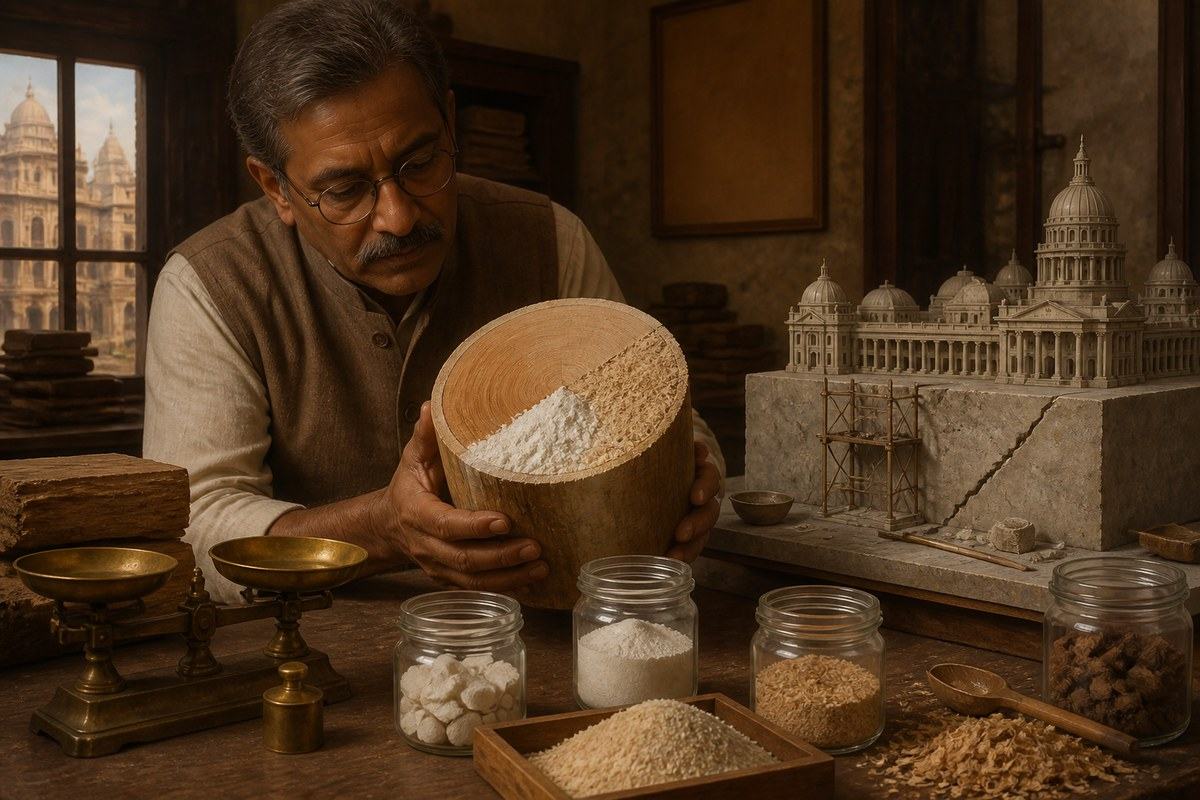
Costume Ambition
Uses the speech voice supplied by your browser or device.

Acronyms expanded in this post:
- IT: Information Technology. the practice of building, operating, and supporting computing systems.
What gets called ambition in modern India is often something narrower, sadder, and more combustible: status anxiety under theatrical lighting.
Not excellence. Not devotion to craft. Not the long, private, slightly unglamorous labor by which a person becomes good at something difficult. Something else. A public struggle against invisibility. A dread of being ordinary in a civilization so crowded, so comparative, and so relentlessly social that obscurity begins to feel not like a neutral condition but like a verdict.
That distinction matters.
Because once ambition stops being about the object of effort and starts being about the audience witnessing the effort, the entire moral and psychological structure changes. Work becomes costume. Achievement becomes display. Discipline becomes branding. Even suffering gets repackaged as evidence of exceptional destiny.
And then the familiar language arrives. Hustle. Grind. Passion. Impact. Legacy. Nation-building. Personal brand. Leadership. Disruption. These words are rarely false in the literal sense. They are false in the architectural sense. They describe a noble façade erected over motives that are frequently more primitive: fear of shame, fear of social descent, fear of being the one schoolmate who did not “become something,” fear of returning to the family gathering as a cautionary tale, fear of vanishing in a society where everyone is counted, compared, ranked, forwarded, photographed, and discussed.
So the ambition is real. But it is not always ambition toward mastery. It is often ambition as escape.
Escape from mediocrity, yes, but not mediocrity in the honest sense. Not the ordinary human fact that most people will live modestly, work imperfectly, love inconsistently, and die without a stadium chanting their name. The feared mediocrity is social mediocrity. Relative mediocrity. Comparative mediocrity. The shame of not being visibly ahead.
That is why so much striving feels curiously detached from the thing being striven for.
A young person does not always want medicine because medicine fascinates him. He may want medicine because “doctor” is a social exoskeleton. Another does not necessarily want entrepreneurship because he has identified a meaningful problem and cannot rest until he solves it. He wants entrepreneurship because founderhood has become a prestige-emitting object. Someone else wants content creation not because he has something exact and necessary to say, but because visibility itself now appears to be an asset class. Even employment, once a boring matter of income, competence, and institutional fit, now gets drawn into the same machinery. A job is no longer just work. It is biography. Proof. Ammunition. A sortable badge in the marketplace of human worth.
This is not uniquely Indian, of course. Modernity everywhere has turned identity into public relations. Social media did not invent vanity. It industrialized it. But India adds particular pressure to the system.
Scale does that first. In a country of this size, anonymity is common but never feels innocent. Competition is not abstract. It is embodied in millions. Exam culture does the rest early. Childhood becomes a ranking pipeline. Families, often out of fear more than cruelty, turn comparison into pedagogy. Neighbors, cousins, teachers, matrimonials, office chatter, caste memory, class aspiration, migration fantasies, and now digital metrics all cooperate in building a single recurring message: do not merely live; outperform. Do not merely become competent; become unmistakably superior. Do not merely succeed; succeed legibly.
Legibility is crucial here.
A person may quietly become good at mathematics, carpentry, software architecture, nursing, classical singing, materials science, law, or machining. But quiet competence has a public relations problem. It does not always travel. It does not compress into a LinkedIn headline, an Instagram reel, a wedding-introduction sentence, or a parental boast delivered over tea. Spectacle travels better. So does affiliation with prestige objects. So does drama.
That is why the vehicle often matters more than the destination. The real destination is not medicine, cinema, civil service, startup life, management consulting, data science, public intellectualism, or artistic creation as such. The real destination is public recognition. Fame in the wide sense. Not necessarily celebrity, though that too. Rather, socially legible exceptionalism.
This is why people are frequently less interested in the substance of an activity than in its prestige emissions.
They do not want to write. They want to be known as a writer.
They do not want to build companies. They want to inhabit the founder costume.
They do not want to study seriously. They want the social glow produced by difficult exams.
They do not want to understand a subject deeply. They want to possess its badge.
They do not want meaningful work. They want immunization against humiliation.
That is a harsher claim than most people like to hear, but it explains a good deal that otherwise looks contradictory. It explains why some people abandon pursuits the moment admiration plateaus. It explains why the phrase “follow your passion” survives in societies where very few people have the economic luxury to do any such thing. It explains why performative overstatement has become normal. Every ordinary effort must now be narrated as mission, every incremental gain as breakthrough, every exhausted employee as warrior, every mildly successful freelancer as empire-builder, every self-promoter as thought leader.
Heroism has become a style sheet.
And mediocrity, meanwhile, has been grotesquely misunderstood.
There is nothing disgraceful about being ordinary. The disgrace, if one wants to use such an unfriendly word, lies in being fake. In simulating depth. In using the language of excellence while avoiding the disciplines that produce it. In consuming admiration on credit. In wanting the social return on mastery without paying the full cognitive and moral cost of acquiring mastery.
India’s particular tragedy here is that genuine excellence is abundant, but it is crowded out perceptually by mass performance. There are serious engineers, rigorous scholars, exacting musicians, careful clinicians, disciplined craftspeople, patient teachers, original researchers, formidable administrators, and technically gifted workers doing real work with very little noise. But the culture’s attention system is often hijacked by those who are better at self-announcement than substance. The result is not merely annoyance. It is distortion. Younger people begin to confuse visibility with value. They infer, not irrationally, that the path to social survival lies in image optimization rather than competency formation.
Once that happens, the incentives turn corrosive.
You start seeing careers selected for optics rather than fit. Degrees collected as prestige tokens rather than intellectual tools. MBAs pursued as identity laundering. Foreign migration treated not as a concrete economic decision but as symbolic elevation. Public speech inflated with managerial clichés because plain truth sounds insufficiently grand. Even morality becomes performative. One must not only be good, but be seen being good. One must not only care, but stage-care in publicly consumable format.
Social media has poured petrol on all this because it collapses the distance between self and audience. A person no longer merely lives among others; he is continuously potentially viewable by others. That changes interior life. Motivation gets contaminated. Every act acquires a spectral second purpose: how will this look? The result is a society crowded with aspirants, but not always with apprentices. Everybody wishes to arrive. Fewer wish to submit themselves to the humiliating, repetitive, ego-bruising process by which arrival becomes deserved.
And yet this is not simply vanity. That would be too easy, and too smug.
Much of it is fear.
Fear is the hidden engine. Fear of financial precarity. Fear of parental disappointment. Fear of caste or class fallback. Fear of romantic undesirability. Fear of becoming invisible in a market that sorts people mercilessly. Fear that one’s inner worth, never securely established, must be defended by outer markers. Fear that if one is not impressive, one is nothing.
That is why the whole performance can feel so intense, so joyless, so brittle. People are not merely boasting. Many are pleading with reality. They are trying to secure ontological legitimacy through achievement theater. Seen that way, the obsession is not fully ridiculous. It is often desperate.
Still, desperation does not make the pattern wise.
Because once fame, or even its diluted middle-class cousin recognizability, becomes the hidden objective, the craft itself deteriorates. You stop asking the first useful question: what is the work? And replace it with a more dangerous one: what identity does this work let me wear? The first question produces builders. The second produces performers.
One can see this everywhere. In education, where students optimize for credential signaling over understanding. In offices, where career speech becomes detached from contribution. In public discourse, where confidence is mistaken for authority. In culture, where saying becomes more rewarded than knowing. In family systems, where children are trained to accumulate status rather than form character. In friendships, where everyone is allegedly “doing great” while privately decomposing from comparison.
The terrible joke is that this strategy often fails even on its own terms.
Public validation is not a destination one reaches and then inhabits peacefully. It is a rental property with vicious terms. It must be constantly renewed. Someone younger, louder, richer, prettier, more connected, more algorithmically favored, more foreign-returned, more credentialed, or simply more shameless is always coming. If your self-respect depends on external notice, then success does not calm you. It sensitizes you. You become harder to satisfy and easier to threaten.
That is why people who seem to have won often remain agitated. The problem was never insufficient applause. The problem was handing applause jurisdiction over the self.
The deeper alternative is not passivity, and certainly not some romantic sermon against striving. That too would be nonsense. In a harsh society, ambition is often necessary. Money matters. Work matters. Standing matters. Competence matters enormously. The question is not whether to strive, but what grammar governs the striving.
A healthier ambition is object-centered, not audience-centered. It begins with the thing itself. The code must run. The diagnosis must be right. The bridge must hold. The prose must clarify. The design must endure contact with reality. The research must survive hostile scrutiny. The patient record must represent what actually happened. The argument must be truer at the end than at the beginning.
That kind of ambition can still be grand. It can still produce wealth, influence, even fame. But fame arrives as exhaust, not fuel.
That is the difference.
When ambition is healthy, recognition is incidental, sometimes welcome, sometimes useful, never sovereign. When ambition is unhealthy, recognition is the hidden master, and the work is merely its servant.
India at the moment seems crowded with people being taught, often by frightened elders and algorithmic incentives, to confuse the second with the first. To become not excellent, but visibly exceptional. Not capable, but marketable. Not serious, but narratable.
It is an expensive confusion.
It wastes talent by directing it toward prestige traffic rather than difficult problems. It produces shallow elites fluent in the aesthetics of merit but not always in its substance. It makes ordinary life feel like failure. It turns decent employment into embarrassment, private growth into public irrelevance, and genuine apprenticeship into a seeming delay of glory. Above all, it traps people in a permanent audition for an audience that cannot love them, only rate them.
The old fear beneath all this is the fear of being nobody.
But most worthwhile work is done, for very long stretches, by nobodies. Anonymous engineers keep systems alive. Uncelebrated doctors prevent catastrophe. Invisible analysts detect error. Patient teachers alter lives without fanfare. Researchers spend years being obscure in order to become correct. Real craft has always involved a long intimacy with obscurity.
That is not mediocrity. That is incubation.
And a culture that cannot distinguish between obscurity and worthlessness will keep producing anxious performers where it most needs grounded practitioners.
The corrective is not self-esteem slogans. It is a harder and more adult reordering of values. Teach people to admire competence more than display. Depth more than noise. Reliability more than charisma. Apprenticeship more than branding. Let a vocation be a vocation, not a costume shop for wounded egos. Let success include privacy. Let dignity detach itself from spectacle.
Most of all, let us recover the unfashionable idea that being good at something is a sufficient drama in itself.
Because once a society loses interest in goodness and becomes fixated on being seen, it does not become ambitious.
It becomes performative.
And performative civilizations eventually discover, usually too late, that applause is a poor substitute for substance.
Related Posts
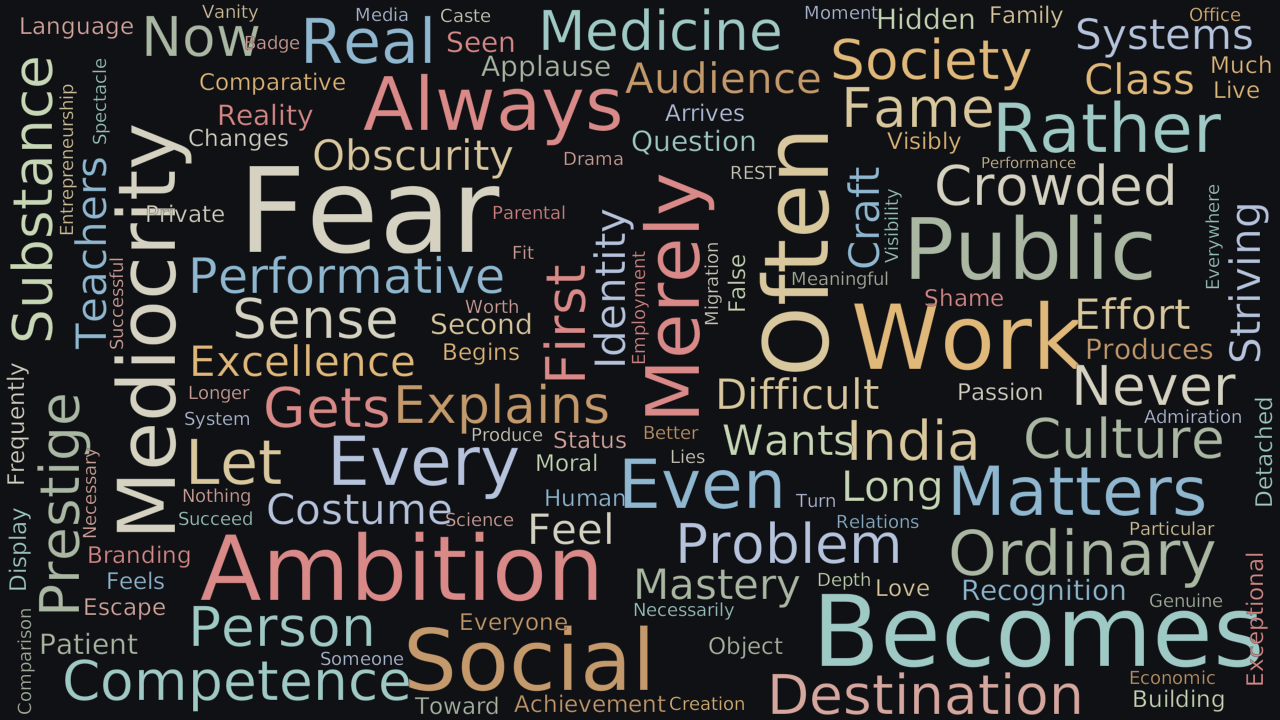
Word Cloud
Related reading
Selected by shared topics and section, with closer publication dates breaking ties.