The Country That Built Rockets but Still Consults the Stars
Uses the speech voice supplied by your browser or device.

Acronyms expanded in this post:
- GDP: Gross Domestic Product. the total monetary value of goods and services produced in an economy.
- IT: Information Technology. the practice of building, operating, and supporting computing systems.
- US: United States. the United States of America.
India’s problem is not that it lacks intelligence; it is that intelligence here is too often trained to pass examinations, obey elders, worship credentials, fear social exile, and then quietly take a horoscope seriously before booking a wedding hall.
That is the thing I found most unsettling after returning from the United States [US, the country where I was educated and worked]. Not poverty. Not noise. Not bureaucracy, though India has enough bureaucracy to stucco the moon. The deeper shock was cognitive. The country of my boyhood had grown flyovers, malls, financial apps, private hospitals, delivery platforms, metro lines, and a permanent cough of television news. Yet underneath this new metal-and-glass casing, much of the public mind still seemed stuck in a kind of societal childhood: emotionally intense, authority-hungry, myth-soaked, easily dazzled, quick to forward, slow to verify, proud before it is precise.
This is not a sneer at Indians. Sneering is easy, and usually the cheapest product in the intellectual bazaar. It is a diagnosis of a broken national habit. India produces engineers, physicians, coders, statisticians, space scientists, and mathematicians by the truckload. Indian Space Research Organisation [ISRO, India’s national space agency] put Aryabhata into orbit in 1975 and later sent the Mars Orbiter Mission [MOM, India’s first interplanetary spacecraft] to Mars with an austerity that made much of the world blink. The same society can also treat astrology as advice, auspicious timing as risk management, cow urine as medicine, a guru’s muttering as epistemology, and a WhatsApp forward as a form of peer review.
This is not a paradox if you look closely. It only looks like one because we confuse technical skill with scientific temper. They are cousins, not twins. Technical skill can build a bridge, write a compiler, operate a ventilator, optimize a supply chain, or crack a multiple-choice exam. Scientific temper is something colder and rarer. It is the willingness to ask, “How do I know this?” and then endure the insult of the answer. It is not a subject. It is a moral discipline applied to belief.
A society can have software engineers without having scientific temper, just as a man can own a treadmill without having fitness. The machine is there. The habit is not.
India’s Constitution makes scientific temper a civic duty, which is both admirable and slightly comic, like putting “develop abdominal muscles” into a tenancy agreement. Article 51A(h) asks citizens to develop “scientific temper, humanism and the spirit of inquiry and reform.” A more beautiful phrase is hard to find in constitutional prose. It says that inquiry is not merely for laboratories; it belongs in family life, public argument, politics, medicine, education, religion, media, and the ordinary marketplace of claims. It asks the citizen not merely to vote, salute, pay, obey, and endure, but to question.
And there is the trouble. Indian society praises questioning in speeches and punishes it in rooms.
The schoolchild who asks “why” is often told it is not in the syllabus. The daughter who questions ritual is told she has become arrogant. The patient who asks the doctor for evidence is treated as impertinent. The junior employee who asks why a process exists is marked as troublesome. The student who challenges the teacher may be “oversmart.” The citizen who asks for proof may be branded anti-national, anti-religious, Westernized, deracinated, or morally diseased, depending on the weather and the loudspeaker.
So the child learns a clever little survival trick. Memorize in public, doubt in private, conform at home, calculate at work, and never ask a question at the wrong dining table.
That is how a civilization produces examination success without intellectual adulthood.
The rote-learning problem is often described too narrowly, as if the damage is merely educational. It is worse than that. Rote learning trains the nervous system to treat knowledge as a fixed packet handed down from authority. It makes truth feel like something received, not tested. It turns the teacher into a priest of answer keys. It turns the student into a storage device with anxiety.
Science cannot flourish in that emotional climate. Science begins with disciplined disrespect. Not rudeness. Not adolescent contrarianism. Disciplined disrespect. The idea is allowed to stand in the witness box. The professor, scripture, parent, politician, textbook, community elder, startup founder, celebrity doctor, television astrologer, and village healer must all endure the same impolite question: what is the evidence?
The Indian home is often where this habit dies first.
A child asks why an eclipse should affect food. The answer is not an explanation but a warning. A teenager asks whether astrology has predictive validity. The answer is a family scandal. Someone asks whether a ritual works or merely comforts. The room freezes. An aunt looks betrayed. A father becomes constitutional. A grandmother invokes ancestry. The questioner is no longer pursuing truth; he has apparently stabbed the household deity with a geometry compass.
The great Indian mistake is to treat questioning as insult. This is how fragile beliefs protect themselves. Strong ideas do not need police protection from a schoolchild’s curiosity.
Scientific temper is also not atheism, though many religious people fear it and many atheists flatter themselves by claiming it. A person may keep a ritual, love a festival, revere a poem, light a lamp, visit a shrine, or retain metaphysical humility without pretending that mythology is laboratory evidence. Culture is not the enemy. False category is the enemy. A myth may be profound without being a medical paper. A ritual may be meaningful without being physics. A story may carry psychological truth without becoming embryology, aviation, plastic surgery, or genetics.
This distinction is where India repeatedly slips on the banana peel.
When ancient knowledge is treated honestly, it is fascinating. Indian mathematics, grammar, astronomy, metallurgy, medicine, logic, and urban planning deserve respect without theatrical inflation. But respect is not the same as retrofitting every modern discovery into scripture. That habit does not honor the past. It pickles it in insecurity. It suggests that ancient India matters only if it already knew everything Europe later formalized, America later funded, and Japan later miniaturized.
A confident civilization would say: our ancestors knew some remarkable things, misunderstood many others, and lived before the methods, instruments, and institutions that make modern science possible. This is not humiliation. This is chronology.
But nationalist vanity hates chronology. It wants the past to be not merely rich, but omniscient. It wants plastic surgery hidden in divine iconography, stem cells hiding in epic births, aircraft hiding in poetic vehicles, quantum mechanics hiding in metaphors, and Wi-Fi hiding in the Vedas if one squints hard enough and has already decided the conclusion.
That is not scientific temper. That is emotional archaeology with a political grant.
After returning from the US, what struck me was not that Americans are magically rational. They are not. America has creationism, anti-vaccine panic, wellness grifters, conspiracy cults, miracle diets, political hallucinations, and enough commercialized nonsense to fill a Costco. But American institutions, at their best, still preserve stronger islands of method: research universities, adversarial journalism, public data, litigation, peer review, museum culture, science communication, technical writing, regulatory documentation, and a public habit, however battered, of asking for evidence.
India has islands too. Some are magnificent. ISRO is one. The Indian Institutes of Technology [IITs, elite public engineering institutions] are another, Jadavpur University [JU, where I received my computer science bachelors degree] is another, though they are more complicated than their mythology and JU still breeds more diluted thinkers than rational or scientific ones. The Indian Institute of Science [IISc, a major research university in Bengaluru] remains one of the country’s serious intellectual institutions. There are excellent clinicians, statisticians, epidemiologists, physicists, engineers, economists, and public health workers. There are teachers in small towns doing heroic work with chalk, weak electricity, and no applause. There are rationalist groups who have challenged superstition at real personal risk. There are journalists and fact-checkers trying to drain a flood with a teaspoon.
But islands are not a mainland.
A nation’s scientific temper is not measured only by what its best institutions can do. It is measured by what ordinary citizens do when a claim arrives in the family WhatsApp group with folded-hands emojis and a threat disguised as concern. It is measured by whether a cough goes to a physician or a miracle oil. Whether exam policy is debated with data or astrology. Whether a bridge collapse is investigated structurally or buried ritually. Whether a pandemic is met with epidemiology or kitchen theatrics. Whether a minister can say something scientifically absurd and face correction without the correction becoming treason.
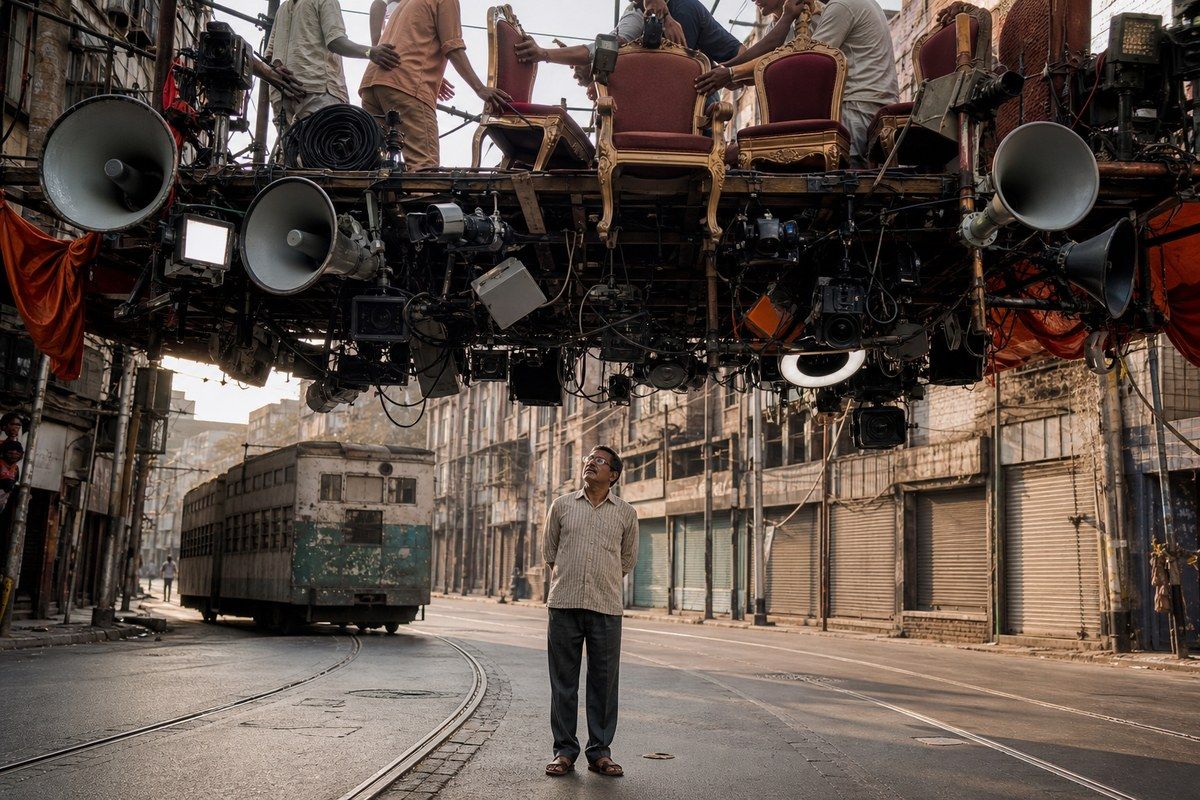
The political class matters here, not because one leader causes the problem, but because leaders reveal what a society permits. When high officials casually blur mythology and modern science, or offer rustic physics before cameras, they are not inventing the national confusion. They are harvesting it. They know the soil. They know a line dressed as civilizational pride can travel farther than a careful explanation. Pseudoscience is not merely ignorance; it is often identity with a microphone.
This is why scientific temper remains hard to popularize. It does not merely correct facts. It threatens arrangements.
It threatens the authority of elders who confuse age with accuracy. It threatens teachers who were never trained to say “I don’t know.” It threatens politicians who prefer emotion to evidence. It threatens gurus, astrologers, miracle healers, quacks, numerologists, vastu consultants, exam-coaching factories, television panels, and entire industries of profitable fog. It threatens families that use tradition as discipline. It threatens bureaucracies that survive by preventing questions from reaching the right desk.
So India does what many societies do when confronted with a difficult virtue. It praises it ceremonially and evades it practically.
Scientific temper also has a class problem. Middle-class Indians often imagine superstition as something practiced by villagers, domestic workers, small-town relatives, and the insufficiently English-speaking. This is nonsense. The educated classes may not visit the same exorcist, but they have their own luxury superstitions: numerology for apartment numbers, astrology for marriages, vastu for office layouts, detox mythology, imported wellness babble, management pseudoscience, motivational neuroscience, and financial astrology dressed in Bloomberg vocabulary.
The poor are not uniquely irrational. They are merely less able to hide irrationality behind good lighting.
In fact, superstition among the poor often has a brutal practical logic. If healthcare is expensive, courts are slow, schools are weak, police are frightening, jobs are scarce, and public systems are unreliable, magical thinking becomes a kind of emotional insurance. Not good insurance. Not accurate insurance. But available insurance. The quack appears where the clinic fails. The astrologer appears where planning fails. The godman appears where the state fails. The rumor appears where trusted communication fails.
A society that wants less superstition must build more reliability. Evidence needs institutions, not just slogans.
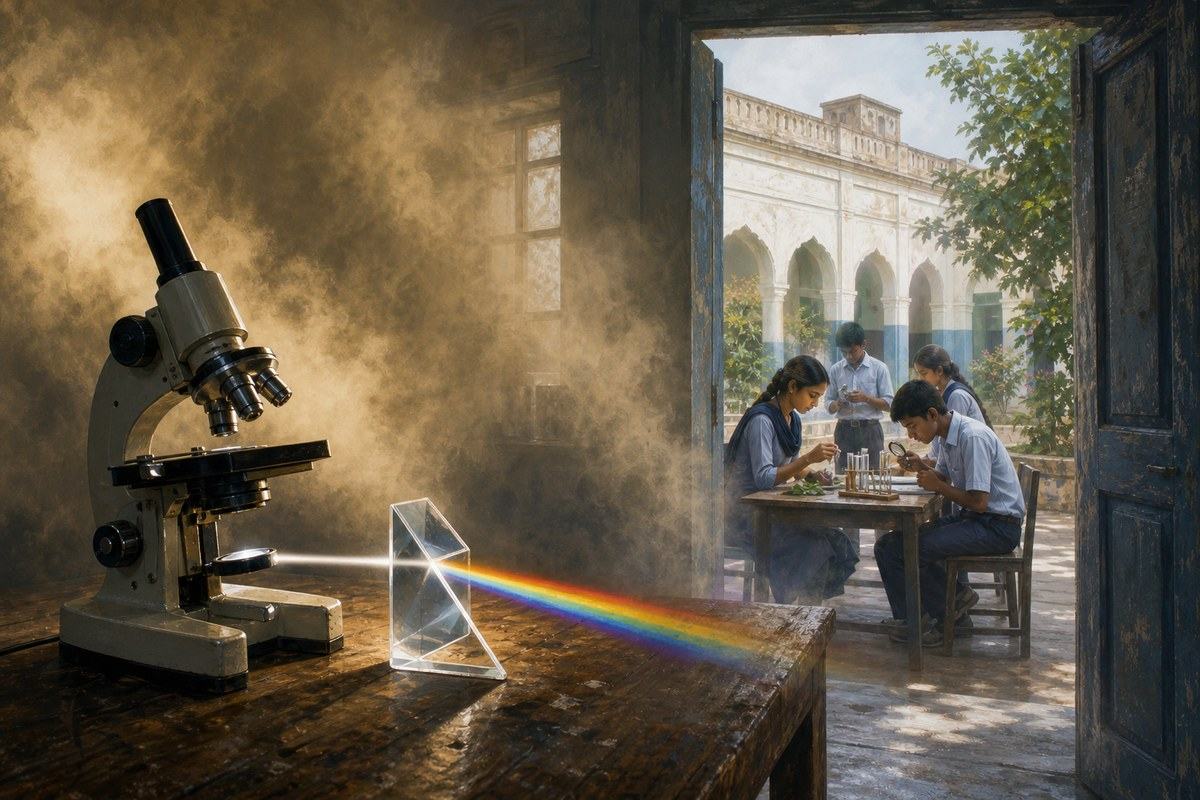
This is the non-obvious point. Scientific temper is not only a mental trait; it is an infrastructure. People learn to trust evidence when evidence-bearing systems repeatedly help them survive. Clean water teaches bacteriology better than a poster. A fair exam teaches merit better than a speech. A responsive hospital teaches medicine better than a slogan. A transparent investigation teaches engineering better than a ministerial condolence. A school lab that actually works teaches science better than a chapter on Newton copied into a notebook while the ceiling fan rattles like a dying helicopter.
Where systems fail, magical explanations breed like mosquitoes in a broken drain.
The WhatsApp age has made this worse because it gives rumor the emotional shape of intimacy. A false claim forwarded by a stranger is spam. The same claim forwarded by an uncle becomes family concern. The platform does not merely transmit information; it launders trust. It turns social closeness into epistemic weakness. The message arrives wearing the face of someone who attended your wedding.
This is why misinformation spreads so easily in India. The country already has dense family networks, high respect for elders, uneven scientific education, strong religious emotion, political polarization, linguistic diversity, weak local journalism in many regions, and cheap mobile data. Add smartphones, video, fear, pride, and resentment, and you have built a rumor accelerator with devotional upholstery.
The tragedy is that Indians are intensely curious. Anyone who has sat in a train compartment, tea stall, hospital corridor, or government office queue knows this. The country talks, probes, speculates, argues, compares, doubts, bargains, and theorizes constantly. India is not short of mental energy. It is short of disciplined methods for sorting the true from the pleasing, the plausible from the proven, the comforting from the dangerous.
Scientific temper does not ask us to become bloodless machines. It asks us to become better custodians of belief. It asks us to develop a small delay between stimulus and forwarding. It asks us to say, “Maybe,” where the ego wants to say, “Obviously.” It asks us to notice when a claim flatters our group too perfectly. It asks us to become suspicious of explanations that make us feel superior before they make us think.
The beginning is almost embarrassingly simple. Teach children that “I don’t know” is not shameful. Teach teachers that a question is not a disciplinary event. Teach parents that obedience is not intelligence. Teach media consumers that virality is not verification. Teach citizens that patriotism without correction is flattery, and flattery is how nations become stupid in public.
But the clean solution is prevented by an unclean reality. India cannot simply import Finnish classrooms, American research culture, European secularism, or Japanese civic discipline like spare parts. Its schools are unequal, languages many, politics loud, families hierarchical, labor market punishing, religion socially embedded, and state capacity uneven. A neat solution would be a lie with PowerPoint formatting.
So the practical direction is incremental and stubborn.
Science education must move from answer production to explanation production. Exams should reward reasoning, error analysis, experimental design, and the ability to change conclusions when assumptions change. Teacher training must include how to handle questions without humiliation. Public broadcasting should treat science communication as civic infrastructure, not decorative programming for National Science Day. Medical misinformation should be countered in local languages before quacks occupy the entire emotional market. Political leaders should be corrected on scientific claims as routinely as budget numbers. Universities should defend inquiry even when it annoys donors, clerics, ministries, alumni, or online mobs. Families should learn the small domestic civility of letting a child ask why.
And educated Indians need to stop using science as a résumé ornament. A degree in engineering does not make a person rational any more than owning a pressure cooker makes him a chef. Scientific temper begins when the method escapes the office and enters the kitchen, the voting booth, the clinic, the classroom, the marriage negotiation, the investment decision, the temple donation, the news habit, the family argument.
When I came back, I did not find a country without science. I found something stranger: a country with satellites above and sorcery below, with orbital mechanics in one hand and planetary appeasement in the other, with superb technical minds moving through a social atmosphere still thick with medieval vapors. It is easy to mock this. It is harder to admit how deep the inheritance runs.
India is not doomed to this childhood. No society is. But adulthood will not arrive through GDP [gross domestic product, the total value of goods and services produced in an economy], slogans, temples, startups, fighter jets, lunar missions, or another hundred engineering colleges. It will arrive when the ordinary Indian is allowed, trained, and socially protected to ask the most dangerous small question in civilization.
How do you know?
Related Posts
Word Cloud
Related reading
Selected by shared topics and section, with closer publication dates breaking ties.