The Educated Horror of Having Nowhere to Go
Uses the speech voice supplied by your browser or device.

Acronyms expanded in this post:
- AI: Artificial Intelligence. software that generates, classifies, predicts, summarizes, or acts on patterns in data.
- IT: Information Technology. the practice of building, operating, and supporting computing systems.
- US: United States. the United States of America.
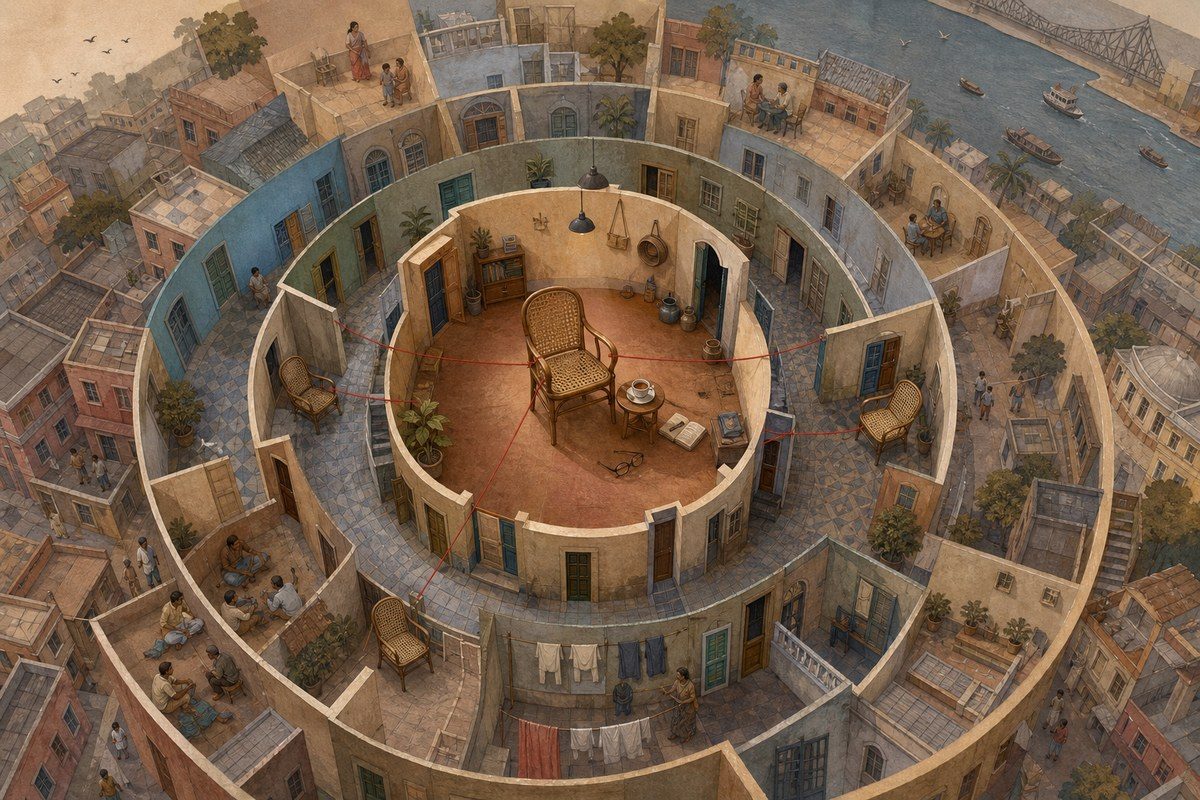
Middle-aged middle-class educated boredom is not emptiness; it is appetite trapped inside a life that still has furniture, bills, manners, and enough vocabulary to diagnose its own suffocation.
That is what makes it horrible. Not the cartoon boredom of a child in summer, not the theatrical boredom of the aristocrat with silk curtains and a ruined soul, not even the fashionable boredom of the young who can convert restlessness into travel, romance, content creation, or a new hairstyle. This is a quieter animal. It lives in the man or woman who has read enough to know the world is large, worked enough to know the world is not waiting, aged enough to know time is now issuing smaller notes, and remained middle class enough to still fear falling more than failing.
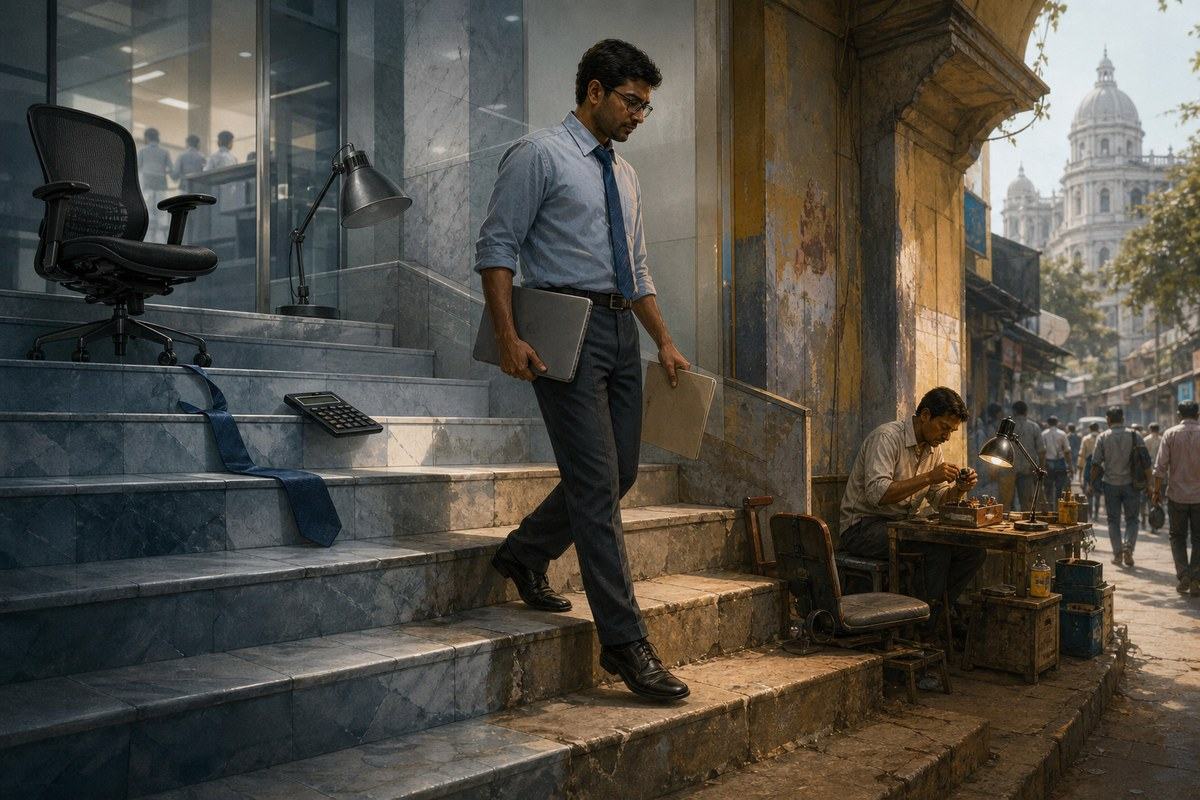
The educated middle-aged person is caught inside a strange civilizational joke. Education was sold as motion. Read, qualify, pass, leave, rise, specialize, become useful, become legible to institutions. For a while the bargain seemed to work. Degrees became doors. English became an elevator. Technical competence became a visa stamp, a job title, a cubicle, a salary account, a conference badge, a mortgage pre-approval, a little private proof that one had escaped the ancient mud of helplessness. Then, somewhere in the long corridor, the machinery changed its terms. The degree aged. The profession automated parts of itself. The body began charging maintenance fees. Parents became frail. Children, if present, became invoices with souls. Marriage, if present, became logistics plus memory. The city did not become more usable. The internet became a carnival of comparison. And the mind, trained for difficulty, found itself doing the same eight tasks while carrying the ghost of fifty abandoned selves.
This boredom is not laziness. Laziness is the refusal to move. This is the horror of having movement available only in forms that do not matter.
The formal rule says the educated middle class has choices. The lived reality says many of those choices are decorative doors painted on brick. You may change jobs, but age discrimination stands at the gate wearing perfume and calling itself “culture fit.” You may start a business, but rent, platform fees, client distrust, delayed payments, and family risk turn entrepreneurship into a casino where the house also employs your relatives. You may emigrate, but immigration law is not a poem about potential; it is a sorting machine with quotas, sponsors, and deadlines. You may reinvent yourself, but the body is tired, the savings are not heroic, and the market prefers reinvention performed by people young enough to look cheap and enthusiastic while being exploited.
So the person scrolls.
Scrolling is not merely a bad habit. It is boredom finding a low-cost emergency exit. Each flick of the thumb is a tiny application for another life. A joke, a war, a recipe, a scandal, a lecture, a young person explaining Artificial Intelligence [AI, software systems that can perform tasks associated with human reasoning, language, and pattern recognition] with the confidence of a magician selling umbrellas during a drought. The educated bored mind does not scroll because it is stupid. It scrolls because the old instruments of agency have become slow, expensive, humiliating, or unavailable. The feed offers novelty without responsibility. A book asks you to bring a self. A feed manufactures one for six seconds at a time.
But the meter is always running.
The cost is not only time. Time is the visible invoice. The deeper cost is the erosion of directed attention, which is the last private property of the middle-aged person. Money may be limited. Beauty may be renegotiating its contract. Professional status may be unstable. Family power may be contested. But attention remains the small republic from the dining table. When that too is annexed by panic, trivia, outrage, and algorithmic bait, the person is not merely distracted. He is dispossessed.
Middle-class boredom has a class signature. The poor are often denied the luxury of boredom because survival keeps sending urgent tickets to the help desk. The rich can aestheticize boredom into wellness, collecting retreats, vineyards, residencies, and spiritual minimalism with good lighting. The middle class gets the cheapest and most poisonous version: enough security to pause, not enough freedom to move; enough education to perceive the cage, not enough capital to redesign it; enough respectability to avoid open collapse, not enough power to escape slow corrosion.
This is why the horror is especially sharp in a city like Calcutta. The city is generous in some primitive, battered way. It lets a modest life continue where a more expensive society might have evicted it from existence. Food can still be found without taking a bank loan. Repair still exists as a profession rather than a YouTube channel. Someone knows someone who knows a man who can fix a pump, argue with a clerk, arrange a nurse, bring medicine, locate a missing document, or negotiate with a landlord who has the personality of a minor weather event. Calcutta is not paradise. It is survivability with damp walls.
Yet the same city that lets you float also eats attention by the spoonful. Noise, dust, queues, broken pavements, familial claims, bureaucratic fog, traffic without choreography, leaking roofs, medical uncertainty, social intrusion, and the general sensation that every errand has brought cousins. A simple act—getting a blood test, renewing a document, arranging a wheelchair, paying a bill, buying a reliable appliance—can become a miniature expedition through the republic of almost. Almost available. Almost fixed. Almost submitted. Almost delivered. Almost honest.
The educated bored person is not bored because nothing happens. Too much happens, but very little develops.
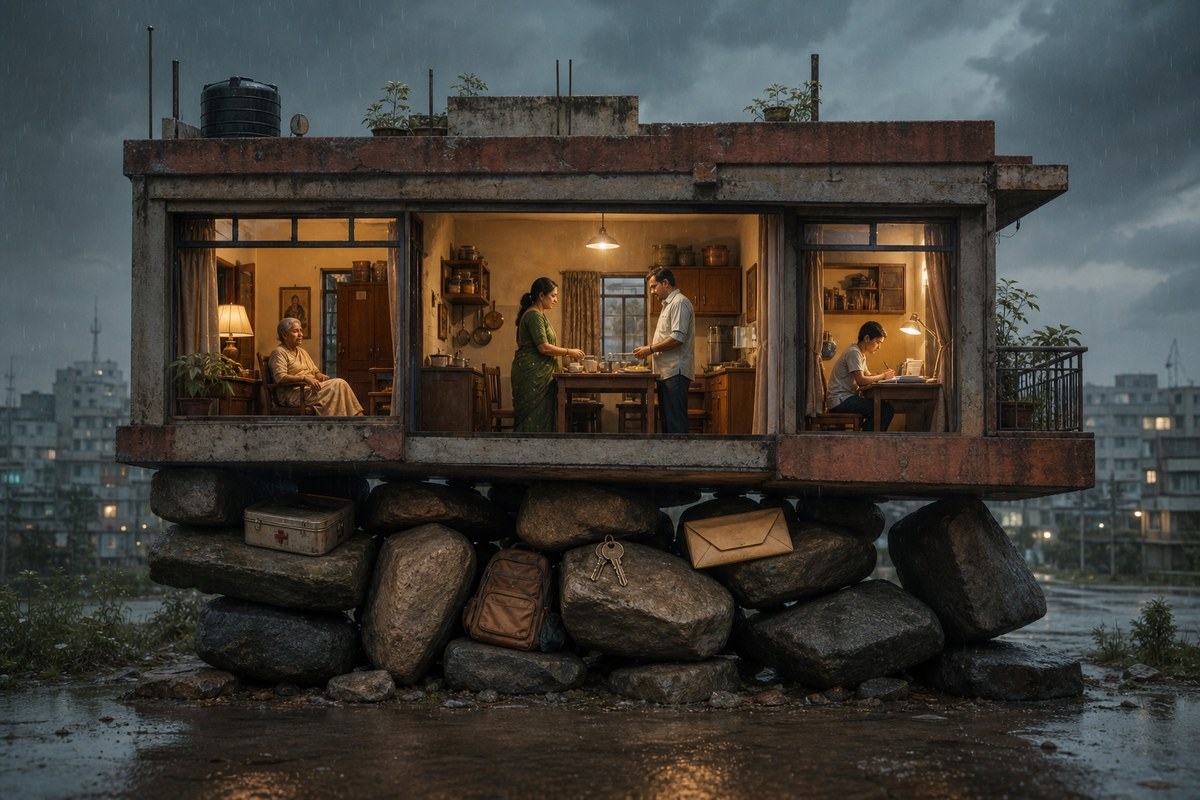
That distinction matters. Eventfulness is not meaning. Calcutta provides eventfulness by the kilo. Meaning requires continuity, a sense that one’s effort enters a structure and produces durable change. The middle-aged mind can endure hardship if hardship compounds into something. A student studies because the exam arrives. A young worker tolerates indignity because the next rung is visible. A parent sacrifices because a child may stand somewhere firmer. But middle age often reveals a more brutal arithmetic. Some efforts merely prevent decline. Some labor only keeps the ceiling from falling. Some duties are noble in theory and punishing in daily format. Some days are not chapters. They are patches.
The technical name, if we borrowed one from architecture, would be maintenance without roadmap.
A production system can run like this for years. Nothing explodes, exactly. The database limps. The interfaces retry. The reports are late. The upstream feed sends contradictory values. The downstream users curse but adapt. No one funds redesign because the system is still “working.” This is also the life of many educated middle-aged people. They are not dead, not ruined, not destitute, not visibly mad. They are functioning. That terrible word. Functioning is what society calls a person when it has decided not to ask what the function is doing to him.
The representation failure is then mislabeled as a character flaw. A man who cannot begin his long-planned book is called undisciplined. A woman who cannot leave a dead job is called fearful. A son caring for an old parent while consulting for uncertain income is told to be positive, as if optimism were a logistics platform. A professional whose field has shifted under him is advised to upskill, which is often correct and still cruel, like telling a drowning man to improve his swimming technique while standing on the pier with a clipboard.
Survival mechanisms are often mislabeled as cultural traits. What looks like procrastination may be risk management. What looks like fatalism may be learned evidence. What looks like gossip may be informal intelligence gathering in a low-trust society. What looks like dependence on family may be the only insurance product that actually pays. What looks like “Indian adjustment” may be citizens writing their own middleware because the official system keeps dropping packets.
None of this makes boredom noble. Suffering does not improve the furniture of the soul by magic. Boredom can make a person mean. It can sour into envy, conspiracy, cruelty, pornography of grievance, petty tyranny over weaker people, or the domestic dictatorship of the disappointed. A bored middle-aged man with education and no purpose can become a neighborhood hazard, a WhatsApp philosopher, a minor patriarch, a consumer of outrage, a corrector of everyone’s grammar and no one’s suffering. A bored middle-aged woman may be pressed into endless service and then blamed for having no radiance left. The mind denied a worthy task will often appoint itself inspector of smaller lives.
This is the hidden bargain. Respectable boredom gives you safety from spectacular ruin but extracts moral stamina. It keeps you housed, clothed, addressable, and socially plausible. In return it asks for your afternoons, your curiosity, your ability to admire others without resentment, your willingness to begin again without applause. It does not stab. It varnishes.
America has its own version of the same animal. There the boredom may be cleaner, quieter, more professionally packaged. A person can sit in a temperature-controlled suburb, drive on disciplined roads, receive itemized bills from institutions that never raise their voice, and still feel the soul being vacuum-sealed. Order without intimacy has its own horror. The United States [US, the federal republic commonly called America] can give enforceable expectations, but it often charges brutally for survival. Health insurance, rent, loneliness, childcare, eldercare, transportation, litigation, and the thinness of casual belonging can turn an orderly life into a subscription service for anxiety. India disciplines through friction. America disciplines through invoices. Neither is innocent. They simply use different instruments.
The educated middle-aged person who has lived between these systems may feel especially stranded. He has seen order, so chaos insults him. He has seen loneliness, so intimacy does not fool him. He knows that procedure without belonging is cold, and belonging without procedure is exhausting. He knows that a society can be clean and still abandon you, and another can be affectionate while quietly stealing your time, lungs, and dignity. This knowledge does not make him superior. It makes him harder to console.
The practical direction is not to “find passion,” that most American of consumer instructions, as if purpose were a scented candle hiding in a mall. Passion is too volatile for middle age. What is needed is architecture.
The first architectural move is to distinguish relief from repair. Relief is scrolling, snacking, complaining, buying, binge-watching, fantasizing about escape, or rearranging the room at midnight. Relief is not evil. Every life needs painkillers. But a life built entirely from painkillers becomes another disease. Repair is different. Repair adds capacity. A walk that strengthens the body is repair. A notebook that catches thought before the feed eats it is repair. A small consulting routine that improves trust with clients is repair. A weekly call made before loneliness becomes emergency is repair. A page written badly but honestly is repair. A household process simplified so an old parent’s care is less chaotic is repair. Repair is usually boring in the noble sense. It does not sparkle. It accumulates.
The second move is to stop treating the day as an empty container and start treating it as a hostile interface requiring design. Middle age cannot rely on mood. Mood is weather, and weather in this climate is frequently a drunk municipal contractor. The day needs friction placed in front of decay and ease placed in front of repair. Put the phone away from the bed. Put the walking shoes where shame can see them. Put the notebook where the tea arrives. Put the medicine list in one place. Put bills into a recurring ritual. Put one serious book within reach and the feed one room away. This is not moral grandeur. It is systems design for a mammal with a failing attention span.
The third move is to choose duties that produce dignity rather than merely consume obedience. Family obligation can be love, but it can also become a black market where guilt is the currency. Work can be service, but it can also become the daily laundering of fear. Civic behavior can be meaningful, but not if it depends on fantasies of total reform by next Thursday. The realistic unit is smaller. Keep the queue. Pay the worker fairly. Do not humiliate the service person because your own status is leaking. Teach a child that public space is not a dustbin with a flag. Make one process clearer for someone weaker than you. Refuse one inherited cruelty. These are not revolutions. They are load-bearing repairs.
The fourth move is to recover difficulty that is not punishment. Education once gave the middle class a relationship with difficulty: a theorem, a language, a machine, a poem, a musical phrase, a legal argument, a programming bug, a historical puzzle. Then life replaced difficulty with hassle. Hassle is difficulty without meaning. It depletes. Chosen difficulty restores proportion. Learn something hard enough to resist you and honest enough not to flatter you. Mathematics, music, drawing, translation, carpentry, philosophy, statistics, gardening, a new software stack, a serious language, singing badly until it becomes less bad. The object matters less than the contract: I will give sustained attention to something that cannot be bribed by my impatience.
There is a constraint, naturally. There is always a constraint. Money is limited. Knees hurt. Parents need help. Clients delay payment. The apartment is small. The city is loud. The mind is not twenty-five and does not leap from intention to execution like a film hero clearing a wall. Depression may be present, and if it is, moral advice is not enough; medical and human help may be necessary. The point is not to pretend that structure cures everything. The point is that without structure, boredom recruits the weakest parts of the self and gives them administrative control.
Middle-aged educated boredom becomes horrifying when the person still possesses intelligence but loses a believable future. Intelligence then turns inward, like a searchlight in a locked room. It illuminates old mistakes, missed chances, rivals, humiliations, bodily decline, social absurdity, and the suspicious cheerfulness of younger people announcing breakthroughs on platforms designed to eat them too. The mind becomes a courtroom where the accused, judge, witness, and stenographer are all the same tired person.
A decent life must interrupt that trial.
Not with slogans. With contact, work, repair, movement, study, service, and some deliberately protected useless beauty. A song practiced for no market. A paragraph written for no client. A plant kept alive. A neighbor helped without joining his entire drama. A parent’s medicine organized without becoming a martyr. A civic rule obeyed when no one is watching. A skill rebuilt in public embarrassment. A friendship maintained with boring consistency. These things sound small because middle age has been trained to respect only scale, salary, and spectacle. But small things are where the operating system of everyday life is actually patched.
The horror does not vanish. Let us not insult the beast. There will still be afternoons when the walls seem to have teeth, when the educated mind opens its mouth and produces only a dry scream, when the city outside feels like a machine for converting hope into honking, and the future appears not tragic but administratively unavailable. On those days, one must not demand revelation. One must lower the standard from salvation to flotation.
Make tea. Walk. Write three ugly sentences. Pay one bill. Repair one object. Call one person without performing success. Read one page slowly enough to remember that the mind was built for more than alarm. Refuse to become cruel merely because life has become narrow.
Not escape. Not triumph. A modest architecture against the mouth of the dark.
Related Posts
Word Cloud
Related reading
Selected by shared topics and section, with closer publication dates breaking ties.