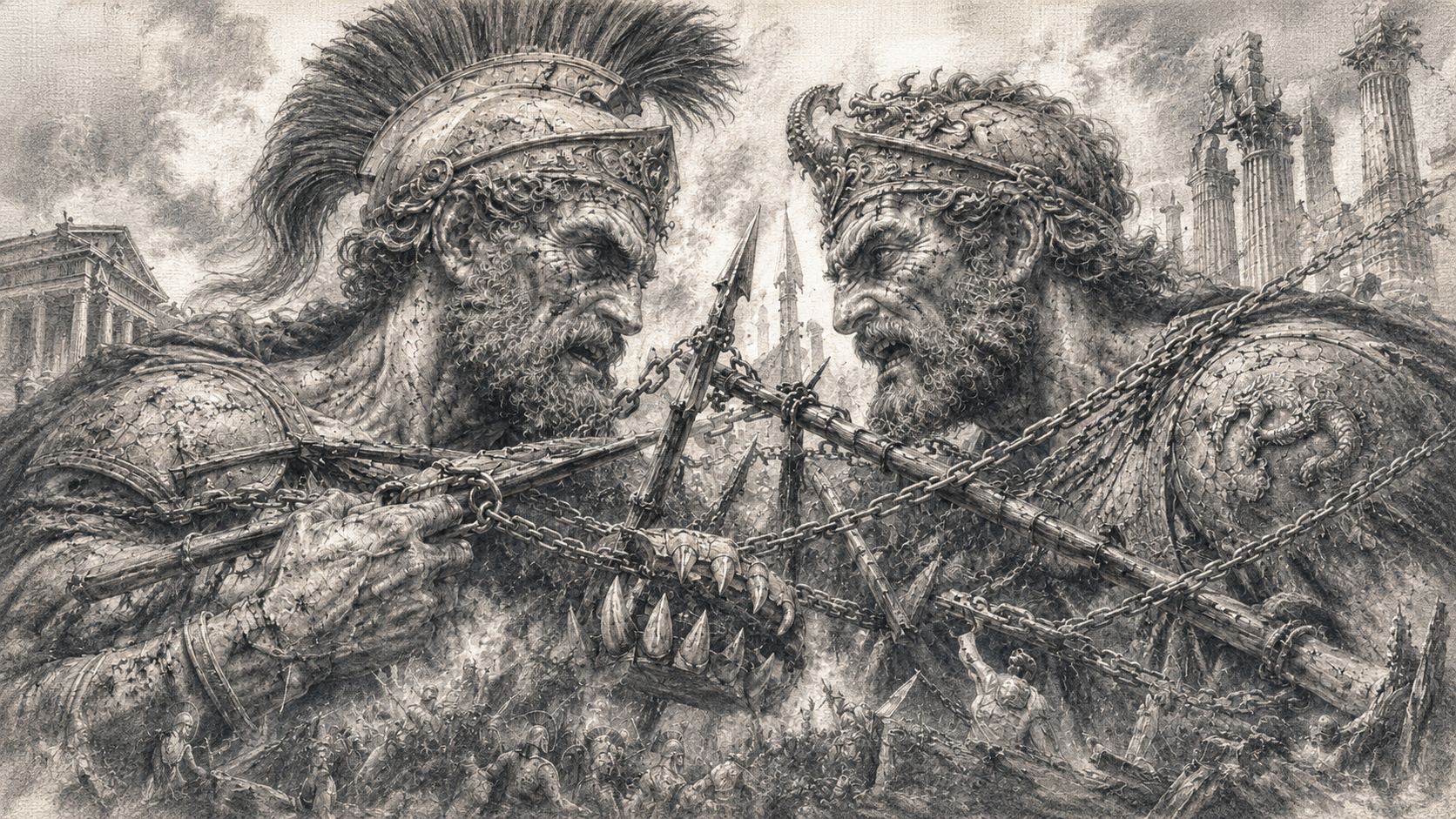
Hormuz, Day 52
Uses the speech voice supplied by your browser or device.

Acronyms expanded in this post:
- AI: Artificial Intelligence. software that generates, classifies, predicts, summarizes, or acts on patterns in data.
- IT: Information Technology. the practice of building, operating, and supporting computing systems.
- LPG: Liquefied Petroleum Gas. bottled cooking gas used in many Indian homes.
By day 52, this is no longer an oil story.
It is a state-capacity story. A logistics story. A public-finance story. A hospital-generator story. A fertilizer-and-food story. It begins with tankers and insurers, but it does not stay there. Once the Strait of Hormuz is impaired for weeks rather than days, the relevant question for nation states is no longer, “Can we still buy crude?” It is, “Which parts of our economy require cheap, predictable molecules and low-friction shipping to keep basic life functioning?” That answer is unpleasantly broad, because Hormuz is not merely an energy artery. Before the conflict, it carried very large shares of crude oil, liquefied petroleum gas, liquefied natural gas, refined products, chemicals, and fertilizer-linked bulk flows; by late March, UNCTAD was describing traffic as near-halted, with average daily transits down about 95% from pre-escalation levels. Reuters reported on April 21 that traffic remained largely halted, with only three vessels transiting in the previous 24 hours versus a pre-conflict norm around 140.
That distinction matters because modern states do not consume oil. They consume derivatives of continuity. Diesel for trucking. LNG for power and industry. LPG for cooking. Petrochemical feedstocks for plastics, sterile packaging, nitrile, solvents, and industrial intermediates. Sulfur, ammonia, phosphate, and urea for agriculture. Insurance, chartering, bunker fuel, and port confidence for the rest. When a chokepoint this central is disrupted, the first shock is price; the second is allocation; the third is political. Prices rise first, then someone decides who still gets supply, and after that voters discover that “supply chain” was just a polite euphemism for state triage. EIA estimated roughly 20 million barrels per day moved through Hormuz in 2024, about 20% of global petroleum liquids consumption, while IEA says about one-fifth of global LNG trade transits the strait and that Asia is by far the main destination for these volumes.
The direct losers are obvious: Gulf exporters whose production exists but cannot clear efficiently to market, importers in Asia that depend on Gulf barrels and Qatari LNG, and countries whose substitution options are thin. The less obvious losers are those buying no oil at all from the Gulf but importing the second-order consequences: fertilizer, freight inflation, weaker currencies, higher debt costs, and more expensive food. UNCTAD’s March and April assessments are useful precisely because they refuse to stop at fuel. They connect energy disruption to transport costs, fertilizer access, food inflation, debt stress, and trade slowdown. IMF made the same point more bluntly: for fuel-importing economies, the shock functions like a sudden tax on national income, and in an adverse scenario a longer shutdown would deepen inflation and cut growth further.
Food is where the public first feels the war in the kitchen instead of on a map.
The mechanism is not mysterious. Oil and gas are not merely fuels; they are embedded cost structures for cultivation, irrigation, fertilizer manufacture, storage, processing, and transport. UNCTAD notes that about one-third of global seaborne fertilizer trade passes through Hormuz, with the Gulf region central to urea, phosphate, and related flows. IMF’s April briefing added that Gulf Cooperation Council countries account for more than 40% of global sulfur exports and roughly 20% of ammonia and nitrogen fertilizer exports. Once gas and fertilizer prices climb together, food systems do not fail theatrically. They degrade season by season. Farmers apply less. Importers defer purchases. Governments increase subsidy burdens. Yields soften later, prices bite immediately, and poor households shift first from proteins to starch, then from quality to calories, then from sufficiency to omission.
This is why a prolonged disruption punishes low-income and import-dependent states out of proportion to their geopolitical importance. UNCTAD’s country exposure tables are telling: large shares of fertilizer imports for countries such as Sudan, Sri Lanka, Tanzania, Somalia, Pakistan, Kenya, and Mozambique originate from the Persian Gulf region. That does not mean every country faces famine. It means a shipping disruption in a narrow waterway can become a budget crisis in a finance ministry, then a planting problem in a farm belt, then a nutrition problem in urban households that were already spending too much of their income on food. The chain is long, but not loose.
Healthcare comes next, and here too people make the wrong initial assumption. They imagine the issue is pharmaceuticals on ships. Sometimes it is. More often it is the substrate around care delivery.
Hospitals are energy conversion systems disguised as care institutions. They require grid reliability, diesel backup, oxygen logistics, sterilization, refrigeration, packaging, disposables, and dependable transport. Fuel inflation hits ambulance fleets, generators, cold chain, and supplier distribution. Petrochemical inflation raises costs for syringes, tubing, gloves, sterile wraps, IV bags, blister packs, and countless small items that administrators only notice when allocations begin. Airspace restrictions and rerouted cargo then hit time- and temperature-sensitive medicines from the other side, especially oncology drugs, biologics, and refrigerated therapeutics. Reuters reported in March that the regional war was already disrupting air routes used for critical medicines to the Gulf, including refrigerated cancer drugs, while Direct Relief warned that fuel shortages, medical supply interruptions, and disruption of dialysis, oncology, maternal health, and immunization services were already emerging across affected systems.
There is an even duller, nastier layer. Healthcare inflation is not only a purchasing problem. It is a reimbursement and access problem. In countries with public systems, governments absorb more cost or ration more openly. In mixed systems, providers delay procurement, distributors reduce credit exposure, and patients discover that nominal availability is not the same as affordable access. In poorer states, donor-funded or humanitarian channels may face the double injury of higher logistics cost and weaker delivery routes. Even products that seem far removed from grand strategy get caught. Reuters reported on April 21 that the world’s largest condom manufacturer planned steep price increases because conflict-related shortages had raised costs of synthetic rubber, nitrile, packaging materials, lubricants, freight, and transit time. That is not a curiosity. It is a reminder that global health commodities are inseparable from petrochemicals, shipping, and cash flow.
For energy-importing states, the macroeconomic damage arrives with remarkable efficiency.
A country like India can partially substitute crude sources, and Reuters reported that March imports shifted sharply toward Russia and Africa as Middle Eastern crude fell. That is helpful, but it is not rescue. Source substitution for crude does not eliminate exposure to freight, insurance, refining margins, LPG dependence, or global price spillovers. India’s own Press Information Bureau said in March that India imports about 60% of its LPG consumption and that about 90% of those imports come through Hormuz. That matters because cooking fuel shocks are politically intimate in a way benchmark crude prices are not. Households do not protest Brent; they protest cylinders.
East Asia’s problem is different. It is not simply oil dependence but gas dependence layered on industrial exposure. IEA notes that almost 90% of LNG volumes exported via Hormuz in 2025 went to Asia, accounting for more than a quarter of the region’s LNG imports. Japan and South Korea therefore face exposure not merely at the pump or on utility bills but across power generation, industrial gas use, and manufacturing competitiveness. The damage here is less visible than rationed cooking fuel, but more structurally corrosive: utilities pay more, industries lose margin, inflation lingers, and central banks inherit a geopolitical headache they cannot raise rates away.
Europe is less directly exposed than Asia to Hormuz LNG, but not insulated. Europe’s challenge is not primary dependence at Asian levels; it is residual fragility in an already-rewired energy system. A sustained disruption forces Europe back into harder competition for alternative cargoes and middle distillates, while inflationary spillovers from freight, insurance, and chemicals leak into manufacturing and food. The effect is not likely to be an immediate systems collapse. It is a broad deterioration in input costs and policy room, especially for governments already running narrow fiscal margins.
Gulf exporters themselves are not spared simply because they sit atop hydrocarbons.
A prolonged blockage strands value inside the region. Production cuts become involuntary. Storage fills. Discounting rises where alternative routes exist, and where bypass routes do exist, they are finite, insecure, or both. Reuters notes that Saudi Arabia’s East-West Pipeline and the UAE’s Fujairah route provide some bypass capacity, but nowhere near a full answer, while Iraq, Iran, and others face much thinner alternatives. Iraq’s reopening of the Rabia border crossing to push fuel oil overland through Syria is a useful symbol of the moment: when maritime efficiency breaks, states rediscover trucks, borders, escorts, leakage, and delay. Overland substitutes exist. They are simply slower, costlier, more corruptible, and smaller.
That is why the political consequences sharpen with duration.
In the first week, governments talk about resilience. In the second, they release reserves and calm markets. By the fourth or fifth, the argument shifts to prioritization. Who gets diesel first: freight, farming, hospitals, or backup power? Which import contracts receive scarce foreign exchange? Which subsidies survive? Which procurement rules get relaxed, and who profits from emergency discretion? When states say they are “managing the situation,” what they often mean is that they have started converting market shortages into administrative shortages. Democracies feel this through inflation and electoral pressure. Authoritarian systems feel it through elite bargaining, hidden rationing, and rising coercion. Either way, the state moves from regulator of markets to allocator of scarcity.
The deepest mistake is to assume that the longer this drags on, the more the world simply “adjusts.”
Some adjustment happens. Crude gets rerouted. Strategic stocks are drawn. LNG demand is destroyed at the margin. Chemical buyers destock. Farmers switch blends or under-apply. Hospitals stretch inventories and defer elective activity. Manufacturers redesign around cost. But adjustment is not recovery. It is often just the system deciding where to absorb pain. IEA has already described the present disruption as the biggest energy supply disruption on record, and Reuters reported that even when ships briefly resumed passage, restoring normal flows was not simply a matter of opening the waterway because confidence, insurance, routing, and asset positioning had all been damaged. Once war-risk insurance is repriced and operators start treating a route as unreliable rather than merely dangerous, the commercial memory outlasts the ceasefire.
So what happens if this moves from day 52 into day 90 or day 120.
Food-importing developing states face a worsening combination of fertilizer cost, weaker currencies, higher shipping bills, and reduced fiscal room for subsidy. Healthcare systems feel more stockouts, longer lead times, and more expensive procurement for both medicines and the low-glamour consumables that make treatment possible. Asian importers keep scrambling for crude and LNG substitution, but at the cost of higher delivered prices and industrial stress. Gulf producers bleed revenue through constrained throughput and discounted routing. Europe imports another wave of inflation and risk premium. Fragile states absorb the damage as malnutrition, service interruption, and budget exhaustion long before they absorb it as elegant macroeconomic terminology.
And because this is a supply systems problem rather than a single-market problem, the sectors do not stay politely separated.
Food prices worsen public health. Public-health strain worsens labor productivity. Higher fuel costs worsen water pumping, sanitation, and transport. Medicine delays worsen preventable morbidity. Higher freight and insurance costs worsen fiscal deficits. Weaker currencies worsen all imports at once. Then the sovereign pays more to borrow precisely when it most needs to spend. UNCTAD’s April note makes that last point directly: developing countries face falling stock prices, weaker currencies, and rising external debt costs as the disruption persists.
The practical conclusion is unsentimental.
Any serious national response now has to be multisectoral. Not an oil ministry plan. A state plan. Fuel prioritization tied to healthcare and food logistics. Fertilizer financing and seasonal crop strategy. Emergency procurement pathways for medical consumables, cold-chain products, and essential drugs. Foreign-exchange triage that recognizes LPG, fertilizer, diesel, and hospital-critical imports as social stability instruments, not just commercial categories. Port, trucking, rail, and inland storage capacity matter more than patriotic speeches. So do reserve release rules, subsidy targeting, and credit lines for importers who would otherwise stop ordering before the public realizes shelves are thinning.
Because by day 52, the real issue is not whether Hormuz is blocked.
It is whether the state understands what actually runs through it.
Related Posts
Word Cloud
Related reading
Selected by shared topics and section, with closer publication dates breaking ties.