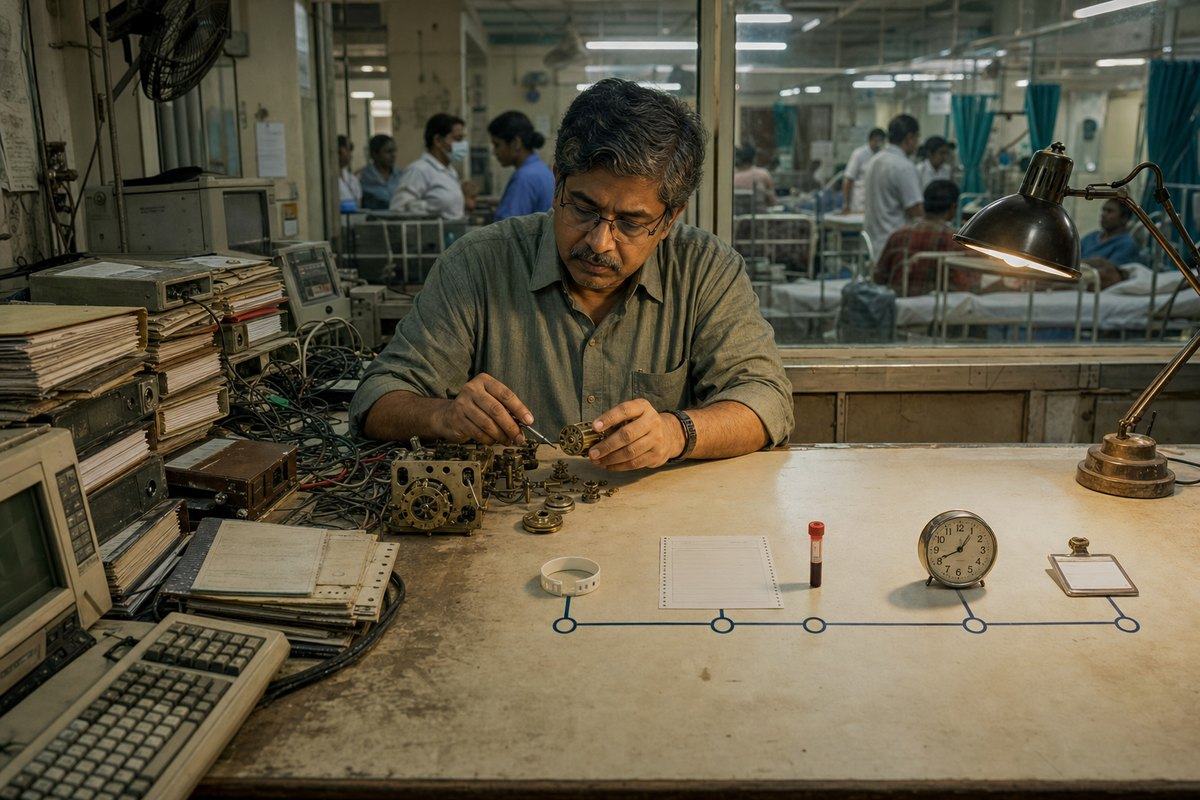
Science Is Not a Solitary Organ
Uses the speech voice supplied by your browser or device.

Acronyms expanded in this post:
- AI: Artificial Intelligence. software that generates, classifies, predicts, summarizes, or acts on patterns in data.
- EHR: Electronic Health Record. the clinical system where patient care is documented and managed.
- IT: Information Technology. the practice of building, operating, and supporting computing systems.
- UTHSCSA: University of Texas Health Science Center at San Antonio. a health science university and research institution in Texas.
- VA: Veterans Affairs. the United States public healthcare system serving military veterans.
Very little serious scientific research is done alone, not because scientists are romantically communal creatures humming in harmony like a laboratory choir, but because reality is too large, the mathematics too treacherous, the data too compromised, and the human brain too fond of congratulating itself before it has checked the denominator.
That was one of the most useful things I discovered while working around Veterans Affairs [VA, the United States healthcare system serving military veterans] and the University of Texas Health Science Center at San Antonio [UTHSCSA, an academic medical and research institution] as a statistician. The popular imagination still likes the lone genius: one person, one blackboard, one thunderclap, one equation, one slightly mad stare into the universe. It is a satisfying picture. It is also, for most real research, nonsense with better lighting.
Actual research is messier. It is a crowded table. A physician brings the clinical question. A statistician brings the model. A data analyst brings the unpleasant news that the fields do not mean what everyone hoped they meant. A research coordinator knows that the patient visit marked “baseline” was not actually baseline because the subject had already received treatment somewhere else. A database person quietly points out that three different source systems have three different truths, all of them produced by respectable software wearing a tie. Then someone finds the missing exclusion criterion. Someone else asks why the model assumes independence when the patients are nested inside clinics, providers, insurance rules, and time itself, that most underappreciated vandal.
This is not bureaucracy. This is science defending itself from premature elegance.
When I would propose a mathematical formula to solve a problem, the formula sometimes behaved beautifully and wrongly, which is one of mathematics’ more dangerous talents. A model can look clean, run fast, produce respectable coefficients, and still be inappropriate for the thing in front of it. The assumption may be false. The outcome may not be distributed the way the method quietly requires. The sample may be biased. The missingness may not be random. The variables may be correlated in ways that make the regression huff and wheeze like an old bus on a Calcutta flyover. Or the whole thing may have been derived from the wrong branch of an equation, a mistake that feels obscure until it destroys the interpretation.
Sometimes the error is grand. Sometimes it is stupid. A sign flipped. A denominator mishandled. A date difference calculated in the wrong direction. A patient counted twice because two systems disagreed about identity. A supposedly continuous variable that is really a billing artifact wearing the costume of measurement. Arithmetic, that humble clerk at the back of the room, can still stab the professor.
This is why conversation matters. Not networking. Not performative collaboration. Conversation. The living act of putting an idea in front of another trained mind and letting it be handled, weighed, questioned, irritated, corrected, and occasionally rescued.
Whenever I would visit the university to talk things over with a professor, or sit with scientists, doctors, data analysts, and statisticians, the problems I carried in were usually not treated as embarrassments. They were welcomed. This surprised me when I was younger. I thought arriving with confusion was a kind of failure. In good scientific company, confusion is often the admission ticket. The problem is the thing. The puzzle is the fire. People lean forward when the question is real.
There is a distinctive pleasure in that room when it works. One person says, “That cannot be right clinically.” Another says, “It may be right clinically but the variable is not measuring that.” A statistician says, “Then the model is answering a different question.” A database analyst says, “Also, half the records before 2008 use another code.” Then everyone groans, which in research is sometimes the sound of progress.
In clinical research, this is especially important because healthcare data is not born as science. It is born as care, billing, documentation, compliance, scheduling, risk management, quality reporting, institutional memory, and occasionally self-defense. The Electronic Health Record [EHR, the clinical system used to document patient care] is not a neutral glass box into which reality politely pours itself. It is a machine for getting through the day. It captures what workflows require, what reimbursement rewards, what regulation demands, what clinicians have time to enter, and what software vendors made easy enough to click before the human spirit collapses.
So the research team must ask a rude but necessary question: what does this data actually represent?
A diagnosis code may represent a confirmed disease, a suspected disease, a billing necessity, a historical condition, a rule-out, or a ghost from a previous encounter that followed the patient like a bureaucratic mosquito. A laboratory value may be scientifically precise but temporally misleading if the specimen was drawn after an intervention. A medication order is not the same as administration. Administration is not the same as adherence. Adherence is not the same as biological effect. These distinctions are not pedantry. They are the difference between analysis and fiction.
This is also where solitary work becomes dangerous. Alone, one tends to trust the shape of the data. Together, people remember how the data was made.
The less obvious machinery underneath is that scientific collaboration is not merely social. It is representational infrastructure. Each person in the research conversation carries a partial map of how reality became data. The clinician understands the disease and the care pathway. The statistician understands the inferential machinery. The analyst understands the source systems and transformations. The coordinator understands protocol deviations and human improvisation. The informaticist understands terminology, provenance, and workflow boundaries. No single person owns the truth. Each person owns a necessary objection.
That is why the best research conversations feel less like meetings and more like triangulation. You are trying to locate a hidden object by listening to the echoes from several walls.
A mathematical model is an argument under constraints. It says, in effect, if these assumptions are acceptable, if this measurement means what we think it means, if the sampling process has not bent the world too badly, if the missing data does not conceal a trapdoor, then this conclusion may be defensible. Remove the “ifs” and the model becomes a well-dressed superstition.
Many young analysts learn methods before they learn distrust. This is understandable. Methods are teachable. Distrust has to be earned by watching a clean dataset turn out to be a compost heap with column names. The beginner asks, “Which model should I use?” The experienced person asks, “What happened before this became a table?”
That question should be carved over the entrance of every analytics department.
In VA and academic medical research environments, the same lesson appeared again and again. The data had history. The patients had history. The institutions had history. The codes had history. The research protocol had a history. The database extract had a history. Even the missing values had biographies, some tragic, some comic, some caused by a form nobody completed because the clinic was short-staffed and the printer had jammed.
The lone analyst rarely sees all of this. Not because the analyst is foolish, but because the system is too layered. A healthcare dataset is not a spreadsheet. It is the fossil record of operational life. Every row is sediment. Every column is a compromise. Every transformation is a small act of interpretation.
This is where collaboration becomes a safeguard against category error. A statistician may see a dependent variable. A clinician may see a syndrome. A data architect may see a field derived from three source systems with incompatible update cycles. A research nurse may see the patient who missed two visits because the bus route changed. None of these views cancels the others. Together they prevent the analysis from becoming a clever answer to a malformed question.
The distinction matters because science is not just calculation. It is disciplined contact with reality.
That contact is fragile. It can be broken by a bad assumption as easily as by bad data. It can be broken by asking the wrong question beautifully. It can be broken by overfitting, underfitting, misclassification, selection bias, survivorship bias, temporal leakage, confounding, poor cohort definition, and the immortal human urge to believe that a statistically significant result must also be meaningful. Significance is not sanctification. A small -value does not sprinkle holy water on a confused study design.
The better research groups know this. They do not treat criticism as hostility. They treat it as oxygen. The modeler wants the clinician to object. The clinician needs the analyst to explain why the extract is unreliable. The analyst needs the statistician to say when a transformation has damaged the inference. The principal investigator needs everyone to say, before publication or presentation, “Are we sure this is the question we answered?”
This is the part of science that public mythology underplays. The excitement is not only in discovery. It is in correction. In watching an idea become less wrong. In seeing a colleague’s objection remove a hidden flaw. In realizing that the first solution was too simple, then the second too clever, then the third finally modest enough to survive contact with the data.
There is a kind of intellectual happiness in that. Not the happiness of being right. Better than that. The happiness of being rescued from being wrong in public.
Of course, collaboration is not automatically noble. Groups can amplify error too. A committee can be an error-preservation device with snacks. Seniority can silence the person who actually understands the data. Medical prestige can intimidate statistical caution. Statistical elegance can intimidate clinical common sense. Institutional deadlines can convert uncertainty into PowerPoint. Everyone who has worked in real systems knows this. Collaboration is not magic. It is an instrument, and like all instruments, it can play music or injure the furniture.
But at its best, collaboration is how science keeps itself honest. It distributes skepticism. It makes private assumptions public. It turns hidden shortcuts into visible choices. It gives the problem more than one brain to bite into.
There is also humility in it, though not the decorative humility people advertise on LinkedIn while polishing their trophies. Real humility is operational. It says, “I may have chosen the wrong model.” “I may have misunderstood the clinical workflow.” “I may have trusted the source field too much.” “I may have solved the equation correctly and still answered nonsense.” This humility is not weakness. It is quality control for thought.
In healthcare research, that humility is not optional because errors do not remain abstract. They travel. A bad analytic assumption can distort a finding. A distorted finding can influence a protocol, a guideline, a funding decision, a quality measure, or a clinical belief. By the time the mistake reaches practice, it may be wearing a badge that says evidence.
That is why the combination of minds is not a sentimental ideal. It is a safety mechanism.
The professor’s office, the hallway conversation, the table with doctors and statisticians and analysts, the informal argument over why a result makes no clinical sense—these are not side activities. They are where much of the scientific work actually happens. The published paper is often the polished surface. The real work is the scratching underneath: the questions, doubts, corrections, discarded models, redefined cohorts, revised assumptions, and those blessed moments when someone says, “Wait. That variable does not mean what you think it means.”
Science advances not because scientists are immune to error, but because good scientific cultures build ways to catch error before it becomes doctrine.
That is the lesson I carried from those rooms. A mind alone can be brilliant. It can also be brilliantly trapped. A group of serious people, each bringing a different discipline and a willingness to be corrected, can do something more valuable than produce answers. It can produce answers that have survived an argument with reality.
And reality, as every statistician eventually learns, is the strictest reviewer in the building.
Related Posts
Word Cloud
Related reading
Selected by shared topics and section, with closer publication dates breaking ties.