Ukraine, Iran, and Civilian Technology
Uses the speech voice supplied by your browser or device.

Acronyms expanded in this post:
- AI: Artificial Intelligence. software that generates, classifies, predicts, summarizes, or acts on patterns in data.
- IT: Information Technology. the practice of building, operating, and supporting computing systems.
War is not a research grant with bad manners. It is a distortion field. It takes money, fear, urgency, logistics, engineering, and state power, then strips away committee drift. That is why it so often accelerates technologies that peacetime would have funded timidly, regulated slowly, and deployed late.
This is the first thing worth saying plainly.
The civilian world does not usually inherit the most glamorous wartime device. It inherits the thing that solved a bottleneck. Not the sword. The scabbard. Not the missile. The guidance package, the sensor fusion stack, the mass production trick, the rugged battery chemistry, the sterilization method, the packetized network, the trauma workflow, the procurement shortcut, the manufacturing ecosystem around the weapon.
That pattern matters now because the war in Ukraine and the current war involving Iran are both forcing unusually rapid adaptation in exactly those layers where civilian spillovers tend to appear later: autonomy, electronic warfare, low-cost sensing, resilient communications, distributed manufacture, missile defense economics, maritime robotics, and medical response under degraded infrastructure.
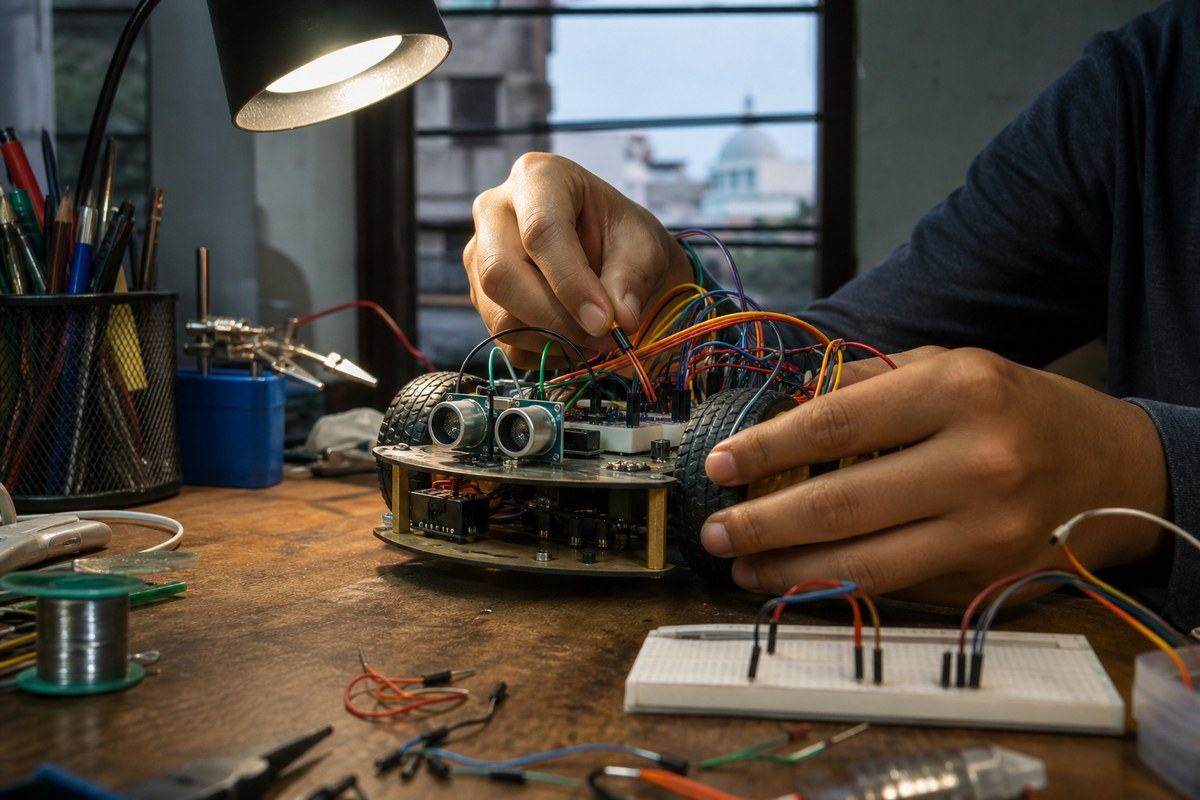
The likely inheritance from Ukraine is not “more drones” in the toy-shop sense. It is the normalization of software-defined, cheap, disposable, continuously iterated robotics. Ukraine has turned the battlefield into a brutal laboratory for first-person-view drones, interceptor drones, unmanned ground vehicles, sea drones, contested-spectrum navigation, and rapid battlefield software updates. The remarkable part is not that drones exist. The remarkable part is the tempo of adaptation. Hardware is being treated more like code. Designs are revised against frontline feedback in weeks, not in procurement epochs. That matters far beyond war.
What does that become in civilian life.
First, counter-drone infrastructure. Not cinematic anti-air systems. Boring, necessary, civilian counter-UAS architecture: sensor fusion, low-altitude tracking, geofenced intercept logic, portable airspace management, and layered defenses against cheap massed intrusions. Airports, ports, refineries, stadiums, data centers, power substations, prisons, and border crossings will all want versions of this. The interesting commercial winner may not be the interceptor. It may be the detection stack: radar, acoustic sensing, passive radio-frequency detection, optical classification, and the software layer that fuses them fast enough to act.
Second, electronic-warfare resilience will spill into civilian communications. Ukraine has shown how fragile radio links, satellite navigation, and conventional command paths become under intense jamming and spoofing. That pressure is likely to accelerate practical alternatives: mesh networking, degraded-mode navigation, terrain-referenced guidance, inertial backup, optical control links, and systems that continue functioning when Global Navigation Satellite System signals are unreliable or absent. Civilian shipping, emergency response, mining, offshore energy, autonomous agriculture, and disaster operations all have reasons to care. A navigation stack that assumes uninterrupted satellite truth is no longer a serious design.
Third, autonomous logistics will mature faster than glamorous full autonomy. War has a way of clarifying where humans are most expensive to expose. In Ukraine that means casualty evacuation, resupply, trench-to-trench transport, minefield approach, route reconnaissance, and repetitive short-haul delivery under surveillance. Those are ugly military tasks, but the civilian analogues are obvious: hazardous industrial inspection, disaster-zone delivery, wildfire resupply, flood response, offshore maintenance, warehouse-to-yard transfer, last-mile operations in unsafe conditions. The real spillover may be reliable semi-autonomy in bad environments rather than pristine self-driving in tidy cities. Mud beats PowerPoint.
Fourth, the manufacturing lesson will travel. Ukraine has pushed a model in which cheap components, local assembly, rapid prototyping, and feedback-rich iteration beat exquisite low-volume perfection in many use cases. That logic maps directly to civilian robotics, agricultural equipment, industrial sensors, and emergency infrastructure. Expect more modular systems built from replaceable subsystems, more field-repairable devices, more locally adaptable manufacturing, and more acceptance that a fleet of adequate low-cost machines can outperform a handful of precious masterpieces.
Fifth, marine robotics will become less exotic. The Black Sea has already taught that unmanned surface vessels can do reconnaissance, strike, deception, and coastal denial in ways once reserved for much more expensive naval assets. The Iran conflict, especially around Gulf infrastructure and shipping risk, sharpens the same lesson in warmer water and tighter commercial choke points. Civilian beneficiaries will include port security, harbor inspection, environmental monitoring, offshore pipeline surveillance, search and rescue, and mine countermeasure technologies that later get laundered into safer-sounding maritime autonomy products. The vessel may arrive wearing a civilian badge. Its grandparents were armed.
Now the Iran side.
The technological pressure from the Iran war is somewhat different. Ukraine is the great teacher of adaptation under attrition. Iran is the great teacher of saturation economics and regional infrastructure vulnerability. Cheap one-way attack drones, missile salvos, decoys, and mixed attack packages force defenders into a cruel arithmetic: the incoming system may be cheap, the defensive interceptor may be expensive, and the target may be essential. That equation is going to reshape civilian security technology.
The first likely spillover is cost-imposed defense. Civilian operators of critical infrastructure will demand layered, cheaper defensive systems that can discriminate among drones, decoys, and conventional aircraft without burning through costly munitions. This will encourage interceptor drones, directed-energy research, smarter cueing systems, and better battle-management software. In civilian language that becomes “site protection,” “perimeter resilience,” and “airspace security.” In plain English it means finding ways to stop a thousand-dollar threat without spending a million dollars.
The second is protection of energy and logistics nodes. The Gulf has again reminded the world that a refinery, petrochemical complex, port, desalination plant, undersea cable landing site, or airbase is not merely a point on a map. It is a systems node. Attacks on such nodes accelerate technology around redundancy, faster damage assessment, robotic inspection, autonomous firefighting support, predictive maintenance, and infrastructure digital twins that can model damage propagation and restoration paths. This will not make infrastructure invulnerable. It will make operators less blind in the first hours after an attack, which is often the interval that decides whether disruption is local or cascading.
The third is mine warfare and counter-mine robotics. If maritime chokepoints remain threatened, unmanned mine detection and clearance will attract far more money and engineering attention than they ordinarily would, because sending humans into mined waters is an ancient way to die stupidly. The civilian afterlife of that work includes seabed mapping, port surveying, offshore energy inspection, autonomous underwater navigation, and safer maintenance of undersea infrastructure. A war at sea tends to produce unusually useful boring machines.
The fourth is integrated air-and-missile warning software. Not merely radars, but decision systems that correlate multiple feeds, rank threats, assign responses, and do so under severe time pressure. That architecture has cousins in civilian emergency management, power-grid incident response, cyber-physical security, and disaster command platforms. One should be careful here. Civilianization of military command software can smuggle militarized assumptions into public administration. Still, the technical components are transferable: fusion, prioritization, degraded operation, and rapid decision support.
The fifth is hardened supply chains. Both wars have exposed dependence on fragile electronics supply lines, scarce components, and geographically concentrated manufacturing. Once a state discovers that a motor, controller, optical sensor, or rare-earth input can stall an entire capability chain, it becomes far more interested in substitute materials, dual sourcing, domestic assembly, and design-for-substitution. That is not merely a defense lesson. It will reach medical devices, telecommunications, industrial automation, and power electronics. The world is rediscovering that a bill of materials is a geopolitical document.
If you want a shorter answer, it is this: Ukraine is likely to give us better autonomy under jamming, better cheap robotics, better counter-drone systems, and more modular field manufacturing. The Iran war is likely to accelerate low-cost air defense, infrastructure resilience tech, maritime robotics, and software for protecting critical nodes against mass cheap attack. Neither war is inventing physics. Both are forcing ruthless optimization.
History has done this before, and with more regularity than polite civilization likes to admit.
The Napoleonic Wars helped push food preservation forward because armies that cannot preserve food eventually become scavengers with uniforms. Nicolas Appert’s work on preserving food in sealed containers emerged from a French government prize aimed at feeding military forces more reliably. The tin can followed. What began as a military logistics solution became one of the quiet foundations of modern food distribution, urban provisioning, and emergency reserves.
The First World War accelerated modern sanitary products in a grimly practical way. Cellucotton, developed as an absorbent substitute for surgical dressings, was found by nurses to be useful for menstrual hygiene. After the war, the material was commercialized into disposable sanitary products. That is not a side note. It is an example of how battlefield medicine and supply improvisation can change domestic life more durably than a weapon ever could.
The same war also accelerated reconstructive surgery. Industrialized artillery and shrapnel produce injuries with an efficiency that no philosophy can redeem. The response forced advances in facial reconstruction, grafting, and the organizational foundations of modern plastic and reconstructive surgery. Again, the spillover was not from the weapon itself but from the medical system built to answer it.
The Second World War gave civilian life several of its most familiar conveniences through exactly this mechanism of compressed necessity. Radar research around the magnetron fed microwave cooking. Penicillin existed before the war, but wartime need forced the scale-up infrastructure that turned it from scientific promise into mass therapeutic reality. One can make similar arguments about jet propulsion, operations research, modern trauma systems, and the industrial habits of large-scale coordinated research.
The Cold War is almost indecently rich in these inheritances. ARPANET and packet switching emerged from defense priorities and became the architectural substrate of the internet. Satellite navigation, developed under military logic, became Global Positioning System infrastructure and then dissolved into ordinary life so thoroughly that people now become anxious if food delivery is two streets away and untracked. Nuclear weapons research also produced national laboratory systems, reactor engineering, radiation medicine, and the durable entanglement of state power with big science. A war project rarely stays in its lane.
But the cheerful version of this story is incomplete and slightly dishonest.
War does not “create innovation” in the abstract. It creates selective acceleration under coercion. It funds what is useful for survival, dominance, or rapid repair. It ignores what is elegant but nonessential. It tolerates technical debt. It rewards systems that are robust, repairable, and manufacturable under stress. That is why wartime spillovers often arrive as rugged architectures rather than refined products. The polish comes later, if it comes at all.
And many wartime accelerations should never be romanticized. The same mechanisms that produce better trauma surgery also produce better ways to wound. The same research ecology that improves resilient navigation also improves target acquisition. The same drone ecosystem that helps inspect bridges can also normalize persistent surveillance from the sky. Technology inherits the moral weather of the system that scales it.
So what should one actually expect over the next decade.
Expect civilian drones to become harder to jam, cheaper to manufacture, and more tightly integrated with sensor networks. Expect counter-drone systems to become a normal layer of critical infrastructure. Expect more autonomous ground and marine systems in logistics, inspection, mining, emergency response, and offshore operations. Expect navigation to become multi-modal rather than satellite-dependent. Expect infrastructure operators to buy resilience software that looks suspiciously like battle management with a tie on. Expect ports, refineries, power plants, and airports to behave less like facilities and more like defended computational environments. Expect governments to subsidize domestic production of small but indispensable components. Expect medicine to absorb more lessons in remote triage, field stabilization, casualty movement, and care under communications disruption. Expect some of this to be sold to the public as convenience when it is really downstream of vulnerability.
Also expect disappointment.
Most wartime inventions do not become microwaves or the internet. Many remain niche. Some become boondoggles. Some are too tainted, too specialized, too expensive, or too politically radioactive to cross over cleanly. Civilian institutions are slower, more regulated, and often less forgiving of failure. The battlefield tolerates ugly prototypes because the alternative is death. A hospital, port authority, airline, or city utility cannot always do the same. Transfer is never automatic.
Still, the broad pattern is hard to miss. When a conflict punishes latency, fragility, centralization, or exquisite cost, the postwar world usually learns something about how not to build ordinary systems.
That, in the end, may be the most durable gift of these wars. Not a miracle gadget. A design philosophy.
Cheap enough to lose. Smart enough to coordinate. Resilient enough to keep working when the map, the signal, and the plan all fail at once.
Related Posts
Word Cloud
Related reading
Selected by shared topics and section, with closer publication dates breaking ties.