LinkedIn, Unemployment, and the National X-Ray
Uses the speech voice supplied by your browser or device.

Acronyms expanded in this post:
- AI: Artificial Intelligence. software that generates, classifies, predicts, summarizes, or acts on patterns in data.
- IT: Information Technology. the practice of building, operating, and supporting computing systems.
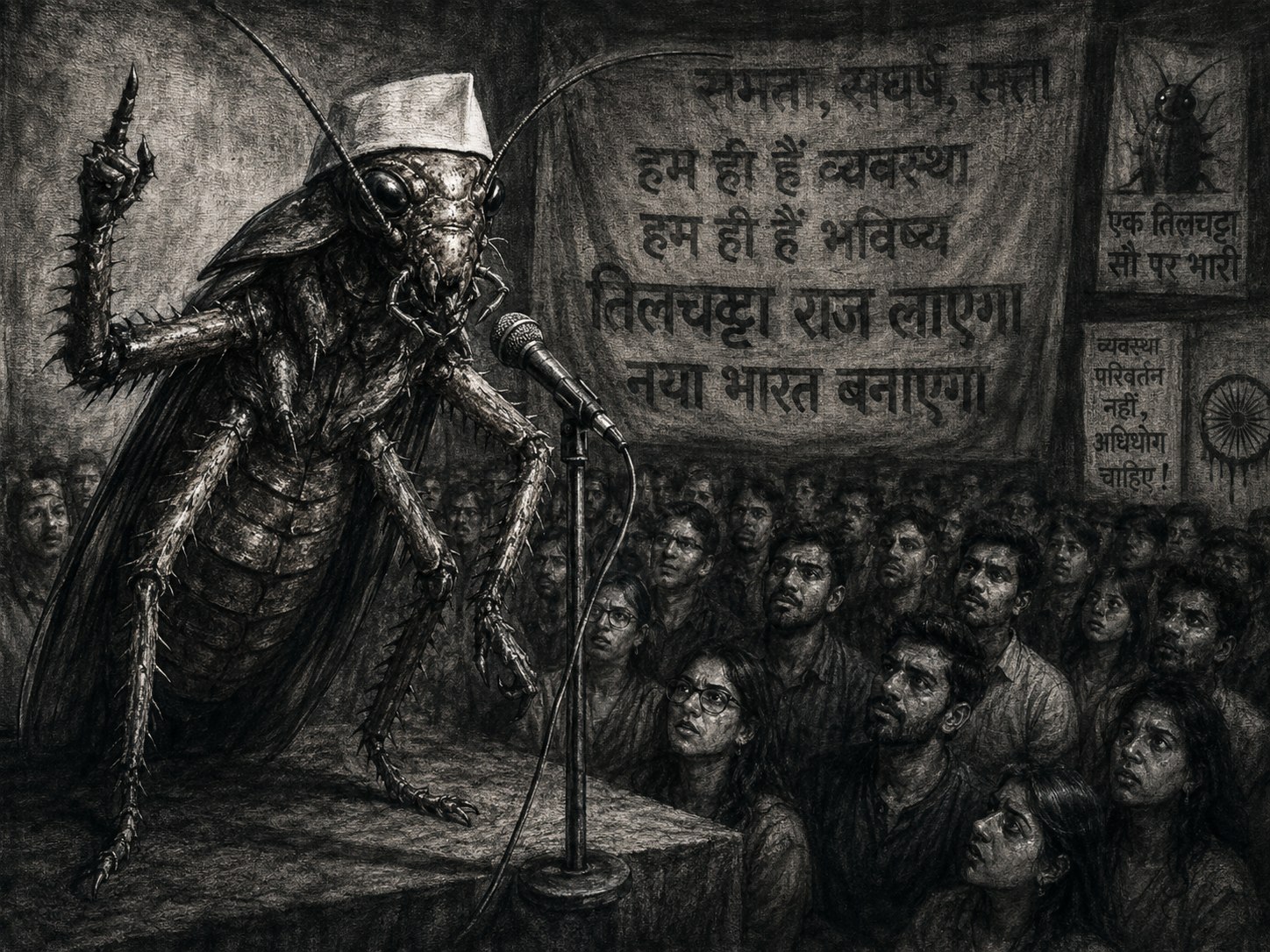
The Indian job market is not merely failing people; it is making them perform their own failure in public, preferably on LinkedIn, with a smiling photograph, a recycled quote about resilience, and a comment section full of strangers clapping like trained seals at a funeral.
I annoy people with posts and sketches. This is known. Some people feel I do not belong in the polite drawing room of professional optimism, where everyone wears a blazer in July and says “excited to announce” with the glazed serenity of a hostage. But I do belong here, unfortunately for them, because I am also one of the many creatures standing at the gate, watching the national machine chew through young people, old people, trained people, semi-trained people, overtrained people, and bewildered people, and then blaming the pulp for not having better formatting.
Why are there so many Indians on LinkedIn? Not philosophically. Not spiritually. Not because the nation has suddenly discovered the joys of professional community. They are there because many are looking for work, looking for better work, looking for any opening in the wall through which money may enter the room. The place has become a bazaar of desperation dressed as ambition. Everybody is networking. Everybody is “building in public.” Everybody is “open to opportunities.” Everybody is quietly trying not to panic.
If people are not getting jobs, several explanations present themselves, none of them pretty. Either there are more qualified people than available jobs, which is what happens when a country produces degrees the way a fever produces sweat. Or there are jobs, but the people certified as qualified are not actually useful to the industry. Or there are jobs, and there are useful people, but the jobs are imaginary, already reserved, quietly sold, politically allocated, internally filled, or posted merely to make a company look alive, like a corpse propped near a window to keep the landlord calm.
“Good enough” is the slippery phrase in this swamp. It sounds innocent, but it can mean anything from genuine technical readiness to the ability to survive a caste-coded, class-coded, accent-coded, English-coded, coaching-center-coded obstacle course designed by people who themselves could not cross it without a cheat sheet and a cousin in Human Resources. We have built an interview culture that often confuses knowledge with recital, intelligence with speed, competence with obedience, and employability with the ability to answer questions that have never once troubled a production system, a sick patient, a delayed shipment, a broken database, a flooded road, or a customer with an actual problem.
There is a special Indian genius for turning every gateway into an examination and every examination into a private industry. A child first learns to fear the test. Then the family reorganizes itself around the test. Then the coaching center arrives, like a priest with a photocopier. Then the child grows into a young adult who can solve abstract puzzles under fluorescent lights but cannot always explain what the machine does, why the system fails, who the user is, or why the problem matters. This is not the fault of the young. It is the fault of a society that has made selection more sacred than education.
The cruelty is that most people are not original thinkers, and were never required to be. We are all, to some extent, carriers of second-hand information. Civilization itself is a giant hand-me-down shirt, patched by a few geniuses, worn by billions, and sold in coaching batches with weekend discounts. The first people to think dangerously were not always rewarded. Many were mocked, silenced, exiled, jailed, burned, erased, or politely omitted from the annual function. Later, their ideas became syllabus material. Then some bored examiner converted them into multiple-choice questions. Then some poor boy in Durgapur or Noida or Salt Lake Sector Five was told his future depended on circling option C.
This would be comic if it were not also a slow social butchery.
I have spent enough of my life watching academic material be written, rewritten, digested, regurgitated, laminated, mispronounced, and flung at candidates by people who understand the jargon approximately as well as a parrot understands constitutional law. There are managers for whom technical vocabulary is no more meaningful than the Sanskrit verse mumbled at a wedding: solemn, ancient-sounding, and mostly there to certify that the ritual has happened. They do not know the thing. They know the password to the room where the thing is discussed.
This creates a national theater of expertise. The interviewer performs authority. The candidate performs preparation. The company performs meritocracy. The college performs relevance. The certification body performs rigor. The government performs development. Everyone performs. Then the lights go out, literally in some places, and the road outside still has a crater large enough to qualify as a minor geological event.
Of course, there may also be no real job. The modern ghost job is a cunning little beast. It sits on the careers page, smiling like a fresh samosa, suggesting growth, dynamism, expansion, digital momentum, and other perfume sprayed over corporate uncertainty. The post remains open for months. Candidates apply, refresh, pray, message recruiters, rewrite resumes, attend webinars, and slowly acquire the emotional texture of damp cardboard. The company gets traffic, optics, data, a pipeline, and perhaps a little search engine glitter. The applicant gets silence. Silence, in India, has long been an institution.
Then there is the older and more durable technology: nepotism. No artificial intelligence has yet improved upon the brother-in-law. The brother-in-law is an ancient, low-latency, high-throughput system for converting public opportunity into private comfort. He requires no cloud subscription. He scales across ministries, offices, contractors, colleges, clubs, committees, procurement chains, municipal boards, hospital administrations, and the small, sweaty rooms where things are decided before they are announced. India did not invent favoritism, but it has given it a rich tropical habitat.
Add to this the uglier corridors where jobs become bait. The promise of employment can become a trap for money, obedience, humiliation, or sex. It is not fashionable to say this too plainly because polite society prefers corruption in abstract nouns. But exploitation is not abstract to the person sitting across the table, needing a salary, a reference, a recommendation, a signature, an internship, or one merciful line in an email saying selected. A society with too few decent opportunities will always create predators. Scarcity is not only an economic condition. It is a feeding ground.
And yet it would be too easy to say that young people are simply unprepared. Many are. Many are not. Many are bright, anxious, poorly guided, over-certified, under-mentored, and drowning in bad advice from motivational vendors who sell confidence the way street stalls sell pirated chargers. The deeper problem is that India has never built enough serious bridges between education and work. We have built gates, exams, coaching funnels, placement brochures, rankings, slogans, and convocation speeches. Bridges, fewer.
A real bridge would mean apprenticeship. It would mean industry and colleges admitting that employability is not created by dumping theory into a skull and shaking vigorously before campus placement season. It would mean building laboratories that touch actual production systems, clinics, farms, factories, ports, banks, public works, logistics networks, and municipal problems. It would mean teaching communication without turning English into a class weapon. It would mean teaching science without making students memorize the smell of dead facts. It would mean ethics as engineering, not as a decorative pledge printed in blue ink.
But this would require seriousness, and seriousness is expensive. Spectacle is cheaper.
The country does not lack work. That is the most obscene part. Walk outside. Look around. India is not Switzerland with mild boredom and too many punctual trains. It is a vast, underbuilt, overstrained, overheating civilization full of things that need repair, redesign, measurement, sanitation, maintenance, planning, auditing, coding, mapping, nursing, teaching, wiring, cooling, documenting, cleaning, translating, integrating, and protecting from the next committee of fools. The roads need engineers. The clinics need systems. The schools need teachers who have not been crushed into clerks. The cities need planners who understand heat, drainage, density, and human movement. The courts need technology that does not move like a sleepy buffalo through molasses. The public sector needs records that can survive both monsoon and minister.
Even the great metro cities are not prepared for what is coming. Heat is no longer a summer inconvenience. It is an architectural fact, a public health fact, a labor fact, a productivity fact, and a moral fact. A city that cannot shade its walkers, cool its workers, drain its rainwater, protect its elderly, and keep electricity stable is not “developing.” It is gambling with bodies. India needs designers, builders, technicians, nurses, climate modelers, public health workers, water engineers, data people, electricians, urban ecologists, and administrators who can tell the difference between a dashboard and reality. Instead we produce waves of applicants trained to clear filters for jobs that may not exist.
Our great institutions are praised as if they were divine machinery, but too many of them function as export refineries for talent. The student enters with hope, parental debt, and a face still soft from adolescence. The system polishes, sorts, brands, and dispatches. If the best leave, we call them global Indians. If they stay and complain, we call them negative. If they fail, we call them unemployable. Convenient, this vocabulary. It absolves everyone above the young person.
India says it wants talent but often behaves as if talent is a nuisance unless it is obedient, connected, devotional, politically harmless, or already rich. We do not retain talent merely by shouting national slogans at airport departure gates. Talent stays where it can breathe, build, earn, question, fail safely, speak plainly, and not spend half its life negotiating with clerks, brokers, bigots, landlords, uncles, police stations, broken portals, and men who believe authority is measured by how long they can keep you waiting.
The national contradiction is almost comic in its symmetry. We are smart and foolish. Ambitious and lazy. Technically capable and administratively medieval. Capable of sending engineers into the most advanced systems in the world while failing to make a footpath that does not attempt murder after rain. We can produce brilliant mathematicians, surgeons, programmers, writers, and scientists, and then surround them with a culture that rewards flattery, lineage, conformity, and the ability to say “sir” with the correct amount of spinal collapse.
The arithmetic of capitalism is not mystical. When enough people can earn, buy, build, sell, repair, insure, transport, compute, educate, and trust one another, a country begins to come out of darkness. Not through speeches. Not through hashtags. Not through the theatrical waving of flags by men whose own children will never stand in the queues they glorify. Prosperity is a network effect. It grows when small businesses can survive, when contracts mean something, when women can work safely, when minorities are not terrorized for sport, when cities function, when courts move, when banks lend sensibly, when schools teach reality, when public data is reliable, and when corruption is treated not as culture but as sabotage.
If instead we spend our energy on caste vanity, religious chest-thumping, minority-baiting, misogyny, historical revenge fantasies, and the intimate worship of a few billionaires, then the country does not rise. It merely decorates its cage.
The nationalism of flags is easy. It asks almost nothing. Stand up, chant, forward, accuse, boycott, threaten, suspect, obey. The nationalism of institutions is harder. It asks whether the bridge is safe, whether the hospital has oxygen, whether the school teaches science, whether the police protect the weak, whether the data is honest, whether the river is poisoned, whether the job exists, whether the exam measures anything, whether the minister’s nephew is mysteriously qualified again. One form of nationalism is theater. The other is maintenance. We adore the theater because maintenance has no drumbeat.
India is constitutionally secular, which is good, but paper does not educate people by osmosis. A secular republic populated by frightened, misinformed, superstitious, economically cornered citizens can still become a carnival of medieval impulses with broadband. Rational society does not arrive because a founding document said nice things. It has to be built in classrooms, courtrooms, newsrooms, laboratories, families, municipal offices, films, textbooks, and everyday speech. Science has to be made intelligible without being made stupid. Doubt has to be made honorable. Evidence has to become more attractive than rumor. This is slow work. Therefore it is unpopular.
Religion is not going to save the unemployed. Nor will astrology, miracle oils, political chanting, motivational reels, imported productivity systems, or that special Indian family advice in which a man who has not updated his own skills since 1998 tells a young person to “just work hard.” Work hard at what? For whom? Under what conditions? At what wage? With what protection? In which industry? With what future? The phrase “work hard” has become a broom with which society sweeps structural failure under the carpet.
The young are being asked to perform optimism inside a burning house. First we leave them an overheated planet. Then we give them underfunded schools, overpriced degrees, fake meritocracy, poisoned public debate, shrinking decent employment, algorithmic humiliation, and a rental market run by people who seem to regard unmarried tenants as escaped livestock. Then we tell them to smile more on LinkedIn.
No wonder the content is strange. No wonder the platform is full of exaggerated gratitude, synthetic humility, borrowed wisdom, and declarations of personal transformation after attending a webinar that probably should have been a pamphlet. People are not merely posting. They are signaling employability to invisible judges. They are performing sanity for the market. They are trying to look energetic while privately calculating how long they can keep going.
An older man looking at this spectacle is not necessarily wiser. Age can merely mean one has had more time to become disappointed in a wider variety of fonts. But it does give a certain sour clarity. I do not envy the young. I do not envy their choices, their climate, their job market, their attention economy, their family pressures, their surveillance, their debt, their forced cheerfulness, or their need to convert every hobby into a portfolio item. They have inherited not a world but a set of invoices.
Still, despair is not an operating model. Rage can diagnose, but it cannot build drainage. Satire can puncture nonsense, but it cannot hire nurses, train welders, protect women, reform hiring, redesign cities, or make interviewers literate. The practical answer is dull because most real answers are dull. Build better bridges between education and work. Publish real hiring numbers. Punish fake recruitment and bribery. Make apprenticeships respectable. Protect whistleblowers. Teach science as a method, not a slogan. Treat public infrastructure as employment, climate defense, and civilization insurance. Make small enterprise easier than political brokerage. Reduce the worship of degrees and increase the measurement of demonstrable skill. Stop confusing English polish with intelligence. Stop confusing obedience with character.
And above all, stop telling the young that their private failure explains a public malfunction.
A job market is a national X-ray. It shows the bones beneath the slogans. If the image is ugly, do not blame the film. Blame the fractures, the old injuries, the untreated infections, the heroic speeches delivered over a skeleton that still cannot stand straight. India has talent. India has need. India has work everywhere. What it does not yet have, in sufficient quantity, is the honesty to connect the three without first feeding them through the sacred grinder of status, corruption, superstition, and cheap spectacle.
So yes, people are on LinkedIn looking for work. They are also looking for proof that the country has not quietly decided to abandon them while asking them to clap for its greatness. They are looking for a door that is not painted on a wall. They are looking for a future that does not require a godfather, a coaching loan, a fake smile, a family connection, or the emotional digestion of daily insult.
That is not entitlement.
That is the minimum claim of a citizen who has not yet agreed to become debris.
Related Posts
Word Cloud
Related reading
Selected by shared topics and section, with closer publication dates breaking ties.