Mind Is What the Brain Does, Not a Ghost in the Attic
Uses the speech voice supplied by your browser or device.

Acronyms expanded in this post:
- AI: Artificial Intelligence. software that generates, classifies, predicts, summarizes, or acts on patterns in data.
The mind is not a mist floating above the brain; it is the brain in action, the way flame is not hidden inside a match but appears when chemistry, oxygen, temperature, and structure fall into the right quarrelsome arrangement.
That sentence is simple enough to sound settled, but it took humanity a very long time to get there, and we are still not entirely comfortable with it. Ordinary speech continues to treat the mind as a small sovereign tenant living somewhere behind the eyes. We “use” the brain. We “control” the body. We “listen to the heart.” We “manifest” desires into the universe as if reality were a hotel concierge with a mild interest in stationery. The old ghost has not died. It has merely learned wellness vocabulary.
The current scientific picture is not that the mind is unreal. Quite the opposite. Pain, memory, attention, grief, hunger, shame, intention, imagination, and selfhood are real events. But they are not real in the way a marble is real. They are real in the way a storm is real. No single raindrop contains the storm. No one gust of wind is the storm. Yet the storm can flatten a roof, close an airport, and make a fisherman reconsider metaphysics. The mind is like that: an organized, dynamic pattern arising from nervous tissue, bodily regulation, sensory input, memory, prediction, language, culture, and action.
The older story begins almost everywhere with separation. Ancient traditions often divided the human being into body and soul, flesh and spirit, appetite and reason. This was not stupidity. It was a reasonable inference from ordinary experience. The body can be cut, burned, drugged, exhausted, and buried. Thought seems lighter, stranger, less located. Dreams arrive without permission. A dead body looks like a person recently vacated. A memory of one’s mother can return with more force than the chair one is sitting on. Before microscopes, electrophysiology, neuroimaging, anesthesia, lesion studies, and computational neuroscience, the idea that an invisible principle animated the body was not a silly superstition. It was an explanatory bridge built from the materials available.
The Greeks placed the argument on a more durable table. Plato gave the soul a kind of higher citizenship, treating the body as a troublesome province. Aristotle, more biological and less cloudy, tied mental life more closely to the living organism, though not in our modern neural sense. Later religious traditions deepened the moral and cosmic stakes. The soul became not only the explanation for life and thought but the bearer of identity, guilt, salvation, and immortality. At that point, the mind-body problem stopped being merely scientific. It became emotionally loaded architecture. You were no longer asking how memory works. You were asking what survives the funeral.
Then came René Descartes in the seventeenth century, often blamed for dividing mind and body as if he had personally installed the partition wall. His view was subtler than the cartoon, but the cartoon mattered. The body was machinery. The mind was thinking substance. Animals could be treated as biological automata; humans had an immaterial rational soul. This gave early science permission to study the body mechanically while leaving the mind in a protected metaphysical upstairs room. It was a clever political compromise with theology, and like many clever compromises, it became a long-term maintenance problem.
The nineteenth century began dismantling the upstairs room. Neurology showed that damage to particular brain regions could alter speech, movement, memory, mood, personality, and perception. Paul Broca’s work on speech production and later observations about language comprehension made it harder to pretend that thought lived nowhere in particular. Phineas Gage, the famous railway worker whose frontal lobe injury was followed by reported personality change, became a crude but memorable emblem: alter the brain, and the person changes. The lesson was not that one brain part contains one moral faculty like a pigeonhole full of virtue. The real lesson was more unsettling. The self is biologically vulnerable.
By the twentieth century, the brain had become less a lump of mysterious jelly and more a signaling organ. Neurons [nerve cells that transmit information through electrical and chemical signals] communicate through action potentials [brief electrical impulses moving along a neuron] and synapses [junctions where neurons influence other neurons]. Neurotransmitters [chemical messengers such as dopamine, serotonin, glutamate, and gamma-aminobutyric acid] modulate mood, attention, movement, reward, inhibition, and learning. The mind was no longer being explained by a single hidden pilot. It was being traced through circuits, feedback loops, development, plasticity, hormones, immune signaling, sleep, metabolism, and the body’s constant negotiations with the world.
This is where emergence becomes essential. Emergence does not mean magic wearing a respectable hat. It means that a system displays properties that cannot be understood by staring at one component in isolation. Wetness is not found inside a single hydrogen atom. Traffic jams are not caused by one molecule of Toyota. Inflation is not hiding inside a rupee coin like a tiny economist. Likewise, consciousness is not expected to reside inside a single neuron. A neuron is necessary, but not enough. Mental life appears from patterns of coordinated activity across networks that perceive, compare, remember, predict, evaluate, inhibit, and act.
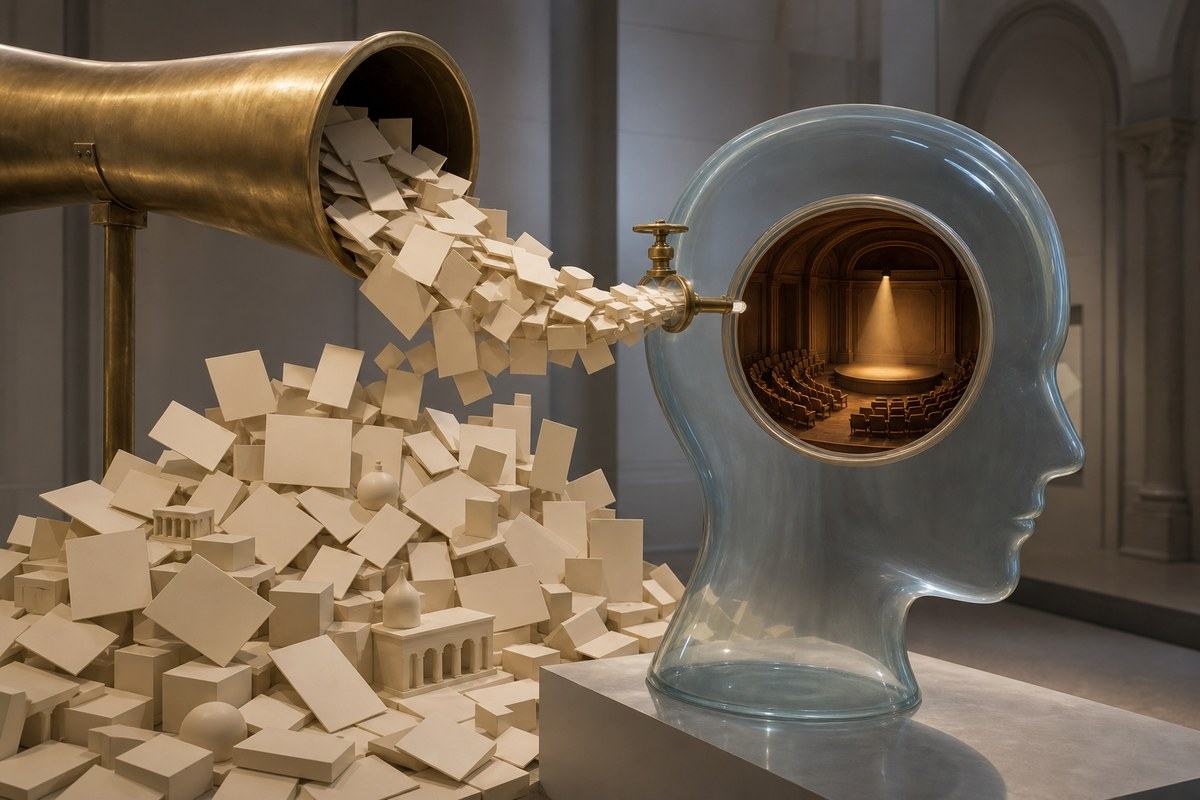
The non-obvious point is that the brain is not merely producing inner movies. It is regulating a living body in a changing world. Much of what we call mind is controlled hallucination disciplined by sensation and corrected by action. The brain predicts what is likely to be out there, checks the prediction against incoming signals, updates the model, and prepares the organism to do something. Seeing is not passive photography. Memory is not a file cabinet. Emotion is not decorative weather added after thought. Emotion helps assign value, urgency, bodily meaning, and action-readiness to perception. A mind is not a spectator in a skull-sized theater. It is more like an operations center inside a storm-damaged city, constantly guessing, repairing, routing, rationing, and occasionally issuing confident nonsense.
This is why brain injury, drugs, anesthesia, sleep, dementia, epilepsy, trauma, fever, meditation, sensory deprivation, and psychiatric illness matter so much scientifically. They reveal dependence. Change the chemistry, and mood may change. Change the temporal lobe, and memory may fracture. Disrupt parietal integration, and body ownership may wobble. Alter dopaminergic signaling, and salience can become pathological, making neutral events feel loaded with cosmic significance. Give anesthesia, and the ordinary unity of consciousness dissolves. These are not small dents in a spiritual vehicle. They are interventions in the machinery of experience itself.
Still, one must be careful. Saying the mind emerges from the brain does not mean every mental event can already be explained neatly from neurons upward. That is the cheap version of physicalism [the view that reality, including mental life, depends on or is constituted by the physical world]. We know a great deal, but not enough to swagger. Neuroscience can correlate conscious states with brain activity, identify necessary circuits, model perception and decision-making, and show how damage changes function. But the full bridge from cellular activity to first-person experience remains incomplete. The hard problem of consciousness, the question of why subjective experience feels like something from the inside, has not been dissolved by slogans. Anyone who says otherwise is probably selling either a book, a supplement, or enlightenment in twelve modules.
The better position is disciplined naturalism. Mental life depends on the brain and body. It is shaped by development and culture. It is implemented through biological processes. It can be studied scientifically. But our explanatory tools still operate at multiple levels: molecular, cellular, circuit, cognitive, behavioral, social, and linguistic. A panic attack is not “just chemistry,” though chemistry is involved. A poem is not “just neurons,” though no neurons means no poem. Depression is not “just low serotonin,” a phrase that has done more harm than a drunk librarian with a labeling machine. The mind is biological, but biology is not simple.
Much of the woo survives because people confuse mystery with permission. Consciousness is mysterious; therefore, crystals. Placebo effects are real; therefore, the universe responds to intention. Meditation alters brain states; therefore, ancient sages knew quantum field theory. Trauma affects the body; therefore, every disease is a message from the soul. These leaps are not explanations. They are intellectual bungee jumps with the cord quietly omitted.
The persistence of woo also has a moral cause. People do not only want mechanisms. They want dignity, agency, consolation, and a story in which suffering is not merely malfunction. A strictly mechanical description can feel cold, especially when delivered by the sort of person who says “neural substrate” while standing too close to the coffee machine. But the choice between superstition and reductionist bleakness is false. A brain-based understanding of mind does not degrade human life. It makes it more astonishing. The fact that love depends on neural circuitry does not cheapen love. Music depends on vibrating air, and nobody sane thinks Beethoven is therefore “just pressure waves.”
The historical mistake was to assume that matter is dull and spirit is interesting. Modern science has made that distinction look almost comically unfair to matter. Matter, organized in the right way, becomes bacteria, forests, immune systems, octopuses, language, grief, mathematics, cricket commentary, and the private ache of remembering a childhood room. The brain is not a lump that somehow imprisons the mind. It is the most complicated known arrangement of matter in the universe, and it spends its life making models of everything, including itself, which is rather like a map trying to draw the cartographer while the cartographer is sneezing.
The design lesson, if one may borrow a word from engineering, is that the mind should be understood as layered process rather than hidden object. At the bottom are metabolic and cellular constraints. Above them are circuits and networks. Above them are perception, memory, affect, language, and decision. Above them are social roles, institutions, stories, rituals, technologies, and incentives. Each layer constrains the others. A hungry person thinks differently. A sleep-deprived physician reasons differently. A child raised in fear predicts the world differently. A society saturated with superstition gives people poor interpretive tools for their own mental events. There is no single master switch called “mind.” There is an organism trying to remain viable while carrying a biography.
This also explains why common language remains dualist. It is useful. We say “my brain is tired” as if the speaker and brain were separate because grammar likes clean little actors. We say “I fought my anxiety” because it captures the lived experience of conflict, even if the conflict is occurring within distributed regulatory systems. Everyday speech is not a neuroscience paper. It is a survival tool. The problem begins when metaphor is mistaken for ontology, when “inner child,” “energy,” “vibration,” “manifestation,” or “soul purpose” stops being poetic shorthand and becomes a counterfeit explanation.
A mature view of the mind can preserve subjectivity without mystification. First-person experience is data, but not infallible data. Brain scans are data, but not complete data. Behavior is data, but not transparent data. Language is data, but often embroidered, censored, and post-rationalized. The scientific problem is to connect these levels without pretending one level abolishes all the others. The philosophical problem is to understand how subjective experience belongs to nature. The cultural problem is to stop handing unsolved questions to charlatans merely because they speak warmly and use candles.
So yes, the mind is best understood as an emergent activity of the brain-body system, not as an immortal bead rattling inside the skull. But emergence is not dismissal. It is not “nothing but neurons.” It is the recognition that organized matter can produce realities that are higher-level, causally powerful, and still entirely natural. A thought can move a hand. A belief can alter stress hormones. A memory can ruin sleep. A sentence can change a life. None of this requires a ghost. The machinery is strange enough.
The old dualism gave us a soul trapped in a body. The worst modern reductionism gives us a brain pretending to be a person. The better account gives us something more difficult and more beautiful: a living system whose matter has learned to model the world, suffer its own models, revise them, defend them, sing through them, and occasionally mistake them for messages from the cosmos. That is not woo. That is biology becoming autobiography.
Related Posts
Word Cloud
Related reading
Selected by shared topics and section, with closer publication dates breaking ties.