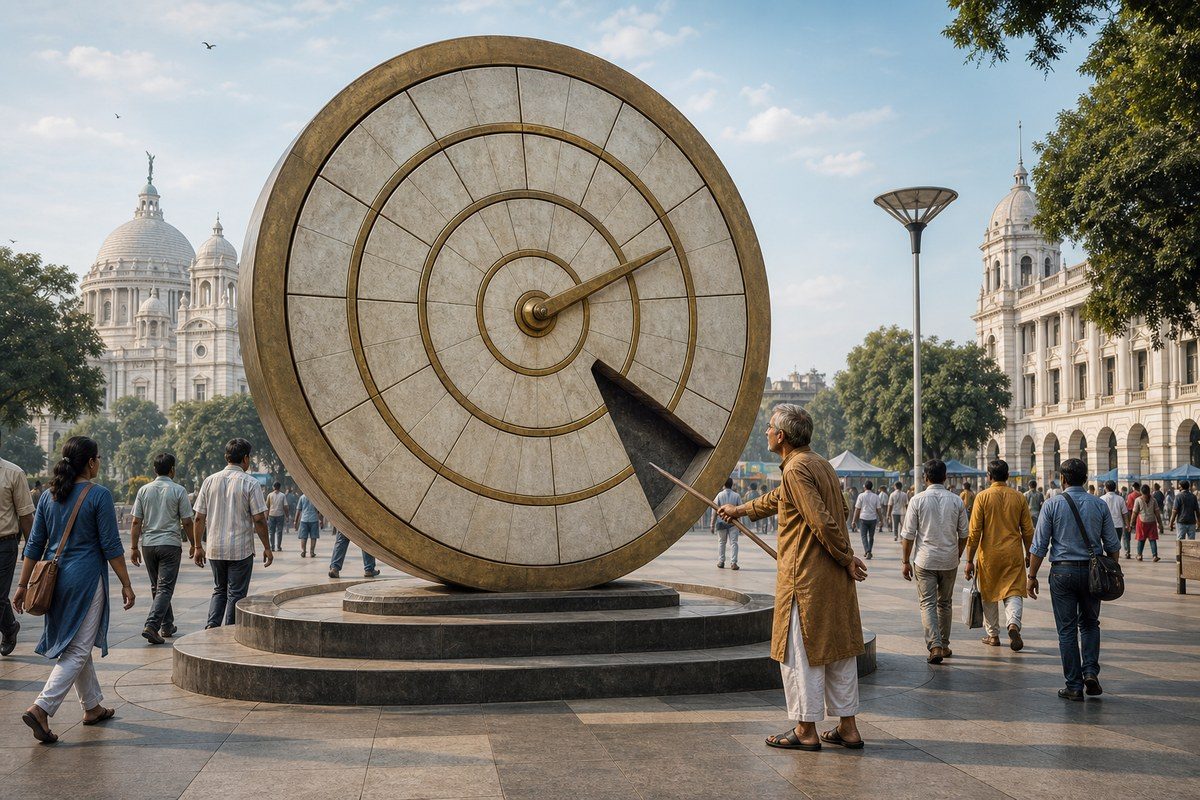
Pohela Baisakh
Uses the speech voice supplied by your browser or device.

Acronyms expanded in this post:
- AI: Artificial Intelligence. software that generates, classifies, predicts, summarizes, or acts on patterns in data.
Pohela Baisakh is not just a harvest festival, not just a cultural new year, and certainly not some untouched civilizational relic descending from the sky wrapped in conch shells and alpana. It is a calendar event. Calendars are instruments of power before they become sentiment. They decide when rent is due, when revenue is assessed, when crops are counted, when ledgers are closed, when courts record dates, when a state tells ordinary people what year it is. That is the first thing to recover here.
The Bengali calendar has older roots than the Mughals. That part should be said plainly because history is not improved by trading one simplification for another. There are strong claims tying the Bengali era to earlier regional and Sanskritic time-reckoning traditions, including the era associated with Shashanka in the early seventh century. Month names such as Boishakh, Joishtho, and Asharh are not Mughal imports. The deeper astronomical substrate is older still, part of the subcontinent’s long solar-lunar calendrical tradition.
But that is not the end of the matter. It is the beginning of the real one.
What Pohela Baisakh became in Bengal, and why it became administratively meaningful, runs straight through the Mughal state. Under the Mughal Empire, especially under Akbar, the problem was brutally practical. The Islamic Hijri calendar is lunar. Agriculture is not. A lunar year slips against the harvest. Taxing peasants in a grain economy by a calendar detached from sowing and reaping is a good way to create chaos, resentment, and bad revenue. Akbar’s solution was not theological. It was bureaucratic. The imperial administration introduced a reformed system, associated with the Tarikh-i Ilahi and the Fasli cycle, to align assessment with the solar agricultural year. In Bengal, that reform took local shape as Bangla san or Bangabda in lived administrative practice.
That is the missing hinge.
So when people speak as though Pohela Baisakh is merely some eternal and unbroken expression of “native essence,” they are flattening the most interesting part. The calendar Bengalis inhabit is layered. Its era may preserve older foundations. Its operative public year, however, was sharpened by a Mughal Muslim state trying to solve a revenue problem in an agrarian province. In other words, one of the central annual rituals of Bengali identity carries the fingerprints of imperial Muslim fiscal rationality. History has a wicked sense of irony.
This is why the phrase “zero day” needs care. If by zero day one means the deep epoch or original starting year of the Bengali era, the story is contested and likely older than Akbar. If by zero day one means the effective resetting of the social and fiscal year into a usable annual opening that ordinary cultivators, merchants, zamindars, and record-keepers could act on, then yes, the Mughal intervention is decisive. It turned a chronology into an operating system. That distinction matters. Without it, the argument becomes clumsy. With it, it becomes true.
The connection to the Gregorian calendar is equally revealing. Pohela Baisakh now falls in mid-April, typically 14 April in Bangladesh and 14 or 15 April in India depending on the variant and leap-year behavior. That is not an accident of folklore. It is the consequence of a solar-year structure being mapped into a modern civil world dominated by the Gregorian calendar. Bangladesh, especially after twentieth-century reforms, standardized the Bangla calendar further so that the first day of Boishakh lands predictably on 14 April. That is not a betrayal of tradition. It is tradition being regularized for print culture, schools, government, newspapers, public holidays, and national life.
Which is to say: the Bengali new year now sits at the junction of at least three clocks. An older Indic astronomical inheritance. A Mughal fiscal-administrative redesign. A modern civil alignment with the Gregorian regime that governs global commerce, bureaucracy, and state paperwork. Anyone who tells you it is purely one of these is either selling romance or laundering ideology.
And that laundering has become a national habit.
In contemporary India, especially under the long shadow of textbook revisionism and cultural majoritarianism, the Mughal layer is often treated as contamination rather than history. Contributions made under Muslim rule are either reduced to architecture, demonology, or a set of names to be endured before the “real” India resumes. That is nonsense, but it is politically useful nonsense. It allows a civilization to continue using institutions, languages, cuisines, urban forms, legal habits, artistic vocabularies, and calendrical inheritances shaped by centuries of Indo-Muslim presence while pretending those centuries were only interruption.
Pohela Baisakh is awkward for that project because it refuses to cooperate.
You can chant about civilizational purity all morning, but the ledgers do not care. The old haal khata custom, the ceremonial opening of new account books at the new year, is precisely the sort of residue one expects from a calendar that was tied to revenue cycles, trade rhythms, and agrarian accounting. This was never only about poetry and mango leaves. It was about when the books start over. A people remembers its fiscal history long after it forgets its administrative theory.
That forgetting is not innocent either. A great deal of modern public memory works by aestheticizing what it no longer wishes to explain. So Pohela Baisakh is permitted as color, costume, sweets, songs, red-white clothing, perhaps a little folk charm, perhaps a little sanitized “Bengali culture,” but not as evidence that Bengal’s everyday temporality was materially shaped by Mughal governance. Once you say that aloud, the festival stops being merely decorative. It becomes archival. It starts testifying.
And the testimony is inconvenient.
It says that Muslim rule in South Asia was not some foreign weather event passing over an otherwise sealed civilization. It was constitutive. It altered land systems, court languages, administrative categories, taxation, architecture, food, urbanism, music, and yes, calendars. Not everything it altered was benevolent. Empires are not charitable institutions. But historical causation is not a moral endorsement. To admit that the Bengali new year as publicly lived bears a Mughal imprint is not to romanticize empire. It is simply to stop lying.
The uglier truth is that syllabus politics prefers origins that can be weaponized. Ancient is useful. Medieval Muslim is awkward. Hybrid is intolerable. Yet hybrid is what Bengal is. Hybrid in language. Hybrid in food. Hybrid in devotional practice. Hybrid in music. Hybrid in names. Hybrid in timekeeping. Bengal did not become less Bengali because Mughal administration reshaped one of its calendars. Bengal became more historically itself in precisely that entangled condition.
This is what current nationalist pedagogy cannot digest. It wants neat ownership. It wants Hindu here, Muslim there, authentic here, intrusive there, as though five hundred years of shared material life can be chopped into museum labels. But calendars are stubborn things. They survive polemic because people need them to eat, trade, marry, sow, settle, celebrate, and remember. A calendar does not need your ideological permission. It only needs repeated use. That is how power becomes culture.
So Pohela Baisakh should be understood neither as a pure Mughal invention nor as a purely pre-Islamic inheritance floating above history. It is better, and truer, than both caricatures. The underlying era likely reaches back before Akbar. The socially decisive annual reset that made the Bengali year administratively legible in agrarian Bengal bears the mark of Akbar’s reforms. The modern fixed-date public celebration then passed through later standardizations shaped by the Gregorian world. In one festival, you can watch Bengal carrying ancient astronomy, Mughal bureaucracy, colonial-modern print discipline, and contemporary identity politics all at once.
That is why the forgetting matters.
Because when a society is taught to treat the Mughal past as removable dirt, it loses the ability to read its own institutions. It continues to inhabit structures whose genealogy it has been trained not to name. It celebrates a new year while being subtly encouraged to forget who helped make that year countable in the form it came down to us. That is not historical correction. That is historical self-amputation with festive lighting.
Pohela Baisakh deserves better than incense and amnesia. It deserves to be read as what it is: a living Bengali observance whose heartbeat is agricultural, whose public rhythm was systematized by Mughal Muslim statecraft, and whose modern regularity now stands partly synchronized with the Gregorian order. To say that aloud is not to diminish Bengal. It is to restore scale to it. Real civilizations do not remain pure. They accumulate.
Related Posts
Word Cloud
Related reading
Selected by shared topics and section, with closer publication dates breaking ties.