The Middle Class on Tilted Stones
Uses the speech voice supplied by your browser or device.

Acronyms expanded in this post:
- AI: Artificial Intelligence. software that generates, classifies, predicts, summarizes, or acts on patterns in data.
- IT: Information Technology. the practice of building, operating, and supporting computing systems.
The Indian middle-aged middle class is not standing on a floor. It is balancing on a pile of stones arranged by salary, debt, family obligation, medical risk, school fees, housing aspiration, aging parents, and the increasingly expensive fiction that respectability is a renewable resource.
From a distance it looks solid enough. A flat with a lift. A scooter or car. A refrigerator with magnets. A child in English-medium school. Health insurance whose brochure smiles more confidently than the policy. A salary message arriving on the phone like a small monthly monsoon. Some mutual funds. Perhaps a home loan, a personal loan, a credit card, a provident fund account, and a wardrobe containing the ceremonial clothes of upward mobility. The smell of talcum powder, petrol, damp laundry, and pressure-cooker steam. The middle-class household, that heroic little republic of spreadsheets and stainless steel.
But the deeper truth is less comforting. This class is often not wealthy. It is cash-flow synchronized. Its apparent security depends on things arriving in the correct order. Salary before Equated Monthly Installment (EMI [the fixed monthly payment on a loan]). Bonus before school admission fee. Medical reimbursement before the next test. Rent before landlord patience expires. A job switch before professional obsolescence becomes visible. The stones are not merely uneven. They are moving.
The great mistake is to describe this as individual failure. A man loses work in middle age and is told to network harder. A woman returns to the job market after caring for children or parents and is told to upskill, as if the lost years were mislaid socks. A family falls behind because of one hospitalization and is lectured about financial literacy. These scoldings have the moral grandeur of blaming a passenger for the weather. Of course individual choices matter. They always do. But the middle-aged Indian middle class is exposed to structural fragility that cannot be repaired by inspirational posters, another certification, or a weekend webinar on personal branding.
The first instability is employment, not unemployment in the simple newspaper sense. The problem is not only whether one has work. It is what kind of work, with what predictability, what benefits, what bargaining power, what renewal risk, and what shelf life. Periodic Labour Force Survey (PLFS [India’s official employment survey]) categories can tell us who is working, seeking work, or outside the labor force, but the middle-class terror often sits in the unlit corridor between categories. A person may be employed but disposable. Contracted but respectable. Paid but uninsured. Skilled but mismatched. Experienced but too costly. Educated but not credentialed in the newest dialect of usefulness. Middle age is when the résumé becomes less like a passport and more like an old ration card, full of stamps from a country whose borders have shifted.
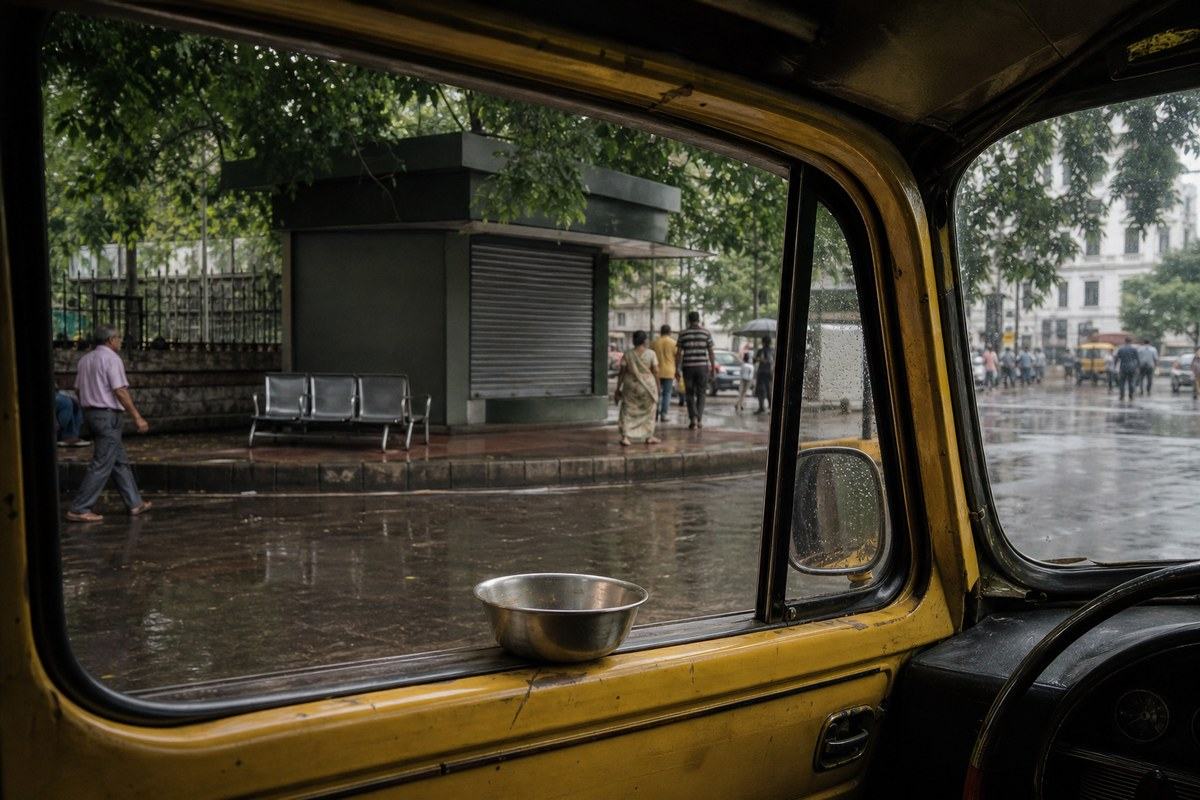
India’s middle-class employment story has always had a peculiar bargain at its heart. The old promise was that education would convert uncertainty into station. A degree would harden into a job; a job would harden into seniority; seniority would harden into pension, property, and social authority. It was never universally true, but it was plausible enough to organize a life around. Families sold land, pawned jewelry, tolerated awful commutes, and swallowed humiliation for it. In Calcutta, one could see this bargain in the morning procession: clerks, teachers, bank staff, salesmen, engineers, junior doctors, insurance agents, and government hopefuls moving through tramlines, bus smoke, tea stalls, and bookshops like pilgrims of the monthly salary.
Now the bargain has become more conditional. Education still matters, but it no longer guarantees a stable landing. Experience still matters, but sometimes it counts as baggage. English still matters, but fluent English without market-fitting expertise can feel like a polished key to a vanished door. Technology changes the surface of work quickly; institutions change the security of work slowly; families continue to demand stability as if the old economy were still sitting in the next room reading The Statesman.
The second stone is housing. For much of the urban middle class, housing is not simply shelter. It is biography in concrete. It says: we arrived, we endured, we are not floating anymore. But housing purchased with debt converts aspiration into a long-duration obligation. The apartment becomes both roof and creditor. The home loan regularizes anxiety. It turns time into collateral. The household must not merely earn; it must earn on schedule. A missed month is not only arithmetic. It is shame, phone calls, penalties, and the faint metallic taste of downward mobility.
This is the quiet violence of the EMI. It makes the future report to the present. The middle-aged borrower is paying not only for a house but for the continued assumption that tomorrow’s income will resemble yesterday’s. That assumption is increasingly brave. A younger worker may move, reskill, compress expenses, accept volatility, or experiment with new work. The middle-aged worker often cannot. He or she is attached to school districts, elder care, medical routines, apartment committees, family reputation, and the monthly tyranny of fixed costs. Mobility becomes expensive exactly when adaptability is demanded most.
The third stone is healthcare. Out-of-pocket (OOP [paid directly by households rather than pooled through insurance or public funding]) medical expense remains one of the classic middle-class trapdoors. The poor may face under-treatment and ruin; the rich buy options; the middle class buys hope in installments. It has enough income to enter private care but not enough wealth to absorb prolonged illness. A diagnostic cascade can make the family wallet sound like a tin trunk kicked down a staircase. One scan leads to another. A specialist recommends a procedure. The pharmacy bill becomes a second rent. Insurance excludes, delays, limits, disputes, or reimburses after the household has already borrowed from relatives, friends, credit cards, or the small emergency fund kept aside for a child’s tuition.
The cruelty here is representational. On paper, a family may appear middle class because it has assets, education, and consumption. In crisis, what matters is liquidity. Can money be mobilized without destroying the household’s future? A flat is not a hospital deposit unless it can be sold, mortgaged, or pledged quickly without social and logistical collapse. Jewelry helps only so much. Retirement savings are psychologically guarded because they are the last bridge to old age. The family may look prosperous and yet be frighteningly illiquid. It is not poor in a census sense. It is fragile in a timing sense.
This is also why middle-class distress is so often misread. The signs do not always resemble destitution. They resemble deferred dental treatment, postponed tests, unpaid credit card balances, cheaper coaching classes, silent marital resentment, old parents moved between siblings like sacred luggage, and a child being told that a dream course is impractical. Precarity often arrives not as dramatic collapse but as narrowing. The lane gets thinner. Choices become fewer. The household still eats, still pays, still smiles at weddings. But the air has changed.
The fourth stone is education, which in India functions partly as learning, partly as insurance, partly as caste-neutral prestige, partly as migration strategy, partly as parental penance. Middle-aged parents know that the labor market is harsher than the brochure, so they try to buy their children a safer boat. English-medium schooling, coaching, devices, college applications, test preparation, hostels, transport, and the little invisible expenses of being “competitive” together create a second mortgage, even when no bank is involved. The child becomes the family’s most beloved startup: high burn rate, uncertain valuation, emotionally impossible to shut down.
This produces a strange intergenerational compression. Middle-aged people support children longer while parents live longer and require more medical and domestic care. The household becomes a bridge with traffic moving from both ends. There is duty behind it, and often love, but love does not reduce the bill. The Indian family is celebrated as a welfare institution, and in many ways it is one. It absorbs shocks the state and market do not. But the family is not a magic reservoir. It is a set of people with salaries, illnesses, grudges, memories, and limits. When the family becomes the default insurance system, daughters, daughters-in-law, unmarried siblings, and the most reliable earner become the hidden infrastructure. They are not called infrastructure, because infrastructure is a word used for roads, ports, and fiber-optic cable, not exhausted humans.
The fifth stone is status performance. This sounds frivolous until one sees how much social life extracts from people. Weddings, festivals, funerals, school events, apartment contributions, gifts, clothes, travel to ancestral homes, and the duty to appear unbroken all keep the machine humming. Respectability in India is not a private condition. It is audited by relatives, neighbors, classmates, colleagues, and WhatsApp groups. The middle-aged middle class must not merely survive. It must maintain a face. The face has school fees behind it, bank messages under it, and acid reflux beneath that.
Digital credit has made this performance smoother and more dangerous. Credit no longer arrives dressed as a stern bank manager. It arrives as a cheerful button. Buy now. Pay later. Convert to EMI. Pre-approved. Instant. Paperless. The old moneylender sat at the bazaar and looked like trouble. The new one lives inside the phone and looks like convenience. This does not mean credit is bad. Credit can be productive, humane, even liberating. But when credit becomes the padding between stagnant confidence and rising obligation, it turns the middle-class household into a small private treasury department run from a dining table.
The non-obvious point is that middle-class precarity is not the absence of assets. It is the mismatch between rigid obligations and uncertain income under conditions of social compulsion. A family can possess a home, degrees, appliances, insurance, and bank accounts, and still be one bad sequence away from fracture. The dangerous object is not poverty alone; it is brittleness. A clay cup may sit proudly on the shelf for years and still shatter from one badly angled knock.
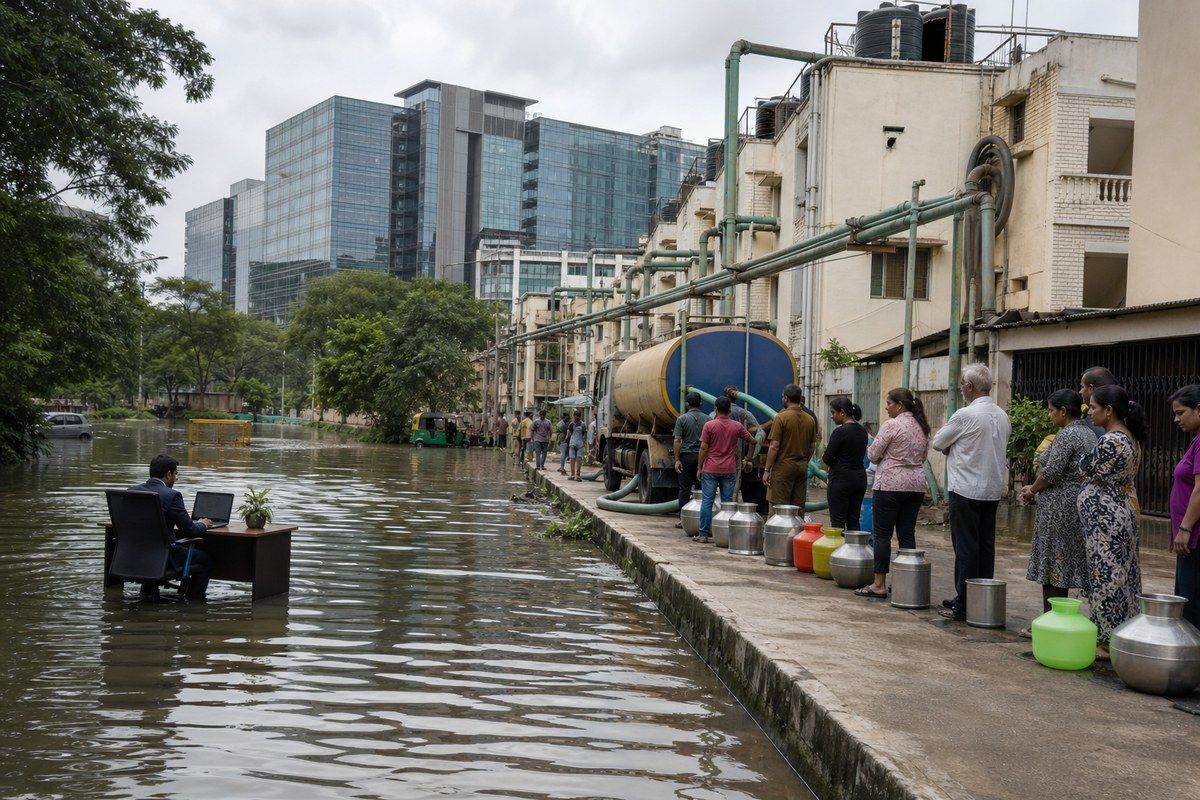
This is why the lopsided-rock image is so exact. Each rock by itself can be defended. Education is good. Housing is good. Healthcare access is good. Caring for parents is good. Borrowing for productive life goals can be sensible. Social dignity matters. But stack them vertically on a narrow base, remove stable employment, add medical uncertainty, season with age discrimination, stir in inflation, and place the whole arrangement in a society where failure is privatized and success is moralized. The result is not a ladder. It is a balancing act.
Age makes the act worse. Middle age is not simply a number. It is a location in the life-cycle where reversibility declines. A young person can sleep on a friend’s floor and call it hustle. A middle-aged person doing the same is viewed as a cautionary tale. A young person can change careers and be praised for courage. A middle-aged person trying the same is asked whether something went wrong. The body changes, too. Blood pressure, diabetes, back pain, dental work, eye tests, and the slow mutiny of joints begin to issue memoranda. The labor market, meanwhile, speaks in the language of energy, flexibility, and cultural fit, which too often means youth with fewer obligations and cheaper expectations.
There is an Indian cruelty in calling such people “settled.” Settled where? On what foundation? Many are settled the way dust is settled on a shelf: temporarily, until the next disturbance. The word flatters society more than it describes the person. It allows everyone to pretend that the middle-aged middle class has crossed the dangerous river, when many are merely standing on a slippery stone halfway across, holding an umbrella, schoolbag, prescription file, and loan statement, while being told to admire the bridge.
Public policy often sees the very poor and the formally organized better than it sees this group. The poorest require welfare and basic protection; formal workers may have provident funds, pensions, and employer-linked benefits; the wealthy have buffers. The middle segment is harder to classify. It earns too much to qualify for many protections and too little to self-insure. It is visible as a consumer but hazy as a risk category. It buys phones, pays taxes indirectly and sometimes directly, borrows from formal finance, votes, educates children, and feeds the service economy. Yet its vulnerability is often treated as embarrassment rather than design failure.
The architectural repair cannot be sentimental. It requires a colder honesty about household risk. Stable employment matters, but so does portable social protection that does not vanish when a contract ends. Health coverage must treat outpatient care, diagnostics, chronic disease, and medicines as central, not decorative. Retirement design must recognize that informal and semi-formal careers are not exceptions anymore. Credit regulation must understand behavioral fatigue, not merely disclosure. Education financing must be discussed as household leverage, not just aspiration. Labor-market data should capture underemployment, benefit insecurity, age barriers, and income volatility more clearly, because a society cannot fix what it insists on measuring too politely.
At the household level, the advice is less glamorous but more real. Reduce fixed obligations where possible. Treat liquidity as dignity, not laziness. Do not confuse asset ownership with resilience. Do not let every child-related expense masquerade as destiny. Insure carefully, but read exclusions as if they were written by a bored demon with a law degree. Keep skills alive, but be skeptical of the certification bazaar that sells hope by the module. Build relationships before crisis, because crisis is a terrible time to discover that networking is just friendship with an invoice.
Still, household prudence cannot carry the whole burden. A civilization that tells every family to become its own insurer, pension fund, employment exchange, hospital negotiator, elder-care provider, education financier, and mental-health clinic is not celebrating resilience. It is outsourcing institutional failure to the dining table. The middle-aged middle class can tighten belts, delay purchases, and learn new tools, but it cannot individually solve a labor market that discards experience, a healthcare system that monetizes panic, a credit system that lubricates overreach, and a social order that mistakes visible consumption for security.
The old middle-class dream was modest and immense: a home, education for children, care for parents, a little savings, a little respect, a life not spent begging permission from fate. That dream deserves neither mockery nor worship. It deserves structural seriousness. For now, too many people are still up there on the uneven stones, shawl flapping, eyes wide, holding the staff of habit and hoping the next pebble does not shift.
Related Posts
Word Cloud
Related reading
Selected by shared topics and section, with closer publication dates breaking ties.