Read This First

By
Compress 20260510 023412 2917

Acronyms used: ICSE — Indian Certificate of Secondary Education, the school examination many English-medium students in India take around Class 10. WWA — Women’s Welfare Association, part of the old school name, grand in sound if not always visible in daily welfare. US — United States, the country where I studied, worked, bought too many books, and learned that exile can come with central heating. AI — Artificial Intelligence, software that can imitate, generate, color, polish, and occasionally behave like a clerk who has swallowed the internet. LLM — Large Language Model, the text-generating kind of AI that has made everyone suspect everyone else of being automated.


I was not manufactured for childhood. Some children bloom like hibiscus. I developed like damp paperwork in a North Calcutta cupboard.

School is where this story begins, because school is where a Bengali middle-class child is first told, with chalk, prayer, punishment, and sharpened pencils, that life has a syllabus and failure has handwriting. Mine began in Cossipore, or Kashipur, depending on whether you were speaking as a Bengali, an English-medium hopeful, or a colonial ghost still mispronouncing local geography from the afterlife.

Cossipore sounded to me like coughing, which was suitable. I had lungs that behaved like old harmoniums: wheezy, emotional, and ready to collapse during performance. I almost vanished from whooping cough as a child, then returned to the world through the professional confidence of Dr. Bhaskar Mani and antibiotics strong enough to make microbes reconsider their career choices. I survived. The lungs did too, though they remain dramatic. Today, when Calcutta air enters them, they react like two elderly uncles reading the electricity bill.

The name Cossipore, alas, does not come from coughing Bengalis, though the air quality has tried very hard to support the theory. The name is tied to Kashinath, and to an older estate history involving Mulakchand Dewan Kashinath-ji and Lord Clive. Kashipur became Cossipore after the English did what they often did with Indian names: picked them up, dropped them, stepped on them, and then wrote the result into official paper.

My school name had WWA attached to it, which gave it an air of institutional virtue. I cannot say I saw much welfare being distributed. I saw classrooms, uniforms, discipline, long skirts, water bottles, chalk dust, fear, and teachers who seemed enormous to my thin, coughing, bespectacled self. One teacher, Ira Paul, our English teacher, had grace. Children notice grace. They may not know the word yet, but they know when an adult enters a room without making the room smaller.

The building smelled of childhood illness, wet walls, old wood, ink, and the faint panic of examinations. This was not the golden school of sentimental songs. No slow-motion sunlight. No violin. No gentle voiceover saying, “Those were the days.” Those were days of ambition, shame, cough, digestive emergencies, bookish escape, and the early suspicion that the world was built by people who had never been children, or had forgotten the evidence.

Calcutta itself is a name with too many ancestors. Some connect it to Kalighat and the Shakti Peeth story, where Sati’s body falls in pieces across the subcontinent, turning grief into geography. Some connect it to Kalikshetra, the field or region of Kali. Some argue for dug canals, burnt shell lime, flat land, or older local words worn smooth by time. In Bengal, etymology is not a straight road. It is a para lane after rain: god, mud, empire, gossip, scholarship, devotion, and tea-stall certainty all flowing together with great confidence and poor drainage.

This is important because memory works the same way.

You think memory is a cupboard. Actually it is a fish market at closing time.

You go in looking for one clean childhood scene and come out holding a rickshaw ride, a school toilet, a cough syrup bottle, a cracked wall, a teacher’s voice, a shame you never told anyone, and the smell of wet socks. Memory is not a museum. It is a badly run godown where the most embarrassing boxes are always easiest to find.

One of my earliest discoveries was that the body is a traitor. Adults sell childhood as innocence, but childhood is when the body first starts sending unsigned notices. Hunger. Fear. Urine. Stomach pain. Shame. Comparison. Smell. Desire without dictionary. You are a small citizen inside a republic you do not govern.

The school toilet was my first lesson in Indian public infrastructure. It taught me more about civilization than civics did. It was a place where water was theoretical, smell was democratic, and courage had to be summoned at the door. I learned to hold my bowels with the seriousness of a border guard. Twice I failed. On a hand-pulled rickshaw, over potholes that seemed personally designed by geologists with grudges, I came home carrying the kind of shame that does not make a speech. It simply sits inside the child and becomes furniture.

My mother cleaned what had to be cleaned. This was before washing machines entered the North Calcutta middle-class imagination. We did not have domestic backup teams, scented sprays, or elegant solutions. We had buckets, soap, tired mothers, and the mute economy of love. Much of childhood is sustained by labor children cannot yet see.

There was also the College Street toilet incident, which deserves a small memorial plaque. I was there with other children, all apparently equipped with superior internal plumbing. I had to use a makeshift toilet in an English bookstore. The flush arrangement was missing in action. When I asked for water, the shop clerk suggested I carry a leaking bucket across the street in my school uniform. I fled instead, not heroically, but practically. Some escapes are not from war or prison. Some are from sanitation.

This is the kind of thing respectable people edit out. I understand why. Respectability is mostly the art of pretending bodies do not happen. But bodies do happen. Especially in India, where we have metaphysics by the truckload and toilets by negotiation.

What did these small humiliations teach me? Not dignity. Dignity came later, and in installments. They taught me secrecy. They taught me observation. They taught me that shame becomes powerful when it is hidden in a corner and fed regularly. So I name it now. Not to shock. Not to perform bravery. Simply to remove its crown.

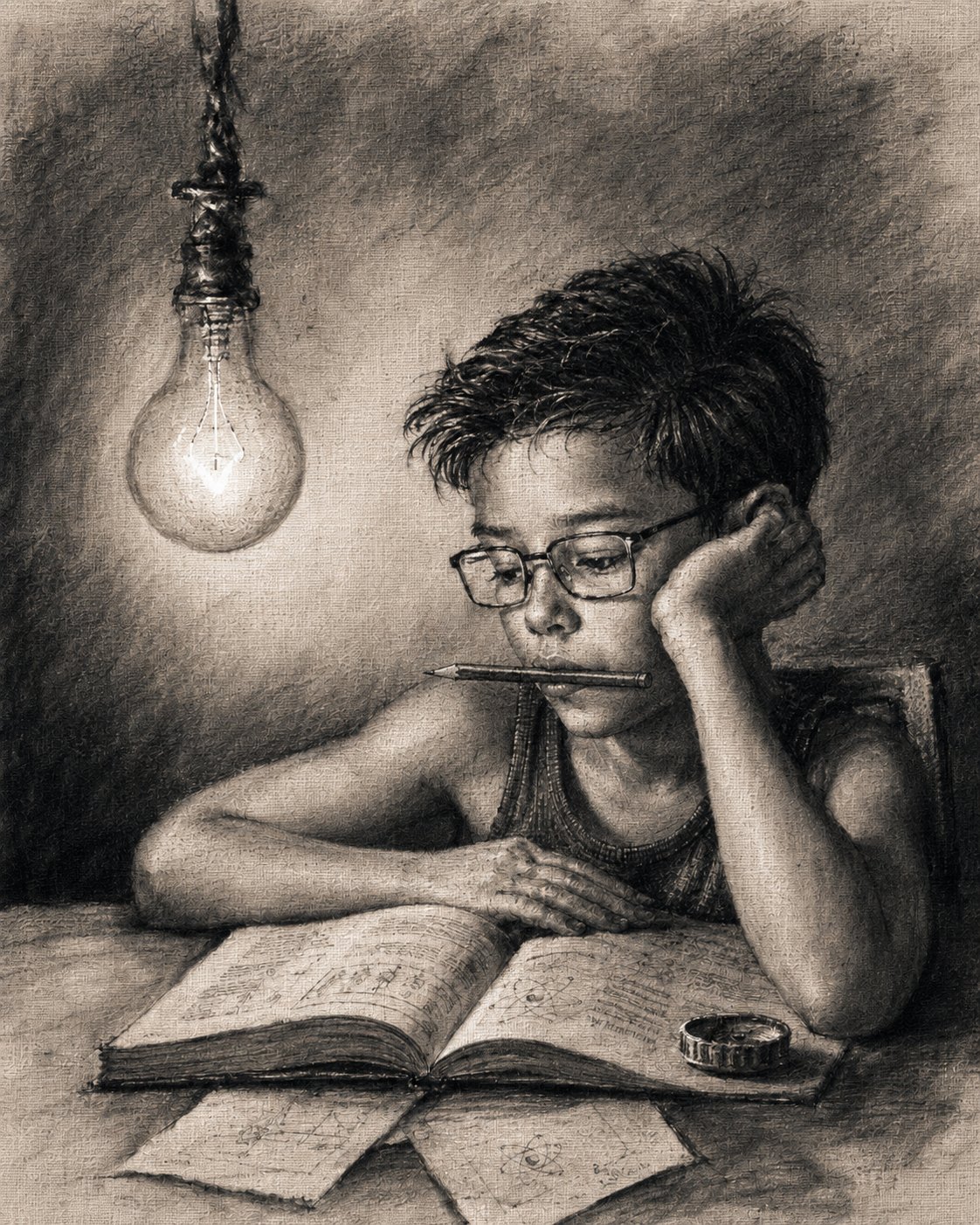
I was small, thin, myopic, nervous, and watchful. The world arrived through thick glasses and then went into the brain for excessive processing. Other children seemed to run. I interpreted. Other children played. I noticed hierarchy, smell, gesture, tone, unfairness, the mysterious power of size, beauty, money, accent, and confidence. It is a nuisance to be a child with an adult-sized suspicion of the world. Nobody thanks you for it.

The Calcutta middle class gave its children a ladder and called it destiny. The ladder was education. The wall was life. The instruction was simple: climb, don’t look down, don’t ask who built the wall, and for heaven’s sake don’t embarrass the family.

If you were not tall, fair, handsome, rich, athletic, smooth-spoken, well-connected, or blessed with that strange social confidence some people wear like imported perfume, you compensated. You studied. You read. You memorized. You tried to become valuable by examination. This was the Bengali middle-class version of bodybuilding. Some boys developed shoulders. We developed vocabulary.

My mother started me early. She read to me before I could read, then I learned to read and accidentally became a problem. I asked questions. Not cute questions. Not the sort that make adults smile and pat your head. I asked why. Then why again. Then why the answer contradicted something said last week. Adults dislike this. A child is expected to be intelligent in the ornamental sense, not in the cross-examination sense.

So I was given the terrace and the attic room. Every family, if honest, has some method of storing its inconvenient weather. I was mine.

Books became my unauthorized door out. Tintin, science, Bengali fiction, history, later the mad American abundance of Half Price Books, Barnes & Noble, and Borders in Texas, where I bought books as if the cashier were stamping my visa into human worth. In San Antonio and Austin, I stood among shelves like a refugee who had found not food exactly, but permission.

Did reading make me rich? No.

Did it produce a magnificent career arranged in clean marble steps? Also no.

Did it produce a beautiful domestic life with filtered sunlight and crockery that matches? Kindly stop laughing.

Reading did something less marketable and more dangerous. It gave me private freedom. A book allows you to stop time. You can pause inside a sentence. You can stare at a word until it becomes a room. You can go back three pages because your mind wandered. Try doing that to a pompous man speaking at a public event. He will not permit footnotes. A book permits everything.

Reading is the one place where the weak man can control the strong one. The author may be a genius, a Nobel laureate, a dead Russian, a smug Englishman, a scientist, a poet, or a philosopher with eyebrows like nesting birds. Still, when he becomes difficult, you can close him. You can reopen him. You can make him repeat the argument. You can drag his idea down to the tea stall and ask, “Fine, but what does this mean if the milk is watery and the biscuit has fallen in?”

That is why I still read.

I read because the world lies fast, but books can be slowed down.

The Indian education system I passed through was not designed to create free minds. It was designed to create answer-producing organisms. English-medium schooling especially had the perfume of status. Behind it stood the old colonial machinery: clerks, exams, hierarchy, neat handwriting, obedience, and the idea that pronunciation could become morality. We were being trained to sound employable before we were allowed to think dangerously.

This is not to say the West is pure. Please. The West has committed enough historical mischief to keep Satan’s clerical staff busy for centuries. Human beings everywhere are apes with flags, stationery, and flattering stories about themselves. Every country writes its own advertisement. Every tribe retouches its own photograph. The rich call their luck discipline. The conquered are told to call their wounds culture.

India, meanwhile, has a special talent for mixing brilliance with bunkum. We produce mathematicians, doctors, coders, philosophers, poets, and then seat them next to astrologers on television as if the universe were a family debate. We discovered subtle philosophies, argued about consciousness, grammar, logic, materialism, and doubt for centuries, and still millions will forward nonsense before breakfast with the confidence of a man who has personally audited Saturn.

The Bengal of my childhood wore Marxism like an old cotton kurta: faded, argumentative, sometimes noble, sometimes full of holes. There was atheism in the air, but also superstition in the walls. Darwin could be treated as optional while fish farming received practical respect. Astronomy often meant horoscope. The stars, those magnificent furnaces of physics, were reduced to marriage advice.

Now the country feels louder. More televised. More religiously perfumed. More eager to confuse mythology with evidence and volume with truth. We have faster phones, brighter billboards, cleaner malls, and the same old drains waiting outside with philosophical patience. Progress often feels like someone placing a glass table over a leaking roof and asking us to admire the transparency.

I went to the US in August 1998 with about sixteen hundred dollars in my pocket, bought with my father’s salaried rupees. The plane was a Boeing 747-400, the Queen of the Skies. It sounds glamorous now. At the time I was a nervous Bengali boy with a suitcase, ambition, fear, and the faint suspicion that the world had made a clerical error by allowing me to travel that far. The rupee then was in the lower forties to the dollar. Today the number feels like a slow obituary for middle-class arithmetic.

What did America give me? Work, books, loneliness, libraries, highways, central heating, depression with better grocery stores, and the knowledge that foreignness does not end when immigration stamps your passport. It also gave me distance from Calcutta. Distance is useful. From too close, a city is only noise, sweat, relatives, errands, and electricity cuts. From far away, it becomes pattern. From very far away, it becomes myth. Then you return and realize it is still also the same leaking tap.

I returned, or perhaps life returned me. Now I am almost fifty, single, lower-middle-class in the shanty edges of Calcutta, a man who has worked in healthcare IT in the US and now often struggles to make the day move. Some mornings begin like a court case. The toothbrush is Exhibit A. The tea is pending. The bath is under appeal. The laptop sits there like a creditor with a black screen.

This is not laziness. Laziness has leisure in it. Depression has weight. Bipolar mood has weather. Anxiety has teeth. Irritability has sparks. Shame has glue. Some days a simple task is not simple. It is a parade of invisible negotiations. Get up. Don’t think. Make tea. Don’t check the phone. Open the laptop. Don’t remember every failure since 1987. Answer one email. Don’t collapse into the old swamp. Bathe. Eat. Remain a mammal.

Naturally, society has advice. Society always has advice. Society is a fat uncle leaning on the gate saying, “You should be positive,” while not paying your rent. The world loves the inspirational story after the survivor has survived. During the actual surviving, it generally prefers you to keep quiet and not spoil the mood.

This blog is partly my refusal to keep quiet.

It is also not a wellness brochure. If you want scented wisdom arranged beside a stock photo of pebbles, you have taken a wrong turn near Ultadanga. I write because my mind sometimes becomes unbearable unless given a shape. A sentence is a small rope bridge. A paragraph is a temporary railing. A joke is a match struck inside a dark staircase. Not enough to renovate the building, but enough to see the next step.

Bipolar writing has its own climate. When I am up, language accelerates. Anger sharpens. Jokes become knives with bells tied to the handle. When I am down, the same sentences look monstrous. I delete. Then I regret deleting. Then I rewrite. Then I suspect the rewrite. Many things on this site are survivors. Many more were privately executed in the night by a depressed editor with no appeals process.

So do not confuse mood with final identity. A storm is not the whole sky. A sentence written in rage is not necessarily a constitution. A comic insult is not a court affidavit. I am, like everyone else, but perhaps more visibly, a liquid poured into the vessel of the day. Some days I take the shape of irritation. Some days shame. Some days lucidity. Some days absurd hope. Some days merely the cup.

Writing helps because it interrupts rumination. The mind, left alone in depression, can become a ceiling fan with one bent blade: round and round, noisy, useless, slightly dangerous. Writing puts a stick into the fan. It may not fix the motor. It stops the blur for a moment.

Sketching does the same. The line drawings are mine. Some are colored or shaded with AI, but the creatures began in my hand and head. I do not claim gallery-level craft. I am not sitting in a Paris attic with cheekbones and turpentine. I draw because certain thoughts look like crooked people. Some moods have noses. Some anxieties have knees. Some hypocrisies deserve a belly and bad posture.

A lot of my grotesque imagination comes from Bengali children’s literature, especially Shirshendu Mukhopadhyay and his Odbhuture world, where oddness does not need apology. Add to that George Carlin, Robert Crumb, underground comics, Calcutta cynicism, American misanthropy, Bengali para humor, and the daily sight of respectable absurdity walking around in polished sandals, and you get my little circus.

I lean left, though the word has been mangled by parties, slogans, television, WhatsApp, and people who cannot discuss politics without turning into pressure cookers. The left-right distinction began, roughly, with seating in the French Revolution. Those who wanted to protect king, church, hierarchy, and the old order sat to the right. Those who wanted equality, democracy, and rupture sat to the left. My own version is simpler: when I see a can of worms, I prefer the left boot.

Religion, politics, media, family, market, school — all these institutions teach people to lie politely. The lie changes costume. In school it is discipline. In family it is respect. In politics it is nationalism. In religion it is faith. In business it is opportunity. In media it is balance. The structure remains familiar: someone above declares reality, someone below must nod.

This is why I became suspicious early. I noticed adults did not always answer questions. They managed them. If logic failed, tone arrived. If tone failed, authority arrived. If authority failed, guilt arrived. If guilt failed, the child was called arrogant. The whole arrangement was like a badly repaired umbrella. Every rib bent in a different direction, but everyone insisted it was shelter.

The same habit continues at national scale. We prefer stories that flatter us. Every country does, but India has turned it into a cottage industry with broadband. Ancient greatness, wounded pride, spiritual superiority, miracle cures, selective history, holy outrage, heroic victimhood — all stirred together and served hot before the facts have removed their shoes.

Meanwhile an ordinary day continues. The price of fish rises. The local drain smells philosophical. Someone’s scooter blocks the lane. A neighbor discusses geopolitics while spitting paan. A young man scrolls job listings with the face of a condemned poet. An old woman bargains over coriander as if negotiating a border treaty. The country may be arguing about civilization on television, but in the para the real question is whether the water will come before the pump gives up.

I live in that scale now. Not the scale of grand speeches. The scale of tea, rent, dust, medicine, electricity, deadlines, and the daily effort to remain employable while the mind tries to resign from the committee.

And yet I read.

That is the stubborn miracle. Not a large miracle. More like finding one green chili in the fridge when the dal is boring. But still.

Reading still returns me to myself. Writing still proves I have not entirely disappeared. Sketching still lets me laugh at the monsters before they become landlords. This blog, then, is not a brand. It is not a temple. It is not a clean autobiography. It is a table in a small room, with books, unpaid worries, cracked humor, political suspicion, old school shame, bipolar weather, and a man trying to make something before the day folds him back into bed.

Some people will not like the tone. Fine. Some will find the anger too sharp, the humor too crooked, the confession too bodily, the politics too impolite, the atheism too naked, the self-mockery too much, the lack of spiritual perfume inconvenient. Also fine. A blog is not a government ration shop. Attendance is voluntary.

There may be disguise here. There may be compression, rearrangement, blurred details, fictional stitching. That is not fraud. It is survival. We live in an age where every sentence can be scraped, searched, modeled, quoted, misquoted, and presented back to you by some solemn fool as evidence. A little fog is not cowardice. Sometimes fog is how a small boat crosses a river without being shot at from both banks.

The truth does not always require GPS coordinates.

What I want, finally, is simple enough. I want to leave a record of one mind that read, failed, raged, laughed, doubted, worked, broke down, got up badly, sat down again, watched Calcutta from its less decorative edges, and kept trying to describe the machinery of being alive. Not nobly. Not neatly. Not with the smooth moral complexion of a prize-winning memoir. Just honestly enough.

If a younger boy or girl somewhere in Calcutta, or anywhere, is sitting with thick glasses, private shame, family pressure, strange questions, and the suspicion that the adult world is mostly bluff wrapped in clean clothes, I would like that child to find this and feel less alone.

Not rescued.

Less alone.

There is a difference. Rescue is rare. Less alone is a cup of tea passed across a dark room.

So read this first. Then read whatever you like. Leave if you must. Stay if you can. This place is only a cracked window, a desk, some strange drawings, too many books, and a middle-aged Bengali man trying, with uneven success, to keep the mosquitoes, gods, politicians, algorithms, and private demons from winning by default.

Topics Discussed

  • Personal Essay
  • Calcutta Blog
  • Kolkata Memoir
  • Bengali Writer
  • Middle Class Life
  • Bipolar Writing
  • Mental Health Essay
  • Reading Culture
  • Book Lover
  • School Memories
  • Childhood in Calcutta
  • North Kolkata
  • Indian Middle Class
  • Atheist Writer
  • Political Satire
  • Personal Blog
  • Creative Nonfiction
  • Autobiographical Essay
  • Humor Essay
  • Bill Bryson Style
  • SuvroGhosh

© 2026 Suvro Ghosh