The Century Has a Hole in It
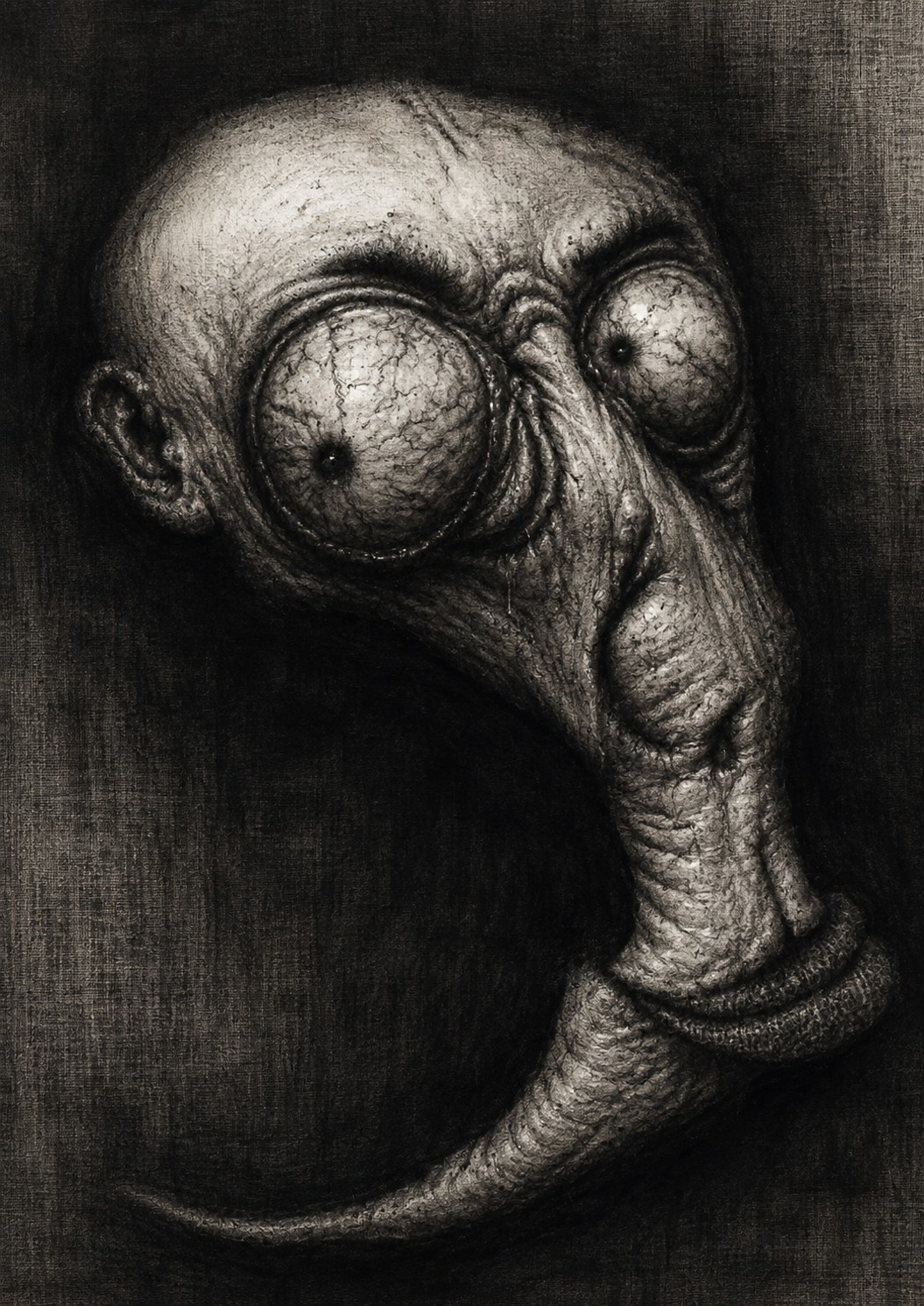
Reality, that grand upholstered sofa on which respectable people sit without checking for bedbugs, is not nearly as solid as advertised. It is a monoculture only from a distance. Come closer and the thing is riddled with tiny comic holes, little logical termite galleries, absurdities, inherited customs, badly translated certainties, ancestral mutterings, half-remembered scriptures, colonial schoolroom furniture, and the occasional fact sitting quietly in the corner like a goat at a physics lecture.
Most people learn not to inspect these holes. They walk through life smoothing the creases, ironing the irony out of existence, looking up frocks, exam results, train timings, marriage prospects, gas-cylinder prices, cricket scores, and other sanctioned distractions. Their contentment has a respectable name when spoken kindly and a rude one when spoken honestly. The polite version is normal life. The impolite version is ignorance with a pension plan.
But there is often a nagging itch under the civilized skin. A small inquisitive rat in the wall. People hear it as children, then spend adulthood learning to ignore the scratching.
I did not ignore it, partly because I was not supplied with the equipment. I grew up with half-practicing Hindu parents, which in Bengal means religion arrived not as a clean doctrine but as weather. There were gods, stories, rituals, warnings, festivals, fragments, prohibitions, jokes, rumors, kitchen theology, neighborhood metaphysics, and a generational tolerance for haphazard apocrypha and hearsay. Nobody sat me down with a diagram and said, “Here is reality, son, laminated for convenience.” Reality came in loose pages. Some were missing. Some had turmeric stains. Some contradicted the others.
So I began, in my small and irritating way, to figure things out myself.
Not the glamorous esoterica sold in special shops to men with beards and imported mala beads. I mean ordinary concepts. The basic furniture of the world. Things adults used every day without ever turning them over to see how the legs were attached. The sort of thing that should have been explained in school but was usually embalmed instead. Our colonial inheritance had trained generations to recite answers with the moral posture of knowledge, while quietly discouraging the dangerous next question: yes, but why?
One of the first cracks I remember was the matter of centuries.
Why, I wondered, do we call this the 21st century when the year begins with 20? The year 2026 looks, at first glance, like a loyal citizen of the 20-something kingdom. It has 20 right there in front, waving its little numerical flag. Yet every educated person insists it belongs to the 21st century. This seems, to a child, like the adults have once again formed a committee to lie with confidence.
The trick is not mystical. It is worse. It is accounting.
Our common historical year-numbering system has no year zero. The year 1 Before Christ [BC, the traditional label for years before the Christian calendar’s starting point] is followed immediately by Anno Domini [AD, the traditional Latin label meaning “in the year of the Lord”] 1. There is no neat little neutral zero-year lobby between them, no arithmetic vestibule where history can wipe its shoes. The calendar steps from one side of the doorway to the other and pretends the missing plank is perfectly normal.
That missing zero changes the counting.
The 1st century AD runs from AD 1 through AD 100. Not AD 0 through AD 99, because AD 0 does not exist in that system. The 2nd century runs from AD 101 through AD 200. The 3rd from AD 201 through AD 300. The 20th from AD 1901 through AD 2000. Therefore the 21st century begins on January 1, 2001, and ends on December 31, 2100.
This is why the year 2000, despite all the fireworks, shiny spectacles, millennium hysteria, and apocalyptic software indigestion, was technically the last year of the 20th century. Humanity threw the party one year early, which is exactly the sort of thing humanity would do after inventing both calendars and marketing departments.
The formula is simple enough to be mildly offensive. For any positive AD year, the century is the ceiling of the year divided by 100. The ceiling function takes a number and rounds it upward to the nearest whole integer. So 2026 divided by 100 is 20.26. The ceiling of 20.26 is 21. Therefore 2026 belongs to the 21st century.
You can also use the schoolboy shortcut. Split 2026 into 20 and 26. Since the last two digits are not 00, add one to the first part. So 20 plus 1 becomes 21. But for a year ending in 00, do not add one. The year 2000 remains in the 20th century. The year 1900 remains in the 19th. The year 2100 remains in the 21st. The moment the year becomes 2101, the 22nd century begins, and some future idiot will write the same explanation on whatever glowing neurological advertisement platform has replaced blogs by then.
What fascinated me was not merely the answer. The answer is tidy. A little calendar arithmetic, a missing zero, a ceiling function, and the matter is settled. What fascinated me was that people could say “21st century” every day and not feel even a faint tickle of contradiction when looking at the 20 in 2026. The mind had built a smooth road over a pothole and then forgotten the pothole existed.
That, I think, is how much of reality works. Not by being obvious, but by becoming familiar. Familiarity is the chloroform of thought. It does not prove things. It merely sedates the part of us that would otherwise object.
The century problem is a small example, almost cute. A calendar gnat. But it teaches a larger lesson. Many things we call natural are conventions with wrinkles. Many things we call obvious are agreements made by dead people under conditions we no longer remember. Many things we call facts are facts only after passing through history’s cracked machinery of language, religion, empire, bureaucracy, translation, and habit.
A child asks why 2026 is the 21st century and discovers the missing year zero. An adult asks why society works the way it does and discovers a whole warehouse of missing zeroes.
Missing justice. Missing context. Missing memory. Missing incentives. Missing honesty. Missing explanations. Missing evidence. Missing humility. Missing the small, decent embarrassment that should arrive whenever a confident answer is resting on a pile of inherited nonsense.
This is why curiosity is dangerous. Not because it destroys faith, tradition, or order in one dramatic atheistic thunderclap, but because it makes the wallpaper peel. First the century. Then the calendar. Then the schoolbook. Then the priest. Then the nation. Then the family legend. Then your own biography, that most cherished fraud, stitched together from memory, vanity, injury, and selective lighting.
The Indian Heathens Club, if it exists, probably has no annual membership card. It is more likely a private disease of attention. You notice one oddity, then another. You begin pulling at threads. Soon the shawl of received wisdom is lying around your ankles, and everyone is annoyed because you have made the room untidy.
Still, I prefer the holes.
A smooth reality is comfortable but suspicious. It has the dead sheen of a government office table polished by decades of elbows and evasion. A punctured reality, full of strange little gaps, is less relaxing but more alive. It gives you places to insert a question. And sometimes a question, if sharpened properly, is the only tool a person has against the enormous upholstered sofa of common sense under which so many small truths have been quietly swept.