Pixels That Make Us Feel Present
Uses the speech voice supplied by your browser or device.

Acronyms used: AI [Artificial Intelligence, software systems that learn patterns from data and use those patterns to generate, rank, recommend, predict, or persuade], SEO [Search Engine Optimization, the craft of making online writing discoverable by search engines and recommendation systems], FOMO [Fear Of Missing Out, the anxious feeling that others are participating in something important while one is being left behind].
The phone does not show us the world; it smuggles the world into the nervous system in bite-sized emotional sweets, each one wrapped in urgency.
That is the trick. Not that YouTube lies. Not that social media lies. Sometimes it does, naturally, with the casual confidence of a fish seller before Kali Puja. But the deeper trick is that it makes us feel present. We are not merely watching a quarrel, a war, an election speech, a celebrity collapse, a cricket humiliation, a courtroom clip, a street fight, a spiritual guru explaining the universe while wearing sunglasses indoors. We feel we are somehow there, leaning over the balcony of history with one hand on the railing and the other inside a packet of chanachur.
But we are not there.
We are sitting in a room in the shanty boondocks of Calcutta, perhaps in a lungi, perhaps wearing an old T-shirt from some forgotten American conference, perhaps wondering whether the client will pay this month, whether the ceiling fan is making a new sound, whether tea without milk is still tea or merely hot disappointment. Outside, some scooter is coughing like an elderly uncle. A pressure cooker whistles in a neighboring room. A dog with no visible career plan barks at the universe. And inside this ordinary human afternoon, the phone opens a trapdoor.
A man shouts in a video.
A crowd runs.
A woman cries.
A politician points.
A thumbnail screams.
A voice says, “You won’t believe what happened next.”
And the animal inside us believes it already.
That is the embarrassing part. The body does not wait for evidence. It does not say, “Excuse me, before I release anger, may I inspect the unedited footage, the timestamp, the location, the source, the motive, the surrounding context, and three independent confirmations?” No. The body is not a Supreme Court bench. It is more like a para club committee after someone moved the plastic chairs without permission. It reacts first and asks questions later, if at all.
This is why the modern screen is so powerful. It does not merely inform. It recruits. It presses old buttons built for snakes, storms, betrayal, hunger, sex, tribe, and danger. We evolved to respond quickly to faces and voices because, for most of human history, the face in front of us was actually in front of us. If someone shouted in fear, there might be a tiger, a fire, a flood, or at least a large unreasonable cousin with a stick. Now the shout comes through glass from another continent, another year, another editing desk, another agenda. But the heart does not know geography. The jaw tightens anyway.
This is false participation. A nasty little phrase, but useful. Real participation has weight. If you attend a meeting, you must sit through the boring parts. If you join a protest, your feet hurt. If you accuse someone, you may be asked what you know. If you help a neighbor, your evening disappears. If you care for a sick parent, the work does not end when the mood changes. Real participation has sweat, risk, obligation, correction, boredom, and the terrible possibility of being wrong in public.
Digital participation gives the emotional reward without the cost. You can rage without consequence, mourn without proximity, judge without testimony, belong without membership, and feel brave without leaving the bed. It is activism with no shoe leather, scholarship with no library dust, friendship with no inconvenience, outrage with no receipt.
No wonder it is addictive.
YouTube is the clever uncle in this family. Facebook and X may look like noisy marketplaces where everyone is selling damaged opinion by the kilo, but YouTube arrives dressed as education. We do not say we wasted three hours. We say we “researched.” We “went deep.” We “heard both sides.” We “understood the real story.” In truth, very often, we sat quietly while a recommendation system led us from one emotional sweet shop to another, each one slightly stronger, saltier, angrier, more certain.
First a news clip. Then a reaction. Then a long-form analysis. Then a debate. Then a video of someone “destroying” someone else, which usually means one person interrupted another person with the philosophical subtlety of a bus conductor shouting “Esplanade, Esplanade, Esplanade” into the face of mortality.
The viewer feels engaged. That is the danger. Not informed. Not educated. Engaged. The platform gives him a cardboard steering wheel, like a child in the back seat of an old Ambassador car, and the child believes he is driving through the traffic himself.
The absence of evidence should make us cautious. Oddly, it often makes us more gullible. Distance should create humility. Instead, distance creates appetite. We do not know the place, the language, the history, the missing minutes before the clip, the missing minutes after the clip, who filmed it, who cut it, who captioned it, who benefits, who is outside the frame, who is lying, who is frightened, who is performing, who is being paid, who is being used. Yet the less we know, the cleaner the story feels.
Reality is untidy. A real dispute has mold on the walls, unclear motives, contradictory witnesses, one person who forgot the date, another who remembers too much, and an auntie who knows everything but refuses to say it unless given tea. A video is simpler. It has a villain, a victim, a beat, a caption, a thumbnail, and a comment section full of amateur gods distributing thunderbolts.
The frame becomes the world.
What is inside the rectangle becomes fact. What is outside it becomes invisible. This is how pixels acquire authority. Not by being true, but by being near. The phone sits in the palm. It comes to bed. It travels to the toilet, that last private parliament of modern civilization. It speaks through earphones directly into the skull. The old newspaper sat at arm’s length. Television stood across the room like a loud relative. The phone whispers.
And what it whispers, most often, is this: “Look what they did to us.”
That little word, “us,” is where the machine puts its hook.
Every ulterior message needs a doorway. Fear is a doorway. Loneliness is a doorway. Injured pride is a doorway. Boredom is a doorway. Middle age is practically a railway junction of doorways. By fifty-one, many of us have collected enough disappointment to open a small museum. The old ambitions have lost their hair. The bank account behaves like a weak patient. Friends are busy, dead, distant, successful, or unbearable. The body begins sending small legal notices. Sleep becomes negotiation. Hope, once a large noisy bird, sits quietly on the window grille and refuses eye contact.
Into this condition comes the phone, glowing like a small, immoral temple.
It offers drama. It offers enemies. It offers belonging. It offers the comforting illusion that someone, somewhere, has finally explained why life feels crooked. It offers the sweet relief of blaming. It offers the even sweeter relief of certainty.
And certainty is delicious. Much tastier than truth.
AI makes this sharper, not because it has horns and a tail, but because it is good at noticing what holds our eyes. It does not need to understand our soul. It only needs to measure our pauses. Did we watch the angry video longer than the calm one? Did we replay the clip where the man cried? Did we click the thumbnail with the open mouth and red arrow? Did we stay for the conspiracy, the humiliation, the panic, the moral thunder? Then more shall be served. The waiter does not ask whether the food is nutritious. He asks whether we finished the plate.
This is why the common discussion about misinformation is too small. Misinformation matters, yes. Lies matter. Fake images matter. Edited clips matter. But the larger disease begins before belief. It begins in mood. Tempo. Repetition. Tribe. The body warms before the mind arrives. By the time we ask, “Is this true?” we may already want it to be true.
That is a dangerous condition. Wanting something to be true is the cheapest counterfeit of knowing.
The cure is not to become a stone-hearted skeptic who disbelieves everything. That man is not wise. He is merely gullible in the opposite direction. The real discipline is slower and more boring, which is why it has poor market performance. Ask where the thing happened. Ask when. Ask who filmed it. Ask what is missing. Ask whether the clip is asking you to understand or merely to enlist. Ask why this particular anger has arrived at your doorstep today wearing polished shoes.
Most of all, ask whether your feeling has earned the status of evidence.
Often it has not.
A video may be important. A clip may reveal cruelty. A phone camera may catch what power wanted hidden. Pixels can bear witness. Nobody sensible should deny that. But witness is not context. Motion is not meaning. Intensity is not truth. A comment section is not the public mind. A trending topic is not history. A recommendation queue is not destiny. And participation is not the same as understanding.
This distinction matters because the emotional body is honest but easily fooled. When it reacts, it is not pretending. The anger is real. The fear is real. The sadness is real. The humiliation is real. But the cause may be artificial, exaggerated, incomplete, or arranged like furniture in a showroom. The feeling is yours. The script may not be.
That is perhaps the saddest part of this whole digital circus. We lend our real nervous systems to manufactured scenes. We spend real evenings on synthetic urgency. We donate real attention, real sleep, real peace, real appetite, real family conversations, real small joys, to events that may be distant, distorted, or deliberately baited.
Meanwhile, the rice needs reheating. The tap is leaking. The rent is due. The neighbor’s child is learning multiplication loudly through the wall. A small plant on the balcony is trying, against all evidence, to remain alive. This too is reality. Less dramatic, yes. Poor lighting. No thumbnail. No background score. No expert panel. But reality all the same.
The screen hates such reality because it has no hook. Ordinary life does not shout “Watch till the end.” It simply waits. It asks us to wash a cup, call a friend, read two pages, walk ten minutes, cook something edible, repair one thing, doubt one rumor, and sleep before the mind becomes a haunted warehouse.
That may not sound revolutionary. Good. Most revolutions advertised on screens are just new ways to sell old agitation.
The sane act is smaller. Restore distance. Put a little air between pixel and pulse. Let the first reaction pass like a tram bell in the distance. Look again. Ask one more question. Refuse to be recruited too cheaply.
The world is already difficult. We need not rent our nervous system to every passing thumbnail.
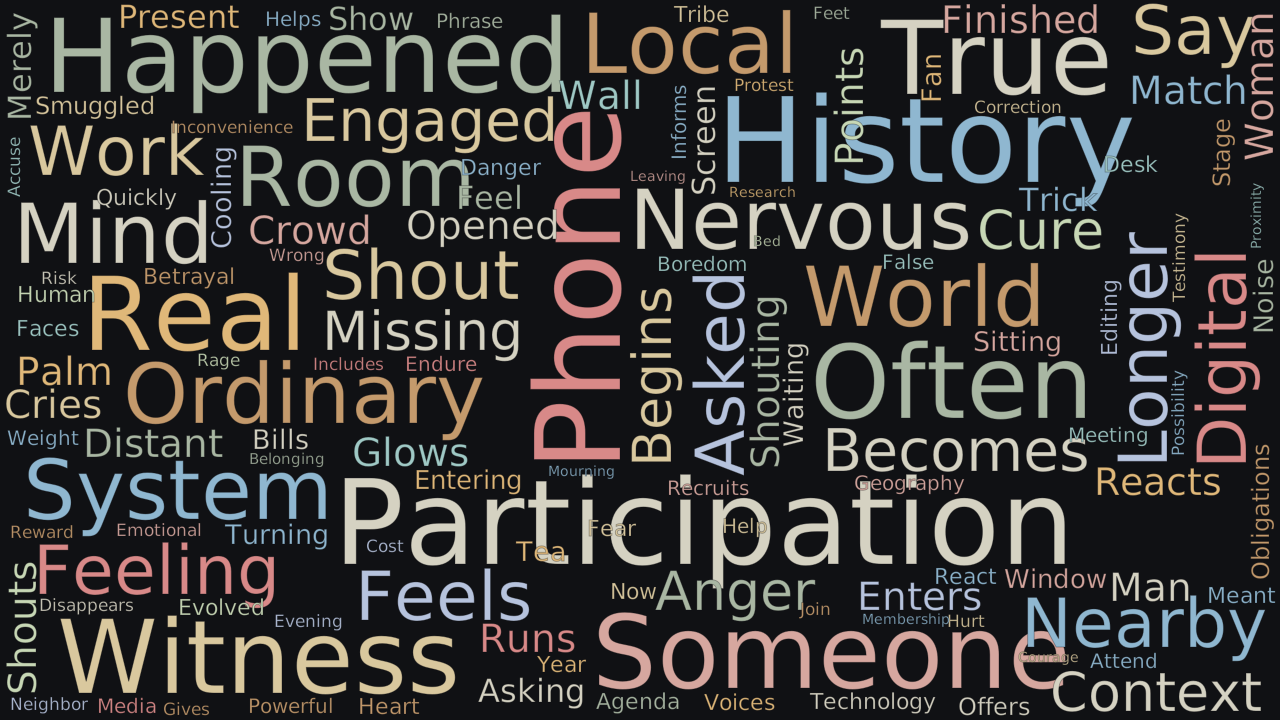
Word Cloud
Related reading
Selected by shared topics and section, with closer publication dates breaking ties.