Shobar Din
Uses the speech voice supplied by your browser or device.

THIS IS A WORK OF FICTION
Mahalaya — 4:41 a.m.
I woke because my tongue was pressing against the back of my bottom teeth hard enough to ache, and I hadn’t told it to do that. It was doing it on its own, a slow, deliberate push, like it was trying to make room for something coming up from underneath. I sat up in the dark and the pressure stopped, and I sat there with my mouth open over the bucket by the bed because I was sure, I was certain, that something was going to drop out of me. Nothing did. But my gums tasted like hot copper, and when I touched my lower front teeth with my fingertip, one of them moved. Not a lot. The way a table leg moves when you lean on the table and the floor isn’t level.
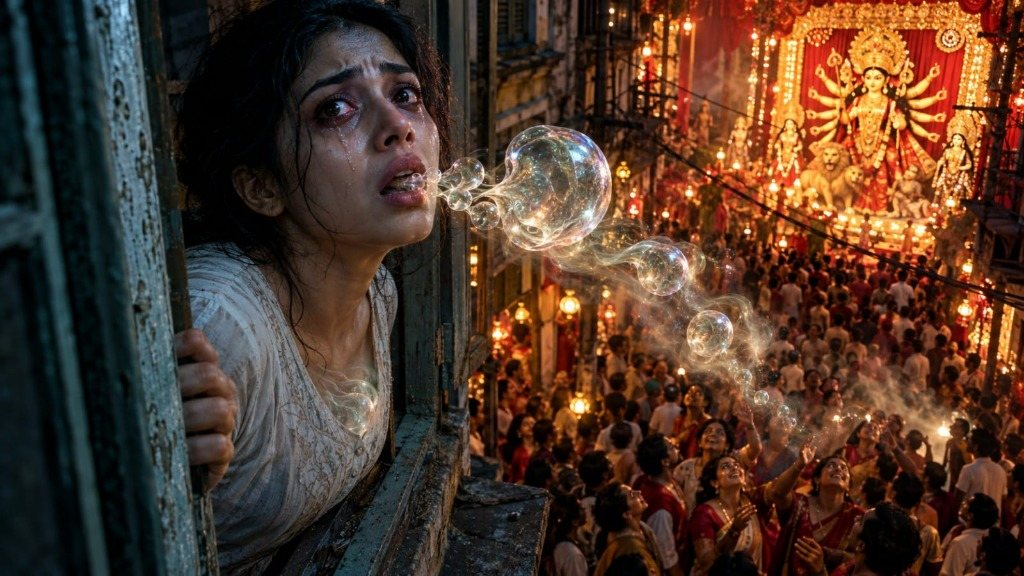
Outside, the radios were playing Mahishasura Mardini. The occupied flats had their windows open. I could hear the conch shells, the chanting, Birendra Krishna Bhadra’s voice coming through the floor, coming up through the soles of my feet like the building itself was listening. I have known that voice since childhood. Even during the years abroad, a recording could put me back inside a Calcutta morning before I had finished recognizing it.
There was a Puja when I was in class seven or eight when it stopped working. Everything arrived: the lights, the drums, the new clothes, the smell of food. I waited for the feeling that was supposed to come with them. I remember waiting very carefully, as though I might frighten it off by wanting it too much.
I could still recognize everything. That was the difficulty. Nothing looked broken enough to account for what had happened.
This morning I pressed my tongue against the loose tooth again. It gave, just slightly, with a feeling like a seed rolling in wet soil.
I have eleven thousand rupees left. That is not a complaint. That is arithmetic.
Mahalaya — 11:15 p.m.
The tooth is still loose. I keep checking it with my tongue and I know I should stop because I am making it looser. There is a rule about loose things: the more you confirm them, the looser they get. I have made a career of confirming things.
I went to the window at dusk with a cup of tea, and the whole lane was strung with lights, and the pandal at the end of the street was going up, bamboo and cloth and men shouting to each other, and every single one of them looked like he belonged to a species I used to be part of. A boy of maybe nine was telling the men that the platform was crooked. They stopped and checked. One of them fetched a wedge.
I stood there holding my tea and thought: I have never once been the person anyone adjusted anything for.
That is untrue. I am putting the correction immediately underneath it. People have loved me. People have made room. The illness can take a life containing those facts and give you, with complete conviction, a life in which they never happened. You can know it is doing this and still feel the corrected version is the lie.
Most of my bipolar illness is down here. On the rare occasions I go up, it is usually irritation, anxiety, a mind that will not leave a thought alone, an anger looking for somewhere to put its elbows. Very little of the magnificent happiness people seem to think comes with the diagnosis. Sometimes the same miserable room simply acquires a faster fan.
Tonight I could feel chanting in my lower jaw. Not hear it. Feel it. A vibration in the bone, right where the tooth is loose. I turned my radio off hours ago. I thought the sound was coming from the flat below, but the Duttas left on Thursday. I heard the car being loaded. I heard the door lock. I heard the silence after.
I took the tablets prescribed for me. Lately they have helped me sleep on some nights. I am trying to let that be something without demanding it be everything.
One tasted of wet bamboo, jute rope, the sweet rot of marigold stems. I checked the strip. The tablets looked ordinary.
The taste stayed after I swallowed. Low in the gum. As though the medicine had passed through and left something tasting me.
Shashthi — 9:03 a.m.
The tooth came out in my sleep.
Six mornings since the first movement. There should be entries between these entries, but there are only things I meant to do. Make food. Wash the pillowcase. Telephone a dentist. The first action of each required some smaller action I could not get behind. I have spent whole afternoons holding an empty cup because putting it down would have meant deciding what to do with my hand afterward.
This morning there was something small and hard under my hip. My lower left incisor. The root was still on it. It was warm.
I should be more upset. I understand that a person should be upset. But the pressure in my jaw is gone, and in its place there is a feeling of such enormous room — like a wall has been taken out of a house you had stopped noticing was cramped. The edges of the socket are smooth, like something has been licking them from the inside.
I wrapped the tooth in a loose page from my battered copy of The Golden Bough and put it in the kitchen drawer with the rubber bands and the dead batteries. Page 214. I am recording the number because numbers are still willing to stay where I put them.
It seemed wrong to throw away a part of myself on the day of the goddess’s awakening. I am an atheist. Nevertheless, I wrapped a tooth in Frazer and put it in the dark, and I have caught myself, twice now, listening for something in the kitchen.
The pandal is finished. From this fourth-floor room I can see her face through its open frontage. Her eyes have already been painted. The ritual waking comes later. I find that distinction unpleasant this morning: being given eyes, and then having to wait inside them until someone lets you look.
I keep thinking about the boy on Mahalaya, telling the men something was crooked.
My jaw aches in the rhythm of the dhaak. I timed it. There is a gap in my mouth and the drums are getting into it.
Shashthi — 6:47 p.m.
I went out. I had to — there was nothing ready to eat but leftover rice and the last of the soy sauce, and I had begun negotiating with myself about whether hunger counted as a reason to get up. But today the gap in my mouth began to hunger, and it negotiated with no one. It wanted something warm. Something with a smell. Something that had been part of another body.
The lane was full. Families. Everyone in new clothes, everyone touching each other — a hand on a shoulder, a mother fixing a daughter’s hair, a man with his palm flat on his son’s back steering him through the crowd. Dhunuchi smoke, frying, sweat, perfume trying to cover sweat. And the dhaak, the dhaak, the dhaak, every beat landing in the socket like a finger pressing on a bruise I was keeping secret.
I bought a fish fry for ninety rupees and ate it against a wall. Near me a family shared food from a paper plate, and the grandmother wiped chutney off the little girl’s chin with her thumb and then licked her thumb, and I had to look away because my eyes were burning, and because the gap in my mouth was aching, aching in a way that felt like appetite and grief had been soldered together.
For several seconds I could taste the fish. Properly. The mustard had a sharpness that interested me. I took another bite because I wanted another bite. Such a small thing to have to describe so carefully.
Then the family moved away. The taste went with them. I finished something hot and textured that might have been cardboard soaked in oil.
At home I looked in the mirror. There is something white in the socket. Smaller than a tooth, curved, like a seed.
I called a dental clinic. No answer. A second number had a recorded message. I found an emergency service and saved the address. Tomorrow I will go. I have written that without perhaps.
Ten thousand nine hundred and ten rupees. If I write this down it is a symptom, and symptoms can be taken to doctors, and doctors can be paid until the money runs out, and after that symptoms are just weather.
Saptami — 8:22 a.m.
The seed has split.
I felt it happen during the night, in that thin miserable sleep where every sound comes in wearing a dream. A slow, deliberate parting in my lower jaw. No pain. There should have been pain. A body should not open that quietly.
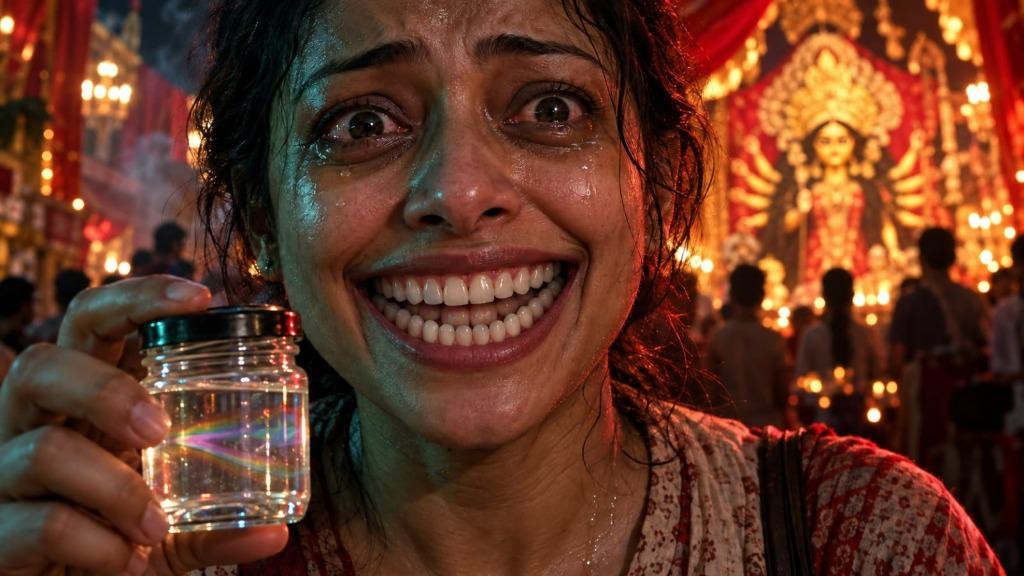
Inside the widened socket are two pale things, each no bigger than a grain of rice. Green. The living green of stems.
I stood at the mirror and laughed. I want to record that I laughed. Fifty-one years old, without regular work for years, alone in a rented room, bipolar, atheist, and something is germinating in my jaw. At last there would be something I could show somebody. Something that did not require them to believe my account of an invisible weight.
Then I took a photograph. The flash made the gum shine. There were two greenish flecks in it. Food, someone might say. The photograph did not contain the movement. I took another. And another. Soon I had twelve photographs of a mouth nobody would want to look at, and I was more tired than before.
I used to work with data. I know what an observation is worth. I also know that twelve copies of the same uncertain observation do not make it less uncertain. I kept taking them anyway.
The radio began again. The passage from Mahishasura Mardini I had heard on Mahalaya. Of course anyone can replay a recording. I told myself that before I went to the wall.
The sound became clearer when I opened my mouth.
I closed it. The chanting thickened, muffled, as though somebody had shut a cupboard on a man who was still speaking.
Saptami — 3:55 p.m.
I went out with the emergency address on my phone. I had washed my face. I had put the money in my pocket. These are small preparations, but I want them here. Later I may need evidence that I tried.
At the crossing, the clinic was to the left. The pandal was to the right. I knew this. I was looking at the map.
Then the dhaak began, and something in my jaw turned, and for the first time that day the street had depth. I do not mean I had been unable to judge distances. I mean that the tea stall seemed to contain the possibility of tea. A man laughing into his phone seemed to be somewhere I could also be. The afternoon had a next thing in it.
I turned right.
I knew while I was doing it. That is the part I cannot make sound reasonable. There was no blackout, no sudden conviction that the goddess was a dentist. I knew where I had meant to go. I also knew that if I turned away from the crowd, the afternoon would close again.
At the pandal, people were folding their hands. People were crying at the sight of her. The two green things shifted toward them, slowly, like seedlings rotating toward light, and warmth spread through the socket.
It was feeding on the crowd. Or feeding on something the crowd let it take from me. I cannot distinguish the two. I only know that while it fed, I could feel why a person might want to be alive on a particular afternoon.
I stayed for twenty minutes.
When I finally made myself leave, the warmth stopped before I reached the corner. On the stairs the familiar weight came back so abruptly I had to sit down. The bare bulb hurt my eyes. The sound of my own breathing annoyed me. I wanted to shout at someone and could not have endured an answer.
I have had agitated spells before. I recognize the speed, the irritation, the terrible inability to settle. Usually I can at least recognize them as mine.
This had stopped and started when I crossed a street.
Ashtami — 6:40 a.m.
There are three shoots now. Each perhaps half a centimeter tall, translucent, with two tiny leaves. They are beautiful. I wish I could leave that out, but an honest account must contain the things that make the writer look bad.
During the night I wanted to sleep and could not. I was exhausted. Every time I began to drift, the leaves brushed the inside of my lip and my thoughts accelerated: the rent, a message I had not answered, a conversation from years ago, a plan for work, the certainty that the plan was idiotic, anger at the person I imagined calling it idiotic. I could hear myself doing it. Hearing myself did not stop it.
At four I made tea. I put in the leaves twice and forgot whether I had added sugar. I drank it standing up. I have done things like that before. The familiarity frightened me more than the shoots. Something could move a long way through my life wearing symptoms I already knew.
I wrote yesterday that nobody would believe me. Earlier I thought there was no one to tell. My mother is alive. She lives in North Calcutta. Her love is real. The distance between knowing that and being able to reach for it is also real. I will not make her cruelty out of my inability to cross it.
For now I am keeping this notebook open. I am putting corrections beside the sentences that need them. There has to be somewhere the first thought does not automatically win.
The wall is breathing. Very faintly, under the drums. I put my ear against it and the breathing matched mine, half a beat behind.
I held my breath.
It went on for two more breaths before it noticed.
Ashtami — after Sandhi puja
Forty-eight minutes at the junction of Ashtami and Navami. I had always imagined a junction should be a smaller thing. A point. Apparently there is time to do quite a lot while one day is becoming another.
The ceremony was in the morning. By the time I opened the curtain, the lane was already thick with people. The leaves had been flexing for an hour, opening and closing like small hands practicing, and I understood that they wanted the window.
I gave it to them.
There was a pause in the drumming at our pandal. Ordinary noises went on: a motorbike, a vendor, someone calling for a child. Then those sounds seemed to move a great distance away. The furrow in my jaw grew warm. In that warmth I could feel something listening through the street to something underneath it.
When the drums resumed, the roots pulled.
Not just in the gum. Under the tongue, behind the hinge of the jaw, a deep grinding adjustment. My head turned toward the goddess. I had not decided to turn it.
And the weight lifted.
I need to describe this without making it beautiful. The room stayed shabby. The money did not increase. I did not become brilliant or chosen or capable of rescuing my life by lunchtime. I simply looked at the cup on the table and could imagine washing it. I could imagine the cup clean. For a few minutes, the effort between those two things was the size it ought to have been.
I washed it. Then the other cup. Then the plate.
I was crying by the time I reached the plate.
Something pulled again under my tongue, and I put everything down and went back to the window, where it wanted me.
My face is a flowerpot. I am going to say it plainly. Something is growing in me, and it has discovered what I will do for an ordinary morning.
Navami — 10:15 a.m.
The shoots have buds. Tight, the color of old ivory, with a red seam at each tip.
The breathing has left the wall. It is in my mouth now. When I inhale, the leaves draw inward. When I exhale, they release. I watched for a long time, trying to decide which of us began.
I tried to pull one out. I want that on record. I caught the smallest shoot between my fingers and felt it pulse, once, like a small animal woken. Then I pulled, and the pain ran down into my neck, and under the pain was the sensation of things tightening around things I still need.
I let go.
The shoot leaned against the inside of my lip. The pain stopped. So did the self-disgust. Not gradually. The way a fan stops making noise when someone turns off the switch at the wall.
I stood there with my fingers wet and, for several seconds, could remember the people I had disappointed without hearing a verdict. I could think of my marriage as something that had ended, and of work as something I had once been able to do. There was grief in it. There was no prosecution.
I thought: it forgives me.
I have been looking at those four words for nearly an hour.
What exactly had required forgiveness? Being ill? Trying to remove something from my own body? I know the questions. I can write the answers. But the relief had been so complete that I wanted to put my face back into it before I had finished objecting.
The buds had grown larger while I stood there.
Navami — 11:58 p.m.
They opened at dusk. Three marigolds. Small, because they must grow in the small, but unmistakable: the dense orange petals, the peppery smell, flowers for a festival, flowers for a funeral, the city using the same scent for every occasion on which it cannot bear to leave a body undecorated.
I can barely close my mouth. I have managed water and a little soft rice. Swallowing feels like moving something through a room where strangers have taken up all the chairs.
The flowers turn when people pass outside. Their roots warm. I feel the warmth as something almost like anticipation.
This evening I tried again to leave for help. I made it to the second-floor landing before a woman and her daughter came up the stairs. Visitors. The girl was perhaps six. She was close enough to see my mouth.
She stopped. Her eyes moved from the flowers to my eyes and back. Then she folded her hands.
Her mother glanced at me, smiled uncertainly, and guided her upstairs. Perhaps she thought I was dressed for something. Perhaps she did not look properly. It happened very quickly. I could not get a word around the flowers before they were gone.
But the child’s attention had reached into my chest. I felt it arrive. An actual pressure beneath the breastbone, and then a loosening, and the terrible familiar need to justify my presence went quiet.
I remained on the landing until the girl looked back once. I did not want to miss it.
Afterward I went upstairs instead of down.
I have read this entry twice. Both times I have wanted to change the last sentence to I was too weak to continue.
I was weak. That is true. It is also true that I wanted to be where they might see me when they came back.
Dashami — 9:30 a.m.
The sound in the lane is different. Today they take her to the river. I know the sequence: the drums, the dancing, the goddess swaying on her platform, the water working its way into the painted clay. I have seen it from streets and windows and, in other countries, on a screen. Every year there is a moment when the face stops being a face, though the eyes are still on it.
The marigolds have closed. I hoped they were dying. I am ashamed of how long it took me to decide whether I hoped that.
The petals have folded inward, tight as fists. The stems have thickened. Beneath the skin of my neck are cords that hum when the dhaak beats. I can follow them with a fingertip as far as the collarbone. Below that I can only feel where they go.
There is a terrible convenience to having an explanation. Something planted me. Something waited through every sleepless night, every treatment that failed to give me my life back, every morning that required the same impossible first movement. It would explain everything, and I would no longer have to bear the untidiness of being ill for years before this happened.
But I do not know that it waited. I do not know that it caused any of it. I know a tooth moved on Mahalaya. I know I had a life before the tooth moved, however much of that life I spent unable to feel it.
I am writing this because the other explanation is arriving more easily now. Whole sentences. No effort. They make my suffering sound like preparation. They make the flowers sound inevitable.
I have left those sentences out.
Downstairs they are bringing the goddess out. The roots tighten under my ribs, then ease, then tighten again. Testing.
When the procession turns the corner, my right foot turns with it.
Dashami — 3:47 p.m.
The procession has gone. Others are still passing farther away. The city will take its time dismantling the festival; there will be lights and hammering and cloth half removed for days. I can already imagine the exposed bamboo. I have always found that stage difficult. The people who made the illusion have other jobs to get back to.
The flowers are heavy. Something moves inside their closed heads when I bend forward.
I filled a glass at the tap. Nothing. No movement toward it. But when the breeze came through the window carrying that far-off wet smell from the direction of the river, all three stems pulled so hard that my knees struck the table.
Water. That water. They know the difference.
I have put on my clean shirt. The ten thousand nine hundred and ten rupees is in my pocket. I want to use it to pay someone to look inside my mouth. I am writing that here because every time I plan the journey, the hospital disappears from the route and there is only the ghat.
I can still imagine refusing. I can still hear a voice in my head explaining why I should. What I cannot find is the place where the explanation reaches my legs.
The roots are loosening in my chest. There is relief in it, and I no longer trust relief. There is a little eagerness, too. My body is getting ready to leave the room with an efficiency I have not been able to ask of it for months.
If anyone reads this: the kitchen drawer. The tooth is wrapped in page 214. Keep it. Do not plant it. Do not let anyone throw it away as an unpleasant thing that can have nothing to do with the person I have become.
It was mine before this began.
I have put the notebook beside the door so I will see it when I come back.
I want to come back. I want that sentence here as well.
Dashami — 11:26 p.m.
I am back.
There is river mud on my shoes. My shirt is dry. All the money is still in my pocket. I remember the walk in pieces: a barricade, a man carrying one end of a bamboo pole, the backs of people’s heads. Water below a flight of steps. Three small weights leaving my mouth. I remember trying to see where they landed, but my head was already turning toward home. After that, nothing I can arrange in order.
The flowers are gone. There is a new tooth in the gap, smooth and white, a little too broad. I can close my mouth. I can pronounce my name.
On the stairs a neighbor said I looked better. I heard myself thank him. It was a warm, easy exchange. I asked how his Puja had been. I listened to the answer. The whole time, something beneath my ribs adjusted to the rhythm of his voice.
He said it was good to see me out.
Inside, I washed my feet. I folded the shirt. I put the money away. There was no argument before any of it. Each task arrived with its first movement attached.
Then I saw the notebook.
I read from the beginning. Twice I caught myself smiling at how frightened I had been. The smile remained while I tried to stop it. That is why I sat down to write this entry. That is why the writing is smaller. My hand keeps wanting to close the book and do something useful.
The tooth is still in the drawer. I checked. The paper around it is damp.
Outside, someone called to someone else. My head lifted. I felt an interest in the voice, in the person it belonged to, in the possibility of going downstairs and standing among people again. Under that interest, very deep, something opened.
I am afraid. The fear is still here. It simply has no effect on my face.
Tomorrow people may find me easier to speak to. I may answer messages. I may finish the things I start. I can feel how little trouble it will take to convince them.
Please do not use that as evidence that I have left.
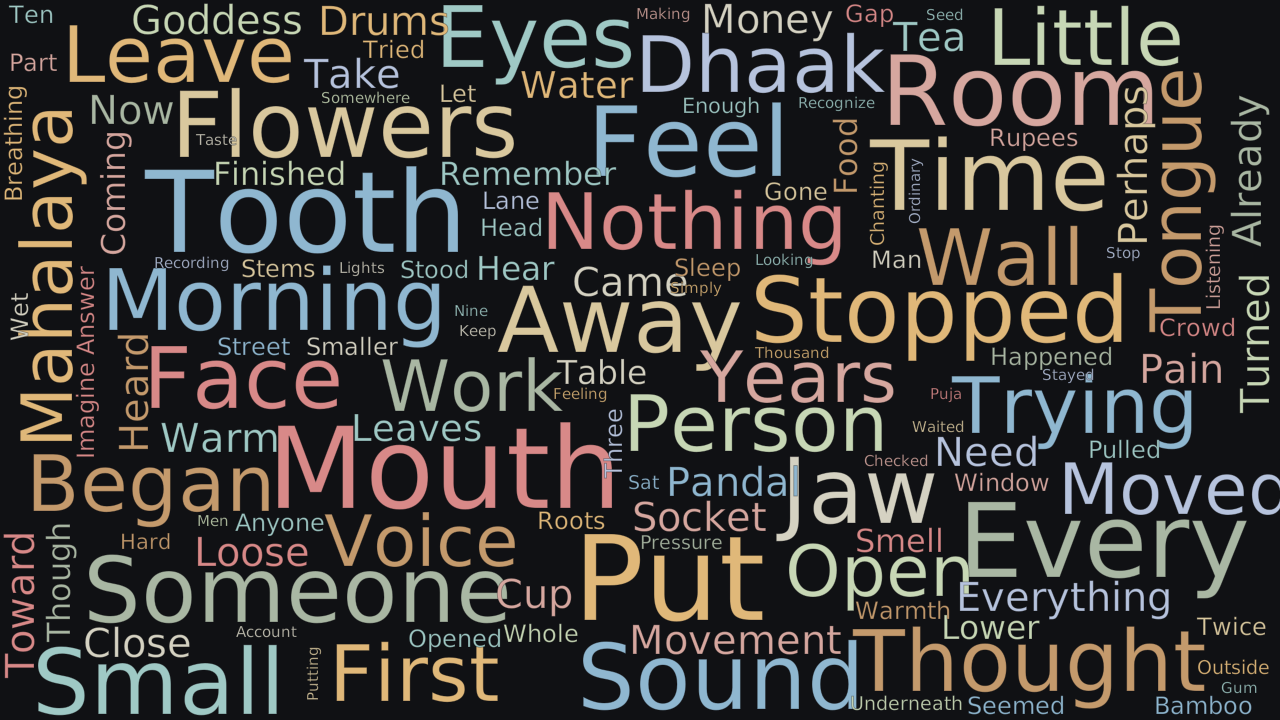
Word Cloud
Related reading
Selected by shared topics and section, with closer publication dates breaking ties.