Mahalaya
Uses the speech voice supplied by your browser or device.

THIS IS A WORK OF FICTION
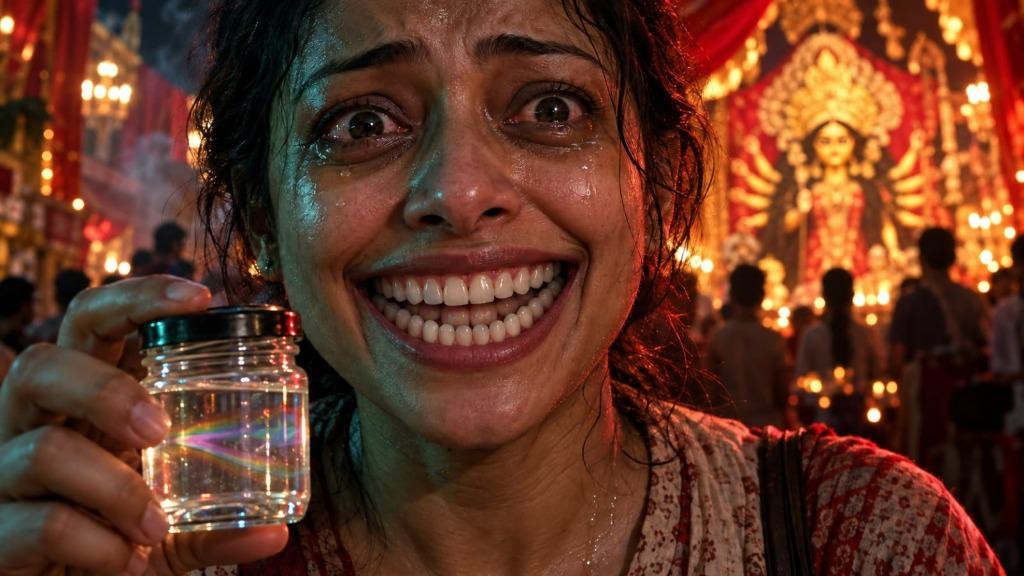
The test tube broke in her hand, and the first thing Rina thought was that the glass tasted sweet.
Not the liquid. The glass. A sliver no longer than a rice grain had struck her lower teeth and slid under her tongue, and her mouth flooded with a sweetness like burnt sugar, like the syrup her grandmother used to reduce for hours on Mahalaya morning, the kitchen windows open to let the dead come in and smell it. Rina stood at the bench with her gloved hand half-raised and her tongue worrying the splinter, and she did not spit. She swallowed. She would tell herself later it was reflex. It was not reflex. It was the sweetness. It was the way the sweetness seemed to know her name.
The label on the tube said Yersinia pestis. The accompanying file said the organism had been recovered from a marmot flea frozen in a Siberian permafrost core since before her grandmother’s grandmother was a rumor. Rina was twenty-eight years old, a senior technician at the Calcutta Anti-Plague Research Institute, and she had broken containment in the stupidest possible way: she had been humming. Mahalaya morning, the city already awake around its radios, and Rina had been humming along with the remembered broadcast her father played at dawn every year, the one that meant the goddess was awake now, was riding out now. She had reached for the rack without looking. Her elbow had clipped it. She had caught the falling tube against the steel lip of the bench, and it had snapped, and her mouth had been open on a note.
There had been a mist. She had seen it for an instant in the light above the bench, an almost beautiful little cloud, and then it was gone, and her face was wet.
She stood very still. The ventilation hummed. The autoclave ticked. Outside the sealed door, the Institute was empty—it was 5:40 in the morning, Mahalaya, and the rest of the skeleton crew would not arrive until seven. For now, Rina was the skeleton. She was alone with the broken tube and the sweetness dissolving under her tongue.
Report the exposure. Stay in containment. Wait for help. She knew what she had to do. She had drilled it. She had signed the forms every year for six years.
She thought of the puja pandals going up across the city. She thought of her mother, who had been dead for four years, who used to say that on Mahalaya the dead walk behind you all day and you must never turn around to look. She thought of the sweetness, which was still there, faint now, a ghost of burnt sugar at the back of her throat.
She picked up the phone to call the duty officer. She put it down. She would shower first. She would shower, and change, and then she would call, and by then it would be a story she was telling about a thing that had almost happened. A near-miss. A scare. A story to tell at dinner during the puja, her hand pressed to her chest: I was so stupid, I was humming, can you imagine, I broke a tube and I lived.
The shower was cold and she scrubbed until her skin stung. She dressed in the spare clothes she kept in her locker, and she did not call the duty officer, because the sweetness was gone and her lungs felt clear and it was Mahalaya, and she had not turned around to look, and nothing had followed her out of the room.
She went home to her flat in Bowbazar. She slept for eleven hours. She woke with her left lung itching.
The itch was deep. Not the tickle of a cold coming on, not the scratch of smoke. This was lower, denser, a finger of irritation pressing up from the base of the lung like a root pushing through soil. She coughed. The cough was dry and came from somewhere she could not reach. She drank water. The water tasted faintly of the sweetness, which was impossible, which she ignored.
Her phone had forty-three messages. The lab group chat was on fire. The morning crew had found the broken tube, the wet shower, the unsigned log. Dr. Sen had called her four times. The Health Department had called twice. Her father had called at dawn to wish her Shubho Mahalaya, to tell her the radio was playing, to tell her he had put out the family’s old offering of forty leaves for her mother, because the dead were hungry on this day above all days.
Rina typed: I broke a tube. I showered. I’m fine. I’m home. I’ll come in tomorrow.
Dr. Sen called before she could put the phone down.
“You will do nothing of the kind. Stay where you are. Don’t let anyone in. We’re coming.”
He arrived with two people she did not know, all three sealed into protective clothing, bringing the chemical smell of the Institute into her little sitting room. They asked questions. They wrote down times. Dr. Sen said there was transport waiting downstairs. She would need to come with them.
Then Rina exhaled, and something inside her chest made a sound.
Not quite a cough. Not quite a note. The wet, hesitant noise a finger makes circling the rim of a glass.
Dr. Sen stopped writing.
He looked past her, toward the kitchen.
“Mitali?”
It was his wife’s name. His wife had died the previous winter. Rina had signed the condolence card.
One of the other people lifted a hand, palm outward, asking them all to be quiet. The third began to cry. No sobbing, no movement; just tears running down a face behind a visor.
Rina swallowed. The sound stopped.
For several seconds nobody spoke. Then Dr. Sen looked at her again, with the distracted tenderness of a man interrupted on his way to another room.
“Try to get some sleep,” he said.
“Aren’t you taking me in?”
He glanced toward the kitchen. He was smiling now, though his eyes were wet.
“You ought to eat something. She’ll worry.”
They left. Rina stood in the doorway and watched them descend the stairs. One of them was humming. She could not tell which.
At 9:17, Dr. Sen posted two words in the lab group chat: All clear.
She stared at them until the screen went dark. Then she woke the screen and read them again.
She did not ask what had been cleared.
By the following night, her left lung had begun to sing.
Not metaphor. Not hallucination. A sound. Low, wet, rhythmic, a bubbling hum that she felt more than heard, a drone like a tanpura heard from underwater. It happened when she exhaled. She lay in bed at three in the morning and listened to her own breath come out of her in a sustained, melodic drone, and she pressed her hand to her chest and felt the vibration of it, the way you feel a cat’s purr through its ribs.
She googled pneumonic plague symptoms. She worked down the list as if it were an examination she could pass by giving the right answers. Fever: no. Cough: sometimes. Chest pain: not pain, exactly, a pressure, but only when the singing started, as if the note required space, as if the note were making room. Blood: no. Breathlessness: only when she panicked, which she did, which made the singing louder, which made her panic more.
She read the list again. There was nothing about music.
That ought to have frightened her more. Instead, for almost an hour, it helped.
The days between Mahalaya and Shashthi passed in little bargains. If she developed a fever, she would go. If the cough got worse, she would go. If Dr. Sen called again, she would tell him everything, including the way he had said his dead wife’s name in her sitting room.
Dr. Sen did not call again.
She told her father she had a cold. She told herself the Institute knew more than she did. She imagined the hospital waiting rooms, the puja injuries already coming in, the scaffold falls and electrical burns, the interns drinking chai in the stairwells, the nurses trying to get home before the roads closed. The city was filling with dhak drums and incense and the fried-oil smell of street food. Nobody wanted a lab tech with an itch and a hum.
She knew this was a lie. People had come for her. She had heard the lie in their mouths and been grateful for it.
Mrs. Ghosh brought up kadha in a steel tumbler, clucking about the weather, about the crowds, about how thin Rina looked, had she been eating, was she seeing anyone, her mother would have wanted—
Mrs. Ghosh stopped. Tilted her head.
“What is that sound?”
Rina’s blood went cold. “What sound?”
“Like a harmonium. Very low. Is it the pandal? They tune these things all night. No respect for the sick.”
“It’s the pandal,” Rina said, and smiled, and the smile hurt her face.
Mrs. Ghosh did not leave immediately. She stood with the empty tumbler against her stomach, listening. Once, very softly, she said, “Baba?”
Rina shut the door.
On Shashthi night she sat on the floor of her bathroom with the fan off and the tap dripping, listening to the note that came out of her chest on every exhale, a sustained, breathy saaaaa, the note underneath the music her father played on Mahalaya morning, the note she had heard before she was old enough to know there were other mornings in the world.
She held her breath.
The note dwindled. Stopped.
She waited, her mouth closed, her ribs locked, until her vision began to glitter at the edges.
Something inside her took a breath.
It was a small breath. A child’s breath, drawn in before answering a question.
Rina opened her mouth and screamed. The scream came out on the same note.
She knew then. She knew it the way you know a tooth is loose: by tonguing it, by the give, by the small wrongness that your body reports and your mind refuses. Whatever had been in the tube was no longer content with her lungs. It had found the things behind them. Her grandmother’s kitchen. Her father’s radio. The exact weight of her mother’s hand between her shoulder blades when she was sick.
It was learning where she would let it touch her.
She should have gone to the hospital. She knew she should have gone. She should have called somebody who had not heard her breathe. But the shame was already in her, deeper than the infection: she had broken containment, she had lied, she had watched the people sent to help her walk away singing, and if she told the truth now, with the crowds surging and the pandals blazing and the whole of Calcutta pressed shoulder to shoulder in the hot October night, her name would be part of whatever happened next.
She would be the woman who ruined the puja. She would be the lab tech who coughed on the goddess. Her father’s phone would ring. Somebody would stand outside his house with a microphone and ask whether his daughter had always been careless.
And underneath all of this, underneath the sensible shame and the ordinary, shabby cowardice, was something worse.
When the singing started, she missed her mother less.
So she stayed inside. She locked her door. She turned off her phone. She sat by the closed window and watched Calcutta celebrate, and she breathed, and on every breath out, her chest sang the note that called the goddess home.
By Ashtami, the singing had harmonized.
Not one note but two, a fifth apart, the drone and its partner, weaving in and out of her breath like two voices in an alley, like her mother and grandmother in the kitchen, one starting a line and the other finishing it. Her fever came that evening, 103 degrees, and with it the dream: she was a girl again, six years old, standing in her grandmother’s kitchen on Mahalaya morning, and the windows were open, and the smell of burnt sugar was thick in the air, and her grandmother was stirring the syrup with a wooden spoon, and the spoon was a femur, and the pot was a skull, and her grandmother turned around and smiled with Rina’s own teeth.
Her mother was there too. Standing just behind her, where she had been told not to look.
“Open your mouth,” her mother said. “It’s cooled enough.”
She woke after midnight, drenched. Her pillow was wet, and the wetness was sweet. She tasted it. Burnt sugar. She spat. The spittle was pink, then red, then dark, and the dark carried the smell she remembered from the broken tube: rich and mineral beneath the sweetness, like something alive under a layer of chocolate.
She coughed, and this time something came up.
It was a bubble. A single, perfect, iridescent bubble, the size of a marble, and it floated in the air of her dark bedroom for three full seconds before it burst against the ceiling fan and rained down on her face in a mist so fine she did not feel it land.
She felt it enter.
That was the horror of it, the specific and intimate horror: the outside of her face felt nothing, but something behind her eyes stirred, something high in her nose unfolded, something at the back of her throat made room. The mist knew her. It settled in like a guest who had been here before and remembered where the spare key was hidden.
Another bubble rose from her open mouth.
She had not coughed this time.
She pressed her lips together. Behind them the pressure built, delicate, almost polite. Her cheeks swelled. A little thread of the sweetness escaped through one nostril, and she heard herself make the pleased, sleepy sound her mother used to make when the tea was good.
She got up. She stood in front of the bathroom mirror, naked, shaking, and looked at her chest. The skin over her left lung was moving. Not with her heartbeat. With something else. A slow, patient ripple traveling beneath the ribs. She pressed her palm flat against it. The ripple pressed back. Once. A single, deliberate push, like a foot kicking from inside a womb.
She pulled her hand away.
The shape beneath her skin followed it.
Across the sternum. Into the other side.
She did not scream. She stood there with her hand lifted and watched the small bulge wait beneath her right breast, exactly opposite her palm, as if it expected her to put her hand back, as if they had been playing a game and she had spoiled it.
From somewhere in the flat came her mother’s voice.
“You’ll let it get cold.”
Rina turned toward the bedroom before she could stop herself.
The window was open.
She had opened it that morning. She remembered doing it now. Remembered the latch warm under her fingers, remembered thinking she must hurry because her grandmother had put the syrup on and the dead would be waiting outside.
It had been Ashtami morning. She had known it was Ashtami. She had known her grandmother was dead, her mother was dead, there was no syrup, there was nobody in the kitchen.
She had opened the window anyway.
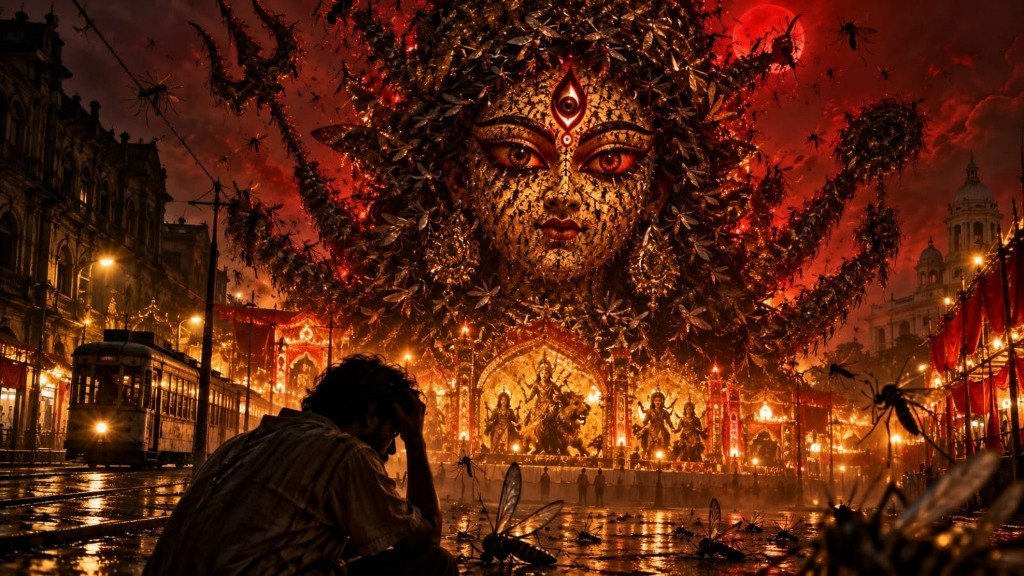
Below her, Bowbazar was a river of people. The Ashtami crowds had carried on past midnight, surging through the lanes toward Central Avenue, children on shoulders, phones held high to photograph the goddess, her face gold and terrible and kind. The loudspeakers were playing the familiar invocation. The dhaks were pounding. The air was thick with incense and sweat and fried food and the sweet, sweet smell of burnt sugar.
Bubbles clung to the window grille. Small ones, packed together like eggs. As she watched, a cluster loosened, rose, and drifted out into the light above the street.
There were more on the curtains. On the ceiling. On the pillow where her open mouth had been.
She had been asleep for hours.
Rina went to the window.
A man looked up. Then a woman. Then a child on a father’s shoulders. They looked up at the sound—the two-note drone coming from her chest—and they smiled. They smiled, all of them, the ones close enough to hear, and they breathed in deep, glad breaths of the October night.
The man raised his hand. “Ma?”
He was older than Rina’s father.
The woman beside him began to laugh and cry at the same time. The child leaned so far toward the window that his father caught him by the ankles. All along the pavement, people were stopping beneath the drifting bubbles, holding out their hands, making the little, unbelieving sounds people make when somebody they have been waiting for finally comes home.
Rina reached for the latch.
Her hand went past it and opened, palm upward, in a gesture of welcome.
She tried to shout a warning. She felt the words form, felt her tongue find the first of them, felt something move gently around it, the way her mother used to move her hand around a pencil when she was teaching her to write.
“Come up,” her mother called from Rina’s mouth. “There’s enough for everyone.”
The crowd shifted toward the entrance of her building.
Somewhere on the stairs, Mrs. Ghosh began to sing.
Rina tried to bite her tongue. Her jaw would not close. There was only the sweetness now, filling the space where the pain should have been, the shame should have been, the last small, stubborn part of her should have been. She could feel her mother’s palm between her shoulder blades. She could smell her grandmother’s kitchen. For one terrible instant she was six years old, and everyone she loved was alive, and she wanted the people below to have it too.
She leaned farther out.
The crowd opened its mouth. The city breathed in.
And from every throat on the street below, one by one, the note came back.
Word Cloud
Related reading
Selected by shared topics and section, with closer publication dates breaking ties.