Ashtami Approach
Uses the speech voice supplied by your browser or device.

THIS IS A WORK OF FICTION
The first officer was still wearing his sister’s red thread on his wrist when the instrument panel went dark.
Not all of it. Not all at once. That would have been kind. The altitude figures flickered, the artificial horizon froze, and then the screens in front of him turned into black mirrors reflecting his own face back at him—twenty-six years old, sweating through his uniform shirt, mouth open like a man about to ask a question he already knew the answer to.
“Captain,” he said. “Sir.”
Captain Mehra was looking at his own displays. One blinked off and returned. Another filled with warnings. Somewhere behind the panel, something clicked repeatedly, a small, domestic sound, like a ceiling fan trying to start.
“Sir, I’ve lost the flight instruments on my side.”
“Standbys?”
Vikram looked at the little instruments between them. Airspeed. Attitude. Altitude. Still there. Still working. He had been looking so hard at what had disappeared that he had forgotten what remained.
“Available, sir.”
“Then use them. Fly the plane.”
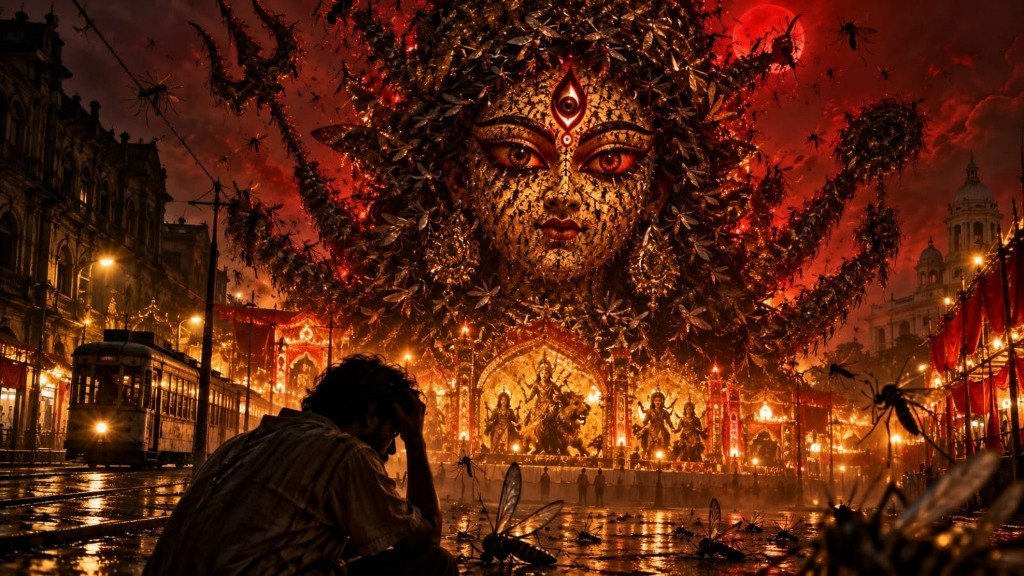
Outside, the sky over Calcutta on Ashtami night was full of light. Not city light. Festival light. Strings of bulbs in geometric patterns, strobes, rotating beams, a thousand small suns arranged in the shape of devotion.
Vikram had his license, his type rating, and ninety hours on the 747. He had a mother in Salt Lake who still packed him lauki ki sabzi in steel tiffins. He had a training loan of forty lakh rupees and a bank that sent him cheerful messages about it. He had a sister who had tied that red thread on his wrist before he left, her hands smelling of mustard oil and marigold, and said, “Come back before the visarjan. Don’t be late.”
He was going to be late.
The Boeing 747-400, charter flight 217 from Dubai, was descending through eight thousand feet with 312 passengers aboard. Some had saved for years to come home for the pujas. Some had left the booking until the last possible moment and paid for that mistake with money they would not have by Diwali.
They had already been delayed for more than an hour. The engines were running. The aircraft was controllable. There was still time to stop descending.
Mehra reached for the checklist.
Then the city appeared through a break in the haze, and he looked up.
In the cabin, Mrs. Sen in seat 34A was arguing with her husband about whether they should have come a day earlier.
“Yesterday’s tickets were twice the price,” her husband said. “You saw the price.”
“I wanted to be there for Ashtami anjali.”
“You knew this was a night flight.”
“I know what I knew. We were supposed to land at ten. Now look.”
She held her watch toward him as if he had personally arranged the delay.
“We’ll still have Navami,” he said.
“My mother has been waiting since yesterday.”
He looked down at his hands. There was no useful answer to somebody else’s mother.
A child in the row ahead began to cry. Not the bored crying of a tired toddler, but a sudden, sharp wail as the aircraft banked and the engine note changed, as something in the enormous room around them shifted without anyone announcing why.
Mrs. Sen looked out the window. They were passing through cloud, or smoke, or something between the two. Below, the city was a circuit board of gold. As they descended, the pandals emerged—dozens of them, each one a temporary palace of cloth and bamboo and light.
Then she could see the queues.
She thought: We are too low.
She thought: That is the pandal with the LED avenue. I read about it in the paper. Forty lakhs just for the lights.
The letters on its entrance arch slid beneath her window, enormous and briefly legible.
She thought: We are low enough to read the welcome.
In the cockpit, Vikram had made a decision. This was the moment the investigation would later dissect, the moment the psychologists would map, the moment his mother would refuse to believe.
The electrical fault had taken his displays and one radio. The other radio still worked, but the frequency was crowded, voices stepping on voices, instructions arriving while Mehra read out warnings and Vikram tried to keep the aircraft steady. They had been turning toward the final approach when the trouble began. Now neither man was properly checking where that turn had left them.
And then, through the windshield, Vikram saw it.
Two straight rows of white lights, with blue lights scattered beyond them. Extending into the haze, with the perspective of a vanishing point, with the geometry of salvation. The far end was hidden. His mind supplied it.
“Captain,” he said. “Runway in sight. Left eleven o’clock.”
Mehra leaned forward.
He had slept badly in Dubai. He had been awake longer than he cared to think about. He had landed at Calcutta for nineteen years, and exhaustion had reduced those nineteen years to a single useful certainty: he knew where the airport was.
“Yes,” he said. “There she is.”
Vikram transmitted that they had the runway in sight. Before the controller could finish answering, Mehra began calling for the landing checks.
The small, stubborn part of Vikram’s mind that wanted another confirmation was relieved of its duties.
They lowered the landing gear. They set the flaps. The aircraft settled into its descent, too fast, with the lights sliding toward the middle of the windshield.
Vikram called out the height from the standby altimeter in a voice that sounded confident because he had practiced this sound in the shower, in front of mirrors, in his head during the long nights in the hostel when he dreamed of this moment, of being the one with his hands on the yoke, of bringing three hundred people home to their mothers.
“She’s beautiful,” Mehra said, looking past him at the illuminated city. “Every year.”
The lights grew closer.
There should have been more darkness around them. A space cleared for an aircraft. Instead, there were lights against lights, rooftops against rooftops, and the two white rows were narrowing into something that seemed much too small.
“Captain. That doesn’t look wide enough.”
“It’s the haze. Keep coming.”
A warning sounded. Vikram glanced at the surviving display, then back outside. Mehra was still looking ahead. Still calm. His calm was the last instrument Vikram trusted.
The controller’s voice broke through: “Two-one-seven, go around. Go around.”
“PULL UP,” said the aircraft.
Between the lights, the surface moved.
It took Vikram a second to understand that the movement was people.
He pushed the thrust levers forward and pulled back on the yoke. Mehra’s hand struck his, helping or stopping him; afterward, Vikram would not be able to remember which.
The engines began to answer.
The 747 crossed the boundary of the pandal at one hundred and eighty knots.
The committee had spent eleven months planning the pandal. The idol’s maker, a third-generation craftsman from Kumartuli, had sculpted the goddess’s face with his own hands, had painted her eyes last of all, had wept when he finished them because they were so lifelike. The bamboo framework around her was lashed with jute rope. Above it, fabric had been stretched into the shape of a palace that would never have to survive a monsoon.
The lights—forty thousand of them—had been installed by a contractor from Chandannagar who specialized in Jagaddhatri-style illumination. Along the approach road, his white LEDs ran in parallel rows above the queues, while blue bulbs marked the fences and side entrances. From the ground, the effect was a procession toward heaven.
He had promised the committee that their pandal would be visible from aircraft.
He had meant to people looking down.
The committee had spent their budget on the lights and cut corners on the fire safety. There was one extinguisher, hidden behind the sound system. There were two exits, both leading to the same narrow lane. There were five thousand people inside the enclosure at that moment, and another ten thousand in the queue outside, shuffling forward in the humid night, smelling of sweat and dhunuchi smoke and the sweet, cloying scent of khichuri being served at the community kitchen.
Some heard the engines and looked up.
Some followed the eyes of the people looking up.
Most were still looking at the goddess.
The plane hit the bamboo roof at 11:47 PM.
It did not explode immediately. First the roof vanished into it. Fabric wrapped around the nose and tore away. Bamboo burst along its length. The LED arrays sparked and died in cascades, and the goddess’s painted face disappeared beneath the descending belly of the aircraft.
The left wing struck the concrete upper story of a building beside the enclosure. The aircraft slewed. An engine tore through the shops beyond it. Metal opened, fuel sprayed across the road, and the wreckage supplied more than enough sparks.
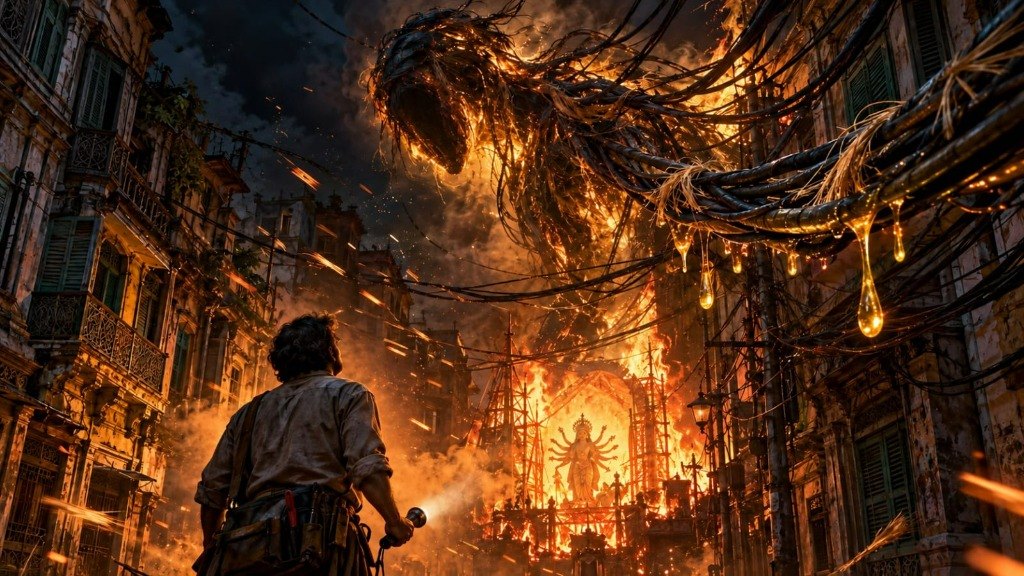
The fire rose above the roofs.
Across Dum Dum, people turned toward a light their committees had not paid for. Farther away, on terraces where the sound had not yet arrived, they watched the horizon brighten and waited for the fireworks to begin.
In a neighboring pandal, a priest looked up with a flower still in his hand and thought, for one confused second, that the goddess herself had descended in flames.
Vikram survived the initial impact inside a section of the nose that tore free and slid beyond the main fire. It struck a wall, rolled, and stopped against the remains of a shuttered workshop.
He remembered none of this.
He woke upside down, hanging from his harness, with the night visible through a place where the cockpit wall had been. Mehra hung beside him. His head rested at an angle Vikram could not keep looking at.
There was a sound like an enormous animal trying to breathe. For a few seconds, Vikram thought it was the aircraft. Then the sound separated into voices.
He released his harness and fell. His right arm folded beneath him in a way an arm should not fold. He crawled toward the opening, dragging it. His face was burned. He did not feel that yet.
He emerged into a lane that no longer existed.
The buildings nearest the wreckage had been opened to the night. A bed hung over the edge of a broken floor. A calendar remained on a wall with no room attached to it. Farther down, where the fire had not reached, people were throwing buckets of water at something too large to understand.
A man sat in the middle of the road, apparently unhurt, holding a shoe that was not his. A woman walked in circles, calling a name. A child sat on a pile of rubble, eating from a packet of chips with mechanical, rhythmic bites.
Vikram got to his feet. He fell once, got up, and walked. He did not know where he was going.
He passed a body covered with a banner from the pandal—Jai Maa Durga—and understood, in some deep place beneath the shock, that he had done this. That he had looked at a festival and seen an airport. That he had killed the goddess and her children in one stroke.
At the mouth of another lane, a man in a torn committee T-shirt was trying to arrange an ambulance. He looked at Vikram’s face, then at the arm hanging beside him.
“Sit down,” he said. “Don’t walk.”
Vikram asked for the phone.
He had to say his sister’s number aloud before he could remember how to dial it.
She answered on the second ring. Behind her voice he could hear the sounds of his mother’s house: the television, the neighbors, a conch shell blowing somewhere beyond the window. All of it still going on. All of it appallingly intact.
He said her name.
“Vikram? Whose number is this? Where are you? Maa is waiting.”
“I’m here,” he said. “I’m in Dum Dum.”
“Good,” she said. “Come home. She kept food for you.”
He looked at the fire. He looked at the shoe in the road, the woman calling the name, the child eating chips.
“I’m trying,” he said. “I think I’m lost.”
He sat down on the curb of a street that ended in the side of his aircraft, and he waited for someone to find him, to arrest him, to save him, to tell him what he already knew: that he had seen the lights, that the lights had been beautiful, that he had wanted, more than anything, to land.
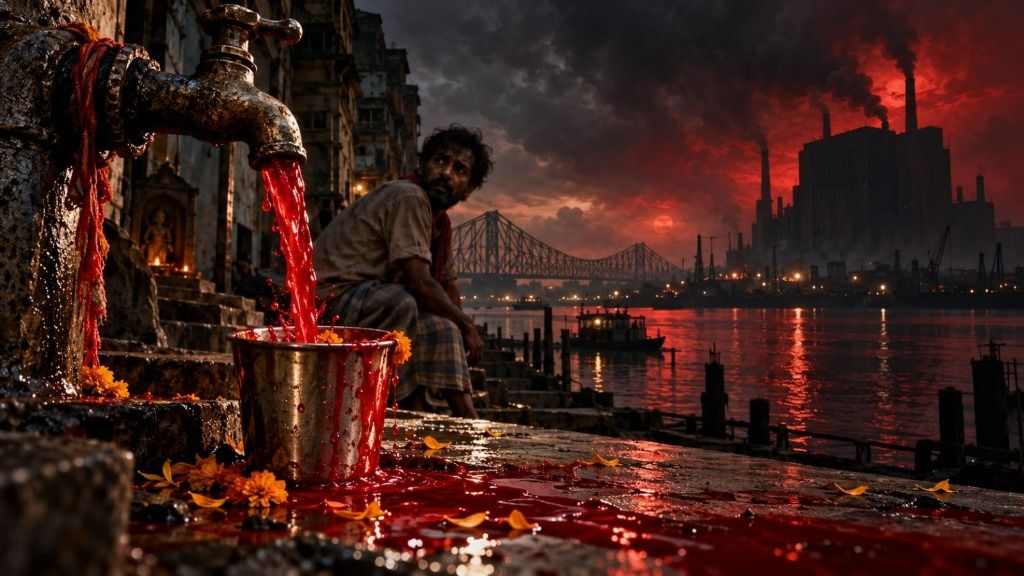
Water from a broken main was running along the gutter. Blood entered it farther up the lane. Somewhere, his sister was still saying his name into a borrowed phone.
The red thread on his wrist was black with soot. He worked it loose with his good hand and let it fall into the water, where it turned in the current like a small, exhausted flame.
Word Cloud
Related reading
Selected by shared topics and section, with closer publication dates breaking ties.