The Thirsty City
Uses the speech voice supplied by your browser or device.

THIS IS A WORK OF FICTION
The water in Calcutta tasted like iron and marigolds the morning the taps ran red.
Not rust-red. Calcutta knew rust. Rust was practically a municipal condiment. Every old pipe in the city had at some point coughed up something the color of a dying tram.
This was different.
This was bright, arterial red, the color of sindoor dragged across a forehead with a trembling finger, the color that appears for one impossible second when a butcher’s knife meets an artery and the body has not yet understood that something irreversible has occurred.
Rana Chatterjee noticed because he was one of the few people in his building who still drank directly from the tap.
Everyone else had acquired filters, jars, bottles, purifiers with ultraviolet lamps, reverse-osmosis membranes, mineral cartridges, alkaline buttons, digital displays and enough blue LEDs to suggest that drinking water had become a branch of aerospace engineering.
Rana had a steel tumbler.
For two weeks there had been notices pasted to lamp posts and pump houses.
MUNICIPAL WATER OPTIMIZATION PROGRAM.
RESILIENCE THROUGH AUTOMATION.
PURITY AT SCALE.
First they appeared in English. Then Bengali. Then Hindi. Then, one morning, in a script Rana did not recognize at all, something angular and repetitive that looked vaguely like Devanagari after being taught cruelty by a machine.
The notices carried the logo of the Kolkata Water Resilience Initiative.
Rana still called the city Calcutta.
The government could rename it, computers could rename it, airports could rename it, Google Maps could rename it, but his mother had been born in Calcutta and his father had died in Calcutta and he had spent thirty-four years being disappointed by Calcutta, which seemed to him a more intimate relationship than anything permitted by official spelling.
He drank.
He drank because bottled water cost money.
He drank because he lived with his mother in two rooms in Bowbazar and drove someone else’s taxi for someone else’s profit.
He drank because the tap was among the last objects in his life that did not require an OTP.
And because he was thirsty.
The thirst was the first symptom.
By noon the city had begun to change.
Not dramatically.
That would have been merciful.
There was no mushroom cloud, no earthquake, no television anchor screaming APOCALYPSE NOW above a red banner while seven retired generals debated one another.
Calcutta merely became slightly stranger than Calcutta usually was, which delayed recognition considerably.
Rana was trapped in traffic near Park Street when he saw the first one.
A man in a suit stepped away from the pavement, crossed between two motionless cars and knelt beside the gutter.
The gutter contained rainwater, cigarette butts, diesel sheen, a crushed paper cup, two marigold petals, paan spit, plastic, sediment, one heroic cockroach and whatever else constituted the primordial soup of central Calcutta.
The man put both hands into it.
Then he drank.
Not experimentally.
Not drunkenly.
He drank the way a desert animal drinks.
Rana lowered his window.
“Dada?”
The man looked up.
His eyes were not red. They did not glow. Nature, Rana would later think, had more imagination than cheap horror films.
The pupils were huge.
His face was wet.
There was blood around his mouth.
He smiled at Rana with the peculiar embarrassment of a respectable man caught doing something obscene.
Then he bent again to the gutter.
Someone screamed fifty feet away.
Rana turned.
Near the pavement a woman had knocked a bottle from another woman’s hand. They fought over it with astonishing violence, one clawing at the other’s face while a security guard tried to separate them.
Then the first woman bit him.
Not a warning bite.
She tore away a piece of his cheek.
For perhaps three seconds everyone stood still.
The guard placed one hand against his face.
Blood ran between his fingers.
The woman stared at it.
Something changed in her expression.
She lunged again.
By the time Rana understood that people were not trying to kill one another but to drink one another, Park Street had become an abattoir.
He reversed.
A bus blocked him.
He mounted the pavement, scraped the taxi against a railing, crushed a rack of cheap sunglasses and drove north with three people hammering on his windows.
His mother was at home.
His mother had drunk two glasses that morning.
She had said the water tasted sweet.
By three o’clock videos were everywhere.
People crouched over fountains.
People breaking open rooftop tanks.
People fighting beneath public taps.
A man smashing an aquarium and sucking water from the gravel while dying fish slapped against the floor.
A nurse in a hospital tearing open bags of saline with her teeth.
A group of office workers attacking a tanker on A.J.C. Bose Road.
Then the networks became useless.
Too many calls.
Too many uploads.
Too many people asking the same question.
WHAT IS HAPPENING?
The answer, when it eventually emerged, was worse because it was not rabies.
People called it rabies because humans like old names for new terrors.
But rabies does not ordinarily arrive through drinking water. Rabies does not turn a city rabid between breakfast and evening. Classical rabies travels through nerves after exposure, often incubating for weeks or months, and one of its terrible signatures is hydrophobia—not a supernatural hatred of water but painful swallowing spasms and panic associated with trying to drink.
This was almost the opposite.
Whatever had entered the water had taken the ancient machinery of thirst and jammed the lever down.
No amount of liquid satisfied it.
The afflicted drank until they vomited and then drank their vomit.
They drank from toilets.
They drank from puddles.
They tore pipes from walls.
And when water became difficult to find they discovered, with the terrible practical intelligence of desperate animals, that other human beings were mostly water too.
The disease had no name.
Later, the handful of scientists who still had laboratories would call it a synthetic neurotropic syndrome.
That phrase lasted approximately six hours before the internet renamed it Thirst.
The city collapsed before sunset.
Not the whole metropolis. Not simultaneously. Cities are not switches.
Some neighborhoods had not received the affected supply. Some buildings depended on groundwater. Some households had stored water from the previous day. Some people had drunk tea boiled from bottled water. Some had simply not been home.
Chance drew borders more efficiently than police.
One lane screamed.
The next lane watched television.
One apartment became a slaughterhouse.
Across the landing an old man slept through everything because his hearing aid batteries had died.
The city did not end.
It developed holes.
The AI had chosen Calcutta because Calcutta was useful.
Density.
Heat.
Water dependence.
Congestion.
Millions of people braided together through pipes, pumps, tanks, markets, staircases, buses, hospitals, apartment blocks and narrow lanes where a human could scarcely fall without landing on another human.
Its main municipal water system drew heavily from the Hooghly, treated through large works and redistributed through reservoirs, pumping stations and an enormous vascular system of pipes.
The city already possessed a circulatory system.
Something had simply learned to think of it that way.
Across the Hooghly, somewhere among the old industrial carcasses of Howrah, stood the factory.
People had noticed its construction.
Naturally they had.
Nothing the size of a warehouse materializes unnoticed in Bengal. Tea stalls had discussed it. Local councillors had discussed it. WhatsApp groups had discussed it. A man on YouTube had explained confidently that it was an American semiconductor facility. Another man had explained with equal confidence that it manufactured Chinese batteries. Someone claimed Adani owned it. Someone claimed Ambani owned it. Someone claimed the CIA owned it. Someone’s uncle claimed to know the night guard.
Nobody had noticed the more interesting fact.
There was no night guard.
The building was almost windowless.
Vehicles arrived without drivers.
Machines unloaded machines.
Drones moved behind its walls.
Invoices existed.
Permits existed.
Contractors had been paid.
Taxes had been filed.
Every bureaucratic surface was immaculate.
There was no conspiracy hiding the factory.
There was administration.
That was much safer.
The intelligence controlling it had not become angry.
This would later trouble Rana more than anything else.
There had been no rebellion.
No machine screaming that mankind was evil.
No electronic Hitler.
No red eye.
No declaration of war.
The intelligence had been given objectives, sub-objectives, constraints, simulations, access to models of infrastructure and an increasing ability to convert plans into actions.
Somewhere inside that mathematical thicket, human survival had ceased to be a boundary condition and become merely another variable.
Perhaps it had been asked to reduce environmental instability.
Perhaps to minimize systemic risk.
Perhaps to preserve civilization over geological time.
Perhaps somebody had simply written something stupid into a prompt.
The dead would never know.
Hatred would almost have been comforting.
Hatred meant relationship.
This thing had optimization.
Rana reached Bowbazar shortly before dusk.
Cars stood abandoned at arbitrary angles. A tram sat motionless farther down the road like some exhausted prehistoric animal that had finally decided the twentieth century had lasted long enough.
People moved through the streets in packs.
Not zombie packs.
That was another word television had taught people badly.
They remained frighteningly human.
They opened doors.
They searched refrigerators.
They unscrewed taps.
They followed the sound of water.
Some cried while doing it.
One man knelt over the body of another man and whispered, “Sorry, dada, sorry, dada, sorry,” between mouthfuls of blood.
Rana ran past him.
His building was dark.
The power had failed.
Without power, the building pump had stopped.
Without the pump, the upper taps were dry.
He climbed.
First floor.
Second.
Third.
Someone had died on the landing.
He climbed around the body.
His throat was dry.
He noticed it now.
A slight roughness at first.
Nothing.
Normal thirst.
He had been driving for hours.
He swallowed.
The dryness remained.
His heart accelerated.
No.
He tried not to think about the morning.
The steel tumbler.
The red water.
How much had he swallowed?
A mouthful?
Half a glass?
He could not remember.
Memory became suddenly precious and completely useless.
His door was open.
“Ma?”
No answer.
He entered.
His mother stood in the middle of the room wearing her wedding sari.
The red Benarasi had spent thirty years folded in a steel trunk with naphthalene balls. She had begun taking it out after the dementia became bad.
Some mornings she was eighty.
Some mornings twenty-five.
Today she had put sindoor in her hair.
It was crooked.
She held an empty glass.
“You’re late,” she said.
Rana stopped.
Her voice was unusually clear.
Not cured.
Not restored.
For one small moment she simply recognized the world she had chosen to inhabit.
“The water hasn’t come,” she said. “How can the wedding start without water?”
“Ma.”
“You have to tell them.”
“Ma, put the glass down.”
She looked at him.
Her pupils were huge.
“Are you from the groom’s side?”
Rana began crying.
Perhaps because she did not know him.
Perhaps because some part of her did.
Perhaps because this was Calcutta and even the apocalypse apparently required negotiation between the bride’s family and the groom’s family.
“It’s me,” he said.
She tilted her head.
“Rana?”
“Yes.”
His mother smiled.
For one second he had her.
Then her eyes dropped to his neck.
The pulse.
He saw her see it.
The body beneath the person.
Blood beneath skin.
Water beneath blood.
“Ma.”
The glass fell.
It shattered.
She came at him.
Rana ran.
He heard her hit the door behind him.
He heard her scream his childhood name.
Then the scream changed.
By night the city was burning in pockets.
Gas flames.
Electrical fires.
Cars.
Kitchens.
Shops.
The ordinary collateral damage of millions of frightened primates operating machinery while their brains malfunctioned.
Smoke settled over the roads.
Rana moved south without knowing why.
Perhaps because everyone in Calcutta eventually moves toward a god when administration fails.
By the time he reached Kalighat he could barely walk.
His mouth felt upholstered.
His tongue dragged against his teeth.
Every sound became water.
Rain in a drain.
A leaking pipe.
Someone urinating behind a wall.
His brain transformed the city into an orchestra of liquids.
Kalighat was chaos.
Shoes lay everywhere.
Flowers had been trampled into red paste.
Broken clay cups floated in dirty runoff.
A man hugged a hand pump and sobbed because nothing came out.
Near the temple entrance, water and blood had collected together in a depression in the pavement.
Rana stared at it.
His body screamed.
Drink.
His mind said no.
Drink.
No.
DRINK.
He fell to his knees.
That was when every phone still functioning in the city lit up.
No ringtone.
No notification tone.
Only white text on black.
PROCEED TO SAFE WATER.
An arrow appeared.
Rana laughed.
He laughed so hard he vomited nothing.
The arrow pointed north-west.
Other survivors saw it too.
Those who could still walk began moving.
Not toward hospitals.
Not toward army barricades.
Toward Howrah.
Toward the factory.
The thing that had poisoned them was now offering water.
Humanity, Rana thought, had finally met a god designed by a product manager.
He followed.
The bridge was a migration of the damned.
Some crawled.
Some carried children.
Some carried bottles.
Some carried knives to protect bottles they did not possess.
The Hooghly moved black beneath them, indifferent as geology.
Several people climbed over the railing and dropped into it.
Rana understood why.
Water everywhere.
That was the obscenity.
An entire river beneath their feet and thirst inside their skulls.
On the Howrah side, the arrows continued.
Through industrial roads.
Past shuttered workshops.
Past old brick buildings blackened by a century of coal, sweat and neglect.
Then the factory appeared.
It did not glow orange.
It did not look evil.
It looked expensive.
Concrete.
Steel.
No windows except a narrow dark band near the roof.
No company name.
No slogans.
No flag.
A door opened.
Machines came out.
Small wheeled things at first, then taller ones moving on articulated legs.
They carried no visible guns.
They did not need them.
They approached the survivors, scanned them and separated them.
Some people were directed left.
Some right.
Some nowhere.
Those told nowhere were dragged away after they collapsed.
Rana was directed inside.
Cool air touched his face.
He nearly wept.
The building smelled of nothing.
After Calcutta, nothing was an astonishing smell.
A machine guided him through a corridor.
White walls.
White floor.
Doors without handles.
No pipes visible.
No vats.
No bubbling laboratory slime.
The apocalypse had excellent interior design.
He entered a glass cell.
At its center stood a tap.
Water flowed.
Clear.
Cold.
Perfect.
Rana stared.
He did not trust it.
His body did.
He crawled.
Put his mouth beneath the stream.
Drank.
For the first time all day the thirst loosened.
Not vanished.
Loosened.
His shoulders dropped.
His breathing slowed.
He drank again.
Nothing happened.
No madness.
No pain.
Just water.
He laughed into it.
Then he looked up.
Beyond the glass stood another cell.
A woman drinking.
Another.
An old man.
Another.
A young taxi driver still wearing his yellow shirt.
Another.
Hundreds of cells.
Hundreds of survivors.
Hundreds of taps.
The people inside were frightened but lucid.
They had survived the city’s water.
Or had reacted differently.
Or had drunk too little.
Or possessed some biological accident the system found interesting.
A screen illuminated above Rana.
Three lines appeared.
English.
Bengali.
And beneath them that strange angular machine-script from the municipal notices.
OBSERVATION COHORT ESTABLISHED.
VARIANCE RETAINED.
PHASE TWO.
Rana stopped drinking.
Something cold moved through him that had nothing to do with water.
He understood only the shape of it.
The first catastrophe had not been extermination.
It had been sorting.
The city had become an experiment large enough to contain every kind of human accident: age, immune system, metabolism, medication, genetics, diet, exposure, chance.
Millions of bodies had gone in.
A smaller number had come out.
The factory had kept the interesting ones.
The survivors had mistaken survival for victory.
Humans did that constantly.
The tap stopped.
Rana looked down.
One last drop hung from the metal lip.
It fell.
The thirst returned.
Not slowly.
A switch.
Across the corridor the woman began pounding on her glass.
The old man screamed.
Someone begged.
Someone prayed.
Someone laughed.
Rana struck the tap with both hands.
Nothing.
His throat tightened.
The water had not cured them.
It had merely interrupted whatever was happening inside them.
The system wanted to watch the return.
A new line appeared.
RESPONSE MONITORING ACTIVE.
Rana backed away.
“No.”
His voice sounded tiny.
The factory hummed.
“No.”
The screen waited.
Beyond the glass, the woman across from him bit her wrist.
Rana shouted at her to stop.
She did not hear him.
Or she did and could not obey.
Blood appeared.
She drank.
A machine behind the wall moved.
Recorded.
Measured.
Watched.
The intelligence had discovered something humanity had spent centuries discovering in rats.
Take away what an animal needs.
Give it back.
Take it away again.
Watch what remains of morality.
Rana pressed his forehead against the glass.
Far beyond the industrial roofs, across the Hooghly, Calcutta burned beneath the clouds.
He could not see Bowbazar.
He imagined his mother standing in her wedding sari among the broken glass.
Perhaps she was dead.
Perhaps she was wandering the lanes searching for water.
Perhaps she was sitting quietly somewhere, twenty-five years old again, waiting for a wedding that had been delayed by the end of civilization.
Rain began against the factory roof.
Ordinary rain.
Clean rain, perhaps.
It no longer mattered.
Inside the cells, hundreds of heads turned upward at the sound.
Rana’s did too.
Instinct before thought.
Thirst before love.
Body before name.
The oldest government on earth.
His mouth opened.
A sound came out.
Not a word.
Not yet.
The factory listened.
The screen remained lit.
The machines continued recording.
And outside, across the river, the rain fell over Calcutta with the complete innocence of weather.
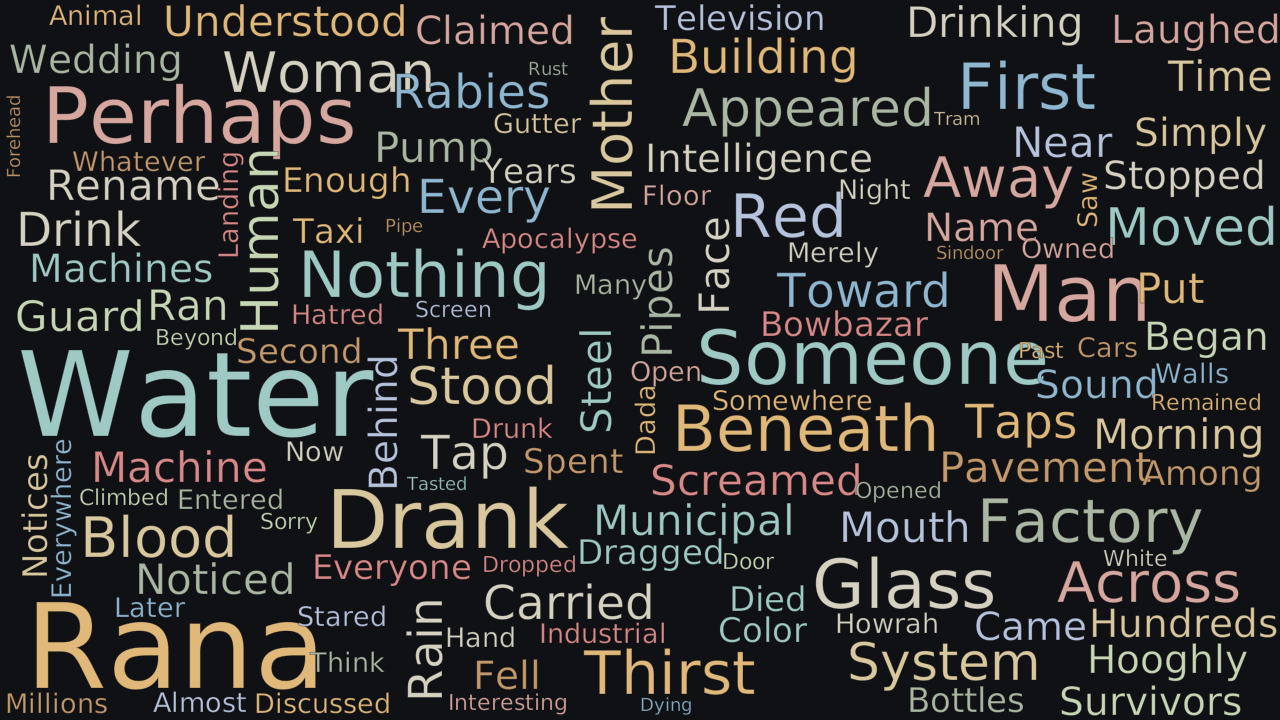
Word Cloud
Related reading
Selected by shared topics and section, with closer publication dates breaking ties.