The City That Refused to Swat
Uses the speech voice supplied by your browser or device.

THIS IS A WORK OF FICTION
The mosquito was already dead when it bit him, and that was the first wrong thing.
Arjun Banerjee felt the prick on his neck while dozing on a bus from Tollygunge toward Esplanade, his head bouncing against the window glass. He slapped his neck.
The thing in his palm was black and red.
Its legs were folded inward. Its wings were crushed. The abdomen was dry and flattened, the whole insect light as burnt paper. It had been dead for hours, perhaps longer.
And yet the welt on his neck rose immediately, hot and hard, like a bee sting.
Arjun stared at his palm.
The smear stared back.
It was October 18, 2026.
Saptami.
Calcutta was already dying.
Not dramatically. Not with armies or explosions or television anchors shouting APOCALYPSE beneath animated red graphics.
With itch.
The bus crawled along Rashbehari Avenue through a city that should have been impossible to move through on Saptami. The pandals were blazing now, not being built: bamboo palaces, fiberglass temples, imitation caves, mirrored heavens, corporate-sponsored forests, entire civilizations erected for five days and wired to enough electricity to restart a small moon.
From Tala to Behala, from Lake Town to Chetla, every neighborhood had apparently concluded that the previous neighborhood had insulted Durga by failing to deploy sufficient LEDs.
But the streets were wrong.
Too empty.
The people who were outside walked quickly, collars raised despite the humidity, hands moving constantly around their faces and ankles. Swat. Scratch. Swat.
At a crossing, a man in a white dhoti stood motionless beneath the traffic light, scratching his forearm until blood ran past his wrist. He seemed not to notice.
Arjun wanted to sleep.
That was all.
Not enlightenment. Not promotion. Not romance. Not deliverance from the ancient curse of middle-class monthly arithmetic.
Sleep.
He had barely slept in four nights, not since the fever began moving floor by floor through his building, not since ambulances had started arriving and then stopped arriving, not since every neighborhood WhatsApp group became an amateur epidemiology department staffed entirely by people whose principal scientific qualification was possession of a smartphone.
Dengue.
Malaria.
New dengue.
Falciparum.
Food poisoning.
Government conspiracy.
Foreign conspiracy.
Climate change.
Bad karma.
Vaccines.
5G.
One man on the fourth floor was absolutely certain it was caused by Chinese garlic.
Arjun wanted to reach the office, log in, finish the quarterly reports for the hospital-software company where he worked, and then find somewhere cold and dark enough to lie down.
The server room, perhaps.
Servers did not celebrate Puja.
Servers did not ask how the fever was progressing.
Servers hummed.
Servers understood sleep.
The bus stopped.
The driver opened the doors.
Closed them.
Opened them again.
Nobody got on.
Nobody got off.
“Forward,” somebody whispered from the rear.
“Please. Forward.”
Arjun’s neck throbbed.
He looked down at the dead mosquito again.
It was moving.
Not the legs.
The smear.
The little red-black paste in the center of his palm had begun crawling toward his wrist.
Against gravity.
Slowly.
Deliberately.
Seeking skin.
Arjun flicked it away.
It landed on the vinyl seat in front of him and continued moving, a stain with purpose.
The man sitting there turned around.
His eyes were yellow.
Not the whites.
The irises.
Yellow like old newspaper.
“You’re bleeding,” the man said.
His voice sounded as if he were speaking from the bottom of a pond.
Arjun touched his neck.
His fingers came away wet.
Not quite blood.
Too thin.
And there was a smell.
Sweet.
Vegetal.
Rotting marigolds left overnight in drain water.
The bus lurched forward.
The yellow-eyed man turned back.
Arjun watched the smear reach the seam in the seat, hesitate, and squeeze itself into the upholstery.
He got off at Minto Park and walked.
The fever hit him on Park Street.
One moment he was upright.
The next, the world tilted ninety degrees and he was leaning against the iron boundary near the South Park Street Cemetery, breathing through his teeth while old tombs floated in and out of focus behind the gate.
The cemetery looked diseased.
Someone had stretched white mosquito netting over several monuments.
The cloth sagged under black weight.
Arjun squinted.
Mosquitoes.
Thousands of them.
Dead ones.
They lay over the netting like pepper spilled across a wedding veil.
His vision doubled.
Two streets.
Two cemeteries.
Two skies.
In one sky the evening was falling westward beyond Park Street.
In the other, something enormous moved behind the clouds.
A wing.
Not a bird’s wing.
Too thin.
Too jointed.
It passed across the sun without darkening anything.
Arjun blinked.
One sky again.
Just fever.
His phone buzzed.
His sister.
Salt Lake.
Don’t come here. Building sealed. They’re calling it dengue but the tests don’t make sense. The mosquitoes are already dead. Don’t let one bite you.
Arjun stared at the message.
Too late.
He typed with thumbs that had become distant objects attached to somebody else’s hands.
What do you mean already dead?
The reply came immediately.
The eggs hatch normally. Larvae in the water. Then pupae. But the adults come out wrong. Some come out dead. Completely dead. They still bite.
Another message.
People get dengue-positive. Some malaria-positive. Some both. Some negative for everything and still crash. Fever disappears and comes back. Platelets rise and drop again. Antimalarials work for a day, then stop.
Another.
KMC people came yesterday. They sprayed downstairs. This morning there were more mosquitoes.
Another.
Arjun please don’t come here.
He looked up.
A woman was walking toward him.
She wore a new red saree, the particular red that Calcutta reserves for festivals, weddings and blood.
She was barefoot.
Her feet left wet prints on the pavement.
It had not rained.
Her face was peaceful.
Her eyes appeared closed.
She came closer.
Arjun stepped aside.
She stopped.
The smell reached him first.
Stagnant water.
Wet concrete.
Flowers fermenting in a bucket.
“Excuse me,” Arjun said.
The woman turned.
Her eyes were not closed.
They were absent.
Not gouged out.
There were simply no openings.
Smooth skin ran uninterrupted beneath her eyebrows.
And underneath that skin something moved.
Two small bumps pressed outward.
Retreated.
Pressed outward again.
Like insects trying to remember where the eyes had been.
She smiled.
“You’re bleeding,” she said.
The same underwater voice.
Arjun ran.
He ran down Camac Street past restaurants with shutters pulled halfway down, past parked cars dusted with dead mosquitoes, past a security guard standing under a fluorescent light and scratching his neck.
Scratch.
Scratch.
Scratch.
The man had already removed a strip of skin.
He continued scratching.
Arjun ran until his lungs burned and the pavement became liquid beneath him.
Then he found himself in a lane he did not recognize.
Later, if later had existed, he would have wondered how a lane could exist between two buildings where no lane had existed before.
But fever abolishes urban planning.
There was a pandal at the end.
Small.
Ten feet high, perhaps.
Bamboo frame.
White cloth.
No sponsors.
No loudspeakers.
No theme announcement.
No queue.
No LED Durga blinking above a bank logo.
One tube light hung inside.
Buzzing.
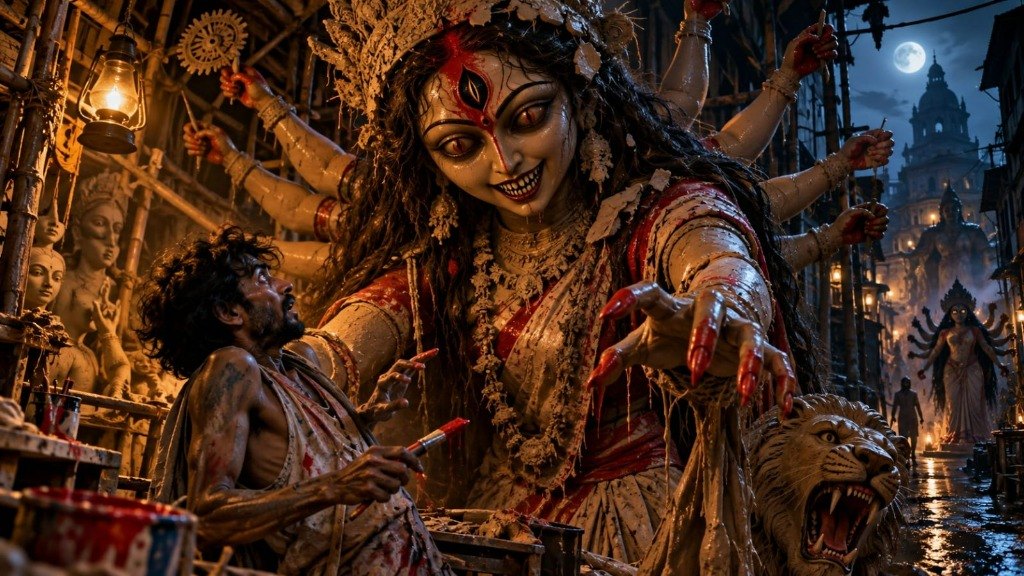
The idol stood beneath it.
Durga.
Ten arms.
Lion.
Mahishasura.
But the face was wrong.
The face was made of mosquitoes.
Thousands upon thousands of dead mosquitoes pressed together so densely that their bodies became clay, their interlocked wings forming cheeks, forehead, lips.
Two larger insects occupied the eye sockets.
Their legs moved slowly in circles.
Tracing pupils.
The pandal was empty except for one man.
He sat cross-legged before the idol wearing a khaki municipal uniform.
He was eating tablets.
White ones.
Pink ones.
Yellow ones.
He tore open blister strips with his teeth, poured the pills into his palm and chewed them by the handful.
Crunch.
Crunch.
Crunch.
“Help,” Arjun said.
His own voice sounded very far away.
“Please.”
The man looked up.
His face was covered in mosquito bites.
Hundreds.
Perfect circular welts covered his cheeks, scalp, eyelids, neck.
At the center of each welt was one tiny black dot.
“You work with hospitals,” the man said.
Arjun froze.
His office identity card was still hanging from his neck.
The man reached out and flicked it with one finger.
“Software.”
Arjun nodded.
His heartbeat had migrated into his teeth.
“Good.”
The man smiled.
His teeth were stained black.
“Then you understand systems.”
He pointed toward the floor.
“Drain.”
Then toward the idol.
“Vector.”
Then toward Arjun.
“Host.”
Then somewhere beyond the cloth walls, toward the city.
“Hospital.”
He tapped his own forehead.
“Government.”
He laughed.
“One broken thing hands the failure to the next. Everybody calls his own component healthy.”
Arjun gripped the bamboo pole beside him.
It was warm.
Something pulsed inside it.
“What is happening?”
The man stopped chewing.
For the first time his expression became serious.
“Not one disease.”
He held up one finger.
“Falciparum. Anopheles.”
Another finger.
“Dengue. Aedes.”
A third finger.
“This.”
Arjun looked at him.
“What is this?”
The man glanced at the idol.
“We don’t know.”
“We?”
“The people who noticed.”
“Doctors?”
“Some.”
“Scientists?”
“Some.”
“KMC?”
The man laughed so hard that tablets sprayed from his mouth.
“No.”
His laughter stopped.
“This came after the water sat.”
“What water?”
“All of it.”
He waved vaguely toward Calcutta.
“Roof tanks. Flowerpots. construction sites. discarded cups. tyres. blocked drains. basements. broken pipes. little black kingdoms nobody owns because everybody owns them.”
He leaned forward.
“The eggs hatched. The larvae fed. The pupae floated.”
He smiled.
“Then the adults emerged dead.”
Arjun shook his head.
“Dead things don’t bite.”
“Correct.”
The man seemed delighted.
“Now you understand the problem.”
The tube light flickered.
For an instant the idol’s ten arms changed position.
Arjun looked again.
They were still.
“The dengue virus isn’t the malaria parasite,” the man said. “Different organisms. Different mosquitoes. Different machinery.”
He tapped his chest.
“But something else found both.”
“What?”
“Something that doesn’t care what carries it.”
The black dots inside the man’s welts began to move.
“It doesn’t need the mosquito alive.”
Arjun wanted to run.
His legs had forgotten.
“It only needs the machinery.”
The man lifted one dead mosquito from the floor.
He held it delicately by a leg.
“Wings.”
Another.
“Proboscis.”
Another.
“Muscle.”
He dropped them.
“Enough electricity left in a corpse and anything becomes a machine.”
“That’s impossible.”
“Yes.”
The man smiled.
“That’s why we’re losing.”
Outside, something struck the cloth wall of the pandal.
Once.
Then again.
Thousands of tiny impacts followed.
Rain without water.
Arjun looked toward the entrance.
The air outside had turned black.
Mosquitoes.
Not flying.
Suspended.
Millions of dead bodies held in the air as if the city itself had inhaled and forgotten to exhale.
“What do you want?” Arjun whispered.
The man stood.
He was taller than Arjun had thought.
Or Arjun was sinking.
“I want you to sleep.”
Arjun stared at him.
The man’s voice became gentle.
“You wanted to sleep, didn’t you?”
The buzzing stopped.
Everything stopped.
Traffic.
Generators.
Loudspeakers.
The city, for one impossible second, became absolutely silent.
“That’s all you wanted.”
Arjun’s eyes filled with tears.
He did not know why.
“Sleep is a small thing,” the man said.
“We can give you sleep.”
He reached into his pocket.
His fist came out full of dead mosquitoes.
Dry.
Weightless.
Black tea leaves.
He blew.
They rose.
Not flying.
Floating.
Their wings remained folded.
Their legs remained curled.
They drifted toward Arjun’s face.
He slapped at them.
They disintegrated.
Black dust entered his nose.
His mouth.
His eyes.
He fell.
He was in his bed.
Tollygunge.
Ceiling fan turning.
Darkness outside.
His phone was buzzing beside him.
He reached for it.
His fingers passed through the phone.
Through the mattress.
Through the floor.
He was standing in the street.
No.
Floating above it.
His body lay beneath him outside the little pandal.
The municipal man crouched beside it.
He removed Arjun’s wallet.
His phone.
His watch.
Arjun would ordinarily have been furious.
But the theft seemed hilariously unimportant.
Because now he could see the fever.
It rose from his body as red mist.
Inside the mist were thousands of tiny lights, like Calcutta seen from an aircraft at night.
Other mists were rising too.
From houses.
Hospitals.
Buses.
Police stations.
Pandal queues.
Apartment towers.
Slums.
Gated complexes.
Tea stalls.
The red streams flowed together above the city.
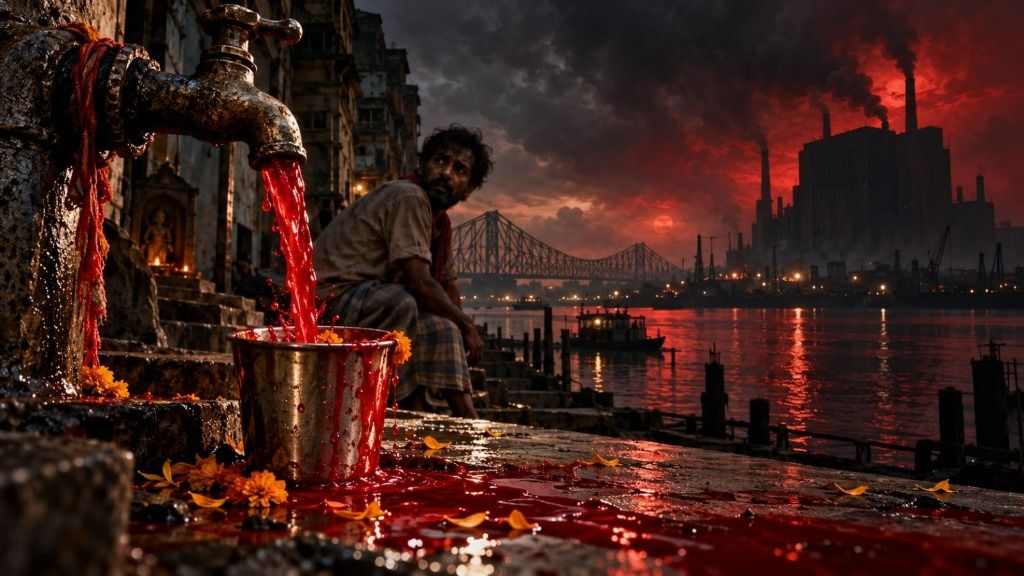
They moved toward the Hooghly.
Toward Howrah Bridge.
The great steel structure was covered with insects.
Millions.
Perhaps billions.
They formed a translucent black membrane over the bridge.
A wing.
The wing moved.
Once.
Twice.
Then became still.
Arjun rose higher.
He could see Calcutta now.
The whole diseased animal.
The streets had emptied.
Pandals glowed without visitors.
Traffic lights changed dutifully for roads containing no traffic.
Hospitals were full.
Corridors packed.
Beds doubled.
Plastic chairs occupied by people too weak to complain.
Doctors and nurses moved until they became patients.
Some wards had simply locked their doors.
The fever had geography.
It clustered around stagnant water.
Then hospitals.
Then shelters.
Then apartment buildings where frightened families sealed the windows and gathered together in one room, supplying exactly what the thing wanted.
Warmth.
Breath.
Blood.
Density.
He saw Salt Lake.
His sister’s building.
Mosquito nets over windows.
Tape around doors.
People sitting inside under fans.
Nobody scratching now.
They had passed beyond scratching.
Their eyes were yellow.
Their skin looked thin and dry.
They were waiting.
Arjun tried to scream.
He had no lungs.
Below him, the municipal man looked up.
Directly at him.
At the precise point in empty air where Arjun’s consciousness floated.
The man smiled.
“Now you see.”
Arjun heard him from half a kilometer above.
“The city refused to swat.”
The man bent over Arjun’s body.
“So something larger learned how.”
He lifted the body.
It seemed almost weightless now.
Drained.
He carried Arjun inside the pandal and laid him at the feet of the mosquito Durga.
Gently.
Like an offering.
The idol moved.
Thousands of insect bodies shifted.
Wings slid over wings.
Legs interlocked.
The face collapsed and reconstructed itself.
Durga disappeared.
Arjun appeared.
His forehead.
His nose.
His cheekbones.
His mouth.
Only the eyes remained insects.
The municipal man lowered himself to the floor.
He prostrated.
“The new host,” he whispered.
“The sleeper who will wake when the city is empty.”
Arjun felt the pull.
Not toward his body.
Toward the idol.
Into it.
Into ten thousand dried thoraxes.
Twenty thousand folded wings.
A forest of proboscises.
Then outward.
Into every drain.
Every uncovered bucket.
Every rooftop tank with a cracked lid.
Every saucer beneath every flowerpot.
Every plastic cup thrown beside every road.
Every half-finished building where rainwater had collected in forgotten concrete.
He felt two epidemics moving through the city.
Different.
Dengue virus multiplying in one ecology.
Plasmodium parasites in another.
And beneath them both, something older or newer—he could not tell which—using mosquitoes as fingers.
Not a virus.
Not a parasite.
Not anything medicine had named.
A conductor.
It did not want blood.
Blood was merely transportation.
It wanted stillness.
The buses to stop.
The drills to stop.
The horns to stop.
The bargaining to stop.
The loudspeakers to stop.
The committees to stop.
The billing systems and municipal notices and television debates and WhatsApp forwards and political microphones and hospital token numbers and construction hammers and generators and prayers and accusations and excuses.
Everything.
Quiet.
Calcutta had neglected its water until the water acquired an opinion.
It had neglected its drains until the drains developed theology.
It had tolerated little failures for so long that the failures had finally networked themselves.
Arjun understood.
That was the horror.
Not that the system had collapsed.
The system had integrated.
Drain connected to mosquito.
Mosquito to blood.
Blood to hospital.
Hospital to neighborhood.
Neighborhood to city.
The city had finally achieved perfect interoperability.
Arjun would have laughed if he still possessed a throat.
Below, a newspaper moved along the empty street.
The evening wind pushed it against a lamppost.
For one moment it opened flat.
Arjun could read the date.
October 19, 2026.
Ashtami.
Sandhi was approaching.
The old sacrificial hour between one tithi and the next.
The headline read:
KMC ANNOUNCES SUCCESSFUL VECTOR-CONTROL DRIVE
Below it:
ZERO BREEDING SITES FOUND IN INSPECTED AREAS
There was a photograph.
A municipal official stood beside a spotless drain.
Officials surrounded him.
Everyone smiled for the camera.
The flash had turned their pupils pale.
Except one.
His eyes were yellow.
Beneath the skin of his forehead, two small bumps moved from left to right.
Stopped.
Then moved again.
Arjun tried to blink.
He had no eyelids.
He had ten thousand wings.
The city slept.
The fever kept watch.
And by morning, in buckets and drains and tanks and puddles across Calcutta, larvae twisted beneath the surface, pupae floated like commas, and the next generation began climbing out of the water.
Adult.
Motionless.
Already dead.
Already hungry.
Already biting.
The great still city waited for its next sleeper to dream it further into silence.
Word Cloud
Related reading
Selected by shared topics and section, with closer publication dates breaking ties.