The Atheist Who Still Waits for Durga
Uses the speech voice supplied by your browser or device.

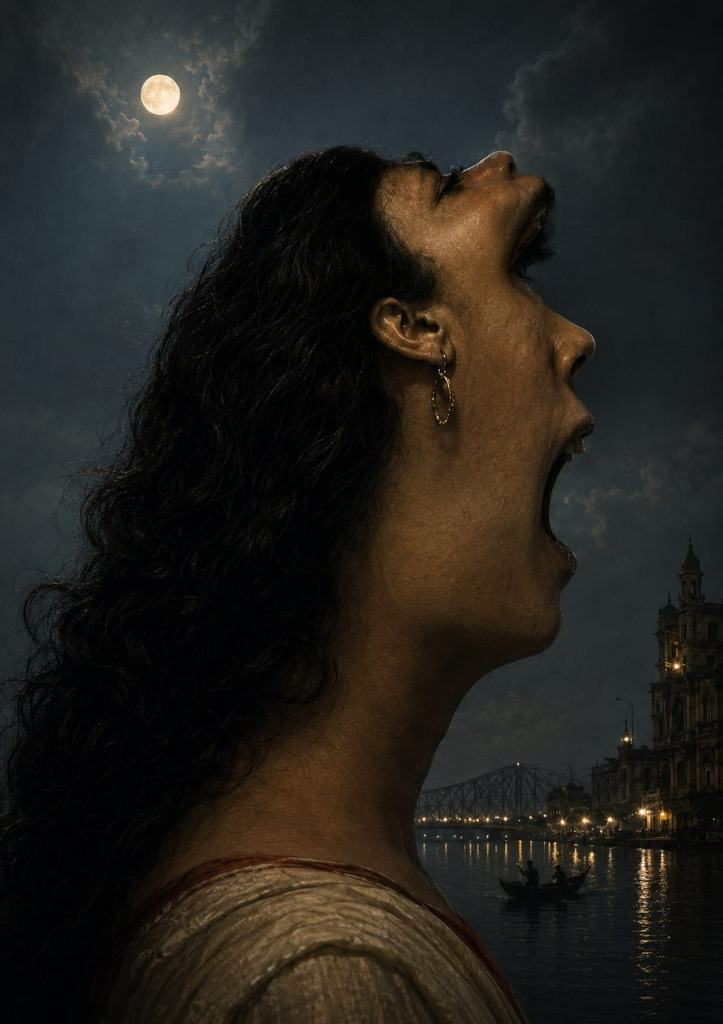
The first dhaak of the season hits my skull like a brass-plated exorcism performed by a drummer who has clearly never heard of consent, and there I am, an atheist with an M.S. in computer science and an honorary PhD in stubbornness, standing in Calcutta feeling my pulse answer a rhythm considerably older than my disbelief and much better organized.
It is only October 3. Mahalaya is still a week away. The actual Puja waits farther down the calendar. Calcutta, being Calcutta, has begun without consulting the calendar.
I do not believe Durga descends literally from Kailash. I do not believe there is a celestial mountain where a ten-armed mother packs Lakshmi, Saraswati, Ganesha, Kartik, the lion, the weapons, and Bengal’s annual emotional luggage into some divine conveyance and heads toward her maternal home. Yet every autumn something in me notices her approach before I consciously decide to notice anything, and that something is not some hidden believer waiting to ambush the atheist. It is memory. It is association. It is culture installed below the level at which I keep my arguments. My brain may be congratulating itself on rationality while the rest of the organism has already formed a parallel government.
The light changes first. It always seems to change first. The clouds acquire those enormous white bellies, fat and smug as politicians promising development, and the monsoon, which has not necessarily received the official notice to leave Bengal, begins loosening its wet grip. Kash flowers appear, white and useless and perfect, sticking out of marshy ground like nature’s middle finger to utilitarianism. Bamboo rises at crossings and club grounds. Cloth, plywood, paint, thermocol’s more environmentally respectable descendants, wire, light and human insanity begin assembling themselves into temporary cathedrals. Loudspeakers conduct preliminary war crimes against the neighborhood nervous system. Somewhere a dhaak starts.
And my atheist body says: Ah. This.
The eyes, those traitorous little cameras, start inspecting half-built pandals. A phrase heard from childhood returns without invitation. Ma aschen. Mother is coming.
This is embarrassing.
Not because atheists are forbidden to enjoy festivals. There is no atheist Vatican issuing encyclicals on appropriate responses to dhunuchi smoke. It is embarrassing because I have always wanted disbelief to be intellectually neat. Proposition goes in, evidence is inspected, supernatural claim fails quality control, proposition goes out. Thank you for using the scientific method. Please collect your reason at the counter.
Instead I have acquired a nervous system with legacy code.
I left India for Texas in 1998. I spent roughly fifteen years of my adult life in the United States, studying computer science and then working, much of it around healthcare research, data and systems. That ought to have been enough time for several cultural software upgrades. Yet apparently a Bengali childhood is one of those applications that installs itself directly into the operating system and leaves undocumented dependencies everywhere.
You can emigrate. Your shiuli flowers remain resident.
You can learn databases, statistics, algorithms, medical vocabularies, interoperability standards and enough American institutional language to survive meetings in which everybody “circles back” until death. Then somebody hits a dhaak thousands of miles from the room in which you learned your first equations and suddenly some prehistoric process buried beneath SQL Server stands up and says, Pujo.
The contradiction interests me the way a loose tooth interests the tongue.
Religion is not merely a proposition about whether gods exist. That part is comparatively easy. Claims about supernatural beings can be subjected to evidence, logic, philosophy, skepticism, whatever tools one prefers. I do not find myself persuaded that Durga exists as a supernatural person. Fine. File closed.
Except religion is also childhood, smell, season, architecture, food, music, family, neighborhood, fear, expectation, grief, repetition and the social calendar. Those do not vanish when a proposition fails.
I can regard Durga as mythology and still feel that something has returned to Calcutta when her face appears beneath a half-finished pandal roof. Something has returned. Not necessarily a goddess. A configuration. A remembered world. A city briefly rearranging itself into the shape in which I first learned to recognize autumn.
The language of childhood has no convenient word for “multisensory autobiographical memory reactivated by recurrent seasonal cues.”
So we say, Ma aschen.
Let us be scientific about this, or at least as scientific as a man can be while becoming suspiciously emotional over bamboo scaffolding.
One influential family of theories in neuroscience treats perception as partly predictive: brains use prior experience to anticipate what sensory input is likely to arrive, compare expectation with incoming information, and update accordingly. Some versions formalize parts of this in Bayesian terms. This does not mean there is a tiny statistician inside my skull calculating posterior distributions every time somebody lights incense. “The brain is a Bayesian prediction machine” is a useful model in some contexts, not a discovery that neuroscientists made by opening a cranium and finding Bayes’ theorem engraved on the hippocampus.
Learning is less glamorous and more devastating.
Things that repeatedly occur together become associated. Neural connections can change with activity and experience. The famous line “neurons that fire together wire together” is not something Donald Hebb actually wrote in those words, but it is a serviceable bumper sticker for one family of learning mechanisms associated with his work.
My own associations have had fifty-one years to become troublesome.
Not fifty-one uninterrupted Calcutta autumns, obviously. Fifteen of those adult years were spent in America. But absence does not necessarily erase associative memory. Sometimes it gives memory better lighting.
The autumn cues accumulate: a particular quality of sky, dhaak, shiuli, incense, clay, paint, crowds, food, new construction appearing overnight, streets becoming temporarily irrational. They are not stored in one little Durga Puja drawer in the brain. Autobiographical memory recruits distributed systems involving the hippocampus, cortical regions and emotion-related circuitry. Smell is especially good at detonating old memories, partly because olfactory pathways are unusually intimate with neural systems involved in memory and emotion.
Which is why a smell can accomplish in half a second what philosophy has been trying to do for three thousand years.
It can return you to a room.
Not metaphorically. Not completely. But enough.
A smell, a drumbeat, a certain late-afternoon light—and some older version of yourself is suddenly standing beside you without having paid rent.
This is where I disagree with both easy religious certainty and easy scientific reductionism.
A believer may experience the feeling as the presence of the goddess. A strict reductionist may describe it entirely in terms of learned associations, memory retrieval, attention, emotion and physiology. But the feeling itself proves neither metaphysics. Goosebumps are very poor theologians.
What they prove is that something happened to me.
That I remember.
That is enough.
I am an atheist because I do not believe the supernatural claim, not because I possess a laboratory certificate proving the nonexistence of every conceivable god. The universe is under no obligation to furnish me with that degree of certainty. Lack of belief is sufficient. So is intellectual suspicion.
But emotional loyalty is not belief.
This distinction matters.
I can know perfectly well that a song is compressed audio data and still be destroyed by it. I can know that a photograph is reflected light captured by a sensor and still stare at a dead person’s face. I can know that a clay image was shaped by human hands and still experience its presence as enormous.
Explanation does not abolish experience.
If it did, sex education would have ended romance.
I have theories, of course. I always have theories. It is my occupational disease: explain the magic until only the wiring diagram remains, then stare at the wiring diagram and wonder why the magic survived.
The first theory is repetition.
Every Bengali knows the annual sequence even when he pretends not to. Mahalaya arrives, and with it that impossible predawn voice of Birendra Krishna Bhadra, the old Mahishasuramardini broadcast that has outlived technologies, generations, political regimes and approximately eleven billion attempts to modernize the Bengali. Then the city accelerates toward Bodhan, Shashthi, Saptami, Ashtami, Navami, Dashami. The idol that arrived must leave. The pandal that consumed months must disappear in days. The lights go dark. Bamboo emerges again from beneath illusion.
Calcutta takes off its jewelry.
The city looks faintly embarrassed by what it has done.
The brain adores recurrence because recurrence teaches prediction. The first time something happens, it is an event. The fiftieth time, it has become part of the architecture.
The second theory is social glue.
Durkheim called one aspect of this “collective effervescence”: that strange amplification of feeling produced when people assemble, act together, repeat symbols together, move together, shout together, mourn together, celebrate together.
Durga Puja is exceptionally good at this because it is not confined inside a temple. It occupies streets. It recruits electricians, sculptors, priests, committee members, drummers, designers, cooks, police, hawkers, children, photographers, atheists, believers, bored adolescents, exhausted parents and people who have come only because the phuchka stall looked promising.
The city temporarily develops one enormous nervous system.
Not literally.
I should say that before some neuroscientist throws a shoe at me.
Rhythmic music can entrain movement and affect physiological rhythms, and studies of musical activity find forms of behavioral, neural and sometimes cardiac synchrony between people. But that does not mean every heart in a Puja crowd obediently locks itself to the dhaak like a metronome. Human synchrony is messier than that, which is probably why humans invented committees.
Nor am I going to blame the whole business on oxytocin and dopamine.
Modern popular neuroscience has turned those molecules into the Laurel and Hardy of human emotion. Love? Oxytocin. Pleasure? Dopamine. Social connection? Sprinkle both and serve.
The biology is more complicated. Reward, attachment, memory, arousal, attention and social affiliation emerge from interacting neural and hormonal systems, not two magic chemicals squirting meaning into the synapses.
Sometimes “it’s dopamine” is just astrology wearing a lab coat.
The third theory is grief.
This one is harder, which is why it is probably closer to the bone.
Durga’s Bengali story is a homecoming story. The daughter comes to her maternal home. She arrives with her children. The city behaves as though a beloved family member has returned. Then Dashami comes and she leaves.
When I was young, that was mythology.
At fifty-one, it is logistics.
My father is dead. My mother, born in 1947, is old now and lives in North Calcutta. Families do what families do under the influence of time: they expand, fracture, migrate, marry, divorce, age, die, stop calling, start calling again, lose money, lose health, lose patience, lose one another. Home ceases to be a geographical fact and becomes an unstable agreement between memory and whoever is still alive.
So the old Bengali sentence Ma aschen contains its own cruelty.
If she is coming, she will also go.
I do not claim that immersion is secretly a psychological grief therapy invented by ancient Bengalis. That would be exactly the kind of retrospective scientific fairy tale I am trying not to write. The ritual has its religious meanings and histories.
I am saying something smaller.
I experience it as rehearsal.
A magnificent thing is made. We know from the beginning that it will be dismantled.
The face is painted.
The eyes are opened.
The drums begin.
The city gives itself over.
And then the idol is carried away.
You do not need to believe that a goddess inhabited the clay to understand the violence of that grammar.
Arrival. Presence. Departure.
Again.
Again next year.
That recurrence contains a strange mercy. Loss is not reversed, but departure is placed inside a cycle. The empty structure is not proof that nothing mattered. It is proof that something was here.
Perhaps that is part of why I wait.
Not for Durga.
For recurrence.
For the evidence that the city can still perform this enormous act of remembering even after individual memories begin to fray, people disappear, houses change occupants, parents age and children become middle-aged men staring out of windows wondering exactly when childhood packed its bags.
So I remain the atheist who waits for a goddess he does not believe in.
It is less contradictory than it sounds.
I wait for the light.
I wait for the dhaak.
I wait for bamboo to become architecture and clay to become a face.
I wait for the great secular-religious-social-artistic machine called Durga Puja to switch itself on and remind Calcutta that for a few days it can be something other than traffic, invoices, illness, politics, humidity and men drilling concrete precisely when you have developed a headache.
I do not need to offer pushpanjali to understand the crowd offering it.
I do not need to believe flowers reach a supernatural hand.
I need only recognize what the human beings are doing.
They are moving together in the dark.
That may be the oldest technology we possess.
UNESCO calls Durga Puja in Kolkata an example of the public performance of religion and art. That description, bureaucratic though it sounds, gets remarkably close. The goddess is not merely worshipped. She is fabricated, sculpted, painted, illuminated, drummed, sung, financed, argued over, visited, photographed and finally immersed.
Kumartuli makes clay into bodies.
The city makes those bodies into meaning.
Memory performs the rest.
The goddess does not have to descend from Kailash for any of this to be real.
A city is real, although you cannot point to a single molecule called Calcutta.
A language is real, although grammar has no pulse.
Money is real, disastrously so, although much of it now consists of numbers sulking inside computers.
Grief is real without being an organ.
Culture is real without requiring supernatural ontology.
Durga can be real in that sense: not as a ten-armed biological organism hiding somewhere beyond the Himalayas, but as a story, image, ritual, artistic tradition, social institution and recurring structure in millions of human memories.
That is enough reality for one goddess.
The dhaak starts again.
I can hear it from the room, distant and insistent, a heartbeat with sticks in its hands.
My body answers before philosophy has finished clearing its throat.
I do not believe in Durga as a supernatural being.
I believe in the dhaak.
I believe in the light.
I believe that a city can teach a body a calendar.
And I believe in the strange loyalty of memory, which can carry a story across childhood, oceans, decades, disbelief and return, not because the story must be literally true, but because sometimes a story can be false as cosmology and true as autobiography.
P.S. References: Hebbian synaptic plasticity, with the usual warning that “neurons that fire together wire together” is a later paraphrase rather than Hebb’s literal sentence; predictive-processing and Bayesian models of perception, treated here as influential theoretical frameworks rather than settled descriptions of the entire brain; research on odor-evoked autobiographical memory and rhythmic entrainment; Émile Durkheim’s collective effervescence; and the author’s own nervous system, which again declined to be interviewed and has retained counsel.
Word Cloud
Related reading
Selected by shared topics and section, with closer publication dates breaking ties.