Mahishasura Was Probably a Systems Problem
Uses the speech voice supplied by your browser or device.

The demon had a neck. Bureaucracies do not.
This, I increasingly suspect, is the engineering defect in our mythology.
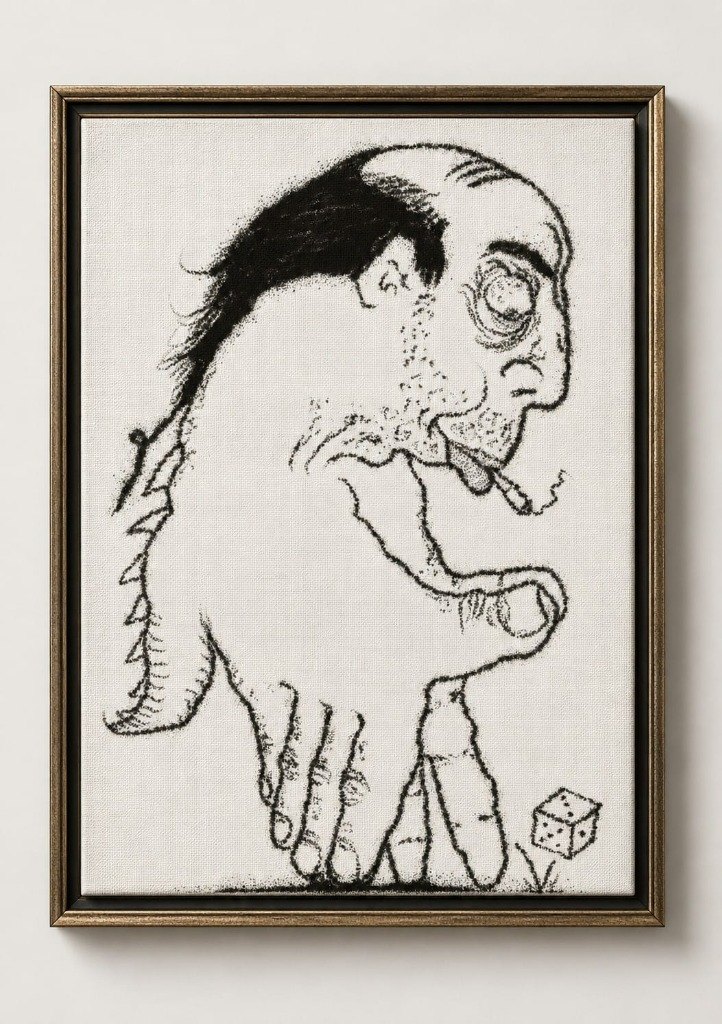
Mahishasura, for all his shape-shifting and buffalo theatrics, eventually presents Durga with something magnificently actionable: a body. In the Devi Mahatmya, she plants a foot on his neck, strikes him with a spear, and finally cuts off his head with a sword. There is a target. There is a weapon. There is an identifiable moment before which the demon is alive and after which he is emphatically not. Excellent incident resolution. Clear ownership. No escalation matrix required.
I grew up in Calcutta, which means I grew up inside this story the way other children grow up inside wallpaper, and every autumn the same thought now crawls out of the pandals and sits on my chest like a tax notice: we keep asking for a trident when what we actually need is a spreadsheet.
Because real wickedness, the kind that lets people deteriorate in hospitals, allows bad drugs into supply chains, loses citizens inside administrative queues, and turns court cases into family heirlooms, rarely has a neck.
It has a network.
It has a procurement file waiting for a signature, a sanctioned post waiting for a doctor, a laboratory result waiting to reach the person who needs it, a complaint forwarded to another department because forwarding is cheaper than solving, a medicine that should have failed somewhere upstream but somehow travelled downstream, an audit observation that everyone agrees is extremely serious and therefore schedules for discussion next quarter.
Nobody wakes up at six in the morning, brushes his teeth, and says, today I shall become Mahishasura.
That would actually simplify things.
Instead one man says it is not his department. Another says the tender followed procedure. Another says there is no budget head. Another says the server was down. Another says the patient should have come earlier. Another says the file is missing. Another says the file was never missing but has now been found and unfortunately requires one additional signature from a gentleman who retired in 2019.
By evening a human being has been converted into workflow.
I know this instinct professionally as well as culturally. I spent roughly fifteen years around American healthcare research, hospital data, databases, interfaces, and the strange plumbing by which one human body becomes codes, laboratory values, timestamps, diagnoses, claims, rows, messages and eventually decisions. One useful lesson from that world is that catastrophe does not require a villain twirling his moustache beside the server rack. A field mapped incorrectly here, an alert ignored there, a queue understaffed somewhere else, a result that reaches the wrong inbox, a protocol everybody assumes somebody else owns—and the final failure can look almost immaculate. Every individual component can produce documentation proving that it behaved reasonably while the patient at the end of the chain gets the full combined benefit of everybody’s reasonableness.
That is the thing about systems.
They can kill without anybody feeling like a killer.
We love Mahishasura because he gives sin a silhouette. There, we say. There is the bastard. Hairy, horned, armed and refreshingly noncompliant with ambiguity. Put the goddess on the lion, hand her the weapons, turn up the dhaak, and by Vijayadashami the problem has a spear through it.
This is excellent mythology and catastrophic public administration.
A distributed failure cannot be decapitated because its intelligence is not located in its head. It lives in incentives, omissions, bottlenecks, patronage, understaffing, bad measurement, weak enforcement, institutional memory loss and that great Indian administrative sacrament: everybody knowing exactly what is happening while remaining professionally astonished that it happened.
Systems do not bleed when you stab them.
They bleed when you audit them.
Which is slower, uglier, less photogenic and almost impossible to dance to.
There is no glorious painting of an internal auditor asking why Vendor C repeatedly won contracts despite charging more. No pandal reproduces the immortal tableau of a hospital administrator comparing infection rates across wards. Nobody blows a conch because somebody finally reconciled the drug inventory against the purchase ledger. Children do not demand plastic figurines of the woman who designed a grievance system that cannot quietly eat complaints.
Perhaps they should.
I am an atheist, which means I do not expect Durga to descend onto Red Road carrying an RTI application in one hand and a forensic audit report in another. No celestial ambulance is coming. No divine regulator is going to inspect the warehouse. No supernatural judge is clearing the cause list before lunch.
And strangely, this makes the myth more useful to me, not less.
Because if the ten arms are not coming from heaven, we have to manufacture them here.
One arm is public health.
One is competent procurement.
One is regulation that can detect a dangerous product before somebody’s bloodstream does.
One is journalism stubborn enough to keep asking an embarrassing question after the press conference has moved on.
One is a court system in which a human lifetime is understood to be a finite unit of time.
One is science funded because the evidence says it matters, not because somebody important likes the ribbon-cutting photograph.
One is interoperable information—records that reach the next doctor instead of dying nobly inside a filing cabinet or proprietary silo.
One is independent audit.
One is education that teaches children that “who benefits?” and “where did the money go?” are not signs of bad manners.
And the last arm, perhaps the most important one, is memory.
Because systems survive by exhausting memory.
Wait long enough and the scandal becomes an inquiry, the inquiry becomes a report, the report becomes a PDF, the PDF becomes a broken government link, and the dead become statistics quoted by somebody during the next scandal.
Then everybody discovers outrage again.
Mahishasura himself was a shape-shifter. That part of the myth may be more useful than the killing.
The modern demon changes shape too.
Close one racket and it becomes a consultancy. Ban one adulterated product and another label appears. Digitize one corrupt counter and somebody discovers that corruption can also have a login screen. Create a watchdog and eventually someone learns how to feed the watchdog. Pass a regulation and an industry of professional regulation-circumventers appears around it like fungus after rain.
There is no final spear for this.
There is maintenance.
That may be the most offensive idea of all.
We prefer revolutions because revolutions have flags. Maintenance has checklists.
We prefer heroes because heroes have faces. Institutions have org charts.
We prefer villains because villains can be hated. Incentive structures require understanding, and understanding is exhausting.
We prefer Durga because she arrives magnificently once a year.
A functioning civilization has to turn up on Monday.
The demon was never merely the buffalo.
The demon was the arrangement that allowed the buffalo to keep returning.
And perhaps the atheist’s version of Durga is not a woman descending from heaven at all but ten boring human mechanisms working simultaneously—records, scrutiny, law, evidence, accountability, competence, memory—none of them divine, none of them photogenic, all of them maintained by ordinary people who refuse to accept “this is how things work here” as an explanation.
No celestial soundtrack.
No weapon glowing in the clouds.
Just the terribly unromantic machinery that makes impunity expensive.
That is how you kill a systems problem.
Not once.
Every morning.
Word Cloud
Related reading
Selected by shared topics and section, with closer publication dates breaking ties.