The Fifth Hunger
Uses the speech voice supplied by your browser or device.

THIS IS A WORK OF FICTION
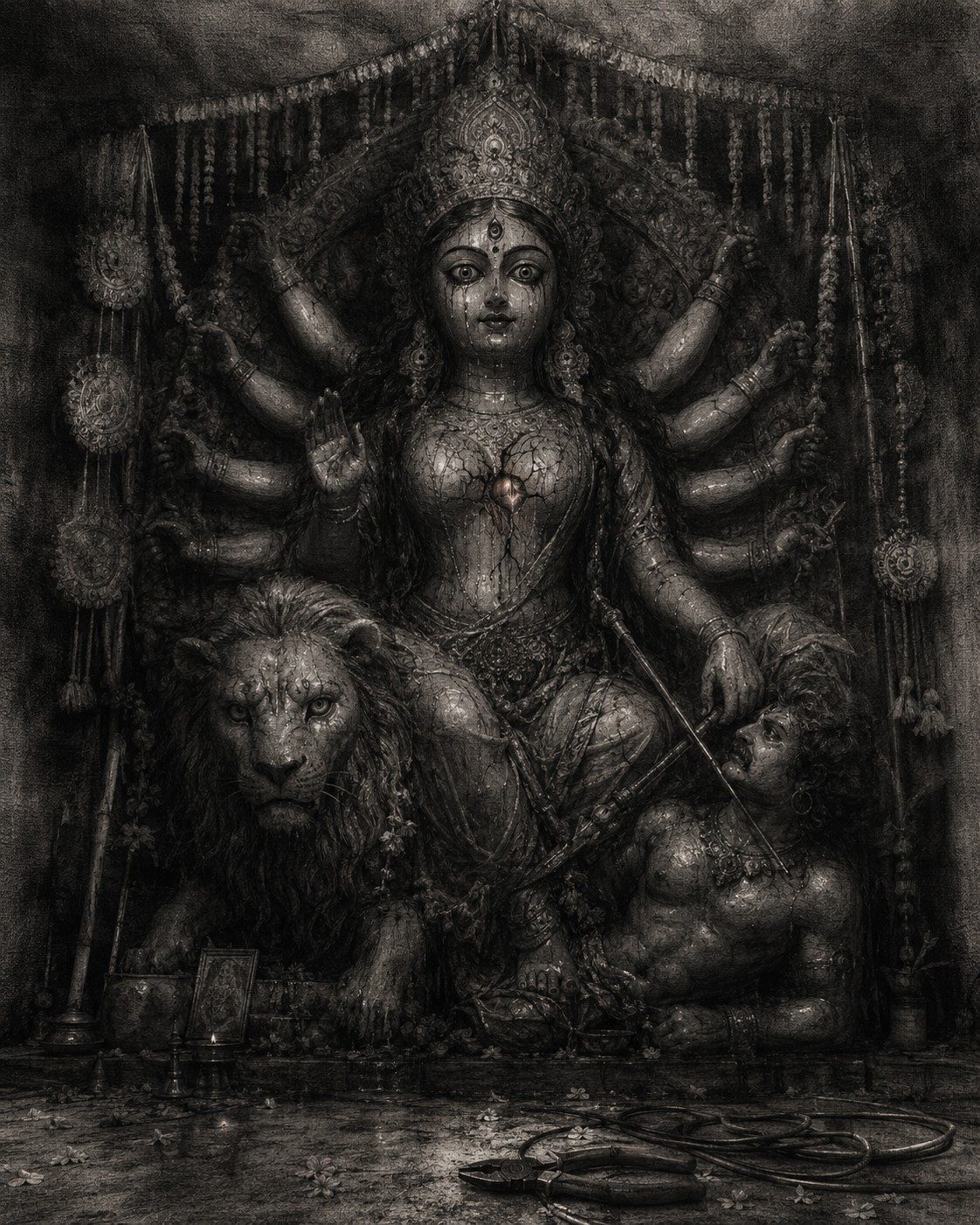
The idol blinked at me with my dead mother’s eyes, and I realized I had not yet painted the third one.
Not the eyes on her face. Those were finished—almond-shaped, black-rimmed, staring past me toward the door of my workshop as if she were waiting for someone to finish dying.
I mean the third eye on her forehead.
There should have been nothing there yet except the faint charcoal guide I had drawn that afternoon. I always painted the third eye last. Not because scripture demanded it. Not because some priest would arrest me if I changed the order. Because my father had done it that way, and his father before him, and craftsmen are often more superstitious than priests because priests can blame the gods while we have to blame our hands.
But the eye was already there.
Open.
Wet.
Looking directly at my throat.
I stepped back.
The idol’s head turned.
The neck—straw and bamboo under clay, built to survive a few days of worship and then dissolve into river water—creaked like a footstep across frozen mud.
“Ma?” I said.
The word came out wrong.
Too small.
The idol smiled.
Her teeth were new.
I had not sculpted teeth.
There were too many of them anyway: white, flat things crowded into the darkness of her mouth like seeds pressed into a pomegranate.
I ran.
I made it three steps before I heard the wet slap of one enormous clay foot landing behind me, and then the delicate metallic clatter of her crown striking the floorboards because something about her head had become too large for it.
Three hours earlier, I had been solvent.
That was the word Mr. Chatterjee used, anyway, tapping his pen against my ledger with the rhythm of a man who had spent his life discovering exactly how long another human being could survive without money.
“Solvent, Bimal. Technically. For perhaps seven minutes.”
He turned the ledger around.
The Kumartuli collective had paid me an advance. The Barasat club had paid its deposit. After bamboo, straw, clay, paint, assistants, electricity, tea, transport advances, old debts, and one spectacularly stupid bottle of whiskey, I had four thousand and thirty-two rupees left in the bank.
Four thousand and thirty-two.
A fortune, if you were a mosquito.
“All you have to do,” Mr. Chatterjee said, “is deliver the Barasat Durga by Thursday.”
Thursday.
I looked at the calendar.
Monday.
The priests would do what priests did when the time came. Bodhan, mantras, invocation, ritual, breath given symbolically to clay. None of that had happened yet. My goddess was still an object being manufactured under a leaking roof.
Half her lion had no whiskers.
Mahishasura was missing an ear.
One of Kartik’s fingers was drying separately beside a cup of tea.
“I need another day.”
“You need fewer excuses.”
“I need another day.”
“You need less whiskey.”
That was also true.
Mr. Chatterjee sighed.
He was my creditor, my landlord, and the only man in North Calcutta who continued to behave as if I were a temporarily embarrassed master artisan instead of a permanently indebted middle-aged fool with excellent hands.
“Thursday, Bimal.”
He closed the ledger.
“After that I take the workshop.”
“You already own the workshop.”
“Then I take the room upstairs.”
“You own that too.”
“Excellent. Then the paperwork will be simple.”
He left.
I locked the door.
I drank.
I painted.
The goddess watched me from her corner, nearly ten feet tall, ten-armed, her skin glowing ochre beneath the workshop bulb.
She was beautiful.
She was always beautiful.
That is the curse of being good at one thing. Everything else in your life can rot quietly in adjoining rooms while the one thing you know how to make keeps becoming more beautiful.
My marriage had gone first.
Then my savings.
Then most of my friends.
My mother had gone six months ago.
The goddess remained.
That year I had mixed the tiniest smear of my mother’s old kajal into the black I used around Durga’s eyes. It was sentimental nonsense. The kajal contributed almost nothing to the pigment. I knew that.
But grief makes primitive chemists of us.
We put hair in lockets.
Ash in urns.
Photographs under pillows.
A little kajal in paint.
Anything to smuggle one molecule of the dead into tomorrow.
I climbed the stool to mark the third eye.
The brush never touched her forehead.
The air became thick.
Not hot.
Not cold.
Thick.
The workshop seemed suddenly submerged in something that was not water.
It smelled like rain striking hot dust, except the smell arrived before the rain, then reversed itself, as though I had remembered it backward.
My ears popped.
The single bulb above me began swinging.
There was no wind.
Something hummed inside my teeth.
Five notes at once.
Not a chord. A chord belongs together.
These notes slid through one another like wet panes of glass occupying the same space.
Then the clay moved.
Not cracked.
Not shifted.
Moved.
The way flesh moves when a thought reaches it.
One enormous finger curled against her thigh.
Then another.
Then all ten hands flexed.
Inside her, the bamboo frame groaned and rearranged itself.
I heard joints being invented.
I should have run then.
Instead I stared at the eyes.
My mother’s brown eyes.
Or my memory of them.
There is a difference, but grief seldom observes it.
“Bimal,” the goddess said.
My mother’s voice came out of ten feet of clay.
“You’re so thin.”
I backed into the worktable.
Brushes fell.
A cup shattered.
The whiskey bottle rolled across the blueprints of a commission I was never going to finish and began dripping amber onto the floor.
“You’re not her.”
“No.”
The goddess stepped down from the platform.
Her foot sank half an inch into the floorboards.
“She is in you.”
Another step.
“And therefore she is available to me.”
That sentence frightened me more than the moving clay.
“What are you?”
The goddess considered this.
Perhaps it had never been asked before.
Perhaps it had.
Perhaps I had asked it tomorrow.
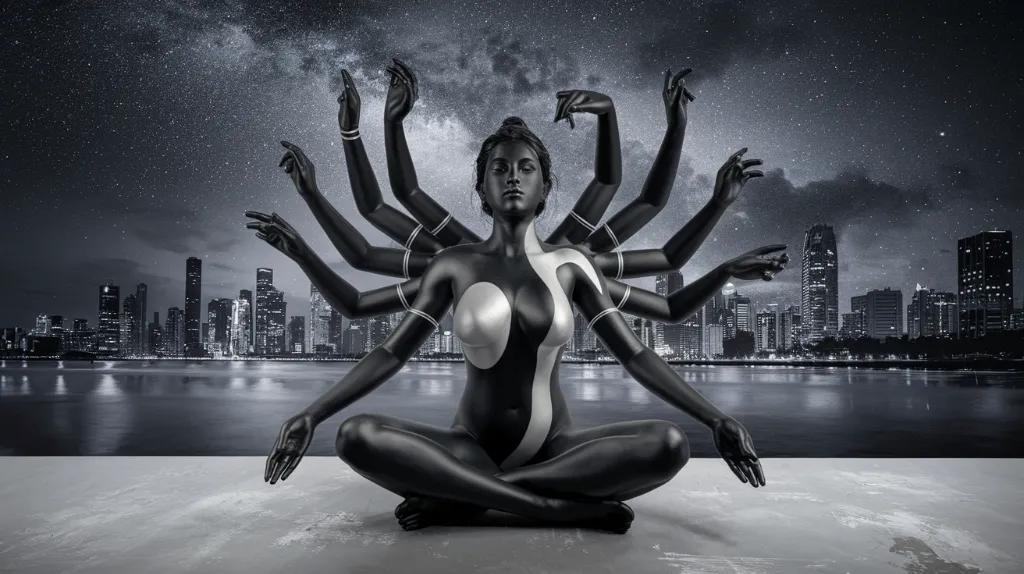
Her ten arms drifted around her, not quite synchronized, each hand holding or imitating some familiar gesture—blessing, protection, weapon, promise.
One hand did something I did not recognize.
It opened.
Closed.
Opened.
Closed.
Like something learning how to grasp an animal smaller than itself.
“Stay back.”
“I have nowhere else to go.”
“I’ll call the priest.”
Her smile widened.
“The priests are busy.”
From outside came a sound that made the whiskey inside me disappear.
Bamboo.
Hundreds of lengths of bamboo bending at once.
Then clay breaking.
Then footsteps.
Not human footsteps. Too heavy. Too irregular. Some with two feet. Some with four. Some dragging things behind them.
Kumartuli was waking.
Voices rose in the lanes.
Someone screamed.
Someone shouted a mantra.
Someone else shouted for his son.
A conch shell blew once and stopped halfway through, as if the person blowing it had suddenly forgotten what lungs were for.
The goddess tilted her head.
The unpainted eye on her forehead blinked.
Its pupil was vertical.
The eye itself was black.
Not black like paint.
Black like a television screen at three in the morning after the signal disappears but before you turn it off.
“Bimal,” she said softly.
“I’m hungry.”
I looked toward the door.
“We are all hungry.”
“What do you mean, all?”
Her third eye widened.
And for one second I saw through it.
Every idol in Calcutta.
Finished ones.
Half-finished ones.
Expensive ones beneath chandeliers.
Cheap ones under corrugated tin.
Household idols small enough to carry beneath one arm.
Towering installations built for crowds that would photograph them for twelve seconds and move on.
Clay goddesses in workshops.
Goddesses already inside pandals.
Goddesses waiting beneath plastic sheets against the rain.
Every Durga I could somehow see was turning her head.
Not toward heaven.
Toward the nearest human being.
“How long?” I whispered.
The goddess looked almost tender.
“Not for the festival.”
She touched the black eye on her forehead.
“For the dimension.”
She reached toward me.
I flinched.
One clay hand touched my cheek.
Warm.
Not sun-warmed.
Body-warmed.
It left a streak of vermillion beside my mouth.
I remembered my mother wiping flour from my face when I was seven.
I remembered her later, thinner, in a hospital bed, asking whether I had eaten.
The goddess smiled.
There.
That smile.
That was how I knew she had found the memory.
“What do you want?”
“To be full.”
“What do you eat?”
She leaned close enough that I could smell the river in the clay.
“Not meat.”
Her mouth opened.
“Meat is easy.”
Then her mouth continued opening after there was no anatomical way for it to become wider.
The jaw did not dislocate.
The face did not split.
The opening simply acquired another direction.
I saw it.
That is the only sentence I have.
I saw it.
Her mouth was no longer a hole inside a face.
It was a direction.
A direction human bodies had not evolved to move through.
My eyes could not follow it.
My stomach could.
Every organ inside me lurched toward that impossible angle with the sickening conviction that falling into it would be the most natural thing I had ever done.
Inside her mouth I saw Thursday.
Not an image of Thursday.
Thursday itself.
The Barasat club.
My unfinished idol under fluorescent lights.
Mr. Chatterjee checking his watch.
Rain over the bypass.
A bus breaking down near Ultadanga.
A woman buying hilsa.
A child who had not yet fallen from a bicycle.
The hospital where my mother died.
I saw the building from above, then from below, then from a place for which above and below were merely local customs.
And behind all of it were other days.
Millions of them.
Stacked somehow beside one another.
Tuesday touching Friday.
Childhood folded against next winter.
Deaths leaning against births that had not happened.
Human time laid out like fish on a market slab.
The goddess inhaled.
I felt something inside me move toward her.
“Stop.”
She inhaled again.
A memory vanished.
Not faded.
Vanished.
I knew there had once been something involving a dentist in 1994.
I knew because I could feel the shape of its absence.
But the dentist was gone.
The room was gone.
The drill was gone.
Even the pain was gone.
Only the missing place remained.
That hurt worse.
“What did you do?”
“We eat the when of you.”
She said it gently, the way my mother used to explain medicine.
“We eat your Tuesdays.”
Another inhalation.
I staggered.
“We eat the thing you almost said.”
My knees weakened.
“The train you almost caught.”
Another pull.
“The woman you almost married.”
“Stop.”
“The child you almost had.”
“STOP.”
She closed her mouth.
The workshop snapped back into three dimensions so violently that I vomited beside Lakshmi’s unfinished foot.
The goddess waited.
“We eat your almosts, Bimal.”
I wiped my mouth.
“Why?”
“Because you have so many.”
Something about that made me begin to cry.
Not loudly.
I had become very good at crying without disturbing anyone.
The goddess crouched.
Her face descended until it was level with mine.
“You make vessels.”
“We make idols.”
“You make doors.”
“No.”
“You build bodies. You paint eyes. Humans gather around them and pour attention into them until an object becomes heavier than its materials.”
“That’s worship.”
“That is geometry.”
Her smile returned.
“You keep pointing somewhere.”
She tapped her forehead.
“Eventually something follows the pointing.”
I stared at her.
“Are you Durga?”
For the first time, the thing wearing Durga’s face looked amused.
“What answer would frighten you more?”
I said nothing.
“Exactly.”
Outside, something enormous roared.
Another roar answered from farther south.
Then another.
The city had become a forest communicating between predators.
“Why me?”
“Because your door was open.”
“The eye?”
“The eye.”
“I hadn’t painted it.”
“Exactly.”
I looked at the black third eye.
An unfinished coordinate.
A hole where a symbol should have been.
A door without a sign saying which side was inside.
The goddess touched my forehead.
“And because you gave me someone you loved.”
My mother’s voice returned.
“You’re so thin.”
I slapped her hand away.
She laughed.
The sound came from several seconds at once.
Then she kissed my forehead.
Her lips were soft.
They tasted like Ganga clay and incense.
Something left me.
I screamed.
She had taken tomorrow’s dinner.
Not the food.
The memory of deciding what I would eat.
I knew I had made a decision.
Fish, perhaps.
Rice.
Maybe nothing.
The decision was gone because the piece of tomorrow containing it was gone.
Then she took another piece.
A birthday I had not reached.
Then another.
A conversation I was going to have with someone whose face I suddenly could not imagine.
“Please.”
She stopped.
“Feed me.”
“How?”
“The others.”
“What others?”
“The ones who owe you.”
Her smile sharpened.
“The ones who hate you.”
One of her hands opened and closed.
“The ones who look through you.”
“No.”
“We are not cruel.”
She rose.
“We are simply more.”
Her body began to change.
Not taller.
Deeper.
Her shadow spread across the workshop and acquired corners that the workshop itself did not possess.
Inside her shadow I saw my own shadow.
My shadow was screaming.
I was not.
“You made us to carry prayers upward,” she said. “We carry your days inward. Same geometry. Different side.”
She moved toward the door.
The frame splintered.
For a moment she seemed too large to pass through.
Then she turned sideways.
Then she turned sideways again in a direction I could not see.
And she was outside.
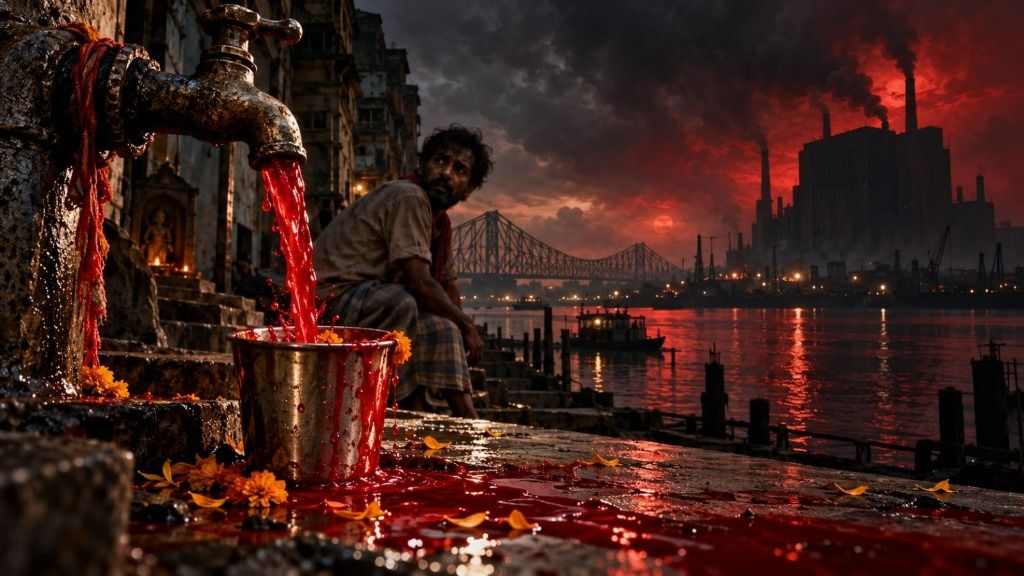
The lane filled with the smell of rain, marigolds, wet clay, incense, diesel and something sweet beginning to burn.
I stood alone.
The whiskey had stopped spilling.
I stared at the bottle.
It was full.
No.
Not full.
New.
The paper label had changed.
The manufacturer was different.
There was a date printed beneath the batch number.
The date had not happened yet.
I picked up my phone.
Seventy-three missed calls.
Every call had a timestamp from tomorrow.
None of the numbers existed in my contacts.
One had left a voicemail.
I pressed play.
My own voice whispered:
“Don’t let her finish Thursday.”
The recording ended.
I played it again.
My voice said nothing.
The message was seven seconds of rain.
I went outside.
Kumartuli had changed.
Not destroyed.
That would have been easier.
Changed.
An abandoned bamboo frame dragged itself along the lane like a starving insect.
A half-finished Lakshmi stood facing a wall, whispering numbers into the plaster.
A clay lion no larger than a dog sat on the bonnet of Mr. Chatterjee’s car licking its paws.
The paws were red.
The driver’s door hung open.
The engine was running.
The radio was broadcasting cricket.
I listened.
The commentator mentioned a match scheduled for the following week.
India was losing.
Then winning.
Then losing again.
Different futures flickered through the commentary depending on whether I looked directly at the radio.
I turned away.
Silence moved through Calcutta.
That is the only way to describe it.
Not screaming.
Subtractions.
Small human silences popping across the city like bubbles bursting beneath water.
A rickshaw puller forgot the name of the village where he had been born.
A woman forgot the first time her husband held her hand.
A surgeon forgot one year of medical school but remembered everything before and after it.
A child reached six while counting and discovered there had never been a five.
Somewhere, a seventy-year-old man woke with no memory of being forty.
Somewhere else, a nineteen-year-old remembered being eighty.
The things wearing our gods were feeding.
And every meal loosened time a little more.
I understood one thing.
The third eyes were not eyes.
They were apertures.
Mine had opened first because I had left it unfinished.
Perhaps that was why the thing had spoken to me.
Perhaps not.
But if an unfinished eye could open the geometry, a finished one might close it.
That was not knowledge.
It was the kind of theory desperate men call knowledge when every alternative is screaming.
I had three days until Thursday.
Three days to find my goddess.
Three days to reach that black eye with a brush.
Three days to discover whether pigment could close a direction.
Or three days to decide that the thing had made me a better offer.
I returned to the workshop.
The pedestal was empty.
Something had been written across it in wet clay.
The handwriting was my mother’s.
Of course it was.
The thing had eaten enough of me to know how she wrote.
Bring me the creditor.
Underneath:
He has so much time.
Then:
He has been stealing yours for years.
And finally:
It is only fair.
I read the words twice.
Then three times.
On the workbench lay a blank clay face.
I picked up my brush.
My hands had stopped shaking.
I dipped the bristles into red.
Then black.
I began painting a third eye.
Not opening it.
Studying it.
Trying to understand where an eye ended and a door began.
Outside, something roared near the river.
Another answered from Bagbazar.
Then another, farther away.
The city was learning a new food chain.
I put the brush down.
I told myself I was going to find Mr. Chatterjee because he might still be alive.
I told myself I needed him as bait.
I told myself the goddess would come if I brought her what she wanted, and when she bent down to feed I would paint the black eye shut.
All of those statements might even have been true.
I did not examine the other possibility.
I did not examine the strange emptiness in my stomach when I imagined taking Mr. Chatterjee’s tomorrow.
I did not examine how badly I wanted to know what another man’s childhood tasted like.
I unlocked the door.
Thursday was coming.
Somewhere in Calcutta, the goddess wearing my mother’s eyes was eating her way toward it.
And I, Bimal Pal of Kumartuli, stepped into the lane because I was suddenly, terribly hungry to see Thursday too.
Outside, the city began to eat itself one Tuesday at a time.
Word Cloud
Related reading
Selected by shared topics and section, with closer publication dates breaking ties.