Perfect Storm
Uses the speech voice supplied by your browser or device.

The calendar is a sadist. It knows. It has been waiting all year to turn the page while my bank account circles the drain, and here comes October, with Durga following close behind, ten arms, lion, children, weapons, lights, drums, traffic diversions, new clothes, restaurant bills, relatives, expectations, and approximately everything in the known universe except cash.
Durga Puja. The great homecoming.
The five days when Calcutta becomes a carnival of light and I become a shadow trying to decide whether it can afford biriyani.
I have calculated the mathematics of my ruin. It is elegant, really. My income is zero. My expenses remain stubbornly greater than zero. Therefore my balance performs the one piece of mathematics even depression cannot complicate: subtraction. The bills arrive as a convergent sequence toward certainty; the money behaves like a variable somebody forgot to define. I am not the limit that does not exist. I am worse. I am the divergent series the bank refuses to sum.
There is a specific texture to this poverty. It is not the noble poverty of the ascetic, who has renounced worldly possessions after first having enough worldly possessions to make renunciation impressive. It is not the temporary embarrassment of the student waiting for his stipend. It is the sticky, humid, Calcutta-specific poverty of the educated failure—the man with certificates, vocabulary, technical skills, old stories, obsolete confidence, and no money for the taxi ride required to explain any of this to anybody.
The city, meanwhile, prepares for the goddess.
In Kumartuli, artisans build bodies from bamboo and straw and layer them with clay, turning agricultural debris and river-basin earth into divinity. Fingers press form into shapelessness. A shoulder emerges. A waist. A face. Ten arms reach outward from what was recently straw tied to a frame. Mud acquires posture, expression, jewelry, weapons, authority.
I recognize the process.
They are building something beautiful from materials that, lying separately on the floor, would look like rubbish.
I too am largely mud and water, minus the craftsmanship, plus the delusion.
My own construction project—this body, this mind, this precarious scaffolding of sanity—has been under renovation for decades, with no completion certificate, no occupancy permit, and several contractors having quietly left the premises.
Bipolar II is the tax I pay on a brain that refuses to depreciate linearly. There is no graceful downward curve here. Hypomania is not necessarily some delightful penthouse party with champagne and increased productivity; sometimes the elevator merely moves too fast, rattles between floors, keeps the lights on all night, and deposits you somewhere you did not intend to go. Depression handles the return journey.
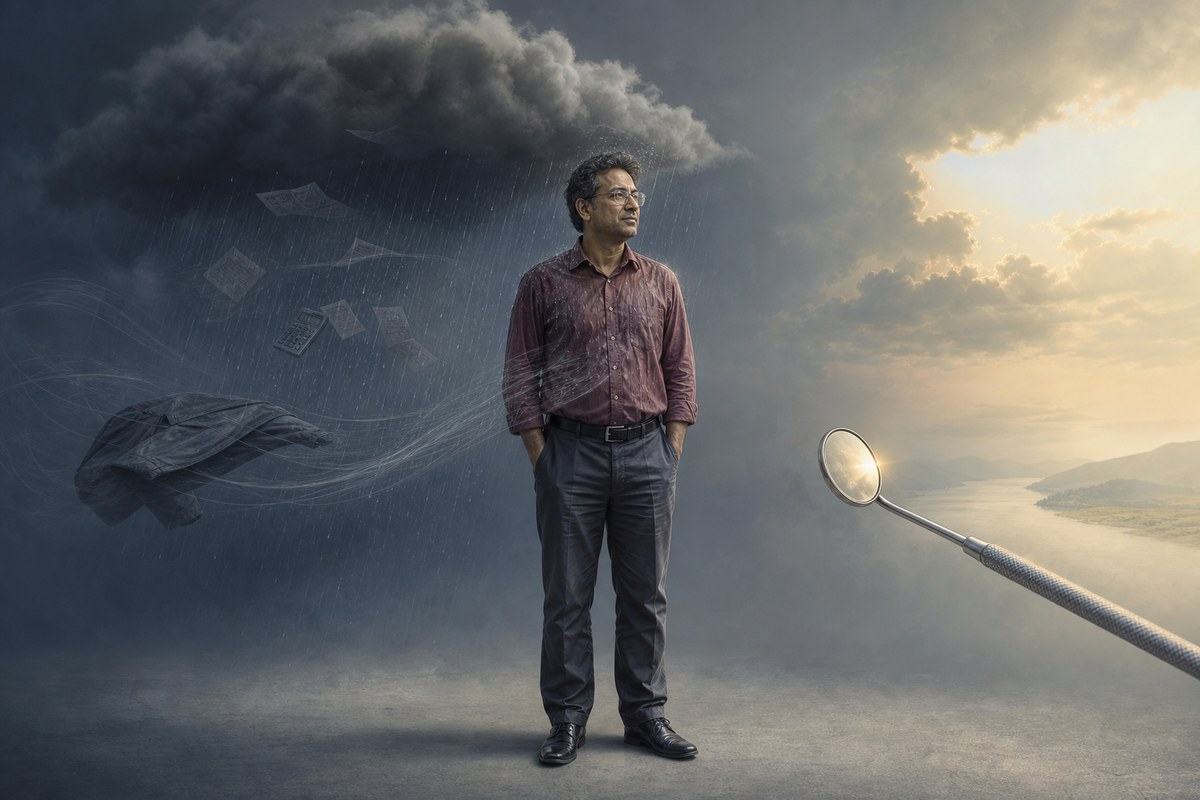
The perfect storm requires three conditions: a low-pressure system of empty pockets, a high-pressure front of seasonal expectation, and the warm, moist air of Bengali social obligation converging over the Bay of Bengal.
Meteorologists would object to this model.
I call it October.
My mother calls it something else.
She calls it, “Why haven’t you bought new clothes for Puja?”
The question hangs in the humid air like shiuli—the little white flowers with orange stems that announce autumn more efficiently than the Meteorological Department. That smell arrives and suddenly Bengal remembers that everybody requires garments.
New shirt.
New trousers.
New sari.
New shoes.
Something for Ma.
Something for the children.
Something for the person who gave you something last year.
Something respectable enough to be seen wearing while standing beneath fifteen million watts of decorative lighting beside people who will tell you money does not matter.
In Bengal, Durga Puja is religion, art exhibition, family reunion, street theatre, civic hallucination and mass migration conducted within one metropolitan area.
And if you are broke, it is also competitive consumption.
It is the Olympic Games of material display, and I am the athlete who has arrived at the stadium without shoes, uniform, sponsorship, entry fee or bus fare home.
The pandals will rise.
Oh, how they will rise.
Bamboo scaffolding will clutch at the sky like the fingers of a drowning mathematician. Palaces will appear where last month there was a traffic island. Temples, ships, caves, foreign monuments, forgotten civilizations, ecological warnings, mythological universes—Calcutta annually discovers that no object in human history is too large, sacred, expensive, geographically distant or structurally improbable to be reconstructed temporarily from bamboo, plywood, fabric, paint, thermocol’s more socially acceptable descendants, electrical wiring and committee optimism.
This year perhaps someone will build a pandal shaped like my credit score.
Visitors will enter through the mouth.
The architecture of collapse.
The geometry of insolvency.
I will walk through these temporary cathedrals with the careful gait of a man trying not to disturb the coins in his pocket, lest they realize they are alone and die of loneliness.
There is a particular humiliation in being broke during a festival of abundance. Poverty is easier when everybody is pretending to be poor. It becomes fluorescent when everybody around you has shopping bags.
It is the inverse of the miracle of loaves and fishes.
I have one loaf, no fish, and five thousand relatives theoretically entitled to hospitality.
The mathematics is against me.
The biology is against me.
The sociology is against me.
Only the theology remains neutral, and that may be because Durga does not carry a wallet in any of her ten hands. She has a sword, trident, discus, conch, bow, lotus and the assorted equipment of cosmic administration.
I understand the symbolism now.
The sword is for cutting expenses.
The trident is for piercing the balloon of my ego.
The lotus is for floating above the sewage of financial planning.
The conch is what the bank manager blows before rejecting the loan.
I try to remember that this is temporary.
That poverty is a state, not an essence.
That unemployment is an economic condition, not a caste into which one is born.
That the arithmetic can change because arithmetic changes the instant one number changes.
In Bengali imagination Durga herself comes home every autumn, leaving Kailash to visit her natal home with her children before returning again. The goddess gets a homecoming.
I too would like one.
At present I seem to be travelling on a visitor’s visa through the Republic of Scarcity, and the immigration officer has taken my passport, gone for lunch and not returned.
The embassy of hope charges a processing fee.
Naturally.
My brain, at least, is more complicated than the old chemical-imbalance cartoon. Depression is not simply a fuel gauge marked SEROTONIN pointing toward EMPTY. Bipolar disorder is a disorder of mood regulation involving biology, psychology, sleep, stress, environment and mechanisms still incompletely understood.
My wallet is much easier to diagnose.
It lacks currency.
The two conditions are not identical, but they converse constantly. Poverty does not manufacture every depression, and money does not cure bipolar disorder, but financial insecurity is an exceptionally competent accomplice. It removes choices. It shrinks movement. It postpones treatment, travel, gifts, repairs, meals, meetings. It converts small problems into engineering projects and ordinary decisions into moral philosophy.
Should I take the taxi?
Should I buy the medicine?
Should I visit Ma?
Should I order food?
Should I replace the thing that broke?
Should I spend ₹300 today and risk needing ₹300 tomorrow?
This is how poverty occupies cognition. Not dramatically. Administratively.
One tiny requisition form at a time.
Treatment may help the brain, but treatment itself exists in the physical world, where consultations cost money, medicines cost money, transport costs money, and even the admirable advice to “take care of yourself” generally contains several hidden line items.
Thus the loop:
money trouble → stress → worse functioning → harder recovery → money trouble.
No Greek letters required.
QED.
Quite Easily Depressed.
I watch the artisans paint the goddess’s eyes.
Chokkhudaan: the giving of the eyes.
The final strokes are among the most charged moments in the making of the image. The pupils appear and the face, which seconds earlier was unmistakably clay and paint, suddenly appears to look back. Ritual life is more complicated than saying that this brushstroke literally makes the deity alive—formal worship has its own rites—but poetry does not give a damn about liturgical footnotes.
An eye is painted.
Mud acquires a gaze.
That is miracle enough.
I wonder when my own eyes were painted, and by whom.
I wonder if they used waterproof ink, because the season of tears approaches with greater reliability than certain municipal services.
The goddess will gaze out at the throngs of devotees.
I will gaze back.
And between us will stretch that absurd human chasm between divinity and overdraft: she assembled from clay and elevated into the sacred; I assembled from carbon and demoted by insufficient funds.
Still.
Still.
There is a perverse comfort in hitting bottom.
The floor, at least, is supposed to be solid.
Though this is Calcutta, a delta city of river, silt, filled land, ponds remembered only by old maps and wetlands that have spent decades losing arguments with real-estate developers, so perhaps even the ground should not be trusted too enthusiastically.
Fine.
I will be the foundation anyway.
The bedrock upon which nothing will be built this year.
Let the others construct their pandals of bamboo and dreams. I will be the swamp. I will be the marshland that swallows the construction cranes of optimism.
I am the wetlands of the soul, biodiverse with failure, teeming with the rare and endangered species of my former ambitions.
The storm is perfect because it is total.
It engulfs the horizon.
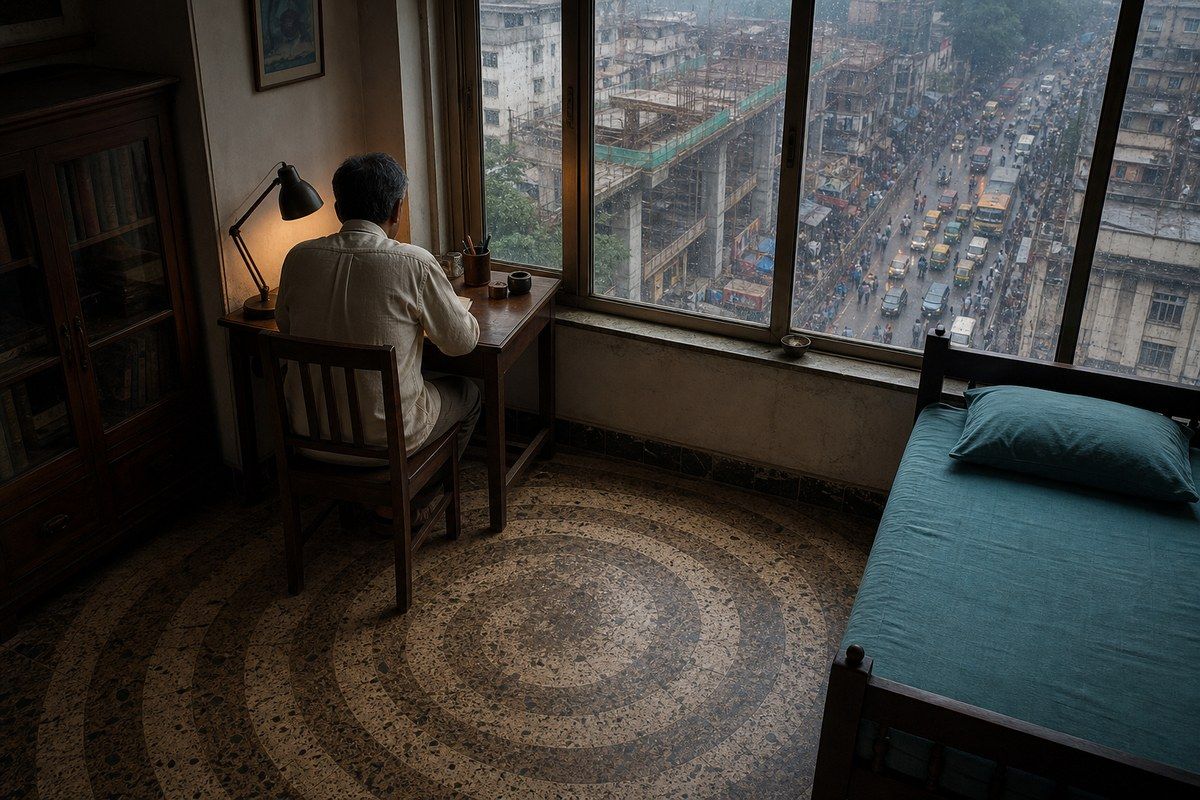
There is no meteorological eye in this cyclone, only the grammatical I—the small, shivering, penniless I standing at the window while the city begins dressing itself for its annual act of magnificence.
Lights go up.
Bamboo rises.
Shop windows fill.
Menus acquire festive surcharges.
New clothes emerge from plastic bags.
Relatives begin asking questions.
Drums are waiting somewhere in the future.
The goddess is coming home.
And I am here in the debris of my fiscal shipwreck, counting coins that are not there, performing the arithmetic of absence, trying to subtract the bills without subtracting the man who owes them.
That last operation is harder.
So for now I remain.
Zero income.
Nonzero expenses.
One body.
One October.
Storm approaching.
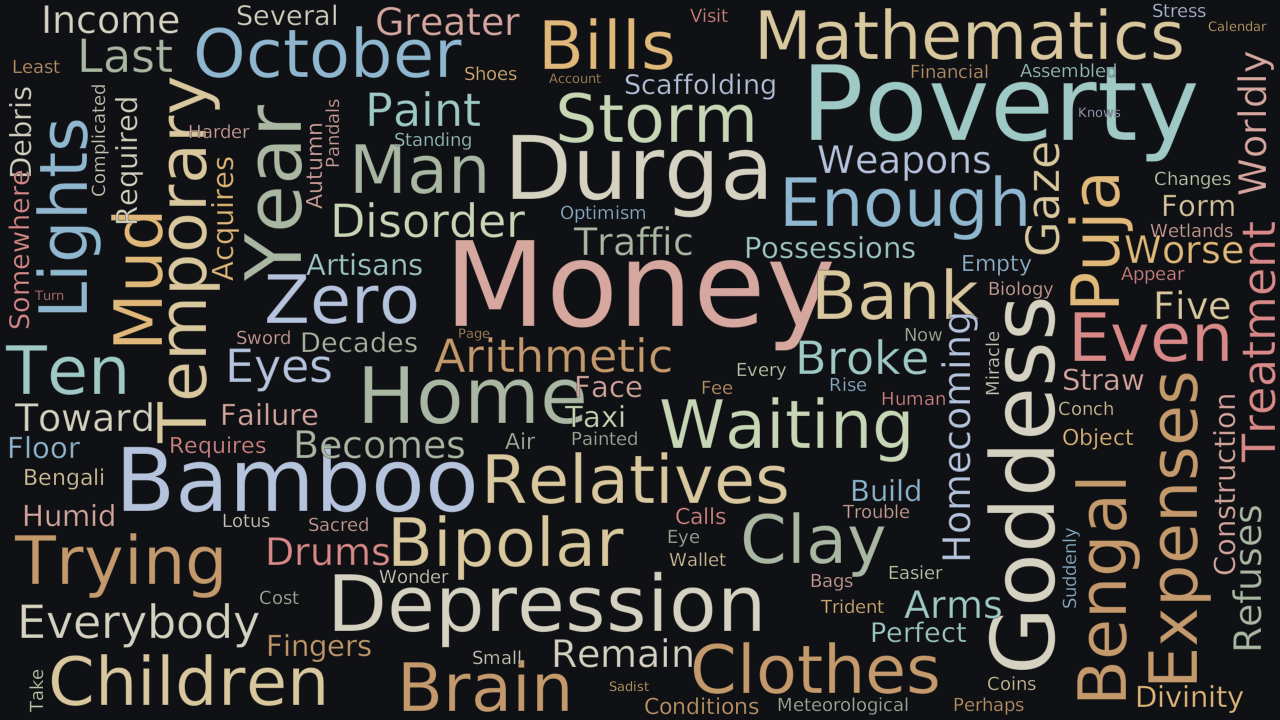
Word Cloud
Related reading
Selected by shared topics and section, with closer publication dates breaking ties.