The Noise of Being Alone
Uses the speech voice supplied by your browser or device.

The loudspeaker does not have to say that I am alone. It plays another song, and I hear it anyway.
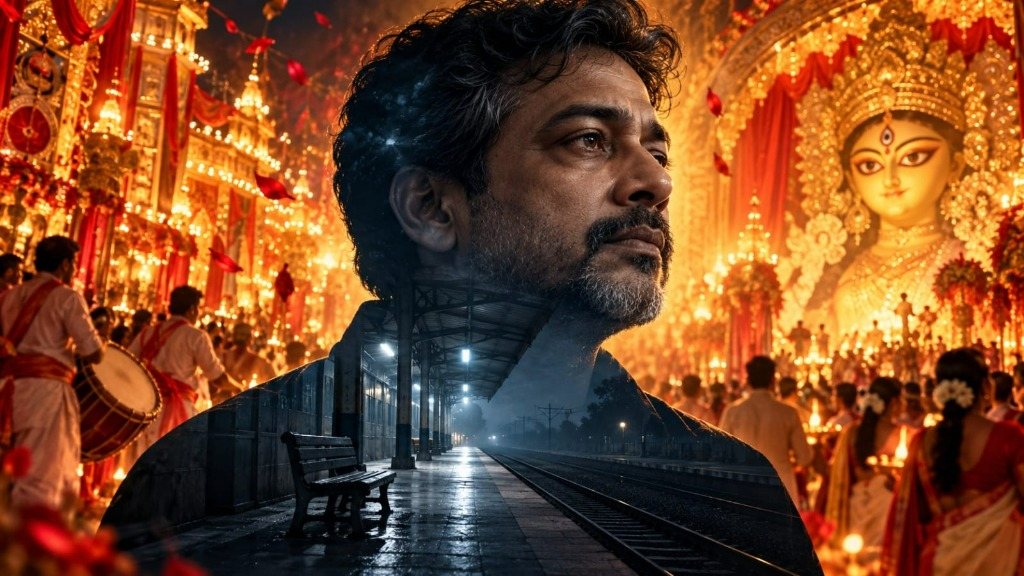
That is what happens to me when the Puja season begins taking possession of Calcutta. The sound acquires a meaning it was never asked to carry. Somewhere people are together. Somewhere an evening is being decided upon. Somebody is taking too long to get ready, somebody wants to eat first, somebody has suggested a different pandal, and the disagreement itself belongs to a life in which people have other people to disagree with.
I envy the disagreement.
There. An unattractive little confession, but we might as well begin where it hurts.
I envy the ordinary inconvenience of being included. The waiting, the rearranging, the mild irritation of having to accommodate another person’s wishes. I have enough room for my own wishes. They can spread themselves out like royalty. Unfortunately, they have become too tired to get dressed.
During an ordinary week, other people’s lives are less insistently visible. Everyone appears occupied. Work, errands, obligations, the usual machinery. My loneliness can pass through those hours without being made to stand beside a brightly illuminated demonstration of everything it lacks.
Then the holidays arrive.
Calcutta puts togetherness on a loudspeaker.
The dhaak, the songs, the announcements, the human noise swelling underneath it all. Even before the festival reaches its fullest pitch, the preparations begin telling me what kind of month this is going to be. People have plans. They have people inside their plans. The days ahead contain appointments with pleasure, however modest, however uncertain. There is a direction to their waiting.
I have the dates.
And I have this terrible tightness that makes the word emptiness seem badly chosen. Empty things ought to have space in them. This feels crowded. There is loneliness in it, and shame about the loneliness, and anxiety, and the exhaustion of trying to keep each feeling from recruiting all the others. My mind can assemble a mob without the assistance of a single additional person.
Outside, the volume rises.
Inside, everything presses closer.
I am fifty-one. I live alone. Money has been difficult for years. Steady work has been missing from my life for far too long. These are facts I can state in reasonably composed sentences. Put them together during the festival season and they stop behaving like sentences. They become the weight with which I wake, the arithmetic attached to an ordinary desire, the hesitation before an evening has even begun.
What would I do? What could I spend? How much effort would it take to make myself presentable to a world whose seasonal instruction appears to be that everyone should now emerge polished, sociable, and grateful for the opportunity?
My inner life has barely managed to stand up, and the city would like it in festive clothing.
Splendid. Perhaps we could put a silk sash around the intestinal obstruction and declare it the chief guest.
Money shows during Puja.
It shows in new clothes and food and travel and shopping bags, in the ease with which an additional expense can be allowed to remain an additional expense instead of becoming a meeting of the emergency cabinet. It shows in the ability to change a plan without recalculating the consequences of the change.
There is a kind of prosperity that consists simply of being able to say, “Let’s have something to eat.”
I know how small that sentence looks.
When money is scarce, it grows teeth.
A meal becomes a calculation. A journey becomes a calculation. The wish to be somewhere else for a few hours becomes a calculation, and eventually the mind begins doing the calculation before it permits the wish. I find myself refusing things internally before anybody has offered them. It is efficient. Poverty can teach a person to close a door from both sides.
Meanwhile, there is all this abundance on display.
Some of it is ordinary enjoyment. Some of it is exhibition. The festival has room for devotion, beauty, generosity, and the prosperous human urge to inflate one’s social posterior until it obscures the moon. All of it becomes visible together. The person with money can choose which parts to participate in. The person counting expenses gets the full spectacle through the eyes and ears, with the choices considerably reduced.
The loudspeaker, at least, practices equality. Everyone receives it.
What troubles me even more than the money, though, is the ease of the plural.
We are going.
We haven’t decided.
We will meet them there.
Such small sentences. They contain entire arrangements of life. Someone has been consulted. Someone is expected. Someone’s delay matters enough to alter the departure time. Even uncertainty has company.
I would like some uncertainty with company.
I have had quite a lot of practice with the other kind.
And there is shame in admitting how much this hurts, because at my age I feel I should possess a more dignified vocabulary for longing. Something seasoned and philosophical. I should have arrived at a refined understanding of solitude, preferably one that can be expressed while looking agreeably detached from the appetites of ordinary people.
Instead, I want the ordinary thing.
I want to belong somewhere without having to make a case for it. I want an evening in which my presence is part of the assumption. I want to be included before I have demonstrated that I can be cheerful enough to make including me worthwhile.
That last part is difficult to say.
Depression makes company complicated. I can want it and feel overwhelmed by the prospect of it. I can feel desperately alone and still recoil from noise, crowds, questions, the effort of arranging my face into something that will not require an explanation. I can long for an invitation and dread what I would have to do with it.
Then I turn on myself for being difficult.
A magnificent little arrangement. First suffer, then prosecute yourself for suffering inconveniently.
The bipolar anguish is inside this contradiction. It is there in the heaviness and the agitation, in wanting some relief while finding even the thought of seeking it exhausting. During these stretches, a small decision can acquire a terrible amount of resistance. I can see what might make an evening different and still struggle to cross the distance between considering it and doing it.
The distance looks negligible from outside.
From inside, I can spend hours failing to cross it.
And Puja keeps coming closer, carrying the assumption that I should be looking forward to it.
I remember first noticing this loss of feeling around class seven or eight, during Durga Puja. That matters to me. The season had already begun hurting before I had a grown man’s collection of disappointments available to explain the hurt. I could recognize that something was supposed to be enjoyable. I could recognize the occasion. The feeling that should have joined the recognition was missing.
I did not then have the name I have for my illness now.
I had the experience.
Decades later, the season can still touch that same place. Only now there are years around it. Years of trying, years of disruption, years in which I have had to begin again while feeling increasingly embarrassed by how little an earlier beginning had left me to stand on.
October does not arrive alone. It brings the other Octobers.
I do not summon them deliberately. They come through the smallest opening: a familiar sound, the approach of the dates, the knowledge that the city is preparing to repeat something I have repeatedly struggled to receive. The present feeling gets tangled with the memory of having felt it before. Soon I am carrying this year’s loneliness and the weight of its predecessors, while trying to explain why I cannot simply enjoy a festival.
Simply.
That little word deserves to be lowered into a septic tank with full ceremonial honors.
There is nothing simple about wanting relief from your own mind while depending on that same mind to find a way toward it.
Nor does understanding my condition make the social facts disappear. I really am alone. Money really does restrict what I can do. Years without steady work really do alter a person’s relationship with the word holiday. A holiday is easier to recognize when it interrupts a life with some structure, some income, some assurance that you will have a place to return to when the celebrations end.
For me, these days can feel like ordinary difficulty with the volume turned up.
The city pauses its routine, and my lack of one becomes harder to overlook.
There are moments when I feel ashamed merely to be seen without the outward signs of having managed my life. The festival makes those signs particularly bright. Clothes. Confidence. Companionship. The casual business of paying for something and moving on.
My mind begins treating these things as a verdict.
I know it is doing that. Knowing does not always stop the hurt.
Then comes the envy, and after the envy comes the disgust at having envied people an evening’s pleasure. They are allowed to enjoy themselves. Of course they are. I can know that completely and still feel wounded by the sight of what I am missing. The two feelings occupy the same body, which would be less exhausting if either of them had the decency to take a shorter shift.
I want their happiness to be harmless to me.
Tonight, it does not feel harmless.
That is a difficult admission because it sounds meaner than the wish underneath it. The wish is almost embarrassingly tender. I would like some of that warmth to reach me. I would like to stop experiencing other people’s ordinary togetherness as something happening behind a surface I cannot get through.
I do not require everybody to understand bipolar depression. I would settle for a little less compulsory brightness. A little less astonishment that a festival can hurt. Some recognition that the person who cannot join in may already be making an effort that nobody can see.
There is a particular loneliness in having to appear better before you feel fit for company.
The effort consumes what little energy I might have brought to the company itself. I begin imagining the questions, the explanation, the awkwardness of admitting that life has not improved in the ways people reasonably hope it will improve, and I retreat before the imagined conversation has finished.
Then the retreat hurts.
Then I hear the music.
Puja celebrates homecoming, too. That reaches me whether or not I believe in any of its divinity. The daughter returns. People gather. Arrangements are made for someone’s arrival. The story contains a place that has kept itself ready to receive a person.
I understand the tenderness of that.
Sometimes understanding it is precisely what makes it difficult to bear.
Loneliness during a festival has all these routes into me. Through money. Through memory. Through the sight of people moving together. Through the sound of pleasure I cannot join. Through the knowledge that I can withdraw from the crowd and still carry the ache of wanting a place within human life.
I cannot solve that ache by increasing the number of bodies around me. A crowd can make it sharper. I need some sense that my particular presence means something within the arrangement.
Someone to whom I am more than another person who happened to turn up.
Someone with whom I could be quiet without the quiet becoming an embarrassment.
I would like an evening that did not require me to defend why I am finding the evening difficult.
The speakers go on. They have no knowledge of any of this. Another announcement, another song, another assertion that the occasion is proceeding. My mind keeps trying to translate the noise into something about my life, and I keep trying to stop it, and the effort leaves me tired in a way that the word tired barely begins to cover.
I want to say, “I am having a very hard time.”
That is the sentence beneath all this. Plain, small, without the protection of a joke.
I am having a very hard time while the city celebrates, and the celebration is making it harder, and I feel ashamed of needing to say so.
If someone were to ask what I wanted to do, I might struggle to answer. I might say I didn’t know. I might explain badly, become irritated with myself, make some bitter remark that hid the need more effectively than I intended.
I would still want the question to have been meant.
And if I said I didn’t know, I would want a little time to find the rest of the sentence.
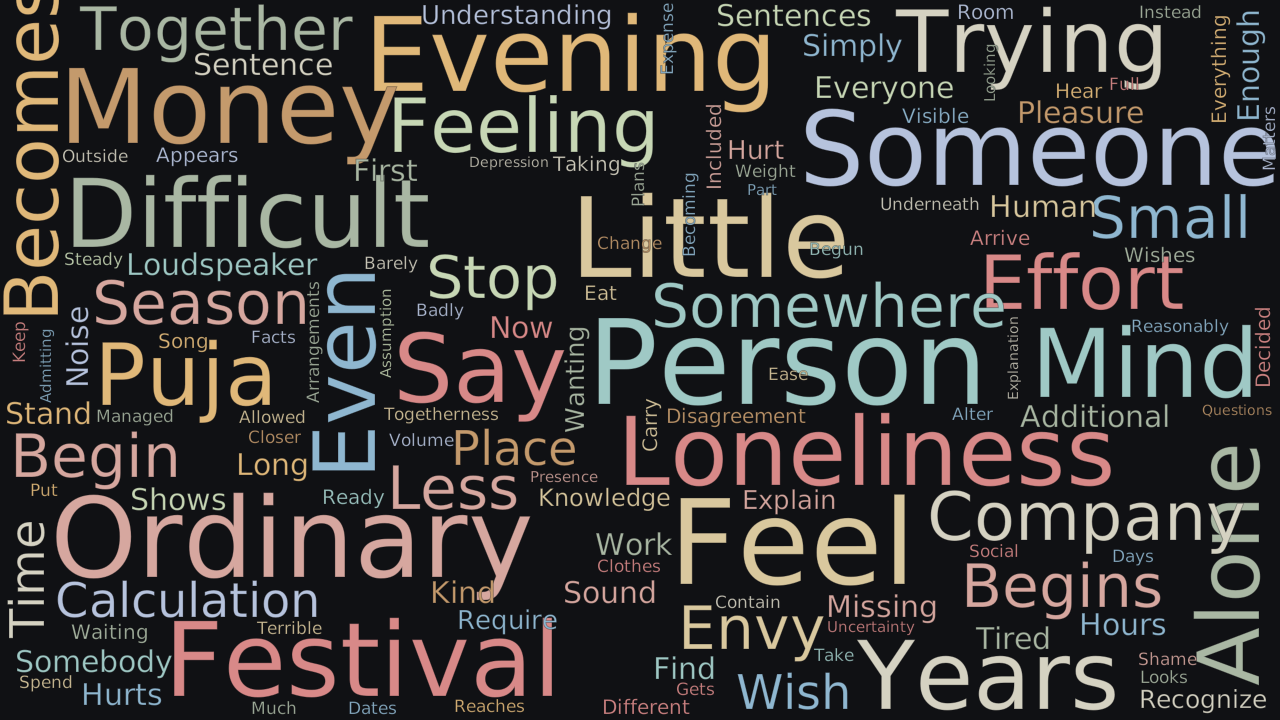
Word Cloud
Related reading
Selected by shared topics and section, with closer publication dates breaking ties.