Sketching the Void
Uses the speech voice supplied by your browser or device.

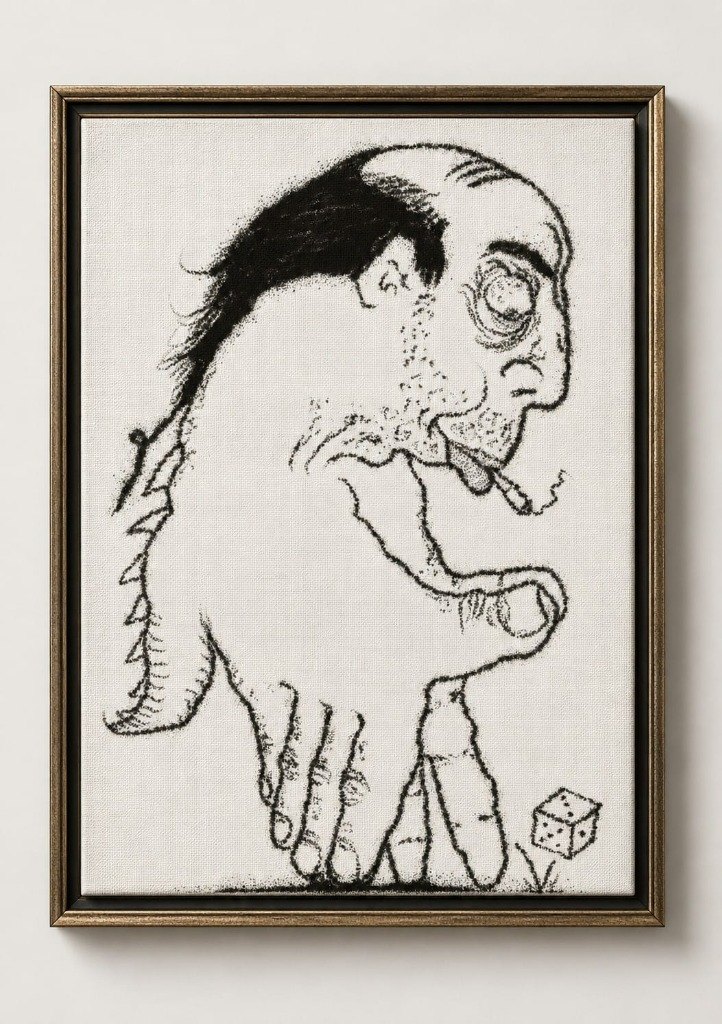
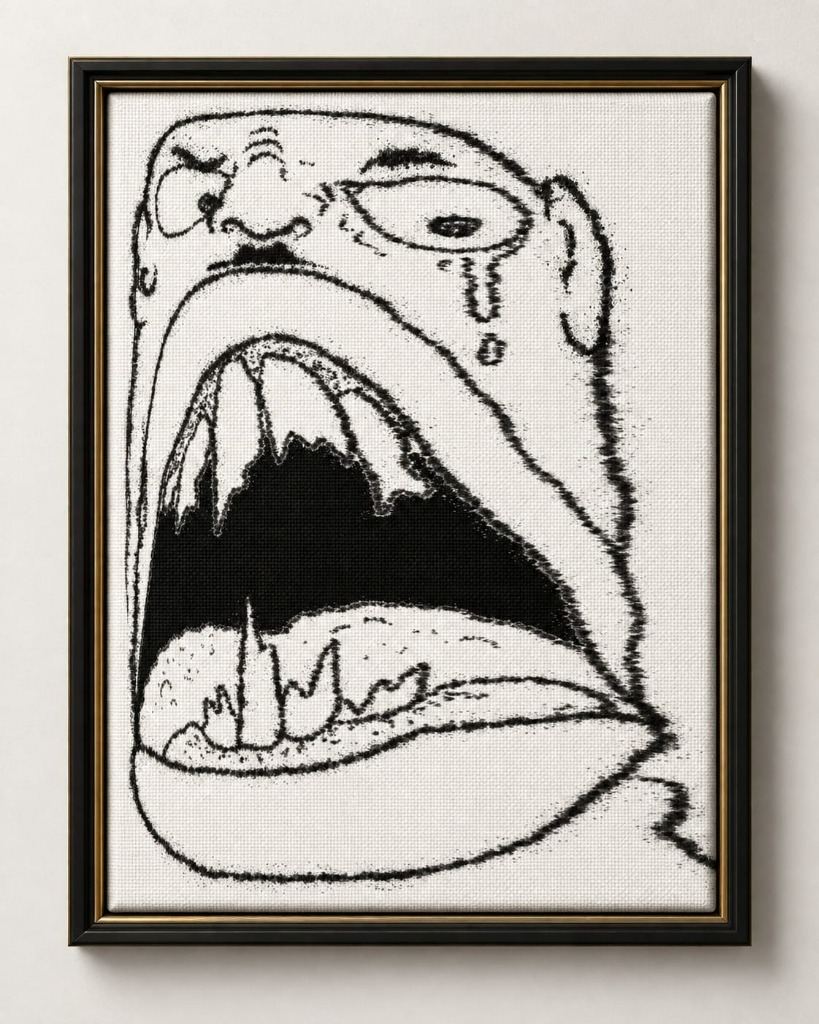
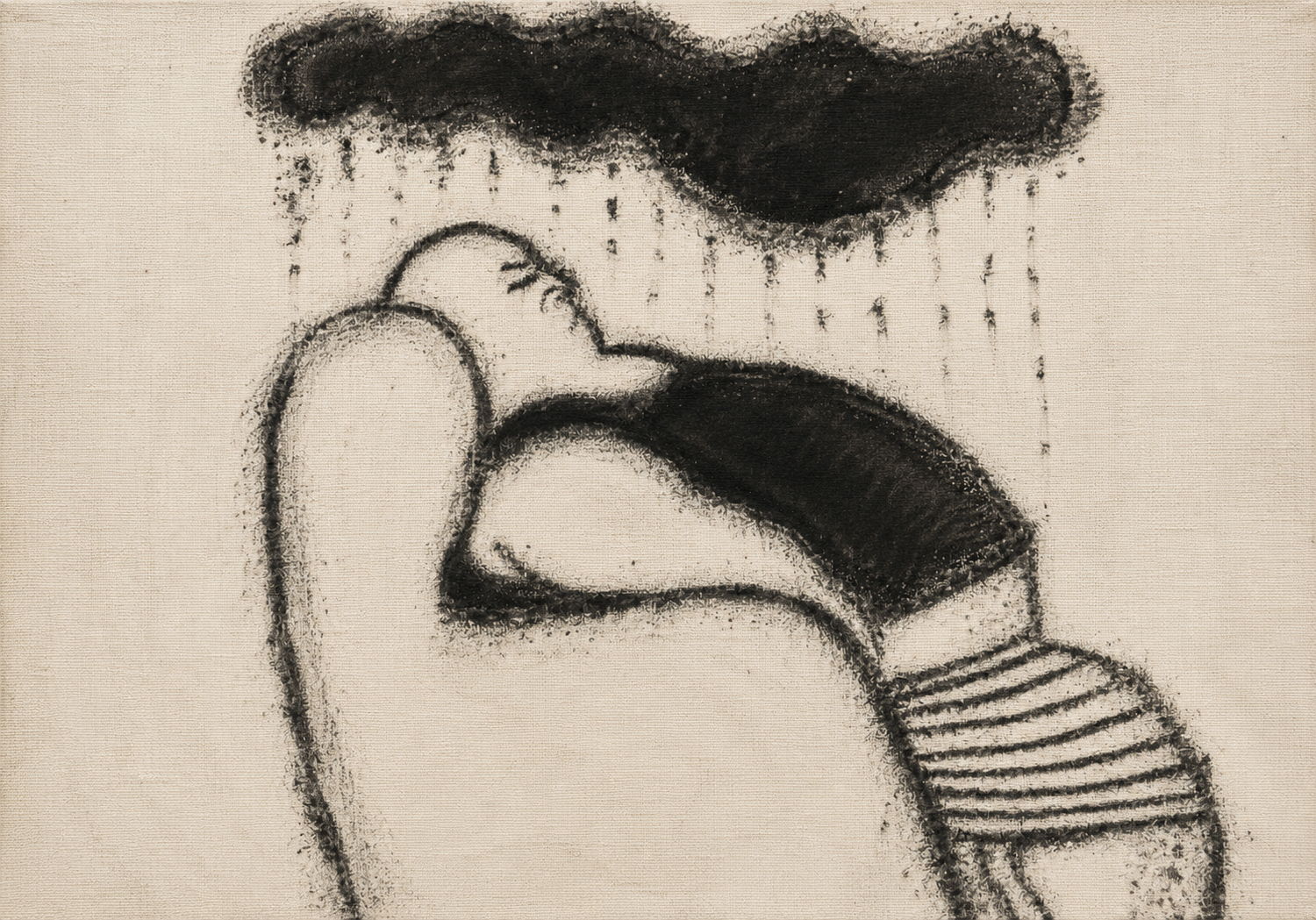
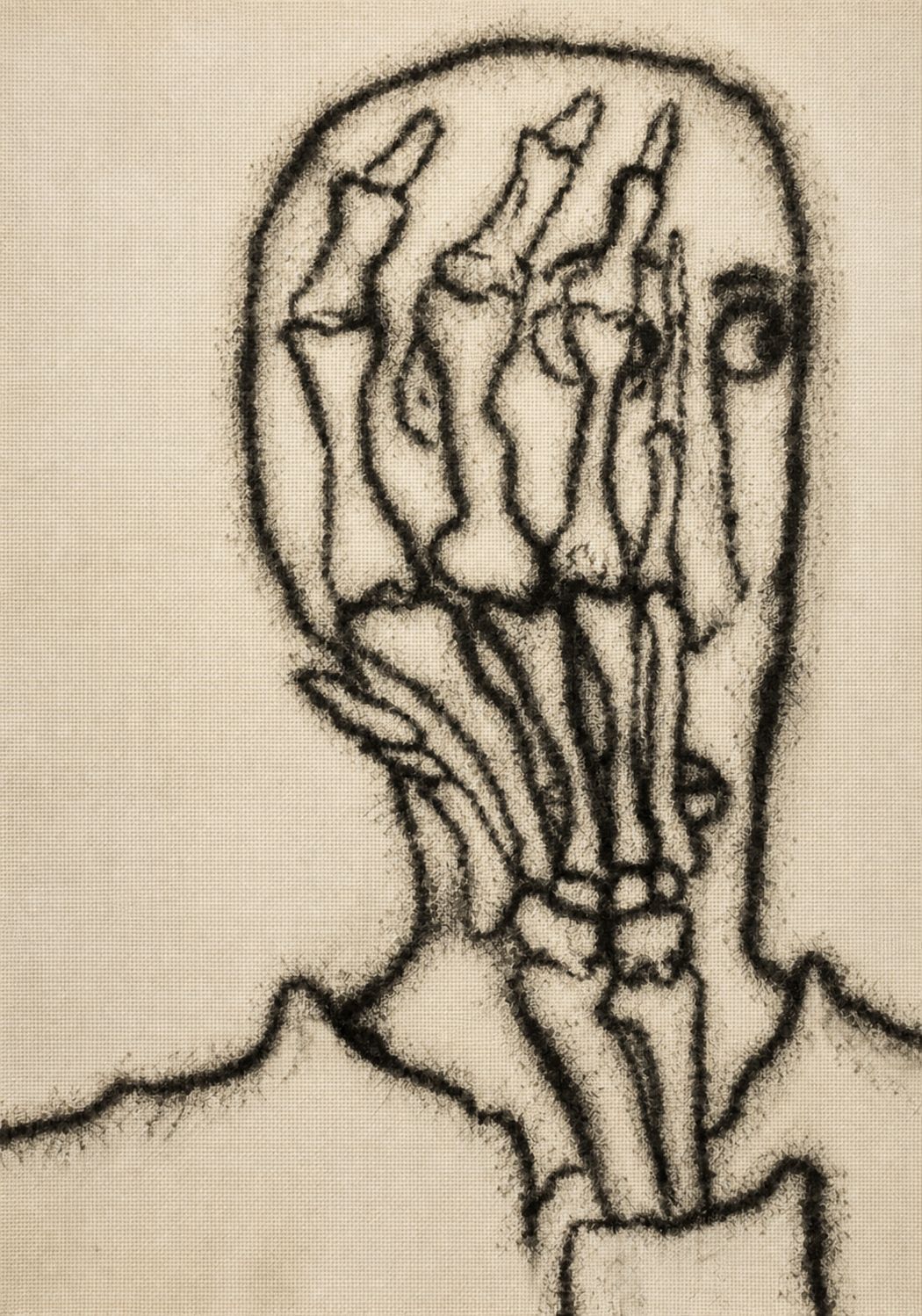
I draw weird. Not weird like your nephew’s refrigerator-magnet phallus, not weird like a Bombay chai stall at three in the morning humming with theosophical cockroaches—no, I draw the kind of weird that makes the paper itself flinch, the kind of macabre that seeps into the interstitial spaces, those hollow, unrented corridors between my depression and whatever wired, irritable bastard cousin of hypomania happens to be pacing upstairs, where the wallpaper peels in tongues and the floorboards remember every footstep I never took. I sketch the architecture of a mind that has been foreclosed upon, repossessed, and sold for scrap to a consortium of pharmaceutical ghosts and algorithmic landlords, and I do it because the alternative is to sit quietly in this single, fifty-one-year-old, poverty-addled, bankrupt Bengali bag of bipolar skin and listen to the drywall sweat.
There is a particular species of suffocation that comes from living a limited life inside an unlimited imagination, a claustrophobia not of walls but of horizons, where every window opens onto the same brick wall of a Calcutta afternoon, humid as a wrestler’s armpit, and every door leads back to the same chair, the same table, the same sketchbook where the ink bleeds like a minor vein that has given up on the heart. I draw because the drawing is a cancellation, a petty, daily insurrection against the incarceration of being me, and if the jailer is going to be my own neurochemistry, then by the ghost of Ronald Fisher and the entire chi-squared distribution, I will at least graffiti the cell walls with the ejaculate of my own festering consciousness.
The sketches are ugly. Let me be precise, because precision is the only courtesy I have left: they are not outsider art, they are not raw brilliance waiting for a Chelsea gallery, they are the visual equivalent of a damp cough in a tuberculosis ward, all twisted perspective and anatomical libel, creatures that look like they were assembled during a bar fight between Darwin and a haunted taxidermist. And this ugliness is not incidental; it is the entire point, the throbbing, tumescent core of the enterprise. For fifteen years I worked in the antiseptic cathedrals of American healthcare research, where every variable wanted controlling, every p-value wanted worshipping, every confidence interval arrived wearing a little halo of legitimacy, and I was good at it, I was clinically, statistically, bureaucratically good at it, and now the machines have come for pieces of that too, large language models and their stochastic-parrot cousins doing in seconds some of the textual and analytical drudgery people once paid humans to perform, and I am left with this: the ability to make marks on paper that mean absolutely nothing to the optimization algorithms of the world unless, of course, I photograph them, upload them, label them, and volunteer them to the maw.
And oh, the exquisite consolation of the temporarily meaningless! The sketches are devoid of purpose, devoid of narrative, devoid of the saccharine redemption arcs that the productivity gurus and their morning-routine semen stains promise will save you if only you journal and cold-plunge and microdose your way to a better quarterly earnings report of the soul. My drawings do not optimize. They do not scale. They do not begin life as prompts or embeddings or neatly paired image-caption examples. This does not make them magically immune to machines—nothing visible is immune once somebody digitizes it—but for the few minutes before the phone camera arrives, before the file name and metadata and upload button, they remain the last unharvested crop in the monoculture of my attention, the final wilderness where the deer and the antelope still play, even if the deer has three eyes and the antelope is melting into a puddle of existential Dijon mustard.
I have tried the soporifics, of course. The chemical lullabies that used to lower me into sleep like a bucket into a well, but the well is dry now, or the rope is frayed, or perhaps whatever sedative bargain once worked simply works less reliably now, and the pills sit in my bloodstream like unwelcome guests at a dinner party that has long since gone cold. I cannot watch the streaming services anymore, those neon-lit opium dens of the twenty-first century, because my attention span has been shot, drawn, quartered, and scattered to the four corners of a digital Colosseum where I am both the gladiator and the lion, and I flit from video to video, from thumbnail to thumbnail, a hummingbird on methamphetamine trying to suck nectar from a stone. Netflix asks, “Are you still watching?” and the honest answer is that I am not even watching. I am buffering, a spinning wheel of existential loading, waiting for content that never arrives.
The books have failed me too, those loyal paper friends. I pick up a novel, a history, a fat textbook of some science I once loved, and I read three pages, four pages, and then the words begin to swim, to blur, to lose their adhesion to meaning, and I am left holding a dead fish of a paragraph, wondering where the sentence went, where the plot went, where I went. Even Audible, that benevolent narcotic for the eyes, cannot hold me; the narrator’s voice becomes a drone, a wasp in a jar, and I realize that I have heard twenty minutes of a book without absorbing a single phoneme, my mind having wandered off to sketch the hollow places again, to doodle in the margins of my own dissolution.
But the sketching, the sketching holds me. For seconds, for minutes, for the duration of a line that curves where no line should curve, I am present. Undivided. The attention that shatters like cheap glass against the screen of a smartphone somehow, miraculously, coheres around the nib of a pen scratching against the tooth of the paper. It is not flow, that once-useful psychology word introduced decades ago and subsequently beaten into a TED Talk, a management seminar, and a productivity app; it is more like a truce, a temporary ceasefire in the civil war of attention and emotion, brokered by the simple act of making a mark. I draw a spiral, and for the length of that spiral, I am not bankrupt, I am not fifty-one, I am not the failed remnant of a healthcare researcher watching autocomplete engines acquire increasingly grandiose ambitions. I am simply the hand that draws, the eye that sees, the breath that moves in and out, in and out, a metronome of meat and electricity.
There is a word, “macabre,” bound up with the medieval danse macabre, the dance of death, and I suppose that is what I am doing, a solo danse macabre in a one-bedroom flat in Calcutta, choreographing the dance with a Pilot pen and a sketchbook cheap enough to survive an economy now measured in tea, medicine, electricity, and postponement. The word’s ancestry itself is appropriately corpse-strewn and uncertain. There is an old theory connecting it through medieval Latin to the Maccabees and their martyrdom; there are competing explanations involving names and textual accidents; the philologists have been worrying the bone for centuries without extracting a clean skeleton. The uncertainty suits me, because everything about my condition is uncertain, is a maybe, is a spectrum, is a “let’s see what happens” followed by another prescription pad. Bipolar II—not a junior edition of bipolar disorder, not bipolar with training wheels, but the form defined by depressive episodes and hypomania rather than the full mania of bipolar I, and quite capable of wrecking a life through depression alone. You do not necessarily get the glorious, godlike mania of cinema. You may instead get irritability, agitation, insomnia, racing thought, mixed features: exhausted and wired at the same time, a short-circuited radio playing static at full volume while the batteries leak acid into the carpet.
I draw the hollow interstitial spaces because I live in them. The textbooks will tell you about the brain, the amygdala and the hippocampus, networks and neurotransmitters, the HPA axis and stress hormones, the venerable monoamine hypothesis and the decades of evidence showing that depression is not reducible to a serotonin gauge with SAD and HAPPY printed at opposite ends. I have read enough of this literature to know the seduction of the colored brain image, the fMRI figure glowing like a depressed Christmas tree, but psychiatry still does not possess some clinical scanner that points at an individual and announces, with papal authority, THERE, THAT PIXEL IS YOUR DESPAIR. The imaging literature finds group-level patterns, network associations, statistical signals, intriguing circuitry; none of that is the same thing as photographing sadness. And none of it captures the phenomenology of it anyway, the lived experience of being a ghost in your own machine, of watching your own life through a sheet of greasy glass. So I draw the glass. I draw the grease. I draw the ghost.
The sketches are a way of saying: I was here, even if “here” is a wasteland, even if “here” is the parking lot of an abandoned mall of the mind where the only stores still open are a nail salon and a shop that sells broken clocks. I sketch the bizarre and the ugly because beauty has been co-opted, because beauty is now a filter on Instagram, a preset in Lightroom, a lie told by the real estate developer who promises “luxury living” in a building that will flood in the first monsoon. Ugliness is honest. Ugliness is the truth serum of the visual world. My drawings do not flatter; they accuse. They say, this is what it looks like when a mind curdles, when a career evaporates, when the future feels confiscated by forces too large to fight and too abstract to punch.
And yet. There is a joy in it, a dirty, secret, masturbatory joy, the joy of the graffiti artist tagging the subway car of his own despair. When the line comes out right—when the grotesque creature on the page achieves a kind of twisted integrity, when the hollow space suddenly breathes—I feel something akin to pride, or at least the absence of shame, which for a Bengali of my generation is practically a mystical experience. We were raised on shame, weaned on it, fed it in our dal and our fish curry, the shame of not being a doctor or an engineer, the shame of being bankrupt at fifty-one, the shame of taking up space in a world that would prefer we be quiet and grateful and unobtrusive. The sketchbook is where I deposit that shame, where I transmute it into ink, where I make of my own degradation a kind of grotesque art.
I do not draw for an audience. There is no audience for this that I can identify, no market, no demographic, no SEO-optimized content strategy. And I cannot even comfort myself with the old fantasy that algorithms need immaculate labeled datasets and therefore cannot digest my scribbles; modern machine learning has long since learned to dine in garbage dumps, swallowing noisy image-text pairs, uncurated pictures, captions written by idiots, and enormous heaps of unlabeled or weakly labeled material. If I put the sketches online, they become pixels, and pixels are edible. Their resistance is therefore not technological. It is temporal and physical and private. Before I scan them, before I post them, before anything else metabolizes them, there is the slow friction of pen on paper, the smell of ink, the smudge of a palm dragged across fresh graphite. There is no ctrl-Z. There is only the line I made and the line I wish I had made and the small human humiliation of having to live with the difference.
That, perhaps, is where their power lies, their pathetic, stumbling, human power. They are slow. They are embodied. They happen in time, not because machines cannot imitate their appearance—they can—but because this particular line required these particular seconds of my life. Nobody gets the seconds back. The machine may reproduce the squiggle; it cannot retroactively have been sitting in this room while I drew it. It cannot confiscate the little interval during which my attention belonged to the page instead of the debt, the screen, the illness, the career, the future, the infernal rotating buffet of everything I cannot presently fix.
So I continue, daily, hourly, in the gaps between the flitting and the sleeping, in the interstitial moments where the soporifics fail and the videos bore and the books blur. I draw the macabre, the hollow, the weird, because it is the only prayer I have left that reliably gets past the receptionist, the only incantation that sometimes works against the silence. It is not Art with the capital A and the grant application and the curator wearing spectacles designed by Le Corbusier’s ghost. It is not necessarily therapy either; I will leave that diagnosis to people with clipboards and insurance codes. It is simply evidence, a blackened, twisted, ink-stained proof that for a few seconds at a time, I was paying attention to something, anything, even if that something was only the void, and the void, being sketched, being seen, being honored with the dignity of a line, consented, for once, to look back.
P.S. References only if needed: No external references were harmed in the making of this confession.
Word Cloud
Related reading
Selected by shared topics and section, with closer publication dates breaking ties.