Beneath the Last Tram
Uses the speech voice supplied by your browser or device.

THIS IS A WORK OF FICTION
The first underground customer returned Arindam’s delivery bag with warm human hair stuck to the zipper and asked him not to let the morning touch it.
He stood on the landing with the bag in both hands.
“What?”
The woman smiled.
She looked about seventy. White nightgown. Thin wrists. A red plastic comb tucked into her hair. Behind her, inside apartment 3B, a ceiling fan turned slowly over a dining table set for four.
“You’re new,” she said.
Arindam looked at his phone.
ORDER DELIVERED.
₹186 credited.
The address had been 17/2 Nalin Sarkar Street.
He knew Nalin Sarkar Street.
This was not Nalin Sarkar Street.
For one thing, he had walked down seven flights of stairs to get here.
For another, somewhere beyond the woman’s apartment, a tram bell rang.
It was 1:43 a.m.
“Didi,” he said, “where is the exit?”
She pointed upstairs.
“That way.”
Then she looked at his insulated delivery bag.
The smile disappeared.
“You opened it outside?”
“No.”
“Good.”
She shut the door.
Arindam stood alone.
The tram bell rang again.
Closer.
He wiped the hair off the zipper.
It did not come off.
The strands were caught inside the teeth of the zip as if they had grown there.
He pulled harder.
Something tugged back from inside the lining.
Arindam dropped the bag.
It landed upright.
For three seconds nothing happened.
Then something inside scratched once.
He picked it up and ran.
He had only wanted ₹1,200.
That was the night’s target.
Rent was overdue. His mother needed thyroid medicine. His motorcycle’s rear tire was showing cloth through the rubber. The delivery app had announced a midnight incentive: complete eleven orders between 11 p.m. and 3 a.m. and receive an additional ₹350.
He had completed nine.
The tenth had taken him to a locked lane off Bidhan Sarani, where the navigation arrow rotated in circles and finally instructed:
PROCEED ON FOOT.
A rusted green gate stood between a shuttered stationery shop and a building with no number.
He had passed that stretch hundreds of times.
He had never seen the gate.
The app showed:
ENTRANCE LOCATED.
Behind the gate was a staircase going down.
He had assumed basement.
Kitchens operated from basements. Cloud restaurants operated from toilets. People ordered biryani from places where rats had union representation.
Nothing surprised a delivery rider for long.
The stairs smelled of wet concrete, kerosene and old movie theaters.
He remembered that specifically.
Old movie theaters.
The smell of damp upholstery, dust, cheap disinfectant and something sweet rotting inside the walls.
After the fourth landing his mobile signal disappeared.
After the fifth, the clock on his phone changed from 1:31 to 12:07.
After the sixth, he heard traffic.
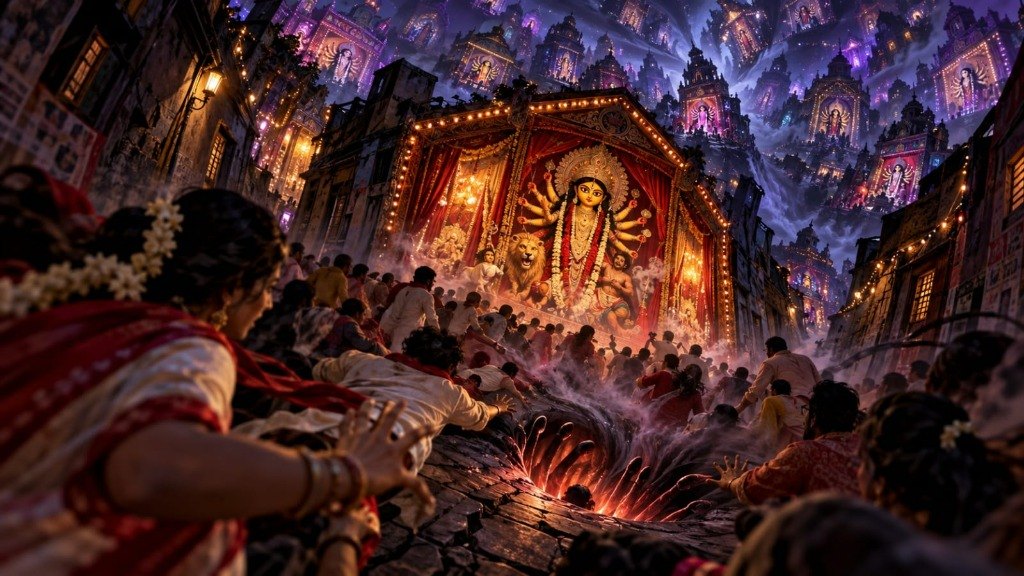
After the seventh, he found a street.
Not a basement corridor.
A street.
There was sky overhead.
Black, without stars.
Buildings stood six stories high on both sides.
Clothes hung from balconies.
A tea stall burned under a yellow bulb.
A tram moved through the intersection.
Its route plate said 12.
Arindam stopped breathing.
Route 12 had been gone longer than he had been alive.
The tram was packed.
People hung from the footboard.
One man glanced at him.
Then another.
Then everyone inside turned together.
The tram continued past.
Nobody spoke.
His phone vibrated.
CUSTOMER IS WAITING.
That had been how he found the old woman.
Now he climbed.
Seven flights.
Six.
Five.
At the fourth landing his left ear popped.
At the third, his gums began itching.
Not pain.
An itch inside the roots of his teeth.
He clenched his jaw and kept going.
At the second landing something knocked from the other side of the wall.
Three knocks.
Pause.
Three knocks.
Pause.
His phone vibrated.
NEW ORDER AVAILABLE.
₹412.
Pickup: Shyambazar.
Drop: METRO CINEMA STAFF QUARTERS, FLOOR B2.
He nearly laughed.
₹412 for one order was absurd.
Then he saw the incentive counter.
10/11 DELIVERIES COMPLETED.
One more.
That was all.
He pressed DECLINE.
The button changed to ACCEPTED.
At street level the green gate closed behind him.
Cars passed.
Dogs slept under shutters.
A drunk man urinated against a wall.
Normal Calcutta.
Arindam opened his delivery bag.
There was no food inside.
There was a folded newspaper.
The Statesman.
April 6, 1967.
He stared at it, then threw it into a garbage vat.
Something moved under his tongue.
He froze.
It felt like a grain of rice.
He spat into his palm.
A tiny white tooth lay in his saliva.
Perfectly formed.
Smaller than a sesame seed.
He touched his own teeth.
All present.
He spat again.
Nothing.
He washed his mouth with bottled water and told himself it had been food.
Bone fragment.
Rice.
Anything.
His phone rang.
CUSTOMER SUPPORT.
He answered.
“Hello?”
Static.
Then a man said, “You left something downstairs.”
The voice sounded bored.
Arindam disconnected.
The phone rang again.
Same number.
He turned it off.
It turned itself back on.
ORDER PICKUP IN 6 MINUTES.
He should have gone home.
Instead he thought about ₹1,200.
That is how poverty defeats fear.
Not heroically.
With arithmetic.
The restaurant was open.
That frightened him more.
At 2:09 a.m., a small biryani shop near Shyambazar was brightly lit. Two cooks worked behind the counter.
“You’re late,” one said.
Arindam showed the order number.
Neither cook looked at the screen.
One lifted a large brown paper parcel from beneath the counter.
It was warm.
Too warm.
Body warm.
“What is it?”
“Food.”
“For Metro Cinema?”
The cook looked up.
“Who said Metro?”
“The app.”
The other cook stopped chopping onions.
Both men stared at him.
Then the first cook shoved the parcel across.
“Take it.”
Arindam did not move.
The bottom of the paper bag flexed.
Once.
Like somebody pressing a tongue against the inside of a cheek.
“Take it,” the cook repeated.
Arindam whispered, “What’s inside?”
The cook leaned close.
His breath smelled of clove cigarettes.
“You people keep asking that after you accept.”
“You people?”
The cook’s face changed.
Not expression.
Color.
It drained so quickly that Arindam saw gray spreading from his lips.
“You’ve been below already.”
Arindam backed away.
“How do you know?”
The cook pointed at his mouth.
Arindam touched his lips.
Blood.
He looked down.
Three tiny teeth sat on his tongue.
He vomited outside the shop.
Tea.
Biscuit.
Yellow bile.
Five more teeth.
All miniature.
All complete.
Incisors. Molars. One tiny canine.
He crouched beside his motorcycle and gagged until his stomach cramped.
A boy walking past laughed.
“Too much drinking, dada?”
Arindam wiped his mouth before the boy could see.
Shame beat fear for several seconds.
He wrapped the tiny teeth in a tissue and stuffed them in his pocket.
His phone buzzed.
CUSTOMER WAITING.
The parcel was already inside his delivery bag.
He had no memory of putting it there.
He called the restaurant.
The shutters were down.
Lights off.
He looked through the glass.
Dark room.
Stacked chairs.
Dust on the counter.
A faded municipal notice dated 2019.
CLOSED FOR RENOVATION.
He stepped backward.
A motorcycle horn screamed behind him.
He almost fell into traffic.
The delivery app displayed a route.
Not toward Esplanade.
Toward an alley beside an old pharmacy.
PROCEED ON FOOT.
“No,” he said.
The phone showed:
DELIVERY CANCELLATION FEE: ₹8,740.
He had ₹913 in his bank account.
He pressed SUPPORT.
A chat window opened.
HOW MAY WE HELP?
Arindam typed:
THIS ADDRESS DOES NOT EXIST.
The reply came instantly.
CUSTOMER HAS CONFIRMED LOCATION EXISTS.
He typed:
I WENT THERE BEFORE. THERE IS SOMETHING WRONG.
Three dots appeared.
Then:
WE UNDERSTAND YOUR CONCERN.
Then:
PLEASE DO NOT EXPOSE ORDER TO DIRECT SUNLIGHT.
Arindam stopped typing.
The skin over his arms tightened.
He wrote:
WHY?
The reply took longer.
BECAUSE THEY HAVE NOT HAD ANY YET.
The second staircase had twelve flights.
Down.
At flight three, his motorcycle key became hot in his pocket.
At flight five, he heard a cinema advertisement.
Not from a phone.
A loudspeaker.
“Tonight only. Uttam Kumar in—”
The voice cracked into static.
At flight seven, the walls changed from concrete to old green tile.
At flight nine, Arindam saw posters pasted over each other.
Movies from the 1950s.
Election slogans.
Missing-person notices.
Some recent.
Some ancient.
One stopped him.
A black-and-white photograph of a sixteen-year-old girl.
MISSING SINCE 1984.
She had a narrow face and thick eyebrows.
Arindam knew her.
She had served him tea ten minutes earlier on the street below.
Same face.
Same age.
He turned around.
Above him, the staircase ended in darkness.
No visible top.
He ran upward.
Flight ten.
Flight nine.
Flight eight.
He kept climbing.
The numbers decreased.
Then 7 again.
He stopped.
His heart slammed against his ribs.
His phone vibrated.
WRONG WAY.
He screamed and threw it.
The phone hit the wall.
The screen cracked.
From the speaker came a quiet voice.
“Arindam?”
His bowels loosened.
Nobody on the app should have known his name beyond the account.
The voice continued.
“Baba?”
He nearly sat down.
His father had been dead eleven years.
“Baba, come down.”
Arindam covered his ears.
The voice now came from below.
Not the phone.
“Come down. Your food is getting cold.”
He stood still until he began crying.
Then he descended.
Metro Cinema was open.
Not the Metro he knew.
This one had old neon letters.
A queue stretched around the block.
Men wore shirts tucked into high-waisted trousers. Women carried handbags under their arms. Children held paper tickets.
Every face looked ordinary.
That was the worst part.
No corpses.
No pale ghosts.
No backward feet.
People complained about ticket prices.
A taxi driver argued about change.
A couple fought over where to eat afterward.
A boy licked an orange ice candy.
He bit through it and Arindam saw that the boy had no tongue.
Just rows of small white teeth filling the floor of his mouth.
The boy smiled.
Arindam looked away.
The app directed him around the cinema to a service door.
Down another staircase.
STAFF QUARTERS B2.
At the bottom stood a man in pajamas.
Arindam knew his father from the shape of his shoulders.
Before the man turned, Arindam knew.
“Baba?”
His father faced him.
Eleven years dead.
Not decomposed.
Not transparent.
Just older than Arindam remembered.
Thin.
Gray-haired.
Irritated.
“You took your time.”
Arindam could not move.
His father looked at the delivery bag.
“You brought it?”
“What is this?”
“Give me the parcel.”
“You died.”
“Yes.”
“I saw you.”
“I know.”
“I touched your feet.”
“I know.”
“At the crematorium.”
His father sighed.
“Arindam, please. There are people waiting.”
“Who?”
His father looked toward the ceiling.
“Upstairs.”
Arindam began sobbing.
It embarrassed him.
Even here.
He wiped his nose with his wrist.
“You’re dead.”
His father nodded.
“Up there.”
The answer stopped the crying.
“What does that mean?”
His father reached for the bag.
Arindam stepped back.
“No.”
“Give it.”
“What’s inside?”
“Morning.”
Arindam laughed.
A single stupid bark.
His father did not.
“The restaurant packed it before dawn yesterday.”
“That makes no sense.”
“It does here.”
His father unzipped the bag.
Arindam tried to stop him.
Too late.
Inside the paper parcel was a plastic food container wrapped in foil.
His father peeled back the foil.
Arindam expected meat.
He wished afterward it had been meat.
Inside lay a rectangle of sunlight.
Actual sunlight.
Bright enough to hurt.
No lamp.
No bulb.
A patch of morning, trapped flat inside a takeaway container.
Warm yellow light spilled across his father’s hands.
His father screamed.
Not in pain.
In hunger.
His jaw opened.
Too far.
The corners of his mouth split to the ears.
Blood ran down his neck.
Tiny teeth poured from beneath his tongue.
He bent over the container and inhaled.
The light went into him.
His skin swelled.
Veins rose black along his face.
His eyes became red.
Then clear.
Then human.
For one second he looked exactly as Arindam remembered him.
He whispered:
“God.”
Above them, the whole city screamed.
Not frightened.
Excited.
Doors opened.
Footsteps began.
Thousands.
Running toward the cinema.
Arindam grabbed the container.
His father clawed for it.
“Give me more.”
“No.”
“You opened the route.”
“I didn’t—”
“Every delivery opens it.”
His father’s fingernails came off against the plastic lid.
He did not notice.
“Do you know how dark it is when nobody remembers you?”
Arindam backed toward the stairs.
“You’re not my father.”
“I am exactly your father.”
“Then tell me something.”
“What?”
Arindam could think of nothing.
That terrified him.
Eleven years of grief, and under pressure he could not produce one private question.
His father smiled.
“That’s why we survive.”
Arindam’s stomach went cold.
“What?”
“You forget us.”
People were pounding on the service door.
His father spoke quickly now.
“Every person lost from upstairs comes somewhere. Not the body. The version that remains in other people. The remembered version. The city keeps us. Streets too. Buildings. Tram routes. Cinema halls. Shops. Names. Everything Calcutta throws away without fully forgetting.”
The door buckled.
“We live on memory.”
Another blow.
The latch cracked.
“But memory has no sun.”
The door burst inward.
The first woman through was the old customer from Nalin Sarkar Street.
Behind her came hundreds.
Some young.
Some old.
Some wearing clothes from decades Arindam knew only from photographs.
One man had an IV cannula taped to his wrist.
A schoolgirl wore a uniform covered in dried mud.
A policeman had half his scalp missing.
A baby crawled between their legs dragging a black umbilical cord.
They all stared at the container.
His father whispered:
“Run.”
Arindam ran.
Up twelve flights.
Or twenty.
Or three.
People followed.
They did not roar.
They begged.
That was worse.
“Dada, one second.”
“Please.”
“My daughter is upstairs.”
“I haven’t seen morning since 1972.”
“Just open it.”
“Please.”
“Please.”
Hands reached around the turns below.
Normal hands.
Burned hands.
Child hands.
One hand wearing a wedding ring grabbed Arindam’s ankle.
He kicked.
His heel crushed fingers.
The woman attached to them said, very politely:
“Sorry.”
He ran harder.
His teeth began moving.
Adult teeth.
He felt the lower incisors shift against one another.
His mouth filled with blood.
He spat a molar onto the stairs.
This one was his.
Full-sized.
A second loosened.
He realized what the tiny teeth had been.
Not teeth growing inside him.
Teeth arriving early.
Replacing him piece by piece with the version below.
He clawed at the wall.
The stairs narrowed.
Behind him his father shouted:
“Don’t let them take all of it!”
Arindam reached the green gate.
Locked.
He slammed into it.
Daylight showed through the gaps.
Not morning.
It was already 4:58 a.m.
The eastern sky was pale.
Behind him, hundreds of people stopped.
Nobody touched him.
They stared through the gate.
A little girl stepped forward.
Half her face was burned.
She whispered, “Is that it?”
Arindam looked at the growing light.
Then at them.
The dead.
The vanished.
The forgotten city.
His father stood in the crowd.
Bleeding from the mouth.
“Open it,” he said.
Arindam shook his head.
His father said, “You would.”
“No.”
“You always felt guilty.”
Arindam froze.
His father smiled.
“That part of you remembers me perfectly.”
The crowd moved closer.
Arindam grabbed the gate.
He pulled.
It opened easily.
It had never been locked.
Sunlight entered the stairwell.
The first ray touched the burned girl’s face.
Her skin inflated.
She screamed.
Her cheek split.
Inside was not flesh.
There was another face underneath.
Then another.
Then another.
Dozens of remembered versions packed inside one body.
Baby.
Child.
Teenager.
Old woman.
Corpse.
Photograph.
Dream.
Each face opened its mouth.
The crowd surged upward.
Calcutta received them at sunrise.
Quietly.
That was the catastrophe.
No invasion.
No screaming mobs.
People simply came out of alleys, basements, metro entrances, locked cinema doors and sealed tram depots.
They stood in sunlight.
They swelled.
They changed.
Then they walked home.
A woman missing since 1996 rang her husband’s bell.
A tram conductor dead since 1978 reported for work.
Children returned to parents who were now older than them.
Demolished shops opened their shutters.
A cinema on Chittaranjan Avenue began selling tickets from behind a concrete bank wall.
Old tram tracks pushed through asphalt like bones through skin.
By 8 a.m., traffic maps were showing roads that had not existed for fifty years.
By 9 a.m., thousands of residents were calling police to report relatives who were dead but refusing to leave the house.
By 10 a.m., the mobile networks failed.
Arindam went home.
His mother opened the door.
She stared at his bloody mouth.
“What happened?”
“Accident.”
“Where?”
“Bike.”
She believed him.
The relief made him hate himself.
He locked himself in the bathroom.
Three teeth were missing.
In the mirror they were present.
He touched the gaps.
His reflection smiled.
Arindam did not.
He stepped back.
The reflection raised one finger to its lips.
Then the bathroom door knocked.
His mother called, “Arindam?”
He turned.
“Yes?”
“Who is this man?”
Every muscle in his body tightened.
He opened the door.
His father stood in the kitchen.
Freshly shaved.
Wearing the brown checked shirt he had been cremated in.
His mother sat at the table, white-faced.
His father was drinking tea.
He looked at Arindam and said:
“You forgot sugar.”
His mother made a sound like air escaping a tire.
Arindam grabbed the wall.
His father took another sip.
Outside, a tram bell rang.
Their street had never had tram tracks.
The bell rang again.
Closer.
His mother whispered, “I watched you burn.”
His father nodded.
“I know.”
Then he looked at Arindam.
“There’s one problem.”
Arindam could barely speak.
“What?”
His father placed the teacup down.
“The sun isn’t enough.”
Something moved under the dining table.
Arindam looked.
At first he thought it was a dog.
Then he recognized his own delivery bag.
It had swollen to the size of a suitcase.
The zipper trembled.
Human hair pushed through the seams.
A notification sounded from Arindam’s broken phone.
NEW ORDER AVAILABLE.
Pickup:
ARINDAM GHOSH.
Drop:
BELOW.
His father looked almost embarrassed.
“They need people now.”
The bag unzipped itself.
Inside was a staircase.
Tiny.
Perfect.
Descending through layers of red flesh where the insulated lining should have been.
Far below, little yellow streetlights burned.
Arindam heard traffic.
Tram bells.
Vendors.
Millions of voices.
And another sound.
Hammering.
From much deeper.
His father leaned over the opening.
“So that’s where they put the ones nobody remembers at all.”
The hammering stopped.
Every light inside the bag went out.
Arindam’s phone vibrated.
A new message appeared.
NOT ENOUGH ROOM BELOW.
PLEASE PREPARE ADDITIONAL CITY.
His mother began to cry.
Arindam looked toward the window.
Across the lane, in the full October morning, the neighboring building had acquired an extra floor.
Then another.
Both underground.
He could see them through the pavement.
People were standing at the windows down there, looking up.
All along the street, manhole covers lifted by an inch.
Not from pressure.
Carefully.
As if somebody underneath was checking whether breakfast had begun.
Arindam closed the curtains.
Then he picked up his delivery bag, because the app was already counting down and he still needed ₹287 for the rent.
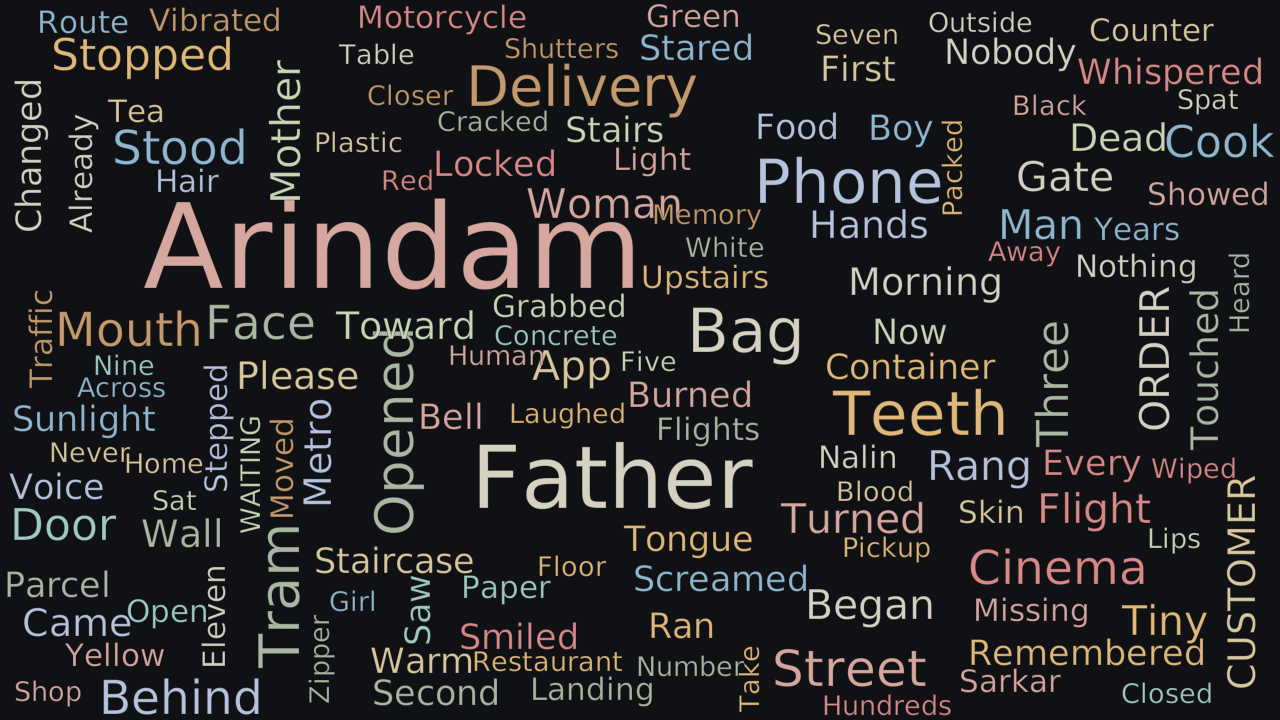
Word Cloud
Related reading
Selected by shared topics and section, with closer publication dates breaking ties.