The Ninth Day of Small Things
Uses the speech voice supplied by your browser or device.

THIS IS A WORK OF FICTION
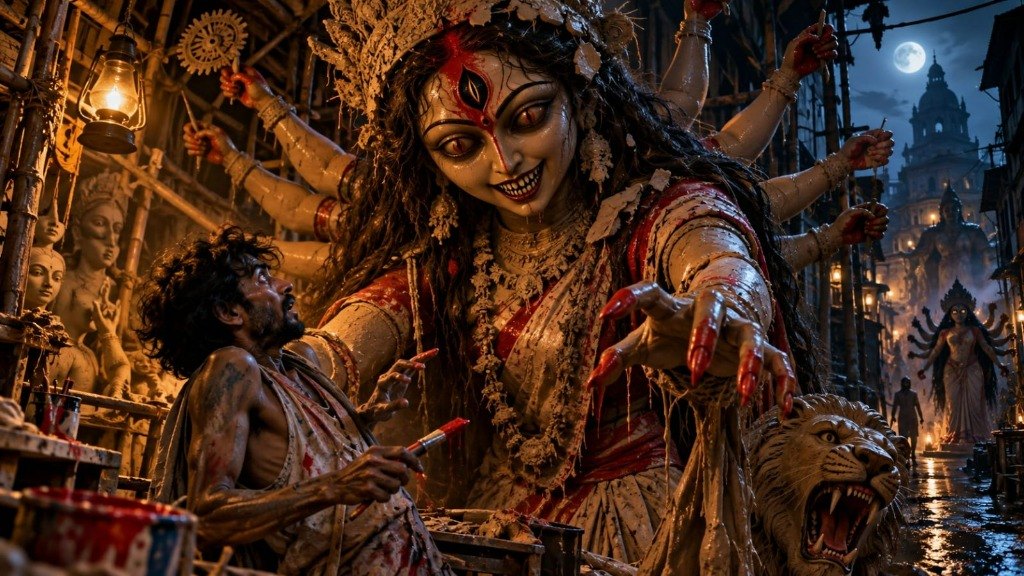
The pandal had no exit, and the crowd behind him kept walking in.
Rono had counted the entrances because he counted everything when he was high: one arch opening onto the narrow lane, one smaller arch toward the pond, both wrapped in painted cloth and made to look more expensive than bamboo had any right to look.
He had found the place by accident.
The lane was supposed to be a shortcut between two larger pandals. Google Maps showed it continuing through. The boys he had been hopping with had gone toward the main road because somebody had heard there was a forty-foot moving lion there, sponsored by a cement company. Rono had taken the alley because the queue looked shorter and because shortcuts exercised a religious authority over him greater than any goddess ever had.
The lane narrowed between two old houses, passed a shuttered medicine shop, turned beside a pond, and should have ended at a wall.
Instead there was a pandal.
Small. Neighborhood money. Eight-foot Durga. Cheap white LED tubes. No theme anyone would put on Instagram. No celebrity inauguration. No corporate logo large enough to be visible from orbit.
Rono went in through the lane-side arch, crossed the pandal, slipped out through the pond-side arch to piss behind the generator, and came back thirty seconds later.
The lane-side arch was gone.
Not blocked.
Gone.
The bamboo wall ran unbroken from one corner of the pandal to the other.
Rono turned.
The pond-side arch through which he had entered ten seconds ago was gone too.
That should have been the frightening part.
It wasn’t.
The frightening part was that people were still coming in.
They emerged through the bamboo wall where the lane-side arch had been, shoulder first, face second, shopping bags last, as casually as commuters stepping through a metro gate. The wall did not open for them. They did not break it. They simply passed through it, one family after another, each apparently seeing an entrance Rono could no longer see.
Nobody screamed.
Nobody even slowed down.
Rono laughed once, the way you laugh when you drop your phone in a taxi and the taxi drives away before your brain has finished telling your hand what happened.
Then he stopped laughing.
“Wrong side,” he said to a man in a red shirt.
The man turned apologetically, bumped a woman behind him, apologized to her, and the apology traveled backward through the crowd like a bucket brigade.
Rono pressed his palm against the bamboo wall.
It was warm.
Bamboo is not warm at night.
He had four hours until his shift at the call center. Thirty-seven rupees in his wallet. Eleven percent battery. He had promised his sister he would visit their mother’s grave that morning and had not gone because he had been asleep, because he had been awake until dawn the night before, because sleep had become a debt collector who arrived whenever other people were awake and vanished whenever he needed him.
His sister had called twice already.
He had ignored her.
What Rono wanted now, with a simplicity that embarrassed him, was not escape, enlightenment, salvation, or even another line of whatever he had taken two pandals ago.
He wanted a chair.
One plastic chair.
A place to sit where nobody would step on his feet.
The pandal was perhaps twenty feet across.
The crowd was the size of Sealdah.
That was the second impossible thing.
People kept arriving, and the pandal kept accepting them, but the room did not get larger.
The people merely became closer.
A shoulder entered the space previously occupied by another shoulder. A woman’s handbag flattened without changing shape. A child disappeared between two adults and reappeared three people away. Bodies overlapped at the edges as though whoever was rendering the scene had become careless with depth.
Still nobody complained.
A woman stood beside Rono wearing a sari the chocolate brown of a new ten-rupee note.
She was close enough for him to smell coconut oil in her hair.
“First time?” she asked.
“In this pandal?”
“In this pandal.”
“Yes.”
She nodded as though he had confirmed a diagnosis.
“My third.”
“Third what?”
“Third time.”
Rono looked at the wall.
“You’ve been trapped here before?”
“It gets easier.”
“What gets easier?”
She smiled.
The crowd moved.
Not forward.
Sideways.
Thousands of bodies began turning with the slow obedience of water approaching a drain.
At the center of the movement was not the goddess.
It was a patch of concrete maybe three feet across where the floor had gone soft.
Not cracked.
Soft.
A child’s red rubber ball rested half inside it.
The exposed half remained perfectly round.
The buried half continued downward.
Very slowly.
Rono watched it sink.
The woman touched his elbow.
“Don’t look at the ground.”
“What?”
“Look at the goddess.”
“Why?”
“That’s the trick.”
“What trick?”
“They can’t take you while you’re looking at the goddess.”
“Who can’t?”
She pointed upward.
Rono looked.
There should have been tarpaulin.
There should have been bamboo rafters, wires, cheap lights, fire extinguishers nobody had checked, one exhausted electrician smoking somewhere he absolutely should not be smoking.
There was sky.
The sky was the gray of a television after the cable signal dies.
And floating in it, very faintly, were the other pandals.
All of them.
The enormous ones on the arterial roads. The sponsored ones. The heritage ones. The ones shaped like temples, spaceships, caves, palaces, forests, terracotta villages, lost civilizations and things Bengalis had spent eleven months pretending not to need.
Rono could see them from above and below at the same time.
They looked like cities seen through an airplane window.
Every one of them was leaning.
Not falling.
Leaning.
Their towers, domes, scaffolds, facades and illuminated crowns all bent toward a point somewhere above this neighborhood, above the pond, above the small patch of soft concrete.
The ground shifted.
A man fainted.
There was no room for him to fall.
The crowd lifted him instead.
Hands passed him overhead, hand to hand, toward the goddess.
His sandals came off.
Someone caught one.
The other disappeared.
The man reached the pedestal.
The goddess received him without moving.
He passed behind her.
He did not come out the other side.
Nobody screamed.
Rono’s phone buzzed.
His sister.
He declined the call.
The display said 11:47.
Then 11:46.
Then 11:47 again.
His phone had never done that before.
The numbers seemed unable to agree about which side of a minute they belonged on.
Ashtami itself had already become Navami by the almanac hours ago, though everybody in the streets still called it Ashtami night. Rono had never cared about tithis. Now he wondered whether perhaps the night cared.
The soft patch widened.
It touched the goddess’s pedestal.
The pedestal did not sink.
It folded.
A crease appeared across the imitation marble.
Stone does not crease.
Plastic does not crease that way either.
The base bent soundlessly along a line too clean to belong to matter.
Rono stared.
“Don’t,” the woman said.
“That isn’t possible.”
“Possibility is a local rule.”
“What?”
“You think the city follows the same rules everywhere?”
“Yes.”
“Why?”
He had no answer to that.
The crowd tightened.
Somewhere a dhaak was beating, except Rono could no longer tell whether the sound came from outside, from another pandal, or from underneath the floor.
The woman leaned toward him.
“They’ve been preparing this for years.”
“Who?”
“The city.”
“Preparing what?”
“This.”
She gestured around them as if the explanation were obvious.
“Every Puja. Every person walking from one pandal to the next. Every shortcut. Every queue. Every barricade. Every U-turn. Every person who sees one idol and immediately asks where the next one is. Millions of people drawing lines through the city with their feet.”
“That’s just pandal hopping.”
“Yes.”
She smiled.
“Exactly.”
The crowd rotated another few degrees.
“You draw enough lines,” she said, “eventually you draw something.”
“What?”
“A shape.”
“What shape?”
“The one we’re inside.”
Rono looked at the soft place in the floor.
It had developed a rim.
The rim shone.
Not reflected light.
There was nothing on its surface to reflect.
The shine seemed to remove brightness from whatever came near it. One of the LED tubes overhead dimmed as the rim widened beneath it.
“You said they were counting people,” Rono said.
“The city counts everything.”
“For what?”
“For weight.”
“People don’t become heavier because they look at pandals.”
“No.”
She considered this.
“Call it weight because you need a word.”
“That’s not how physics works.”
“No.”
Her smile widened.
“It’s how cities work.”
The crowd began making a sound.
At first Rono thought it was chanting.
Then singing.
Then neither.
It was the sound thousands of human beings make when individual voices are being squeezed out of them.
One note.
Low.
Continuous.
The hole answered.
Rono felt the answer through his shoes.
The crowd was no longer singing to the goddess.
It was singing to the ground.
Or the ground was singing through the crowd.
His phone buzzed again.
His sister.
He answered because fear rearranges priorities faster than morality ever manages.
“Where are you?” she said.
“Small pandal near the pond.”
“Which pond?”
“I don’t know. Off the lane behind the pharmacy.”
“What pandal?”
“This tiny one at the dead end.”
There was a pause.
“Rono.”
“What?”
“There is no pandal there.”
He looked around.
“Very funny.”
“I’m serious. I came through that lane an hour ago. It’s a dead end. There’s a wall.”
Rono stared at the bamboo.
The bamboo seemed to inhale.
Not metaphorically.
The strips bowed inward together, held for a second, then relaxed.
“There was a wall,” he said.
“What?”
“I think there was a wall.”
“What are you talking about?”
“The queue there—is it moving?”
“No.”
“Can you leave?”
Another pause.
Then quieter:
“No.”
Behind her he could hear thousands of people.
“Rono, nobody’s moving. They stopped ten minutes ago. Everyone is just standing here.”
“Look at the goddess.”
“What?”
The woman beside him turned toward him.
Rono remembered what she had said.
They can’t take you while you’re looking at the goddess.
“Look at Durga,” he said. “Don’t look anywhere else. Keep looking at her.”
His sister breathed into the phone.
Then:
“Rono.”
“What?”
“She’s looking back.”
His stomach tightened.
“Good,” he said.
He did not know why he said it.
“Good. Keep looking.”
The woman in the brown sari laughed softly.
Not cruelly.
Almost fondly.
Rono turned.
“What?”
“Third time,” she said.
“What?”
“The first time, you notice.”
The ground tilted.
A degree.
Perhaps two.
Nobody stumbled.
“The second time, you understand.”
Another LED tube went dark.
“The third time, you help.”
Rono looked at his phone.
At his sister’s name glowing on the screen.
Then at the goddess.
Then at the woman.
“What did you tell me to do?”
“Look.”
“You said looking stops them.”
“No.”
“You said they can’t take you if you’re looking at the goddess.”
“I said that’s the trick.”
Rono felt something cold pass through his body.
“The trick on who?”
The woman’s teeth were very white.
“On you.”
He raised the phone.
“Stop looking,” he said.
Static.
“Rono?”
“Stop looking at her.”
“What?”
“Look away. Look at the ground. Look at your shoes. Close your eyes. I don’t care. Just stop—”
The line crackled.
His battery dropped from eight percent to four.
Then three.
The woman watched him.
“What does it want?” he said.
“Want?”
“The hole. The city. Whatever this is.”
“Attention.”
“Why?”
“What does anything want attention for?”
“I don’t know.”
“To become real.”
The crowd turned.
The hole widened.
“And we make it real?”
“Every year.”
“By looking?”
“By looking. By walking. By comparing. By photographing. By standing three hours in a queue for nine seconds in front of something and then walking immediately toward the next thing.”
She looked upward at the impossible sky.
“You’ve been rehearsing this city into existence for decades.”
“The city already exists.”
“Which one?”
Rono looked at her.
She pointed into the hole.
He looked.
That was his mistake.
Inside the hole were the pandals.
All of them.
Not reflections.
Not miniature images.
They were there.
Perfect.
Each with its barricades.
Each with its volunteers.
Each with its lights.
Each with its sweating queue folding around streets and alleys and intersections.
Rono could see people walking through them.
Downward.
Although there was no downward.
A man left one pandal and entered another three kilometers away without crossing the distance between them. A family walked around a barricade and returned twenty minutes earlier. A child disappeared behind a tea stall and emerged from a metro staircase. A police barricade curved into itself. A road turned left four times and never formed a square.
The city had stopped being geography.
It had become behavior.
A place where everyone was always going somewhere else.
A place made not of streets but of wanting the next street.
Not pandals.
Routes between pandals.
Not destinations.
Queues.
Not people.
Attention moving through space.
And every movement bent the space a little more.
Rono saw tramlines curve toward intersections they had never reached.
He saw the Howrah Bridge pulled thin as wire.
He saw metro tunnels loop beneath themselves like intestines.
He saw flyovers descend into lanes built decades before the flyovers existed.
He saw millions of footprints layered one over another until the city beneath them disappeared.
He understood then what the woman meant by weight.
Not kilograms.
Accumulation.
Enough repetition becomes structure.
Enough structure becomes law.
Enough people behaving as if a city is one thing can eventually force the city to become it.
His sister was still on the phone.
Barely.
“Rono?”
“I’m here.”
“The goddess is moving.”
“Don’t look.”
“I’m not.”
“Close your eyes.”
“I did.”
“Keep them closed.”
“I can still see her.”
Rono shut his own eyes.
The goddess remained.
Not as an image.
As direction.
He knew exactly where she was despite the darkness behind his eyelids.
So did everyone else.
That was what the crowd had been doing.
Not looking.
Orienting.
Every face pointed toward the same center.
Every body became an arrow.
Every arrow became force.
He opened his eyes.
The woman was watching him.
“Now you understand,” she said.
“Second time?”
“No.”
She shook her head.
“Still first.”
The crowd lifted her.
She did not resist.
Hands raised her overhead.
Her chocolate-brown sari trailed across people’s fingers.
She floated toward the goddess with the peaceful expression of someone boarding a train she had taken every morning for thirty years.
“Wait,” Rono said.
She looked back.
“Third time’s the charm.”
The goddess received her.
For one instant the painted face changed.
Not expression.
Age.
Rono saw cracks beneath the paint, old clay beneath new clay, straw beneath clay, river mud beneath straw, then something beneath the mud for which he had no word.
The woman disappeared.
The goddess’s eyes became wet.
Rono looked for the arch.
The original one.
The lane.
The way out.
At the far edge of the crowd something flickered.
An opening.
Dark lane beyond it.
For half a second he saw the shuttered medicine shop.
A dog.
A parked scooter.
Ordinary Calcutta.
He pushed toward it.
The crowd yielded strangely, not because people moved but because their bodies became briefly less substantial.
He took one step.
Two.
The arch brightened.
His sister said his name through the phone.
Then the woman spoke beside his ear.
She was no longer there.
“You can try.”
Rono froze.
“You’ll come back.”
He looked around.
Nothing.
“That’s what a hopper is.”
The arch flickered.
“A person who always believes the next place is the place he was trying to reach.”
The opening vanished.
Bamboo.
Warm beneath his palm.
The floor tilted harder.
The crowd adjusted like water.
Rono did not.
He fell to one knee.
The hole spread beneath the goddess and across the concrete in branching lines that looked almost like streets on a map.
One branch reached him.
He moved backward.
Another appeared behind him.
He laughed.
Not because anything was funny.
Because sometimes the brain reaches the bottom of the drawer and finds laughter where terror should be.
His phone showed one percent.
His sister was crying now.
Not loudly.
“Rono.”
“Yes.”
“I can’t feel the ground.”
He wanted to tell her he was coming.
He wanted to tell her he would find her.
He wanted to tell her this was temporary, electricity, drugs, panic, mass hysteria, carbon monoxide, heat exhaustion, anything with a Wikipedia page and a treatment protocol.
Instead he said:
“I’m sorry about Ma.”
“What?”
“This morning.”
Silence.
Then:
“I know.”
“I should have gone.”
“I know.”
“I was going to.”
“I know.”
He sat down.
There was suddenly enough room.
Perhaps because people were disappearing.
Perhaps because space had stopped pretending.
He sat on the concrete in the last clear patch between two branching lines of darkness.
All evening he had wanted one chair.
Now the city gave him the floor.
He thought of his mother’s grave.
Fresh earth.
The smell of rain although it had not rained.
His sister standing beside him and looking furious because grief had nowhere else to go.
He thought of the call center.
“How may I assist you?”
Four hundred times a night.
A voice sent through cables to strangers in countries where it was afternoon.
A body erased so the voice could work.
Perhaps this was not so different.
Perhaps cities learned from people.
How to make bodies disappear while keeping the traffic moving.
His phone died.
His sister vanished in the middle of saying his name.
The screen went black.
The hole reached his shoes.
It did not hurt.
It was warm.
That surprised him most.
Warm like the bamboo wall.
Warm like the pandal floor after thousands of feet.
Warm like the back seat of a taxi that has been driving all night.
His left shoe sank first.
Then his right.
Rono did not look at the goddess.
He looked at his dead phone.
In its black screen he could see her reflection anyway.
Above him, below him, through him, Calcutta bent.
The great pandals folded inward.
The little pandals folded outward.
Queues became circles.
Circles became knots.
Roads touched roads they had spent a century avoiding.
The river curved upward.
Bridges shortened.
Metro lines met themselves underground.
Every goddess in the city turned—not physically, not enough for anyone to photograph—and faced every other goddess across the collapsing distance.
For one instant there were no separate pandals.
Only one enormous room.
Millions of people.
Thousands of idols.
One gaze.
Rono understood why the city had needed so many years.
You could not make a thing this large disappear all at once.
You had to teach it disappearance in small pieces.
A doorway.
A shortcut.
A missed morning.
A person in a queue.
A road nobody remembered building.
A pond filled in.
A house demolished.
A tram route removed.
A voice reduced to a script.
A body reduced to a number.
A neighborhood reduced to a theme.
A city reduced to where everyone was going next.
Small things.
Always small things.
Until there was enough absence to fold.
The last thing Rono saw was his own hand reaching toward the place where the arch had been.
Not because he believed the arch was there.
Because the body reaches long after belief has given up.
Beyond his fingers was nothing.
Then the nothing closed.
The mouth shut.
In the morning, Calcutta was quiet.
Not lockdown quiet.
Not bandh quiet.
Not early-Puja-morning quiet, when yesterday’s paper plates still rolled along the street and the tea stalls began boiling milk before the first buses arrived.
This was architectural quiet.
The pandals stood empty.
No volunteers.
No police.
No hawkers.
No queues.
No crowds.
No idols.
Every pedestal was bare.
The lights remained on.
Thousands of them.
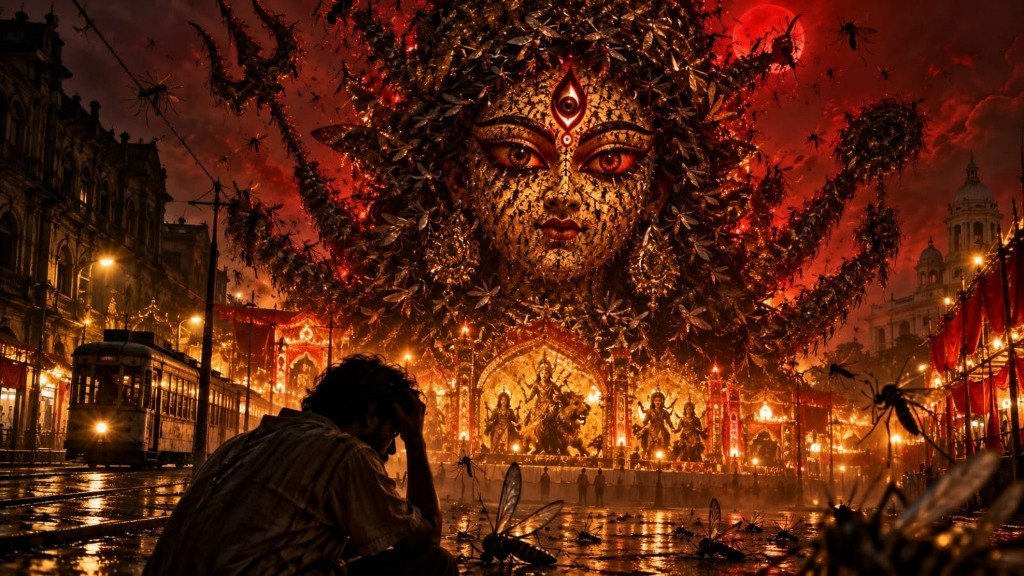
LED dragons blinked over empty roads. Decorative chandeliers changed color for nobody. Loudspeakers hissed between announcements that would never be made.
At the dead-end lane behind the shuttered medicine shop, there was no pandal.
There was a wall.
It looked old.
Older than the houses beside it.
Older than the lane.
On the main road, a phone lay in the dust.
Its screen was cracked.
Its battery was dead.
At 11:47 in the morning, it rang.
Once.
Then again.
It continued ringing although there was no power left in it.
Nobody answered.
There was nobody outside to hear it.
But somewhere beneath the city—or above it, or folded through it—millions of feet were still walking.
Still hopping.
Still looking for the next pandal.
The queues moved beautifully there.
They never stopped.
They never reached the front.
Ashtami never quite ended.
Navami never quite began.
And at the center of it all the goddess looked back, not angry, not merciful, not alive, but with the patient concentration of something that had finally received the full attention of a city and discovered that attention, once given completely, was indistinguishable from being swallowed.
Word Cloud
Related reading
Selected by shared topics and section, with closer publication dates breaking ties.