Entropy and the Thermodynamics of Lonely Bastards
Uses the speech voice supplied by your browser or device.

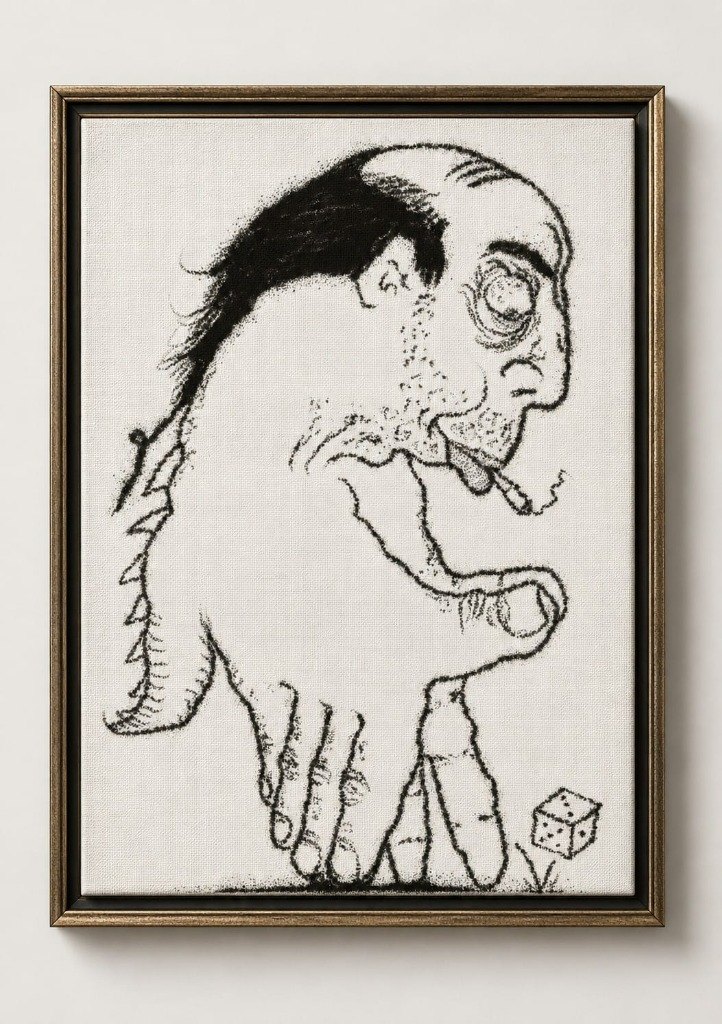
The universe, that magnificent colossal indifferent rectal cavity, has exactly one job description tattooed across its event horizon: things fall apart, and they do not, under any circumstances, ask your permission first. Ludwig Boltzmann, that magnificent mustachioed Austrian who eventually hanged himself in 1906—there’s a career trajectory for you—gave us the statistical interpretation of entropy, , where is the Boltzmann constant and represents the number of microstates corresponding to a given macrostate. What this means, stripped of its mathematical lingerie, is that disorder is not merely probable; disorder is the only game in town, the house always wins, and you, my friend, are the house. You are also the gambler, the chips, and the stale cigarette smoke curling toward the ceiling.
I have been counting my microstates lately, and the arithmetic is not encouraging.
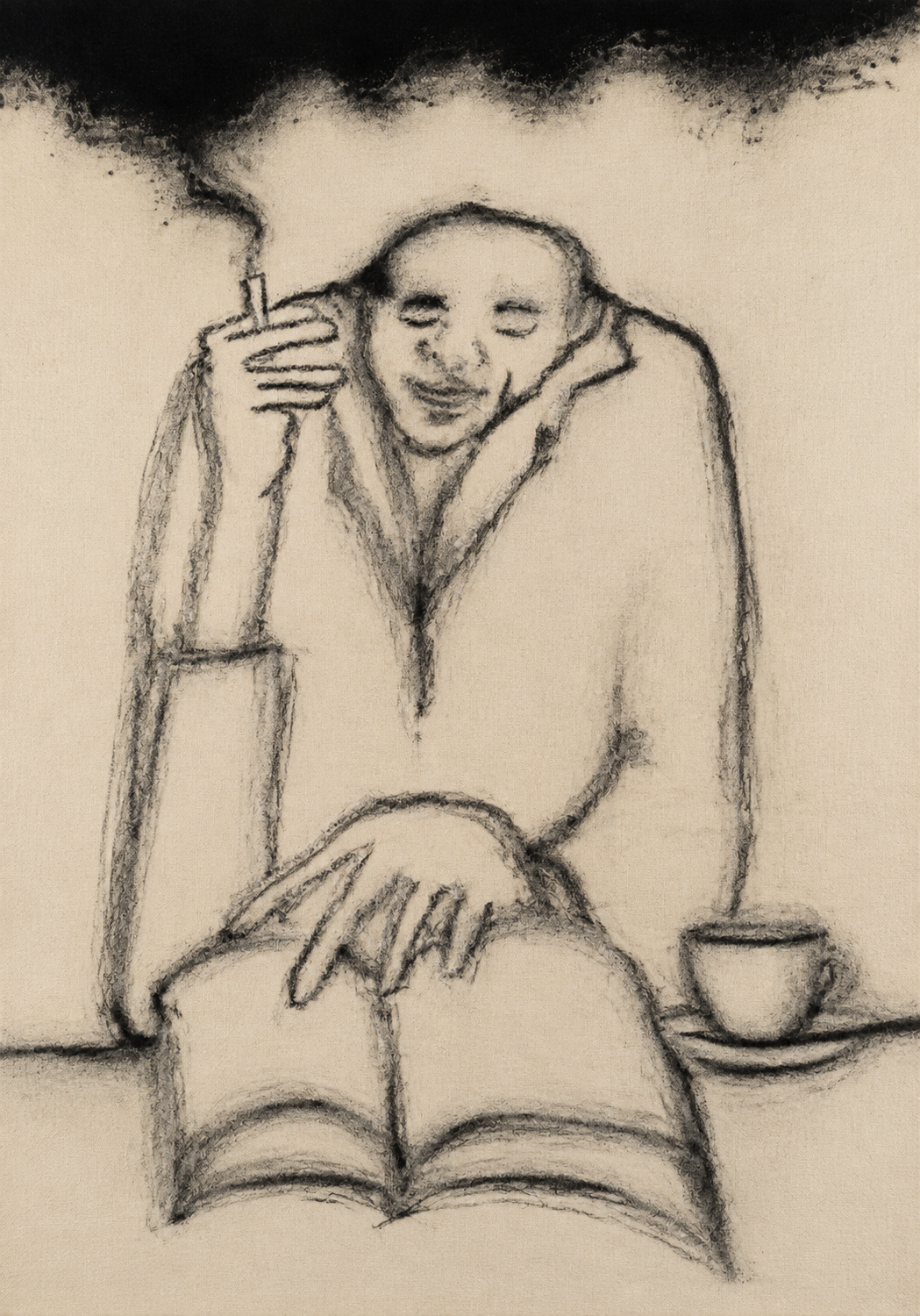
There is a particular species of loneliness that does not announce itself with Wagnerian bombast but rather seeps in through the floorboards like the Calcutta monsoon, that annual hydrological betrayal that turns every street into a feculent tributary and every ambition into mildew. I have been lonely in crowds, which is the most expensive kind of loneliness, the premium subscription model, the loneliness that requires you to rent a face and wear it like a poorly fitted prosthetic while inside your skull the same four thoughts chase each other in ever-decreasing circles until they collapse into a singularity of self-regard so dense that light itself cannot escape. The physicists call this a black hole. I call it Tuesday.
Boltzmann understood this, I think, in his bones, in the very marrow that eventually surrendered to the rope. He understood that entropy is time’s arrow, that the second law of thermodynamics is the only physical law that distinguishes past from future, that every other equation in physics—Newton’s , Maxwell’s equations, Schrödinger’s wave equation —is perfectly happy running backward or forward, like a film reel that doesn’t care about narrative coherence. But entropy? Entropy has a preferred direction. Entropy is the universe’s editorial judgment, and the judgment is: you were more organized once, and you will never be that organized again. Deal with it, buttercup.
I deal with it by not dealing with it, which is itself a form of dealing, a paradox that would make Zeno of Elea reach for the antipsychotics.
The word entropy comes from the Greek en (in) and trope (transformation), coined by Rudolf Clausius in 1865, and I mention this not because I think etymology is some kind of intellectual consolation prize—though God knows I have collected enough of those to fill a mausoleum—but because there is something darkly comic about the Greeks, those marble-obsessed pederasts who gave us democracy and geometry, lending their syllables to describe the inevitable heat death of everything we have ever loved. Trope. Transformation. In. The transformation within. The transformation that is always already happening, whether you signed the consent form or not, whether you showed up to your own disintegration or sent your regrets.
I showed up. I always show up. It is my most reliable character flaw.
At fifty-one, the microstates are not multiplying. The phase space of possibility, that vast multidimensional ballroom where every coordinate represents some potential version of yourself—the you that got out, the you that stayed, the you that said the thing, the you that swallowed it down like a stone and felt it settle in the gut of your becoming—that ballroom is emptying out. The music has stopped. The chairs are being stacked. The janitor, entropy himself in a polyester uniform, is sweeping up the glitter of your might-have-beens with a broom made of broken promises and calcium deposits.
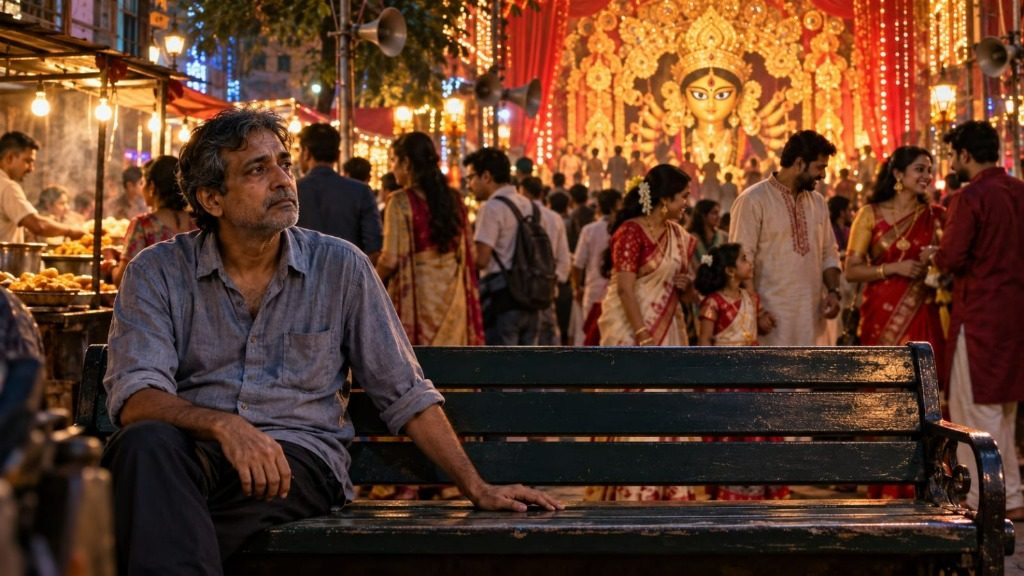
Calcutta does not help, though Calcutta is not to blame. Calcutta is merely the stage, the proscenium, the humid amphitheater where this particular thermodynamic tragedy plays out its final acts. People come back to Calcutta to die, did you know that? It is not in the tourist brochures, which prefer to mention the Victoria Memorial and the Howrah Bridge and the street food that will liquefy your intestines with equal efficiency, but it is the truest thing about this city. The Bengalis who made it to London or New Jersey or that airless suburb of Houston where the heat shimmers off the asphalt like a visual hallucination of damnation—they come back. They come back because the entropy of diaspora is too high, because the disorder of not-dying-at-home exceeds the disorder of dying-at-home, because even the second law has a hometown preference, a statistical bias toward the familiar ruin.
I came back. Or perhaps I never left, which is worse, which is the same thing viewed from a different reference frame, and relativity, that other great Jewish-German gift to human despair, tells us that reference frames are all we have, that there is no privileged observer, no God’s-eye view, no position from which to say definitively: this is the truth, this is the way it is, this is how the story ends. Only stories. Only frames. Only the Doppler shift of your own loneliness red-shifting into the cosmic microwave background of your skull.
And inside that skull, the news. Always the news. Not the news of the world, which I have largely abandoned, which has abandoned me, which exists now as a series of algorithmically generated thumbnails featuring the anguished or triumphant faces of people I do not know, expressions that have been AI-enhanced, AI-optimized, AI-falsified to maximize engagement, to trigger the dopamine drip, to make you click, to make you stay, to make you forget that the click is the only sacrament left in the religion of distraction. I know those expressions are not genuine. You know it. We all know it. And yet we click, because the deceit has fallen below the threshold of our collective alarm, because we have calibrated our instruments of outrage to detect only the most egregious frauds and have learned to accept the daily, hourly, minute-by-minute fraud of manufactured emotion as merely the price of admission to the feed.
The feed. The feed that feeds. The feed that feeds on you.
I prefer the news inside my skull, which is old news, which is the same news, which is the depressive’s weather report: cloudy with a chance of catastrophic self-loathing, followed by periods of numbness and an overnight low of why-bother. It is one hundred percent bona-fide, as the certificate of authenticity might read, stamped and notarized by the department of internal affairs, the ministry of me, the bureau of the same old same old. And yet. And yet. I slept slightly less than yesterday. The lump of melancholy, that dense dark matter that occupies the space where purpose should be, lifted a little, a micrometer, a Planck length, a barely perceptible perturbation in the gravitational field of my mood. Is this something? Is this progress? Is this the antidepressants finally achieving therapeutic concentration, or is it merely the Calcutta weather, that mercurial meteorological metronome that swings between suffocating humidity and sudden unexpected mercy?
I do not know. I know only that uncertainty is the only certainty, which is not wisdom but exhaustion dressed in wisdom’s hand-me-downs.
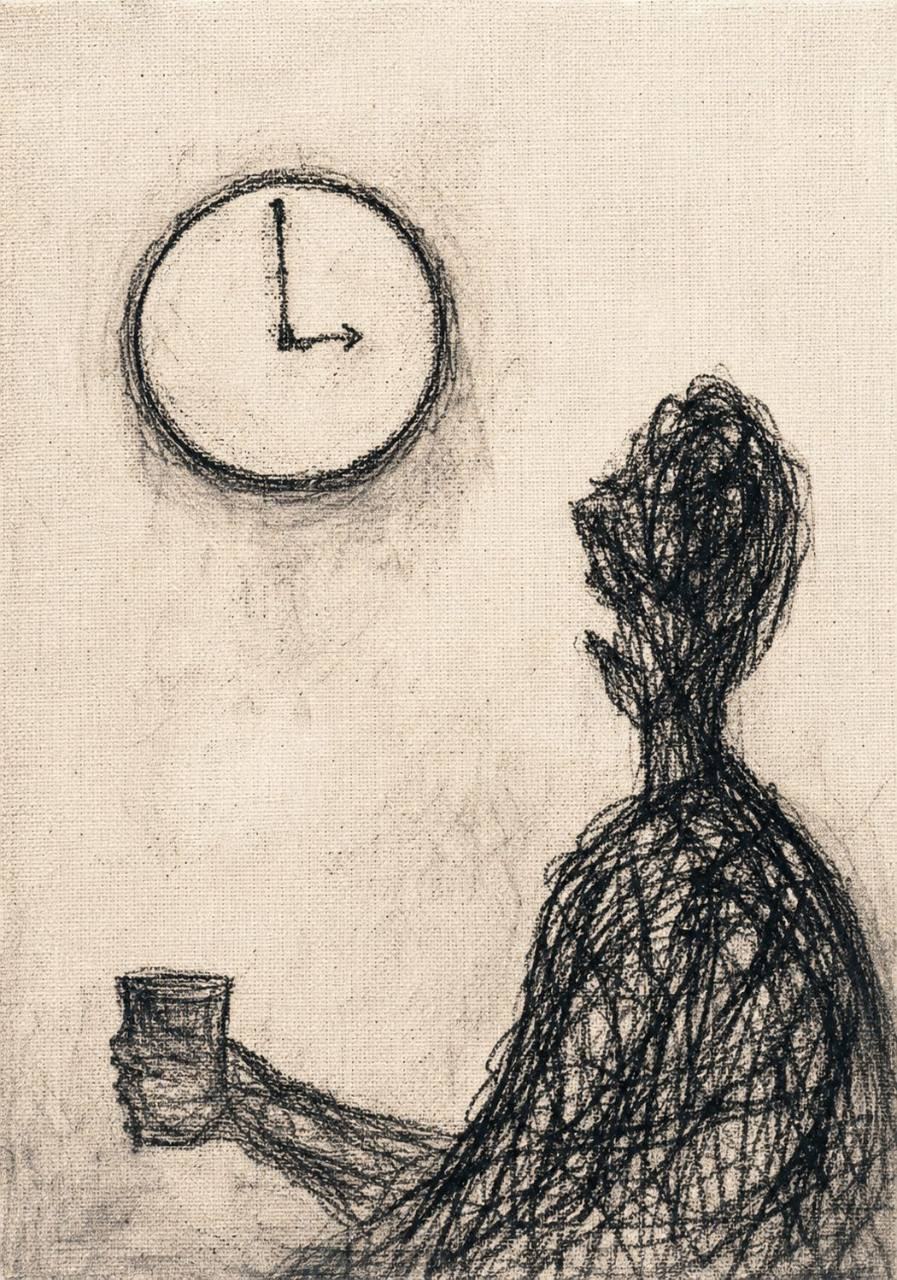
The statistical mechanics of human connection would make for a grim textbook. The partition function of friendship, the chemical potential of belonging, the fugacity of being understood—these are not quantities that yield to easy calculation. I have been in rooms full of people who were, by every objective measure, my people, my tribe, my assigned cohort in the great demographic sorting hat of existence, and I have felt the entropy between us, the irreversible expansion of misunderstanding, the heat flowing inexorably from the hot body of my need to the cold reservoir of their indifference. Or perhaps it was the reverse. Perhaps I was the cold one, the refrigerator in the room, absorbing the warmth of their engagement and radiating back only the faint hum of my own machinery. The direction of heat flow does not matter. What matters is that equilibrium was reached, and equilibrium, in the thermodynamics of human relations, is another word for death.
Not literal death. The death of possibility. The death of the gradient that makes life possible. Life, after all, is nothing but a temporary and local reversal of entropy, a pocket of organization maintained at the expense of increased disorder elsewhere, and when the gradient collapses, when the temperature equalizes, when the chemical potentials balance out—well. Then you are left with the flatline, the featureless landscape, the heat death of the heart.
I am built for this, perhaps. Genetically inferior, as the self-help gurus might say, or superior, depending on which allele you’re tracking, which SNP you’re genotyping, which narrative of biological determinism you prefer to explain away your failures. The heritability of depression is around forty percent, which means that sixty percent of my misery is environmentally mediated, which is not comforting, which means I cannot even blame my parents with mathematical purity, which means the universe of my suffering is sixty percent my own fault, my own choices, my own cowardly refusals and timid acceptances, my own failure to become the person I might have been if only I had been someone else entirely.
Someone else. The microstate I did not occupy. The branch of the wavefunction that decohered into nothing, into the vacuum fluctuation of a self that never was.
And yet I write about math. I write about science. I write about the beauty of equations, the elegance of proofs, the way that contains within its five symbols the entire architecture of complex analysis, the way that Maxwell’s equations , , , unify electricity and magnetism and light itself into a single luminous framework of understanding. I write about these things because they are true, because they do not care about my mood, because the derivative of is whether I have taken my medication or not, whether I have slept or not, whether I exist or not. The universe of mathematics is the only universe that does not require my participation to continue, and there is a profound, almost erotic relief in that, in the abdication of responsibility, in the knowledge that somewhere, in the Platonic realm or the neural architecture of collective human cognition, the primes continue their infinite march, the Riemann hypothesis remains unsolved, and the entropy of the universe increases by exactly every time a bit of information is erased.
Landauer’s principle. The thermodynamic cost of forgetting. I would like to forget more cheaply. I would like to erase the memory of every room where I was lonely, every conversation where I was not heard, every moment where the gradient collapsed and the heat death advanced by another increment. But erasure has its price, and the price is paid in entropy, in the currency of disorder, in the coin of the realm that is always already bankrupt.
So I write. I write because writing is the only form of organization I can still afford, the only local reversal of entropy that does not require external energy input, the only proof that I am still here, still counting microstates, still hoping against the second law that somewhere in the phase space of all possible essays, there is one that someone will read and recognize and say: yes, this, this is the news from inside my skull too, this is the weather report from my own private Calcutta, this is the entropy of being human in a universe that does not know our names and does not care to learn them.
Boltzmann’s tombstone in the Zentralfriedhof in Vienna bears his equation, , carved in stone, the only equation I know of that has achieved the status of epitaph. He died by his own hand, by rope, by the ultimate increase in personal entropy, and we remember him not for the rope but for the equation, not for the disorder of his ending but for the order of his insight. This is the best we can hope for, perhaps. Not to be remembered for our suffering but for what we made of it, not for the heat death but for the temporary, local, doomed organization we managed to impose upon the chaos, the brief beautiful pattern we traced in the dust before the dust settled.
The dust settles. The dust always settles. But first, the pattern. First, the writing. First, the word that stands against the silence, the equation that stands against the void, the lonely bastard in Calcutta who stands against the second law with nothing but a keyboard and a diagnosis and the stubborn, stupid, magnificent refusal to lie down and let the entropy have the last word.
Not yet. Not today. Today I slept slightly less than yesterday. Today the lump lifted, a little, a Planck length, a whisper of warmth in the cold equation. Today I am still here, still counting, still writing in the margin of the universe’s textbook, adding my own footnote to the great indifferent text: the author was present. the author resisted. the author, against all thermodynamic probability, persisted.
P.S. References: Boltzmann, L. (1877). “Über die Beziehung zwischen dem zweiten Hauptsatze der mechanischen Wärmetheorie und der Wahrscheinlichkeitsrechnung.” Wiener Berichte, 76, 373–435. Clausius, R. (1865). Die mechanische Wärmetheorie. Landauer, R. (1961). “Irreversibility and Heat Generation in the Computing Process.” IBM Journal of Research and Development, 5(3), 183–191. And the Bhagavad Gita, 2.14: mātrā-sparśās tu kaunteya śītoṣṇa-sukha-duḥkha-dāḥ—“O son of Kunti, the nonpermanent appearance of happiness and distress, and their disappearance in due course, are like the appearance and disappearance of winter and summer seasons.” Which is to say: this too shall pass, though passing takes longer than one would prefer, and the seasons in Calcutta are less distinct than the Gita’s author might have wished.
Word Cloud
Related reading
Selected by shared topics and section, with closer publication dates breaking ties.