The Goddess Who Comes Home: A History of Durga Puja in Ten Thousand Clay Hands
On this page
Uses the speech voice supplied by your browser or device.

The Goddess Who Comes Home
Prologue: The City That Builds Its Own Dream
Every autumn, Calcutta undertakes a public works project of staggering ambition: it builds another Calcutta inside the one it can barely maintain, invites a goddess to inspect the improvements, and then takes the whole thing down.
I am writing this on October 7, 2026. Mahalaya falls on Saturday the 10th, three days away. Soon, the familiar voice of Birendra Krishna Bhadra will travel through radios and phone speakers before dawn, and a city with considerable difficulty agreeing on anything will agree, at least for the duration of a broadcast, that the season has arrived.
In the workshops of Kumartuli, the goddess has been arriving by less supernatural means: bamboo, straw, clay, paint, and people working against a deadline. Elsewhere, streets acquire roofs, parks acquire palaces, and electricians are asked to reconcile artistic vision with the available supply.
This impossible, crumbling, magnificent city is preparing to become a vast open-air exhibition, a theater with thousands of stages, a collection of family reunions, and a traffic jam with a theology. UNESCO describes Durga Puja as “the best instance of the public performance of religion and art.” A Bengali can manage the same announcement in two words: Maa aschhen. Mother is coming.
This is a story about how she got here. It begins several thousand years before anyone can securely identify Durga, among objects whose makers left us no explanation we can read. It passes through Sanskrit hymns, demon-slaying, daughter-visiting, landed wealth, colonial commerce, nationalism, and the refugee train. It arrives at clay from the river, vermilion on women’s faces, and the temporary architecture of a city that insists on having an occasion.
The journey is continuous. The evidence, inconveniently, is not.
Let us begin before Durga.
Part One: Before the Goddess Had a Name
The Deep Past, Where Everything Is Fuzzy
Here is the first honest thing I can tell you: nobody can draw an unbroken family tree from a prehistoric figurine to the goddess in a Ballygunge pandal. Anyone offering that service should also be able to produce the birth certificates.
Across the Indus civilization, whose mature urban phase flourished roughly between 2600 and 1900 BCE in what is now Pakistan and northwestern India, archaeologists have found numerous terracotta female figurines. Some have elaborate headdresses. Some emphasize breasts or other bodily features. Generations of excavators called them mother goddesses, which is an interpretation, not an inscription found underneath.
They may have served religious purposes. Some may have been toys, household objects, or images with functions our categories do not adequately describe. A female body in clay does not identify its owner as a fertility goddess any more than a photograph of your aunt identifies her as the minister of agriculture.
There is also the famous horned, seated figure on a seal from Mohenjo-daro, surrounded by animals. John Marshall interpreted it as a precursor of Shiva in his aspect as Pashupati, lord of animals. That identification remains disputed. A resemblance to a later deity is an invitation to investigate, not permission to fill several thousand years with whatever story we find most agreeable.
The Indus script has not been securely deciphered. Its people left signs, cities, drains, ornaments, and a formidable amount of material for argument. They did not leave us a theological manual we can presently read.
Earlier female figurines from sites such as Mehrgarh in Balochistan extend the material history further back. But the antiquity of the settlement, whose beginnings reach into the seventh millennium BCE, does not automatically date every figurine found there to its earliest occupation. Archaeology requires attention to layers. Popular accounts generally prefer a very large number and an exclamation mark.
What survives is evidence of a long interest in representing female bodies and, in some contexts, female sacred power. What does not survive is proof that all these images belonged to one universal mother-goddess religion, or that this religion flowed unchanged into Durga Puja.
Later Hindu goddess traditions drew together many strands: village protectresses, dangerous local powers, mountain goddesses, fertility and sovereignty, Sanskrit speculation, and the practical human wish to have somebody formidable on one’s side. Sometimes traditions absorbed one another. Sometimes they competed. Sometimes an identification was proposed by a priest and accepted by a community that continued doing approximately what it had always done.
Hinduism has often displayed the appetite of a digestive system. A local goddess acquires a Sanskrit name, a pedigree, perhaps a place in a larger divine family. But digestion is not always gentle, and the smaller tradition does not necessarily disappear. It may continue inside the larger one, quietly refusing to behave.
The terracotta women of the deep past may belong somewhere in the ancestry of this religious world. They cannot be enrolled, with confidence, as Durga’s grandmothers. The gaps are part of the story, and they deserve to remain visible.
Rivers, Hymns, and a Voice That Says “I”
With the Vedas, the evidence changes character. Now we have words, preserved for centuries through an extraordinarily disciplined oral tradition. The earliest Vedic hymns are usually placed in the second millennium BCE, with later Vedic literature developing into the first. These are among South Asia’s oldest surviving religious compositions, though Egypt and Mesopotamia had produced religious texts much earlier.
The Rigveda gives considerable attention to male gods: Indra, Agni, Varuna, Soma. But its goddesses are not merely wives standing behind their husbands at an official photograph. Ushas, the dawn, receives hymns of her own. Aditi, Saraswati, Prithvi, and Ratri occupy important positions in the religious imagination.
Then there is hymn 10.125, commonly called the Devi Sukta or Vak Sukta, associated with the woman seer Vak Ambhrini and with divine Speech. A female voice declares her presence among the gods, her sustaining power, her reach across the world. The thing that makes a hymn possible has, rather magnificently, begun speaking for itself.
Later Shakta readers could recognize in this voice the supreme Goddess. That is an important history of interpretation. It does not mean that the hymn already describes Bengal’s ten-armed Durga. Nor does its position in the relatively late tenth book make it a passage from the oldest layer of the Rigveda. The future is available here as a possibility, not as a completed festival waiting for someone to order the bamboo.
The name Durga also appears in later Vedic material, notably the Taittiriya Aranyaka tradition associated with the Mahanarayana Upanishad. The verses known as the Durga Sukta invoke Agni and a goddess radiant like fire, asking for passage through dangers and difficulties. The governing image is crossing safely through what is hard to cross.
Fire, protection, difficulty, deliverance: these are substantial powers, but they do not yet give us the elaborate buffalo-slaying figure familiar to Bengal. She emerges through a much longer conversation among texts, images, and local forms of worship.
The reinvention is about to become considerably more dramatic.
Part Two: The Demon-Slayer Gets a Story
How to Give a Goddess the Whole Universe
Across the centuries surrounding the beginning of the Common Era, South Asian religious life changed enormously. Sacrifice continued, but devotional worship, temples, images, and expansive narrative traditions acquired increasing importance. The epics and Puranas became places where divine identities could grow, overlap, and occasionally swallow the competition.
The Mahabharata contains, in some transmitted versions, hymns in which Durga is invoked for protection and victory. These passages have complicated textual histories; prominent hymns to her are treated as later additions in the critical edition. They are evidence of an expanding goddess tradition, not convenient dated photographs of its birth.
Then comes the work that gives the Goddess one of her most powerful theological statements: the Devi Mahatmya, embedded in the Markandeya Purana, generally dated around the fifth or sixth century CE. Its thirteen chapters are conventionally counted as seven hundred verses, hence Durga Saptashati. In Bengal it is widely known as the Chandi, and its recitation as Chandi Path.
The text does not invent female divinity from nothing. It gathers existing powers into an astonishing claim about who actually runs the universe.
There are three principal episodes. In the first, the Goddess is the cosmic sleep enveloping Vishnu. When she withdraws, he awakens and eventually kills Madhu and Kaitabha. Even the god charged with preserving the universe has required her cooperation before getting out of bed.
In the second, Mahishasura has defeated the gods. Their radiance, their tejas, comes together in a blazing female form. The gods equip her with weapons, and the mountain Himalaya gives her a lion. Mahishasura changes shape during the battle, moving through buffalo, lion, man, and elephant, as though the difficulty were merely a poor choice of costume. At the climax, the Goddess pins him down and beheads him as he emerges from the buffalo.
In the third, she confronts Shumbha and Nishumbha and their armies. Kali bursts from the brow of the wrathful Goddess and kills Chanda and Munda, acquiring the name Chamunda. Another adversary, Raktabija, has the exceptionally inconvenient property that every drop of his blood reaching the ground produces another fighter like himself. Kali catches and drinks the blood while the Goddess attacks him. The problem has been diagnosed correctly: ordinary violence is making more work.
Shumbha and Nishumbha are subsequently defeated. The different goddesses can emerge, fight, and merge back into the one Goddess. Multiplicity is her operating method; unity is the theological point.
Read the Devi Mahatmya and you discover that the battles are carrying an argument much larger than the battles. The Goddess sustains, deludes, protects, destroys, and liberates. She is not an auxiliary weapon brought out when the male gods have exhausted their options. Their existence and power belong within hers.
Later Tantric traditions would express the dependence of Shiva on Shakti with the memorable contrast between Shiva and shava, a corpse. The Chandi makes its own case through narrative: the supreme power of the universe can be female, and she does not require a male superior to authorize the arrangement.
It is theology delivered with an action story’s momentum. You arrive for the demon-slaying and discover that the management of reality has changed.
Mahishasuramardini and the Making of an Icon
The familiar image condenses this argument into something a person can understand before reading a line of Sanskrit.
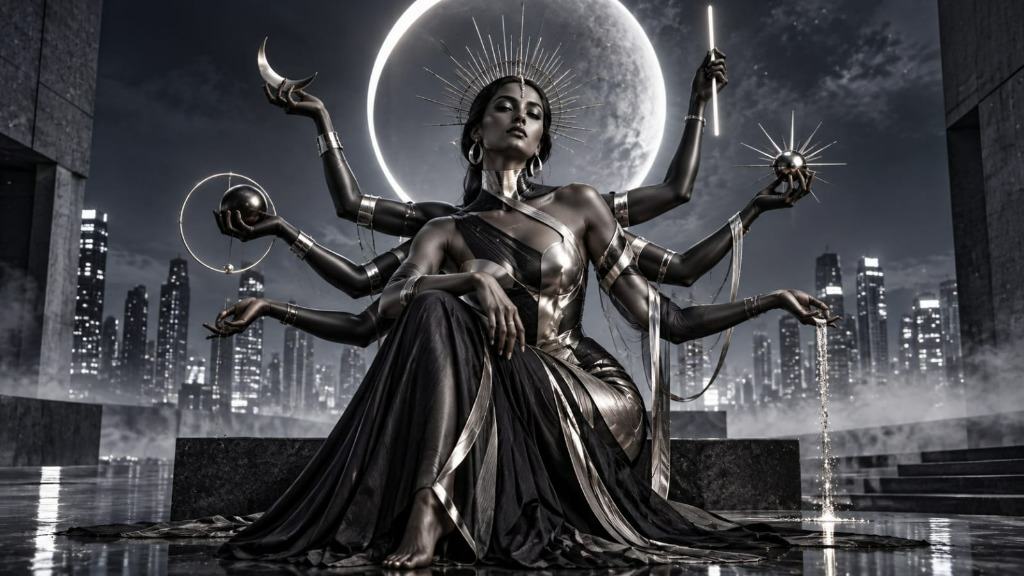
The many arms announce power exceeding the human body. Ten became especially familiar in Bengal, but Durga has never been restricted everywhere to that number. Different images and ritual descriptions give her different complements of arms and weapons. Divinity has been spared the inconvenience of a universal equipment specification.
In the Devi Mahatmya, Shiva supplies a trident, Vishnu a discus, Indra a thunderbolt and bell, Varuna a conch, Agni a spear, and Vayu a bow and quivers. Surya contributes rays. The various iconographic traditions do not reproduce this inventory identically, but the larger statement survives: the powers of the gods are gathered in her.
The lion is her vehicle, her vahana, an animal carrying a considerable reputation for sovereignty and force. In Bengali clay sculpture it can sometimes look like a creature reconstructed by someone who had received a description of a lion over a poor telephone connection. The ferocity is usually unmistakable. Zoological accuracy has been given a supporting role.
Mahishasura appears beneath her, often as a human figure emerging from the slain buffalo. For devotees, his defeat can express the destruction of evil, arrogance, or the forces that obstruct liberation. Other communities tell the encounter differently. Some Asur and other Adivasi accounts mourn or honor Mahishasura, and modern political movements have amplified these countertraditions.
Neither the Sanskrit battle narrative nor a modern retelling establishes, by itself, the ethnicity of an actual ancient combatant. But oral traditions do not become worthless because the winning side’s scripture does not endorse them. The image remains a battlefield of meaning, and the person beneath the trident does not look the same to everyone.
Then there are the children.
Here Bengal gives the cosmic argument a domestic address. Durga’s identification with Parvati or Uma, Shiva’s wife, belongs to a wider and older religious history. Bengal did not invent their marriage. What it developed with extraordinary emotional force was the annual visit of Uma to her parents’ home, bringing Ganesha, Kartikeya, Lakshmi, and Saraswati as her children.
That family arrangement is a Bengali devotional convention. Elsewhere, Lakshmi and Saraswati have other divine relationships and biographies. Hindu kinship is best approached with several notebooks and a willingness to abandon the idea of one definitive family tree.
In the traditional ekchala arrangement, the group shares a single overarching frame. Shiva may appear in the painted chalchitra or as a small image above Durga, occupying considerably less space than one might expect of a member of the supreme divine management.
The Devi Mahatmya does not stage this Bengali family visit, but neither does it keep the Goddess sealed off from all associations with Parvati and Shiva. The contrast is between different emphases: the self-sufficient cosmic power of the battle narrative, and the daughter whose mother has been waiting all year.
The supreme power of the universe is coming home. Somebody should check whether she has eaten.
That is the Bengali transformation, and it matters. Terror and tenderness occupy the same body. The theology of shakti meets the everyday Bengali meaning of maya: attachment, affection, the love that aches.
I will return to this. Everything in this essay returns to this.
Akal Bodhan: The Untimely Awakening
Why autumn? Bengal has a story for that, and it is a very good story.
Before confronting Ravana, Rama seeks the Goddess’s favor. The season is wrong: in the explanation attached to this tradition, the customary spring worship has passed, and the gods are in their period of sleep. Rama therefore performs akal bodhan, the untimely awakening. The Goddess answers, and victory becomes possible.
The familiar Bengali telling belongs especially to the Krittivasi Ramayana tradition, associated with the medieval poet Krittivasa and enlarged through later transmission. Valmiki’s Ramayana does not contain this episode; in its battle book, the famous precombat instruction concerns a hymn to the sun. Bengal’s retelling brings Rama into the Goddess’s autumn calendar.
But a story explaining autumn worship is not the same thing as a historical record of its invention. The Devi Mahatmya itself already refers to the great annual worship in autumn. Its concluding episode also describes King Suratha and the merchant Samadhi worshipping an earthen image of the Goddess beside a river. Bengal did not have to smuggle autumn and clay into a scripture that had never encountered either.
Spring worship, Basanti Puja, continues. Autumn worship, Sharadiya Puja, became Bengal’s great public occasion through a history involving ritual authorities, patrons, local traditions, and the seasonal organization of life. Even the agricultural explanation needs care: the great aman rice harvest generally comes later than Puja. The entire countryside was not simply sitting about with full granaries and nothing left to do.
The story of Rama gives the autumn awakening its dramatic justification. History asks a different question: how did particular communities make this season, this image, and these rites their own?
For that, we have to follow the Goddess into Bengal.
Part Three: The Goddess Crosses into Bengal
Kings, Landlords, and the First Pujas
When did Durga Puja begin in Bengal? This sounds like a request for a date. It is actually several questions wearing one coat.
Do we mean worship of a goddess identified as Durga? Surviving medieval images? Autumn rituals described in Sanskrit manuals? A spectacular household festival? A subscription-funded neighborhood puja? The answer changes according to which of these we have in mind, and the families advertising the oldest puja are not always discussing the same thing.
Medieval ritual literature establishes that elaborate Durga worship was known before the great colonial households. Writers such as Shulapani and, later, the sixteenth-century ritual authority Raghunandana discussed its observances. We are not dependent on a European traveler happening to notice a large party.
The celebrated origin traditions attach lavish celebrations to rulers and landlords, notably Kangsa Narayan of Taherpur in present-day Bangladesh. Dates and priority claims vary. These traditions matter, but a claim to have sponsored an exceptionally grand puja is not proof of having introduced the Goddess to an entire region.
Meanwhile, Bengali literature had been giving divine power a thoroughly local social life. Mukundaram Chakrabarti’s sixteenth-century Chandimangal moves through the worlds of the hunter Kalketu and Phullara, and the merchant Dhanapati and his household. Chandi’s authority is worked out among human needs, rivalries, journeys, and misfortunes.
Elsewhere in the Mangalkavya world, the merchant Chand Saudagar resists the snake goddess Manasa. These poems make divine recognition a matter of household conflict, commercial fortune, and social negotiation. Heaven has entered the Bengali economy, where it will find ample material to keep it occupied.
The landed and mercantile elite supplied money on a scale that changed the festival’s visibility. In great houses, the Goddess occupied the thakur dalan, the pillared courtyard hall. Priests, musicians, cooks, servants, dependents, relatives, and invited guests gathered around her. Worship proclaimed devotion, but it also proclaimed the household’s resources and standing. The Goddess arrived with a social register.
The expression bonedi bari refers to a house of established lineage or standing. These families did not all descend from merchants, and their celebrations did not all begin at the same time. Nor did ritual remain perfectly frozen while everything around it changed. Continuity is something people maintain, not something time politely leaves alone.
At Sovabazar, Nabakrishna Deb’s celebrated puja is conventionally dated to 1757, the year of Plassey. Stories about the festivities and their British guests belong to the uncomfortable meeting of devotion, commercial advancement, and colonial victory. Calcutta’s aristocratic pujas were capable of welcoming the Goddess and entertaining the people dismantling Bengal’s political independence at approximately the same sitting.
The family goddess could be loved sincerely. The family accounts could also benefit. Neither fact cancels the other.
The Company, the City, and the Subscription List
The East India Company did not invent Calcutta by discovering an unoccupied riverbank. Settlements, trade, and local histories preceded it. Job Charnock’s arrival at Sutanuti in 1690 is a milestone in the Company’s settlement, while the acquisition of zamindari rights over Sutanuti, Kalikata, and Gobindapur belongs to 1698. They are different events, eight years apart, which is quite a long time if you are waiting for the paperwork.
By the 1770s, Calcutta had become the seat of the Company’s government in Bengal and of the governor-general. The city that developed around this concentration of power produced the babu: the prosperous Bengali gentleman whose money might come from land, trade, banking, Company employment, or the very profitable business of being useful to powerful people.
He could patronize devotional music and dancing girls, commission a shrine and import a luxury, cultivate Sanskrit learning and an English connection. He was not a single sociological type, but Bengali satire found enough recurring material to keep itself employed.
The competitive household puja became bigger, more conspicuous, and more hospitable to spectacle. Yet the decisive change required a different financial arrangement: several people paying for a celebration that none of them privately owned.
Guptipara in Hooghly occupies the famous place in this story. Its barowari tradition is associated with a group of twelve friends and is commonly dated to about 1790, though alternative dates circulate. The early account concerns Jagaddhatri worship, a related goddess festival, rather than providing a spotless birth certificate for the modern Durga Puja. The familiar etymology joins baro, twelve, to yar, friend.
The important innovation was collective subscription. The neighborhood could organize a Goddess without first finding a palace.
That did not instantly produce universal equality. An association of subscribers could preserve its own caste boundaries, enforce its own hierarchy, and become remarkably insistent about contributions. A subscription book is an instrument of community; in certain hands, it is also a small weapon.
During the nineteenth century, collective pujas developed alongside household celebrations. The explicitly sarbojanin ideal, worship “for all,” gained particular force in the early twentieth century. Kolkata’s Sanatan Dharmotsahini Sabha puja is commonly associated with 1910, while Bagbazar’s began in 1919. The public festival was becoming an institution with a widening constituency and a formidable capacity for growth.
The Goddess was moving into the street. The street, naturally, brought its arguments with it.
A word about the structure that made this possible. Pandal comes into English from a South Indian word for a temporary pavilion or shelter, commonly traced to Tamil. The Bengali mandap acquired a spectacular urban career: bamboo, timber, cloth, painted surfaces, lighting, and eventually almost anything a designer could persuade a committee to finance.
A pandal is architecture built with its dismantling already understood. Much of the structure can be reused; some of the art may survive elsewhere. But the place as a place has an expiry date. You have to see it now. The city has put a deadline on wonder.
Nationalism, Literature, and the Daughter at the Door
The nineteenth century did not suddenly teach Bengalis to love the Goddess. It gave older forms of attachment new institutions, new arguments, and new political employment.
Brahmo reformers challenged image-worship and the extravagance of established religion. Elsewhere, divine motherhood acquired nationalist force. In Anandamath, published in 1882, Bankim Chandra Chattopadhyay incorporated Vande Mataram, whose fuller text identifies the motherland with Durga and other goddesses. The land could now be imagined as a Mother requiring devotion and defense.
This was powerful language. It was also specifically Hindu language, and its capacity to unite some people while alienating others belongs to its history. A symbol does not become universally shared because those who love it cannot imagine anybody declining the invitation.
The partition of Bengal in 1905 intensified the connection between public religious culture and nationalist mobilization. Many opponents understood Curzon’s division as an assault on Bengali unity and a means of dividing political resistance. Other constituencies, including some Muslim supporters of the new eastern province, saw different possibilities. Bengal did not respond with one mind.
Swadeshi politics, neighborhood associations, and community worship increasingly overlapped. In the decades that followed, public pujas offered settings for collective organization and nationalist display. The Goddess had already spent centuries among rulers and patrons; now the modern nation was asking for her endorsement.
But the emotional history takes us somewhere quieter than a political procession.
The agomoni and bijoya songs imagine Uma’s arrival and departure through the feelings of her parents, especially her mother, Menaka. Associated with the wider Bengali Shakta song tradition, including poets such as Ramprasad Sen and Kamalakanta Bhattacharya, they bring the Goddess into the recognizable trouble of family life. Is she being looked after? Why is her husband such an unsuitable arrangement? Can she stay a little longer?
These are enormous questions when a daughter has married away, travel is difficult, and affection must survive long absences. The songs make no attempt to conceal the contradiction between an omnipotent goddess and a girl her mother worries about. They live inside it.
Later fiction, poetry, songs, Puja annuals, and cinema enlarged the festival’s place in Bengali memory. Religious belief was only one way into this cultural world. The printed Puja number could become as much a part of the season as a new garment: something brought home, opened, and remembered. A festival of images had also become a season of stories.
The pujo became a measure of time: the year of a particular new shirt, the year someone came home, the first year someone did not. The calendar acquired absences.
Partition, Refugees, and the Work of Making Home
No honest history can step around 1947. Nor should Bengal’s displacement be softened by presenting it as Punjab’s comparatively uneventful cousin.
The violence surrounding Bengal’s partition included the Calcutta killings and Noakhali attacks of 1946, followed by further episodes of communal terror and displacement. Migration continued in waves over decades. Hindus left East Bengal, later East Pakistan, and subsequently Bangladesh; Muslims also moved in the other direction. The timing differed from Punjab’s concentrated catastrophe. The losses were not therefore small.
Calcutta and its surrounding districts were transformed by refugees and their struggles over shelter, employment, land, and recognition. Bijoygarh, Jadavpur, Netaji Nagar, and the Dum Dum area belong centrally to this history. Many settlements were known as jabardakhal colonies, established through the occupation of land. Others followed different routes, within a resettlement history far more varied than the familiar heroic account suggests.
The colonies built associations, schools, clubs, places of worship, and political organizations. Durga Puja became one way to assemble a neighborhood out of people who had lost their previous one. The club ground could be a meeting place, a playing field, and then, for a few days, the place where the Goddess found them.
It is tempting to write that they had nothing except bamboo, clay, and will. They also needed money, labor, access to space, and alliances. Their opportunities differed by class and caste. Some refugees were far better placed than others to turn displacement into a celebrated story of recovery.
Even with those differences acknowledged, there is something deeply moving in the act itself. People who could not go home made a place for a homecoming. The Goddess was given a new address.
The community puja already existed; refugees did not invent it. They helped extend and reshape its urban world. The para, the neighborhood, became both a practical unit of organization and a claim to belonging.
The festival grew across the expanding metropolis, though exact comparisons across decades are difficult when “Calcutta” may mean a municipal area, a police jurisdiction, or a much larger urban region. We do not need a suspiciously tidy series of numbers to understand the transformation. The Goddess had moved far beyond the aristocratic courtyard.
Calcutta, endlessly pronounced finished by people with a talent for metropolitan obituaries, continued to construct something astonishing every autumn. The pujo did not repair its economy or remove its suffering. It did make the obituary look premature.
Part Four: The Making of a Goddess, Step by Step
Kumartuli: Where the Clay Acquires a Face
Let me take you to the place where the Goddess’s arrival becomes a problem of materials, because the materials matter.
Kumartuli, the potters’ quarter in north Kolkata, developed with the city’s demand for clay images and the movement of artisans from elsewhere in Bengal. Its name preserves the trade: kumor, potter. Workshops crowd into lanes where space must be negotiated among people, materials, unfinished bodies, and finished goddesses preparing to leave.
The river remains central, but the clay does not all come from one convenient spot immediately outside the workshop. Artisans use different kinds of clay, brought through supply networks, with mixtures suited to different stages of construction. The Goddess has a supply chain. She always had one; we are simply more accustomed to photographing the face than the delivery.
First comes the kathamo, the supporting structure of wood and bamboo. Straw is bound around it to establish volume without making the image impossibly heavy. Coarser clay builds the body, finer layers shape its surface, and fibers help strengthen particular mixtures. Drying is essential. A wet week can become a financial event.
Heads, hands, and other components may be made separately. Molds help reproduce a workshop’s recognizable features, while modeling and painting give individual images their expression. There are specialists in frames, faces, eyes, decoration, and all the less celebrated tasks between. The name attached to an image does not necessarily name every pair of hands that made it.
Durga’s arms acquire their weapons. The lion acquires a mane and an opinion. Ganesha has his mouse, Kartikeya his peacock, Lakshmi her owl, Saraswati her swan. In the traditional grouping, this is a remarkable amount of wildlife to accommodate on a family visit.
The ornaments have their own craftspeople. Shola, the pale pith of a marsh plant, can be worked into extraordinarily delicate crowns and decorations. Other styles employ metallic ornament, fabric, clay, or contemporary materials. The painted chalchitra supplies a world behind the figures. It is the image’s backdrop, not the name for the entire pandal.
Then there is the custom everybody remembers after hearing it once: soil from the threshold of a sex worker’s home, included among the ritual soils associated with Durga worship and, in some accounts and practices, mixed into the image’s clay.
The practice is documented, but neither its performance nor its explanation is uniform. Stories about holiness left at the doorstep, the Mother’s embrace of the excluded, and the ritual importance of socially stigmatized places circulate around it. They are explanations offered within a living tradition, not a single securely established origin story.
Nor does taking soil from a woman’s threshold prove that society treats the woman well. A religion can find sacred uses for the doorstep while the city continues to mistreat the person behind it. The contradiction belongs in the picture too.
Finally, the eyes: chokkhu daan, the giving of sight. The painted face suddenly seems capable of looking back. This is the moment photographers want, devotees cherish, and artisans perform with a concentration that makes the surrounding disorder briefly irrelevant.
Mahalaya has become strongly associated with it. But images needed for early delivery or shipment cannot all wait for one morning. Eye-painting happens according to workshop schedules as well as ceremonial occasions. And its symbolic animation should be distinguished from the priestly rites of invocation and prana pratishtha, the consecration through which the image becomes the focus of worship.
The distinction does not diminish the experience. A few strokes can change how a face meets you. Painting has been doing this to people for a long time; here it has an entire city waiting for the result.
The economics are less serene. Materials, rent, advances, hired labor, transport, and the timing of payments determine whether a successful season actually leaves a workshop with money. Durga Puja is a major peak, but artisans also make images for Kali Puja, Saraswati Puja, and other occasions. Some workshops produce fiberglass figures for customers abroad; some artists travel to make images elsewhere. Export and new materials are adaptations within the trade, as well as sources of competition.
This is not an untouched hereditary economy sealed inside a picturesque lane. It is a changing industry containing inherited skill, entrepreneurial ambition, women artisans, migrant labor, and considerable insecurity.
The achievement becomes more impressive when we acknowledge that. Something sacred is being manufactured through entirely practical competence. The clay must hold. The paint must dry. The truck must clear the corner. The Goddess’s arrival depends on people who cannot solve their problems by growing another eight hands.
The Pandal: Architecture with an Expiry Date
From the workshop, the image travels to the pandal, and the festival performs its most improbable trick: it turns an ordinary patch of city into a place that people will queue for hours to enter.
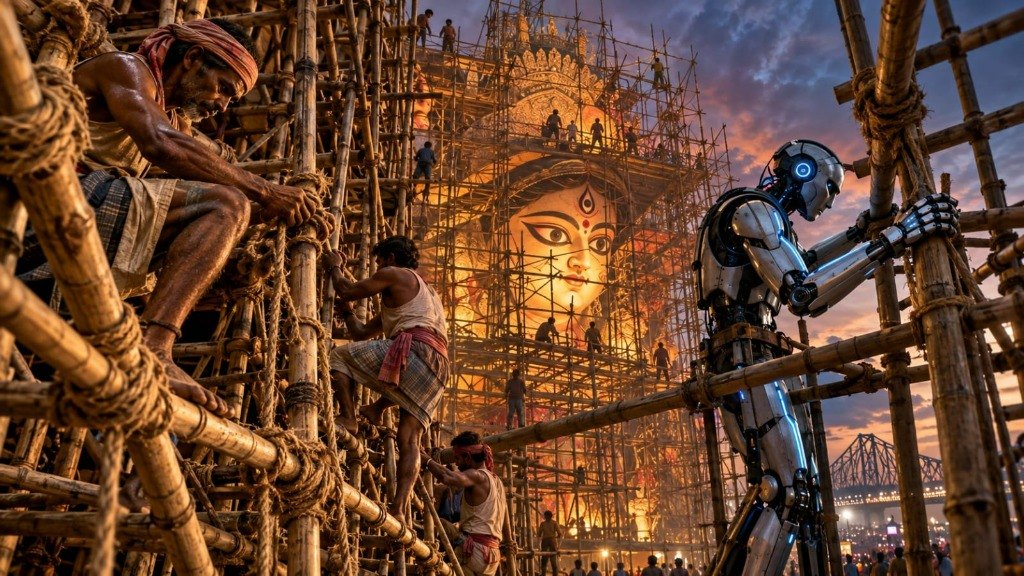
Bamboo and timber provide much of the traditional structure, sometimes joined by steel and other systems. Teams of builders erect and lash the framework. Their skill includes knowing materials, loads, sequence, and how to work together at height. They do not remain upright by avoiding thoughts about falling. The work requires judgment, and the danger is real.
Over the skeleton goes the skin: cloth, painted panels, woven material, paper, metal, terracotta, reclaimed objects, light. The palette changes with the design and the budget. A visitor may enter something resembling a temple, a village, a ruined industrial landscape, a work of abstract sculpture, or a building that has apparently spent the night dreaming about another building.
The rise of the theme puja has given artists and designers a major public platform. This developed over decades, drawing on older skills in decoration, theater, craft, and display. Art-school training and professional design entered an existing field of invention. They did not rescue it from a previous absence of imagination.
At its best, the pandal lets a very large public encounter ambitious art without first passing through a gallery door. At its worst, it demonstrates how much money can be spent making an entrance through which nobody can move. Both outcomes are educational.
Not every puja pursues spectacle. Smaller neighborhood celebrations continue, and their appeal may lie in recognition rather than novelty: the same place, familiar faces, a Goddess who does not need to resemble an international airport to receive visitors.
The money is substantial. A British Council-commissioned study of the 2019 festival economy, published in 2021, estimated the associated creative industries and festival-linked activity in West Bengal at approximately ₹32,377 crore, or US$4.53 billion at the report’s conversion. It compared that amount with 2.58 percent of state GDP.
That is an estimate for 2019, not a measurement of the 2026 festival. It also includes a wide range of activity, with retail contributing heavily. It is not simply the combined bill for idols and pandals, nor proof that five days of celebration added precisely that percentage to the state’s economic output.
Still, the central fact survives the accounting qualifications: Durga Puja supports a large network of livelihoods. Sponsorship pays bills. So do subscriptions, donations, and public assistance. Awards, publicity, tourism, and political patronage shape which celebrations become visible.
The state, the municipality, the police, and other agencies have different responsibilities; they are not one interchangeable organization handing out trophies. Together with the committees, they must accommodate an event that continually tests the city’s capacity to host itself.
The Goddess has become a patron of contemporary art, a source of seasonal employment, and a recurring administrative emergency. Ten arms begin to look like a sensible minimum.
The People: A Festival in Ten Thousand Hands
Here is what the postcard misses. Durga Puja is made by people whose work extends far beyond the image at its center.
The dhakis come from many parts of Bengal, including districts far beyond the familiar western belt. Some combine music with farming or other work. Some belong to families with long traditions in the craft; others enter through different routes. There are women dhakis too. The festival’s human cast is larger than its inherited publicity photographs.
The dhak is a large drum, often suspended from the player’s shoulder and struck with sticks. Its rhythms announce changes in the ritual and changes in the emotional temperature. A recording can reproduce the notes. Standing near the instrument introduces the ribs to the arrangement.
Then the purohit, the priest, responsible for a sequence whose parts should not be collapsed into one generic act of installation. Bodhan awakens the Goddess; amantran invites her; adhibas prepares and sanctifies the ritual setting. The principal worship develops through Saptami, Ashtami, and Navami, with different traditions prescribing their particular details.
On Saptami, the nabapatrika, nine plants including banana, turmeric, and rice, is bathed and worshipped. Draped in a sari, it is popularly called kolabou, the banana bride. Its placement beside Ganesha encourages a familiar family explanation, but its ritual identity concerns the Goddess and her forms, rather than merely supplying him with a wife.
During pushpanjali, devotees offer flowers with the prescribed prayers. Some celebrations conduct kumari puja, worshipping a young girl as a manifestation of the Goddess. At the junction of Ashtami and Navami, sandhi puja occupies the last twenty-four minutes of one lunar day and the first twenty-four of the next. Lamps, offerings, and the dhak concentrate attention on that passage between moments.
The decorators, shola workers, painters, and electricians create another order of transformation. Chandannagar and the wider Hooghly region have a celebrated lighting tradition. Electricians rig illuminated gateways, patterned displays, and moving images, giving the night an additional city to contain.
Closer to the Goddess hang the chandmala, decorative garlands commonly made with discs of paper or shola. Beyond her, whole streets acquire luminous arches. Small, intricate handwork and enormous electrical displays occupy the same field of vision.
The resulting beauty depends on unglamorous provisions: sound electrical work, clear exits, materials appropriate to the structure, and people who take crowd movement seriously. A temporary building still has to accommodate permanent human bodies.
Then the cooks, and the bhog.
Ah, the bhog. Food offered to the Goddess and distributed afterward: often khichuri, vegetables, chutney, payesh, and the particular dishes a household or committee regards as indispensable. Menus and customs vary. There is no central divine catering authority enforcing one standard plate.
Large kitchens depend on professional cooks, helpers, and volunteers. At its most generous, the communal meal places people who would otherwise seldom share a table inside one system of hospitality. It does not abolish class. It gives class, briefly, something less useful to do.
And the taste: hot khichuri, the smell of incense, the dhak somewhere nearby, people trying to find another ladle and somebody shouting that the next batch is ready. A restaurant can reproduce the ingredients. Reproducing the occasion is a more expensive problem.
Flower sellers, including those at Mullick Ghat, supply their own perishable abundance. Hawkers sell balloons, toys, snacks, and things nobody intended to buy. Drivers move images through streets apparently designed to prevent the movement of images. Police, sanitation workers, and emergency crews keep working while much of the city calls the week a holiday.
Committee members arrange money, permissions, labor, meals, and an apparently inexhaustible supply of disagreements. Women contribute as organizers, artists, priests in some contemporary initiatives, and workers whose labor has too often disappeared beneath the word “help.”
On Dashami, sindoor khela brings the familiar vermilion. Traditionally associated with married Hindu women, it also raises questions about who is permitted inside the ritual photograph. Some celebrations have widened participation. The change matters precisely because exclusion was real.
Then there are the people who dismantle the structures and clean what the crowd leaves behind. They belong in the festival’s portrait as fully as the people standing beneath the finished lights.
Part Five: The Festival as Everything at Once
The Contradictions, Stacked Like Bamboo
Durga Puja is religion, and its religious core is neither an embarrassment nor a decorative explanation added for tourists. The mantras, offerings, disciplines, and acts of devotion matter to the people performing them.
It is also theater, commerce, neighborhood organization, public art, politics, family reunion, and memory. Different people enter through different doors. Some do not enter at all. No account improves by issuing a compulsory emotional response to everyone with a Bengali surname.
The contradictions are part of the occasion. The cosmic warrior is a daughter coming home. The work of inherited ritual occupies an installation made with contemporary technology. A festival associated with welcome requires barricades. A celebration of divine female power takes place in a society where actual women still have ample cause for anger.
The sacred and the sponsored coexist. The Goddess looks past the logo; the sponsor hopes we will not. The bhog is offered, the biryani stall does business, a priest recites, a committee member answers a phone, and the whole arrangement somehow continues without being reduced to any one of these activities.
In December 2021, UNESCO inscribed “Durga Puja in Kolkata” on its Representative List of the Intangible Cultural Heritage of Humanity. The nomination research, led by historian Tapati Guha-Thakurta and housed at the Jadunath Bhavan Museum and Resource Centre of the Centre for Studies in Social Sciences, Calcutta, helped document the festival’s collaborative world.
The recognition concerns a living practice, not the declaration of every pandal as a World Heritage monument. It acknowledges artists, craftspeople, communities, and the changing relationships that make the event possible.
Its account of inclusiveness captures something important. People of different religions participate in the labor, commerce, viewing, and social life of the festival. Public celebrations have opened experiences once controlled by powerful households. Those changes are real achievements.
They do not mean caste, class, disability, gender, or religious difference disappear at the pandal gate. Nor does admiration for the Goddess guarantee fair payment to the person who made her. The invitation has widened; the argument over who is fully included continues.
Politics belongs here too. Patronage, public money, visibility, committee influence, and the ownership of cultural symbols cannot be separated neatly from an event of this size. A politician inaugurating a puja may admire it sincerely and understand the photograph perfectly. Human beings are capable of more than one motive, particularly when there is a photographer present.
The festival’s history supplies no lost golden age in which power and money politely waited outside. What changes is who can organize, who pays, who benefits, and who is allowed to call the occasion theirs.
Part Six: The Days Immediately Before
Kolkata, October 2026
And so we arrive where we began: October 7, 2026, with three days to Mahalaya.
The West Bengal government’s published SAHAJ calendar lists Maha Shashthi on Saturday, October 17; Saptami on Sunday the 18th; Ashtami on Monday the 19th; Navami on Tuesday the 20th; and Vijaya Dashami on Wednesday the 21st. Mahalaya is Saturday, October 10.
There is a practical wrinkle. Some ritual schedules, including the one published by Kolkata’s Brindaban Matri Mandir, place Shashthi observances on October 16. Civil festival calendars and the timing of lunar tithis do not always produce identical labels. A particular puja follows its priest’s panjika for the actual rites. The Goddess may transcend time; the person arranging the flowers still needs a definite appointment.
On Mahalaya, remembrance precedes the great welcome. The day is associated with the conclusion of pitri paksha and offerings to ancestors. The approach of devi paksha turns attention toward the Goddess. The dead and the arriving daughter occupy neighboring rooms in the calendar.
Then comes Mahishasuramardini.
The broadcast tradition took shape in the 1930s through a collaboration: Bani Kumar’s script, Pankaj Kumar Mullick’s music, Birendra Krishna Bhadra’s recitation, and the singers and musicians who made the work larger than any one voice. Its early performances were live; the familiar recording belongs to its later history. What sounds timeless was assembled, performed, revised, and preserved by people.
In 1976, an alternative Mahalaya program featuring Uttam Kumar provoked a celebrated backlash. Bengal demonstrated that it could adore a film star and still consider him wholly unauthorized to rearrange the dawn. Bhadra’s familiar program returned. Some traditions defend themselves through scripture; this one also had an audience prepared to complain.
Now the work travels through radio, recordings, and digital streams. A voice can reach a room in Calcutta, a flat in London, or a house in New Jersey without requiring the listener to have solved the much more difficult business of coming home.
The city’s preparations belong to an equally recognizable sequence: orders completed, images delivered, structures finished, lighting checked, shops busy, subscriptions pursued, and committees discovering that something indispensable has been forgotten. There is always another practical task between the intention to welcome the Goddess and somewhere ready for her to sit.
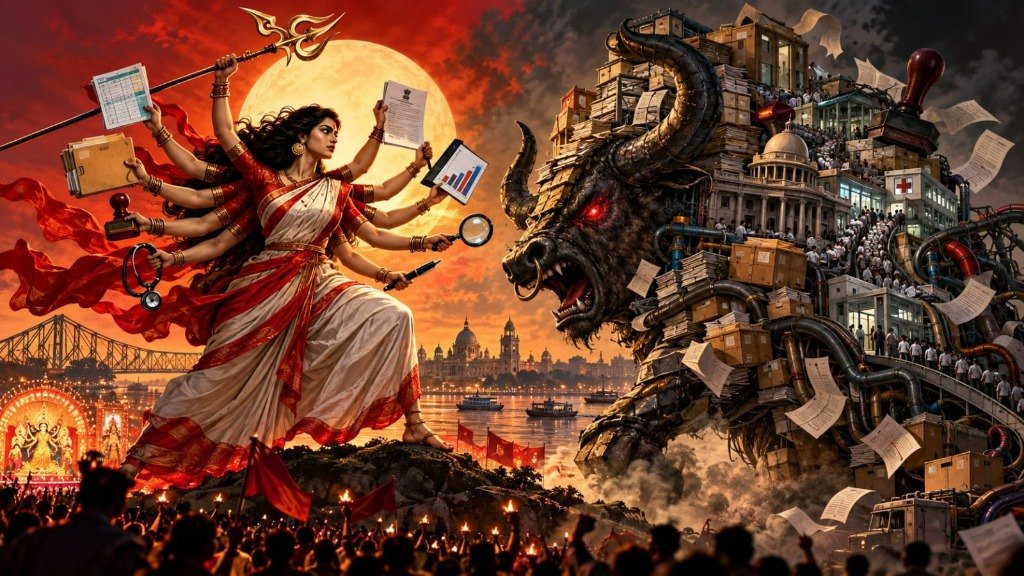
The official permission process offers a less picturesque but thoroughly contemporary view: site plans, electrical declarations, safety documents, land permissions, and departments raising questions that someone has to answer. Behind the temporary dream sits a substantial quantity of paperwork.
The seasonal picture Bengalis carry is clear enough: shiuli flowers, kash, patches of blue sky, white clouds, and the possibility of a morning that feels different. The shiuli, Nyctanthes arbor-tristis, brings its white petals, orange centers, and familiar fragrance. A small flower can carry a remarkable amount of autumn.
That remembered autumn is not a weather report. Rain remains capable of entering the arrangement, and the electrician’s response is likely to differ from the poet’s.
New clothes, gifts, meals, and journeys home help organize the anticipation. So do the calculations of people who cannot afford them. Not every Bengali buys a new garment. Not every family is reunited. Not everyone who hears the dhak feels happy, and the festival loses nothing by allowing those facts to stand.
For those who can return, homecoming is a railway reservation, a flight, a crowded bus, a familiar door. For those who cannot, it may be a voice on a phone. The Goddess travels through both kinds of distance.
Dashami brings the farewell rites. Physical immersions follow the arrangements of particular pujas and the relevant administrative schedules; a whole metropolis does not dispose of its images in one perfectly synchronized afternoon. The parting has its own work, its own crowds, its own delays.
And its own promise: Aschhe bochhor abar hobe. Next year, again.
Where the River Keeps What the City Builds
A goddess acquired stories, images, weapons, philosophical arguments, and a great many local identities. Bengal made an extraordinary home for her. The warrior remained, but the household grew around her: mother, father, children, the absent or inconvenient husband, the welcome already shadowed by departure.
Around that visit accumulated the wealth of landlords, the opportunism of empire, nationalist longing, the labor of refugees, neighborhood rivalry, artistic ambition, and all the trades required to turn an idea into something people can stand before.
It would be comforting to say that the final journey to the river closes a perfectly harmless natural cycle. Clay returns to water, yes. Paint, ornaments, synthetic materials, and discarded festival waste complicate the picture. The people retrieving debris and managing immersion sites have work to do precisely because a beautiful symbol does not exempt anyone from material consequences.
The clay still holds my attention. For a while, something taken from the earth has a face to which people speak. They dress it, feed it, bring their children to see it, ask things of it, and then accept that this particular face will not remain.
I do not believe in the Goddess as a supernatural being. Nor do I need to promise myself a place in the crowd to understand the force of the gesture. A city can be full of homecomings and still contain people who feel nowhere at home. The welcome matters partly because it is something human beings keep trying to make, with uneven success, for one another.
Three days to Mahalaya. Somewhere in the making of this year’s festival, a hand will steady another hand, a painter will finish an eye, a worker will tighten a fastening that most visitors will never notice.
Then the lights will come on, and people will look up.
Maa aschhen. Mother is coming.
Someone has been working very hard to get her here.
Sources and Further Reading
- David Kinsley, Hindu Goddesses: Visions of the Divine Feminine in the Hindu Religious Tradition (University of California Press, 1986), and Thomas B. Coburn, Encountering the Goddess: A Translation of the Devi-Mahatmya and a Study of Its Interpretation (SUNY Press, 1991), for the Goddess traditions and the Devi Mahatmya.
- The Devi Mahatmya, especially chapters 2–3, 7–10, 12, and 13. Sanskrit text and an English translation are available through AuroBharati’s Devimahatmyam project.
- Rachel Fell McDermott, Revelry, Rivalry, and Longing for the Goddesses of Bengal: The Fortunes of Hindu Festivals (Columbia University Press, 2011), and Tapati Guha-Thakurta, In the Name of the Goddess: The Durga Pujas of Contemporary Kolkata (Primus Books, 2015), for festival history, image-making, patronage, and public culture.
- Sahapedia’s documentation of Kumartuli, image-making practices, and Kolkata’s refugee colonies.
- UNESCO’s 2021 inscription decision for “Durga Puja in Kolkata,” nomination no. 00703, for the heritage recognition and its stated grounds.
- British Council, Mapping the Creative Economy around Durga Puja 2019, published in 2021. Its estimates concern 2019 and should not be presented as current-year measurements.
- For 2026 dates: the West Bengal government’s SAHAJ puja calendar and Brindaban Matri Mandir’s ritual schedule. Their different Shashthi dates are identified in the essay; individual ritual timings require the panjika followed by the relevant puja.
Word Cloud
Related reading
Selected by shared topics and section, with closer publication dates breaking ties.