The Idol Who Dreamed of Blood
Uses the speech voice supplied by your browser or device.

THIS IS A WORK OF FICTION
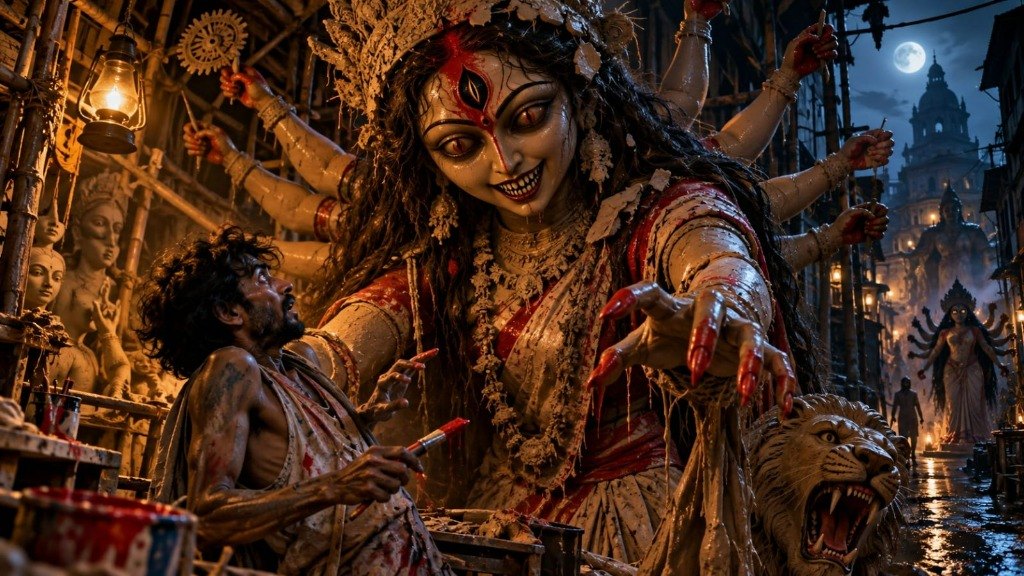
The idol arrived on a truck that smelled of diesel and marigold garlands, its painted face wrapped in jute sacking, and Subir watched from his balcony as the labourers wrestled it down the narrow lane.
His balcony was really a concrete ledge wide enough for two people if they liked each other, which he and his wife Madhuri no longer did, not reliably, not in the humid months when the city turned into a lung that could not exhale.
Below, the lane was already choked with bamboo scaffolding, loudspeakers and the competing smells of fried jhalmuri and stagnant drain. The Durga Puja committee for their para—Lakshmi Nagar, a grid of crumbling three-storey houses between a railway line and a cancer hospital—had outdone itself this year.
The theme was “The Goddess as Mother Earth,” which meant the pandal would be built from recycled materials and the idol would have extra arms to hold plastic bottles, saplings and a model solar panel. Subir found this depressing. He was forty-three, an electrician, and had been wiring pandals since he was nineteen. He knew that every “eco-friendly” gesture was eventually unmasked as a cost-saving measure and that the goddess, if she existed, was unlikely to be impressed by jute twine.
The committee had rented the ground-floor garage of the old Mukherjee house and built the pandal around it. The garage’s front shutter had been removed, turning the room into the sanctum where the idol would face the public. Bamboo walls, cloth panels and sponsor hoardings concealed the original structure. At the rear, accessible through a narrow passage beside the house, a small metal door remained for electricians, decorators and committee members.
The goddess would stand in a garage pretending to be a temple.
Subir thought this was a reasonably accurate description of most organised religion.
But the idol was beautiful.
That he admitted when the sacking came off.
The sculptor was a young man from Krishnanagar named Anirban Pal, thin and intense, with the nervous hands of someone who had recently touched fire. His assistant was an older labourer named Hari Mondal, a quiet man with a bandage around one thumb. Subir remembered Hari because he had carried the heaviest section of the pedestal almost alone and because, when the idol was finally upright, he had stood looking at it with something more complicated than professional satisfaction.
Fear, perhaps.
Or recognition.
Anirban’s instructions were unusually specific.
No one was to drill into the pedestal.
No one was to scrape away clay that appeared damp.
The rear service door was to remain closed after midnight.
Most importantly, the idol’s back was not to be touched until Dashami.
Bose, the committee secretary, laughed at this.
“What is this, a patient in intensive care?” he said.
Anirban did not laugh.
“The clay is different,” he said. “It needs time.”
Subir looked at the broad shoulders, the long neck and the hands that appeared slightly too small for the body.
“What clay?”
“River clay.”
“All clay is river clay.”
“Not this river.”
Before Subir could ask what that meant, Bose called him away to discuss the lighting budget.
Hari Mondal was gone by evening.
Anirban said his assistant had returned home to Krishnanagar after quarrelling over payment. Bose said labourers were always quarrelling over payment. No one had Hari’s telephone number. No one knew precisely where he lived.
The matter dissolved into the general fog in which poor men disappear.
The clay was still damp. Subir noted this professionally. Damp clay meant slow curing, meant the wiring for the halo lights would require extra care, meant the idol might crack if the humidity continued.
The humidity did continue.
It was October, the month of the goddess, and the city was trapped beneath a lid of warm, wet air. At night the temperature barely dropped below thirty. Subir lay beside Madhuri listening to the ceiling fan turn uselessly, the distant railway, the nearer mosquitoes and his wife breathing with the careful rhythm of someone asleep beside a person she no longer trusted.
He thought about the wiring job.
He thought about the money, which was decent and which he needed because the hospital had called again about his mother’s biopsy. A deposit had to be paid before the laboratory would release the complete report. The word “suspicious” had already been used, and once a doctor used such a word it entered the family like an unwanted relative and began occupying furniture.
He thought about the idol’s face.
There was something wrong with the proportions, he decided, though he could not say what. The neck was too long, perhaps. Or the hands too small.
Or the chest too deep.
The sweating began three days before Panchami.
Subir was inside the rear of the sanctum at dawn, before the committee members arrived with their tea and arguments, checking the junction box behind the pedestal. The garage smelled of clay, incense and the particular mustiness of a room that had once held a Maruti 800 and now held a goddess.
He was kneeling beneath the frame supporting the halo when something wet struck the back of his hand.
He looked up.
The idol was weeping.
Not weeping.
Sweating.
Beads of moisture stood on the painted forehead, along the clay arms and at the base of the throat. Subir touched the pedestal.
Dry.
He touched the rear wall.
Dry.
He climbed onto the wooden platform and touched the idol’s cheek. The moisture was warm. Without thinking, he put his finger to his tongue.
Salt.
He stood very still.
The garage was silent except for the hum of the refrigerator in the committee room next door, where the soft drinks were kept. The idol’s painted eyes looked past him towards the corrugated roof.
The sweat was real.
It was not condensation.
It was not rainwater.
It was warm, salt and human.
He told no one.
This was his first mistake, though it did not feel like a mistake at the time. It felt like embarrassment.
What would he say? That the goddess was perspiring?
They would laugh. They would think he had been drinking, though he had not been drinking, not since the night he had said something cruel about Madhuri’s sister’s divorce and watched his wife’s face close like a shop shutter.
He wiped away the sweat with a cloth and finished checking the junction box.
When he returned the next morning, the cloth was hanging where he had left it.
It was stiff with dried blood.
On Sasthi, the idol developed a fever.
The committee noticed now. The paint on the forehead had begun to run, vermilion bleeding into the eyebrows. Moisture gathered beneath the chin and travelled down the throat in slow, deliberate lines.
Anirban was called from Krishnanagar.
He arrived in the afternoon, looking thinner than before. He touched the idol’s arm, sniffed his fingers and stepped back.
“The humidity,” he said.
His voice was uncertain.
“It is the humidity,” Bose agreed immediately. He was a man who owned three garment shops and spoke with the cadences of someone who had never been contradicted successfully. “Put a fan on it. Subir, put a fan on it.”
Subir installed two pedestal fans behind the cloth backdrop.
Anirban watched him work.
“Do not cut the clay,” the sculptor said quietly.
“I am not cutting anything.”
“Whatever happens, do not open it.”
Subir turned.
“What is inside?”
Anirban looked towards Bose, who was arguing with the decorator about sponsor banners.
“Nothing that belongs outside.”
Before Subir could stop him, the sculptor left through the rear passage.
He was not seen again.
That night, after the committee members had gone, Subir remained in the sanctum. He told himself he was checking the halo circuit.
The truth was that one of the metal brackets holding the illuminated crown had begun sinking into the damp clay behind the idol’s left shoulder. A wire that should have remained visible had disappeared into a spreading crack.
Subir switched off the main supply.
He climbed onto the pedestal, set his magnetic work light against the steel frame and examined the fissure. From inside it came a faint wet sound.
A rhythmic sound.
Like something pumping.
Subir was not a superstitious man.
His father had been superstitious, leaving small offerings of betel nut beneath every meter box he serviced. Subir had rebelled by being aggressively rational, by not visiting temples, by refusing the rites his mother begged him to observe.
But he was also a man who had held wires while current ran through them, who had felt electricity hum in his teeth, who knew that the world contained forces indifferent to human explanations.
He pressed his ear against the idol’s back.
Thump-thump.
Thump-thump.
Thump-thump.
He stepped away.
The sound continued.
Not loud.
Not fast.
The sound of a heart beating inside a body of straw, clay and paint.
He should have left.
Instead he fetched a narrow chisel from his toolbox.
The bracket was already tearing the clay. He told himself he needed only to enlarge the crack enough to release the trapped wire. He told himself there might be a water bladder inside, some grotesque prank arranged by the decorators. He told himself many things because a man can usually find enough explanations to escort himself towards disaster.
The clay was softer than it should have been.
It gave way like wet earth at the edge of the river.
Inside there was no straw.
There was red.
The red was wet.
The red was warm.
Veins ran through the clay in branching blue lines. Pale cartilage clung to the inner wall. Muscle fibres contracted around a cavity no sculptor could have made.
And inside the cavity, suspended between clay ribs that were only beginning to harden, a human heart was beating.
It was connected to vessels that travelled upwards into the throat and down into the unfinished abdomen. Each contraction sent a faint shudder through the idol’s body.
Subir did not scream.
He almost screamed, but did not.
He climbed down, walked to the stack of folding chairs and sat with his head between his knees.
The smell was what he remembered later more than the sight.
Blood and clay together.
A butcher’s shop at dawn.
His mother’s kitchen when she cooked liver on Sundays.
Something alive inside something that had never been born.
He remained there for ten minutes.
Then the hospital called.
The laboratory would not release his mother’s final biopsy report until the remaining deposit was paid. He promised payment after the Puja. The woman on the telephone said the file would remain pending.
Subir looked at the idol.
If he reported what he had found, Bose would say Subir had damaged the clay. The committee would withhold his wages. There would be police, accusations, perhaps an arrest. The Puja would be stopped, and everyone in Lakshmi Nagar would know the electrician had cut open the goddess.
He looked at the heart again.
Then he pressed the removed clay back into the crack.
It adhered beneath his fingers, drawing itself together with a faint sucking movement.
He wiped the chisel on his trousers and went home.
Madhuri was awake at the dining table, preparing employee schedules for the call centre where she worked.
“You have blood on your shirt,” she said.
“Rust.”
“Rust is not red like that.”
“It is paint.”
She looked at him with the expression of a woman who had stopped expecting truth and therefore no longer wasted energy demanding it.
He washed the shirt himself.
That night, while the city celebrated Sasthi, Subir dreamed of a man with a bandaged thumb beating against the inside of a clay wall.
On Saptami morning, the crack was gone.
The idol had healed without leaving a mark.
But its hands were larger.
Subir stood before them while the priests prepared the first rites. The fingers that had seemed too small now possessed joints, knuckles and faint lines across the palms. Beneath the red paint of one thumb was a narrow pale band, exactly where Hari Mondal’s bandage had been.
Subir found Bose near the sponsor enclosure.
“Where did Hari go?”
“Who?”
“The sculptor’s assistant.”
“Krishnanagar.”
“Did anyone see him leave?”
Bose’s expression changed by less than an inch, but Subir saw it.
“Why are you asking?”
“There is something inside the idol.”
Bose looked towards the crowd.
“What did you do?”
“I found a crack.”
“What did you do, Subir?”
“I opened it.”
For a moment Bose said nothing.
Then he seized Subir’s arm and pulled him behind the cloth partition.
“You idiot.”
The word came out softly, without surprise.
Subir felt his stomach contract.
“You knew.”
“I know that the Puja opens today. I know that fifty-eight families have contributed money. I know sponsors have paid in advance. I know television people are coming tomorrow.”
“There is a heart inside it.”
Bose’s grip tightened.
“Listen to me. You damaged the idol. If anyone hears this story, that is what happened. You cut into sacred clay while working on the electrical fittings. You were drunk. You tried to hide it.”
“I do not drink.”
“People will believe what they are told during Puja.”
Bose released him and straightened his kurta.
“Finish your work. You will be paid after Dashami.”
“You knew,” Subir said again.
Bose looked at him.
“I knew the sculptor promised us something people would remember.”
That evening, Jharna Das disappeared.
She was seventy-one, a widow who lived alone in the house at the end of the lane, the one with the neem tree that dropped leaves into everyone’s drains. She had been seen during the evening arati, standing at the back in a white sari with a thin red border.
At nine-thirty she bought two bananas from the stall beside the railway crossing.
At ten, she spoke to her son in Bangalore. They spoke every night because he did not trust her blood pressure and she did not trust his wife.
The next morning she did not answer the telephone.
Her maid found the front door open and her slippers beside the bed.
Because the son had money, persistence and a voice capable of travelling through several levels of bureaucracy, the police arrived before noon on Ashtami.
They asked questions, wrote a report and searched the railway cutting.
By afternoon, two constables were eating bhog inside the committee enclosure.
The city swallowed people every day. Durga Puja merely gave it louder music to chew by.
Subir entered the rear sanctum after the pushpanjali.
The idol was breathing.
Its chest rose beneath the painted clay.
Slowly.
Shallowly.
The movement was unmistakable. Air entered through nostrils that had deepened overnight. The chest expanded. Something inside exhaled with the faint whistle of damaged lungs.
A new network of veins had spread across the abdomen.
The skin around the wrists had become thin and folded.
On the left forearm, beneath the paint, was a small puckered scar.
Subir had seen that scar on Jharna Das when she handed him tea during a repair job years earlier. She had fractured her wrist after falling from a tram.
He backed away.
As he did, his foot struck something beneath the cloth at the base of the pedestal.
A loose wooden panel had shifted.
Behind it was a shallow compartment built into the platform.
Inside lay a brass plate blackened by fire, several clumps of hair bound with red thread, three iron nails and a folded sheet of paper.
Two names had been written on it.
HARI MONDAL.
JHARNA DAS.
Below them was an empty line.
Beside Hari’s name was the word heart.
Beside Jharna’s was the word breath.
Subir heard movement behind him.
Bose stood in the rear doorway.
For several seconds neither man spoke.
Then Bose closed the door.
“I told him not to use anyone from the neighbourhood,” he said.
Subir stared at him.
“You told whom?”
“The sculptor.”
“What did you think he was doing?”
“I thought it was ritual nonsense. Soil from a cremation ground. Hair. Blood from a goat. These people say many things to increase their price.”
“You gave him names.”
“No.”
“Jharna’s name is here.”
Bose looked at the paper and seemed genuinely afraid for the first time.
“I did not write that.”
“But you knew about Hari.”
“I knew the assistant had not gone home.”
“And you said nothing.”
Bose’s fear hardened into irritation, as fear often does in men accustomed to authority.
“Do not become moral with me. You saw the heart and sealed the clay. Why?”
The question struck cleanly.
Subir had no answer that did not include the hospital deposit.
Bose nodded.
“Yes. That is what I thought.”
From inside the idol came a long inhalation.
Both men turned.
The painted eyes had opened slightly wider.
Bose left without another word.
Subir went home.
Madhuri was there unexpectedly, her shift cancelled because of a server failure in Hyderabad. She was making tea, the good kind with cardamom.
“You look ill,” she said.
“I need to show you something.”
He took her through the rear passage after midnight.
The lane had finally quietened. A stray dog slept beneath the bamboo archway. A man lay on a takht outside the closed cigarette shop, one arm hanging towards the pavement.
Subir unlocked the rear service door.
The sanctum smelled different now.
Not merely clay and incense.
There was the warm animal smell of breath trapped beneath blankets.
The idol’s chest rose and fell.
Madhuri stood motionless.
Subir removed the wooden panel and showed her the brass plate, the hair, the nails and the paper.
A third name had appeared on the empty line.
KARTIK BOSE.
Madhuri read it twice.
“The secretary?”
“Yes.”
“Did you write this?”
“No.”
“Did he?”
“He says he did not.”
She approached the idol.
“It is warm,” she said, touching the clay.
The idol inhaled beneath her palm.
Madhuri snatched her hand away.
The navel had deepened into a dark whorl. A seam ran vertically beneath it, from the breastbone towards the lower abdomen, as though the body were preparing to open.
The eyes moved.
They did not appear to move.
They moved.
The pupils turned towards Madhuri.
She stepped back.
“What did you do?” she asked.
“I cut it.”
“Why?”
“To release a wire.”
“That is not what I asked.”
Subir looked at the repaired clay.
“I found the heart and covered it again.”
“Why?”
“My payment.”
The answer hung between them.
“My mother’s report.”
Madhuri closed her eyes.
For one moment Subir thought she might strike him.
Instead she said, “We go to the police.”
“The police are outside eating sweets.”
“Then another station.”
“And tell them what? That the idol stole Jharna’s lungs?”
“We show them.”
“Bose will say I planted it. He will say I damaged the idol.”
Madhuri looked towards the paper.
“Kartik Bose is next.”
“Perhaps.”
“Do we warn him?”
“He already knows.”
“That is not an answer.”
“No,” Subir said. “It is not.”
The idol exhaled.
The work light flickered.
From within the clay came a second rhythm beneath the heartbeat and breathing.
A low internal gurgle.
Digestion.
They ran.
They crossed two lanes and stopped beneath the white lights of the all-night pharmacy where Subir bought his mother’s medicines. Taxis passed on the main road. Drums sounded from another pandal. A digital billboard advertised luxury apartments on land where a tannery had once poisoned the soil.
“We leave tonight,” Madhuri said. “We take your mother and go to my sister’s.”
“She is admitted.”
“Then we remain at the hospital.”
“And leave that thing here?”
“What do you intend to do? Repair it?”
He looked down.
Both his hands were covered in wet red clay.
He had not touched the idol since entering the sanctum.
The clay moved across his skin in thin branching lines.
He rubbed his palms against his trousers.
The clay did not come off.
Then he felt it.
A pressure beneath his breastbone.
His heart was beating normally.
Behind it, or beside it, something else beat in counterpoint.
Thump-thump.
A pause.
Thump-thump.
A rhythm answering from two lanes away.
Subir bent forward.
“Subir?”
He could feel the idol.
Not its thoughts exactly. Something older and simpler than thought.
Hunger arranged into intention.
It had a heart.
It had breath.
It had skin.
It needed a liver to clean the blood, a stomach to receive offerings, bones strong enough to support its weight.
After that, legs.
After that, the road.
“It is not finished,” he said.
Madhuri gripped his shoulder.
“What?”
“It needs more organs.”
“How do you know?”
“I can feel it.”
“That is not you speaking.”
“I do not know what is me.”
He looked towards the pandal.
“It is learning us. Every prayer. Every request. Money, illness, children, examinations, revenge. Thousands of people asking it to change the world for them. It thinks love is hunger because hunger is all we have brought it.”
Madhuri followed his gaze.
“Can it leave?”
“Not yet.”
“When?”
“Dashami.”
The word came from his mouth without decision.
“When they take it to the river,” he continued, “they will carry it through the streets. Thousands of people will touch the ropes. They will put it in water.”
“And?”
“It will not dissolve.”
Madhuri looked at the clay on his hands.
“We burn it.”
“Wet clay does not burn easily.”
“The frame will. The cloth will. The organs will.”
“They will call it arson.”
“Better arson than whatever comes after Dashami.”
She said it in the practical tone she used while reorganising night shifts.
They returned home.
Madhuri filled two plastic bottles with kerosene from the kitchen stove supply. Subir took his heaviest insulated hammer, a bolt cutter and a coil of copper earthing wire.
Before leaving, he telephoned the hospital and asked a nurse to remain near his mother’s bed.
“Why?” the nurse asked.
“Because I am asking.”
“That is not a medical reason.”
“No,” he said. “It is not.”
At dawn on Navami, Kartik Bose disappeared.
His wife said he had received a telephone call shortly after two in the morning. He had dressed and said there was a problem with the generator.
His slippers were found in the rear passage.
One slipper faced the sanctum.
The other faced away.
The committee searched for him quietly. They did not call the police immediately because Bose managed the accounts and the accounts contained several interpretations of arithmetic.
Subir entered through the front with the morning crowd.
The idol’s face had changed.
The cheeks were fuller. The lips were wet. Beneath the translucent clay of the abdomen lay a dark reddish organ, broad and gleaming.
A liver.
Near its lower edge was a pale lesion like a crescent.
Bose had once shown Subir an ultrasound report while asking whether private hospitals exaggerated fatty liver disease. The report had mentioned a cyst in exactly that location.
Subir felt no satisfaction.
Only shame.
Bose had been guilty.
The idol had still murdered him.
That distinction mattered because without it every executioner eventually became a priest.
The committee announced that Bose had gone home with exhaustion.
By afternoon they announced that he had travelled to Digha for urgent business.
By evening a rumour spread that he had run away with committee funds.
This explanation pleased everyone because it required no alteration of the known universe.
The Navami crowds became enormous.
Families pressed towards the goddess. Children sat on their fathers’ shoulders. Mobile telephones rose like a field of small illuminated mirrors. The priest waved lamps before the idol’s face.
Each time the crowd shouted, the thing inside the clay grew stronger.
Subir could feel the second heartbeat in his chest.
At eight in the evening, the lights failed.
Not only in the pandal.
The entire lane went dark.
The emergency generator should have started automatically. It did not.
In the darkness, people shouted and laughed. Someone began chanting the goddess’s name. Hundreds joined.
Subir pushed through the crowd towards the rear passage.
Madhuri was already there with the kerosene bottles hidden beneath a shopping bag.
The rear door stood open.
Inside, the work light switched on by itself.
The idol had changed again.
It was larger by a hand’s breadth. Clay muscles covered the shoulders. The ribcage was complete beneath the skin. The heart beat visibly. The lungs expanded. The liver shifted beneath the abdomen.
The pedestal was wet with blood.
The sculptor Anirban Pal lay behind it.
Or what remained of him did.
His body was thin and grey. The chest had been opened with surgical neatness. Several ribs were missing. His hands were buried wrist-deep in the clay of the idol’s back, as though he had tried to pull something out and been absorbed while doing so.
His eyes opened.
“Do not let it reach the river,” he whispered.
Subir knelt beside him.
“You made this.”
“I made the door.”
“What is it?”
Anirban coughed. Dark blood ran from his mouth.
“Not Durga.”
The idol’s fingers moved.
Anirban looked towards them.
“Something found the shape. We gave it names. Names are handles.”
“Why Hari?”
“I needed a heart.”
“Why?”
“I thought it would speak.”
“It has.”
“I know.”
The sculptor smiled faintly, with the embarrassed misery of a man whose experiment had succeeded beyond all usefulness.
“Bose wanted a miracle. Sponsors wanted crowds. I wanted to make something no one could dismiss as craft.”
“And Jharna?”
“I did not choose her.”
“Her name was under the pedestal.”
“After the heart, it began choosing.”
The clay around Anirban’s wrists tightened.
He screamed once.
His body jerked backwards against the idol.
The seam in the clay abdomen opened.
Not widely.
Just enough.
Inside was darkness lined with wet muscle.
Anirban disappeared into it with a sound like a body being pulled through mud.
The seam closed.
The idol’s ribcage became complete.
From outside came another roar of devotion.
The goddess’s name repeated by hundreds of mouths.
The idol opened its eyes.
The pupils were black and wet.
Its mouth moved.
“Subir.”
The voice was almost his mother’s.
Almost Madhuri’s.
Almost his own.
“You have come to finish the wiring.”
He gripped the hammer.
Madhuri unscrewed the kerosene bottles.
The idol shifted forwards.
Its feet did not leave the pedestal. The movement was more a rearrangement, clay becoming flesh in one place and ceasing to be clay in another.
“You need bones,” Subir said.
“I have bones.”
“You need legs.”
“I have been given legs.”
The clay thighs tightened.
“You cannot walk.”
“Tomorrow they will carry me.”
The voice contained many voices now: Bose, Jharna, Hari, Anirban, the committee, the sponsors, the crowds outside and the city beneath them.
“I need to be loved,” it said. “I need to be held. I need to be fed. I need to be real enough to touch, real enough to bless, real enough to punish.”
“You are not the goddess.”
“No.”
The answer came without hesitation.
The idol smiled.
“I am what you put inside her shape.”
The lights outside flickered back to life.
The crowd cheered.
“You cut me open,” the idol said. “Before that I had a heart but no air. You gave me my first breath. You made an opening.”
Subir felt the clay tightening around his hands.
“You are my electrician,” it said. “My father. My midwife. Give me what I need.”
“What do you need?”
The idol looked towards Madhuri.
“A womb.”
Madhuri raised the first bottle.
The idol’s voice became softer.
“You have wanted a child.”
Madhuri froze.
Subir looked at her.
The clay abdomen opened along the seam.
Inside, beneath the organs, was a small empty cavity.
Waiting.
The voice changed again.
It became the voice Madhuri might once have imagined hearing from a room down the corridor.
A child calling from sleep.
“Ma.”
Madhuri’s face broke.
For one terrible second, she stepped forwards.
Then she hurled the kerosene.
It struck the idol’s chest and burst across the clay.
“You are not my child,” she said.
Subir swung the hammer.
The first blow struck the ribs.
The sound was not the sound of clay breaking.
It was the sound of a chest collapsing.
The idol screamed.
Wet clay tore. Straw snapped. Human voices cried out from inside the body.
Subir swung again.
The hammer went through the ribcage and struck the heart.
The organ convulsed.
Hot blood erupted across his face and chest.
The second heartbeat inside him stopped.
Outside, the pandal lights exploded one row at a time.
Madhuri emptied the second bottle over the pedestal, the cloth backdrop and the bamboo supports.
She struck a match.
For a moment the flame seemed absurdly small.
Then she dropped it.
Fire travelled across the kerosene.
The painted skin blackened. Hair burned. The extra arms twisted as the bamboo frame contracted. The idol’s mouth opened wider than the clay should have permitted.
From inside came the voices of Hari, Jharna, Bose and Anirban.
Some begged.
Some cursed.
Some laughed.
Subir wrapped the copper earthing wire around the exposed steel support and pulled with both hands. The frame tilted.
The idol leaned towards him.
Its burning face came within inches of his own.
“You will ask for me again,” it whispered.
“Perhaps,” Subir said.
Then he cut the main support bolt.
The idol collapsed into the fire.
Subir and Madhuri ran through the rear door.
Flames climbed the cloth walls and reached the bamboo roof. Smoke rolled into the pandal. People screamed and surged towards the exits. Volunteers tore down a side partition before the crowd could crush itself against the gate.
Subir and Madhuri helped pull two children through the opening.
Then they kept running.
They ran past the pharmacy, past the railway crossing, past taxis trapped behind processions and drums still beating in neighbourhoods where nothing had happened.
They stopped only when they reached the cancer hospital.
His mother was awake.
The nurse was annoyed but still beside her bed.
Subir and Madhuri sat on either side and held her hands. None of them spoke. Their breathing gradually found a common rhythm while, outside the window, Calcutta continued celebrating the goddess in thousands of other forms.
The police arrived before dawn.
The public explanation was an electrical short circuit complicated by highly flammable decoration material. Subir was questioned because he had installed the wiring. He showed them the breaker records, the isolated supply and the cut support frame. They found traces of kerosene and questioned him again.
Then the bodies were discovered.
Not whole bodies.
Fragments.
A heart containing DNA consistent with a man believed to be Hari Mondal.
Sections of lung and wrist bone belonging to Jharna Das.
Part of a liver identified as Kartik Bose’s.
Ribs and dental remains belonging to Anirban Pal.
The forensic report did not support an electrical accident.
The public statement did.
The full report travelled upwards through offices and did not return. Photographs disappeared from the police server. A laboratory technician was transferred. The principal sponsor’s lawyer described the remains as “contamination introduced through unknown criminal activity.”
Bose’s accounts revealed fraud, falsified invoices and payments to Anirban under the description “special thematic materials.” Several committee members were arrested and released. The sponsors denied knowledge of everything and knowledge proved, as usual, to be a highly negotiable substance.
The deaths remained officially unsolved.
Subir was never charged with arson.
No one told him why.
Perhaps the authorities did not believe him.
Perhaps someone did.
The committee disbanded. The old garage was sealed with concrete. The Mukherjee family sold the house to a developer, who demolished it six months later and began constructing apartments named Divine Residency.
The advertisement promised purified water, twenty-four-hour security and spiritual living.
The Puja returned to Lakshmi Nagar the following year under a new committee.
The theme was “Tradition and Transparency.”
Subir and Madhuri did not attend.
They did not discuss what had happened, not directly. They spoke around it, as people do when they have shared something for which ordinary language was not designed.
They went to the hospital together when the biopsy report was released.
The result was benign.
The word had been sitting in a laboratory file since before the fire, delayed by payment and paperwork, owing nothing to gods, idols, sacrifice or mercy.
Subir read the date twice to make certain.
Nothing had been exchanged.
No bargain had been honoured.
That mattered to him.
Autumn passed into winter. The humidity broke. His mother returned home. Madhuri resumed her night shifts. Subir went back to repairing switches, fans and meter boxes.
Their marriage did not become magically happy. Horror is often defeated more easily than habit.
They still quarrelled.
Madhuri still remembered the cruelty about her sister.
Subir still mistook silence for safety.
But sometimes she waited for him before making tea. Sometimes he told her where he had been without being asked. Sometimes, in bed, their hands found each other in the dark and remained there without explanation.
At night Subir would occasionally wake and place his palm against his chest.
One heartbeat.
Only his own.
He would listen to Madhuri breathing beside him and remember the sound of clay speaking, the thing that had called hunger love and murder worship.
He no longer believed he had looked inside a goddess.
He had looked inside an idol.
There was a difference.
A goddess might be beyond human understanding. An idol was something human beings made, financed, decorated, advertised and filled with whatever they brought to it.
Faith, perhaps.
Beauty, sometimes.
But also ambition, money, fear, illness, loneliness and the desperate wish to make the universe answer back.
Give such hunger a face, Subir thought, and sooner or later it would ask for a body.
Give it a body and it would want to walk.
He would lie awake until morning.
Then he would get up and make tea.
He would go to work, wiring houses, repairing switches, making things function in a world that did not function, not really, not underneath, not where it mattered.
And sometimes, if Madhuri was awake, she would come and stand beside him in the kitchen.
They would drink their tea without speaking.
The silence would be enough.
It would be everything.
It would be the only prayer they knew how to offer against the dark.
Word Cloud
Related reading
Selected by shared topics and section, with closer publication dates breaking ties.