The Vegetarian
Uses the speech voice supplied by your browser or device.

THIS IS A WORK OF FICTION
By seven in the morning, Belgachia had already begun to boil.
The fish market breathed its old wet breath onto the street. Men in rubber sandals stood ankle-deep in silver scales, bargaining with the offended dignity of kings whose kingdoms smelled of hilsa, blood, and melting ice. A tram wire sagged overhead with the defeated grace of a tired snake. Political posters peeled from a wall, their leaders smiling through rain stains and paan spit, promising jobs, justice, and progress to a city that had learned to nod politely at posters the way one nods at mad uncles during weddings.
Nirmalya Sen stood before a vegetable seller near the hospital gate, holding a bunch of spinach in one hand.
He was forty-three, thin as a bookmark, and dressed with the anxious neatness of a man who still believed that clean collars could negotiate with disaster. His mother had always said their family had remained vegetarian for five generations because compassion ran in their blood. Nirmalya had believed her. He believed it the way children believe a house is permanent because the walls have not yet fallen.
The spinach moved.
Not in the wind. There was no wind. The morning was damp and still, wrapped in a yellowish light that made every face look undercooked.
A small white worm slid from the stem and curled on his palm.
Then another.
Then, from between the leaves, something black and polished pushed out a pair of feelers and examined him with the professional calm of a customs officer.
The vegetable seller laughed. “Ki holo, babu? First time seeing nature?”
Nirmalya dropped the spinach.
Around him the market continued. A boy in a Messi jersey carried two chickens upside down by their tied legs. A delivery rider cursed at a taxi. Tea glasses clinked. Someone spat red into the gutter. Somewhere a temple bell rang, thin and busy. Life, with its terrible administrative efficiency, went on.
But Nirmalya could not.
He saw it all at once—not as an idea, but as a revelation dropped into the skull with a hammer. The vegetables had bugs. The bugs ate leaves. Lizards ate bugs. Cats ate lizards. Men ate fish, goats, chicken, eggs. Plants drank the ash of everything. Nothing was clean. Nothing had ever been clean.
The world was not divided into vegetarian and non-vegetarian.
The world was only one long mouth.
He began to scream.
By noon, after he had overturned two baskets of brinjal, slapped a man carrying prawns, and tried to wash his tongue under the hand pump beside the tram depot, his cousin signed the papers.
The psychiatric ward was on the fourth floor of an old private hospital off Central Avenue, the sort of building that had once aspired to white dignity but had surrendered to mildew, paan stains, cheap extensions, and the unending paperwork of human collapse. Its corridors smelled of phenyl, boiled rice, damp walls, urine, and incense from a tiny shrine wedged between the lift and the billing counter.
On the way up, the lift stopped twice without reason. Each time, the attendant looked at the ceiling as if the lift were a temperamental deity.
“Vegetarian psychosis,” said Dr. Kaushik Dutta after examining him for twelve minutes.
He said it lightly, almost fondly, as if naming a rare butterfly.
Nirmalya sat on the metal chair opposite him, fingers pressed into his knees. Through the grilled window he could see the rooftops of old houses, water tanks black against the sky, laundry hanging like surrender flags from balconies. Somewhere below, a woman was shouting at a milkman with such force that the whole neighborhood seemed morally improved.
“I am not mad,” Nirmalya said.
“People who are mad often say that.”
“People who are not mad also say that.”
Dr. Dutta smiled. He was a handsome man with tired eyes and an expensive watch. His forehead shone with the faint oiliness of overwork. “Fair point.”
“There are insects in vegetables.”
“Yes.”
“And insects eat living things.”
“Yes.”
“And birds eat insects.”
“Yes.”
“And cats eat birds.”
“Sometimes.”
“And people eat everything.”
The doctor leaned back. “People eat many things.”
“So vegetarianism is a fraud.”
“Vegetarianism is a dietary practice, Mr. Sen. Not a metaphysical shield.”
This sentence, so smooth and reasonable, enraged Nirmalya more than mockery would have. Respectable people had a way of using calm words as mosquito nets, keeping out the blood and buzz of reality.
“My mother never ate meat,” he said.
Dr. Dutta glanced at the file. “Your mother passed away last year?”
Nirmalya looked down.
“She fed ants sugar every morning,” he said. “Even when sugar became costly. She said they were living beings.”
“And you miss her.”
“She lied.”
The doctor closed the file gently. “Or she needed the world to have one clean corner.”
That evening they put him in Ward C.
There were six beds, though only four were occupied. A ceiling fan revolved overhead with slow bureaucratic despair. Rain began after sunset, slanting hard against the grilled windows, bringing in the smell of drains, wet dust, and the city’s old habit of half-drowning without quite dying.
The other patients watched him with the guarded curiosity of people who had their own ruins to maintain.
Bed One belonged to Bappa, a former coaching-center mathematics tutor who claimed numbers were changing gender at night. Bed Three belonged to Harish, who had not spoken in nineteen days but hummed old Hindi songs through his nose. Bed Four belonged to an elderly man everyone called Professor, though nobody knew if he had ever taught anything. He kept folding and unfolding a handkerchief as if preparing to surrender to a very small army.
The nurse on night duty was Sister Madhuri. She was in her fifties, heavy-footed, sharp-eyed, and possessed of that Calcutta nurse’s mixture of boredom, pity, and battle-readiness. She had seen sons abandon fathers, wives hide jewellery before paying bills, rich men bargain over oxygen charges, and poor men apologize for bleeding on sheets.
“You will eat what is given,” she told Nirmalya. “No drama.”
“I want fish.”
She looked at him. “Your file says vegetarian.”
“I was misinformed.”
“You want fish in psych ward? This is not Park Street buffet.”
“I want meat.”
“You will get rice, dal, potato curry.”
He pushed the tray away.
Bappa laughed from the next bed. “Dada has discovered truth. Truth requires mutton.”
Sister Madhuri pointed a finger. “You keep quiet. Last week truth made you urinate in the corridor.”
Bappa became philosophical at once and turned to the wall.
Nirmalya did not eat.
At ten, the power went out.
The emergency lights came on, weak and reddish. The fan stopped. Heat gathered immediately, intimate and insulting. From somewhere outside came the honk and gasp of traffic stalled in rainwater. In the corridor, an attendant cursed the generator. Someone in another ward began to cry for his mother in a voice so young it made every adult lie in the dark and feel accused.
Then Nirmalya heard the rustle.
It came from beneath the locker beside his bed.
A roach emerged, large, brown, varnished by shadow. It paused near the leg of the bed and moved its antennae. It had the calm confidence of a creature that had survived empires, insecticide, and the Bengali middle class.
Nirmalya stared at it.
The roach stared back.
Something inside him, some locked room where grief had been sitting with its hands folded, opened.
He thought of his mother sprinkling sugar for ants on the balcony of their Dum Dum house. He thought of her fingers, bent by arthritis, separating stones from rice. He thought of the tiny economies of purity—separate utensils, no egg in the kitchen, no onion on certain days, no garlic before puja, no meat ever, no fish even for guests. He thought of the worm in the spinach, white as a revealed nerve.
The world is one long mouth.
He climbed down from the bed.
The roach moved toward the shadow.
Nirmalya caught it.
It crackled once between his teeth.
The sound was small. The ward heard it anyway.
Bappa sat up. “Dada?”
In the red emergency light, Nirmalya swallowed.
He expected disgust. He expected punishment from the body, revolt, nausea, the moral police of the stomach. Instead he felt a terrible peace, like stepping from a crowded bus into rain.
Sister Madhuri came running with a torch.
“What are you doing?”
“Correcting an error,” Nirmalya said.
The next morning Dr. Dutta increased his medication.
There was a note in the chart: patient consumed cockroach during power outage; delusional rationalization; monitor closely.
The hospital served him bread, banana, and tea.
He asked for an omelette.
“No,” said Sister Madhuri.
“Chicken?”
“No.”
“Fish?”
“No.”
“Then what is this place? Prison?”
She placed the tray on the table. “Prison has better funding.”
Bappa found this hilarious. Even Harish stopped humming and smiled faintly.
For two days Nirmalya refused most food. He drank water. He watched.
The ward had its own ecosystem. Ants came in a neat black line near the window after lunch. Mosquitoes sang in the bathrooms. A gecko lived behind the tube light and appeared each evening, pale and patient, to hunt. A ginger cat visited after dinner, slipping through a broken panel near the stairwell, tail high, ribs showing, face marked with the insolent beauty of street animals. The staff called her Mishti. She had no sweetness in her, but Calcutta names are often aspirational.
Mishti accepted scraps from the attendants and allowed Professor to stroke her head. She avoided Nirmalya.
“Animals know,” Bappa said. “They can see files we cannot.”
“Your family visits?” Nirmalya asked.
Bappa’s grin weakened. “Sister comes Sundays. If husband permits.”
“You taught mathematics?”
“I taught hope. Mathematics was only packaging. Joint Entrance, IIT, data science, machine learning, foreign placement. Parents paid me to tell their children the staircase still existed.” He looked at the ceiling. “Then one day I could not solve a quadratic. It stood on the board like a dead crow. Everyone laughed. That was that.”
Nirmalya said nothing.
In Calcutta, failure did not arrive as thunder. It arrived as neighbors lowering their voices. It arrived as relatives saying “still trying?” with smiles like safety pins. It arrived as the gap between education and livelihood, which had become the city’s most crowded bridge.
On the third evening, the gecko fell.
It landed on the floor with a soft, obscene pat, stunned but alive.
Bappa shouted. Harish began humming loudly. Professor folded his handkerchief into a triangle.
Nirmalya rose.
Sister Madhuri was in the corridor arguing with a patient’s son about unpaid medicine bills. Rain ticked against the window. A metro announcement floated up from somewhere distant, a woman’s recorded voice naming stations with perfect indifference.
The gecko tried to run.
Nirmalya placed his foot gently before it.
It looked up at him, throat pulsing.
Later, people would disagree about what happened. Bappa would say Nirmalya moved too fast for a thin man drugged on antipsychotics. Professor would say the gecko offered itself. Harish would hum whenever anyone asked.
Sister Madhuri found Nirmalya sitting on the floor, blood at the corner of his mouth, weeping.
“I was vegetarian,” he said.
She slapped him. Not as a nurse. As a human being.
He thanked her.
After that they tied him at night.
Soft restraints, the hospital called them, though there was nothing soft about waking to find your body officially distrusted. Nirmalya lay on his back while the fan chopped the air above him. His tongue felt changed. Not physically. Historically.
The food chain, once seen, could not be unseen. It was not a ladder. It was a circle pretending to be a staircase. Men called some creatures clean because they could not hear them scream. They called some food pure because its blood was green.
On Sunday, his cousin came.
Subho worked in a Salt Lake software company and had the careful politeness of a man who feared scandal more than sorrow. He brought grapes, a packet of glucose biscuits, and embarrassment.
“How are you feeling?”
“Hungry.”
“They are feeding you?”
“No.”
Subho looked uncomfortable. “Doctor says you are refusing.”
“They are feeding me plants.”
“You are vegetarian.”
“No. I am honest.”
Subho sighed. Beyond him, through the visitors’ grill, the corridor was full of families carrying fruit, flasks, gossip, resentment, duty. Indian families did not abandon the ill exactly. They visited, paid selectively, blamed quietly, and returned home exhausted by virtue.
“Mashi would be heartbroken,” Subho said.
At the mention of his mother, Nirmalya smiled.
“Do you know what she ate?”
Subho frowned. “What?”
“Everything. Through the vegetables. Through rice. Through water. Through the air. Through me.”
“Please don’t talk like this.”
“She was not pure. She was only afraid.”
Subho stood. “I will speak to doctor.”
“Bring me meat.”
Subho looked at him as one looks at a crack appearing in ancestral furniture. “You need rest.”
After he left, Nirmalya slept and dreamed of his mother’s kitchen. The red oxide floor was cool. The pressure cooker hissed. Rain tapped the balcony grill. His mother sat on a low stool cleaning spinach. Worms poured from the leaves in bright white threads, but she did not stop. She looked younger than he remembered.
“Ma,” he said, “why did you lie?”
She did not look at him.
“Everyone eats everyone,” she said. “I was trying to teach you whom not to enjoy.”
When he woke, Mishti the cat was on his chest.
It was night. The ward was dim. His restraints were loose.
The cat’s paws pressed lightly into him. Her eyes shone green in the half-dark.
For a moment he thought she was his mother.
Then she opened her mouth and he saw a small brown roach between her teeth, legs still moving.
She dropped it on his sheet.
An offering.
Or an accusation.
Nirmalya began to laugh.
Mishti vanished before the nurse arrived.
The next day the cat was missing.
The hospital searched half-heartedly. Cats came and went. They were not admitted, billed, discharged, or mourned according to procedure.
But in Ward C the air changed.
Bappa stopped joking. Professor would not touch his dinner. Harish hummed only one tune now, the same four notes over and over, like a lift stuck between floors.
Sister Madhuri looked at Nirmalya with disgust, but also with fear. Fear irritated her. She had spent thirty years refusing fear in rooms where bodies failed, babies died, old men cursed, and relatives demanded miracles at government rates.
That night she checked his restraints twice.
At two-thirty, he whispered, “Sister.”
She turned from the medication trolley.
“What?”
“I am hungry.”
“You had dinner.”
“I had vegetables.”
“You had food.”
“No.”
She came closer, not kindly. “Listen to me, Mr. Sen. You are ill. Your mind is making stories. Take medicines, eat properly, go home.”
“Home?”
“Yes.”
“My mother is dead.”
“Then live anyway. Many people do.”
This was so practical, so brutally sane, that for a moment Nirmalya almost returned.
The ward, the fan, the damp walls, the rain, the smell of phenyl—everything settled around him again with the shabby mercy of reality. He saw Sister Madhuri not as jailer or symbol but as a tired woman with swollen ankles, a son perhaps in Bangalore who called once a week, a husband who had stopped asking about her shifts, a life spent touching strangers no one else wanted to touch.
“I am sorry,” he said.
She softened by one dangerous inch. “Good. Sleep.”
“Sister?”
“What now?”
“Do you eat fish?”
She snorted. “I am Bengali.”
He nodded.
When they found her at dawn, she was not dead.
That was worse.
She sat in the corner beneath the window, staring at her hands. Her uniform was torn at one sleeve. There were bite marks on her forearm, but not enough to explain her expression. She had seen something.
Nirmalya was still tied to the bed.
The restraints had held.
The CCTV showed nothing except static from 2:41 to 3:08 a.m. The hospital electrician blamed moisture. Dr. Dutta blamed a psychotic episode, ward negligence, and staff panic. Management blamed documentation gaps. Everyone blamed downward, as institutions do, until blame reached the floor and had nowhere left to go.
Sister Madhuri resigned that afternoon.
Before leaving, she went to Nirmalya’s bed.
He was awake.
“What are you?” she asked.
He looked genuinely tired. “A vegetarian.”
She crossed herself, though she was not Christian.
After that, the ward became hungry.
Food spoiled quickly. Bananas blackened in hours. Dal developed a skin that seemed to breathe. Ants gathered in circles but carried nothing away. Mosquitoes landed on arms and did not fly after feeding; they burst like tiny red seeds against the skin. The ceiling fan chopped and chopped and chopped.
Bappa began to whisper equations.
“Predator equals prey,” he said. “Cancel both sides.”
Professor stopped folding his handkerchief. He placed it under his pillow and waited.
Dr. Dutta ordered transfer to a government psychiatric facility.
“Today,” he told the administrator. “Not tomorrow. Today.”
But that evening the city flooded.
Rain came like punishment from a bored god. Central Avenue turned into a brown river full of plastic cups, leaves, oil, and floating flowers from roadside shrines. Taxis stalled. Autos refused. The hospital generator failed twice. Water climbed the first two steps of the entrance. Relatives slept on newspapers in the lobby. A puja pandal nearby collapsed with a sigh of bamboo and tarpaulin.
Ward C went dark.
The guard on duty was Haradhan, a broad man from Baruipur who believed madness was mostly indulgence until it looked him in the face. He carried a lathi and a phone full of devotional songs. At 11:15 p.m., he heard Bappa screaming.
When he opened the door, the smell struck him first—not blood, not rot, but wet earth after digging.
The beds were empty except for Nirmalya’s.
Bappa stood near the window, laughing and crying. Harish crouched under Bed Two, humming without sound. Professor sat calmly on the floor with Mishti’s old collar in his lap.
Nirmalya’s restraints lay open.
Not cut. Open.
Haradhan lifted the lathi. “Back to bed.”
Nirmalya stepped from the shadow.
“You eat chicken?” he asked.
Haradhan swallowed. “Back to bed.”
“You eat goat?”
“I said—”
“You eat fear?”
The guard swung.
The lathi struck Nirmalya’s shoulder with a crack. He did not fall. He looked almost relieved, as if pain had proved a theory.
Then the emergency lights flickered.
For three seconds, Ward C was visible in red.
Bappa later told Dr. Dutta that Nirmalya’s mouth did not grow larger. That would have been childish. No, the room grew smaller around it. Beds, walls, rain, people—all leaned toward him, obedient to some old gravity. The food chain had stopped being a metaphor and had become architecture.
When the lights came back, Haradhan was gone.
Only his phone remained on the floor, playing a devotional song through a cracked speaker.
By morning the hospital had locked Ward C from outside.
Police came. Reporters came. A local politician came and announced concern. Families screamed in the corridor. The hospital denied negligence with such speed that one felt they had practiced on previous disasters. On social media, someone posted that a man in a private hospital had eaten a nurse, three patients, and a security guard. Someone else said it was fake news. Someone blamed drugs. Someone blamed meat. Someone blamed vegetarian extremism. Someone blamed the government. Someone blamed Western psychology. Someone made a meme by lunchtime.
Inside Ward C, Dr. Dutta entered alone.
He insisted on it. Perhaps from guilt. Perhaps professional pride. Perhaps because he had begun to understand that institutions are excellent at containing paperwork and very poor at containing hunger.
Nirmalya sat on Bed Two.
The ward was clean.
Too clean.
No stains. No bodies. No smell except rain and phenyl.
Bappa, Harish, Professor, Haradhan, Mishti—all gone. Sister Madhuri had not returned. The room looked freshly made, like a photograph in a hospital brochure.
“You killed them,” Dr. Dutta said.
“No.”
“Where are they?”
Nirmalya touched his stomach. It was flat.
The doctor backed toward the door.
“I did not eat them,” Nirmalya said. “That was the first mistake. Eating is vulgar. Eating is what we call it when we want innocence afterward.”
“What did you do?”
“I reversed them.”
The doctor’s hand found the doorknob.
“Every life lives by pushing another life into darkness,” Nirmalya said. “My mother knew. She failed beautifully. I failed honestly.”
“You need treatment.”
“Yes.”
“Let me help you.”
Nirmalya smiled with real sadness. “Doctor, you told me vegetarianism was not a metaphysical shield.”
Dr. Dutta could not move.
Outside, the corridor noise faded. Rain stopped tapping the windows. The city held its breath, an event rare enough to be supernatural by itself.
“What do you want?” the doctor whispered.
“Freedom.”
“You won’t get out.”
“I already did.”
The doctor looked at the locked door. Then at the window grille. Then at Nirmalya.
From below rose the sound of Calcutta beginning another day: tea being poured, horns arguing, a hawker calling out green chilies, metro gates opening, app notifications chiming in gated towers, old balconies shedding rainwater onto old men reading newspapers full of new disasters.
Dr. Dutta felt something move in his mouth.
Not a tongue.
A small white worm slid over his lower lip and fell onto his shirt.
Nirmalya watched it with compassion.
By the time the police broke open Ward C, they found only the doctor, sitting on the floor, alive and perfectly sane, repeating one sentence to anyone who came near.
“Do not enjoy what you must consume.”
Nirmalya Sen was found three days later at the Shyambazar five-point crossing, standing barefoot in traffic while the city swerved around him with the irritated tenderness it reserves for gods, lunatics, and cows. He was thinner, almost transparent in the monsoon light. A tea seller offered him a biscuit. A butcher offered him a joke. A child pointed at him from an auto.
Nirmalya looked at the child, then at the butcher, then at the wet heaps of vegetables shining on a cart nearby.
He was free to eat anyone he wanted.
So he knelt in the dirty rainwater, picked up one fallen spinach leaf, inspected its underside where a tiny insect trembled, and placed it carefully back on the cart.
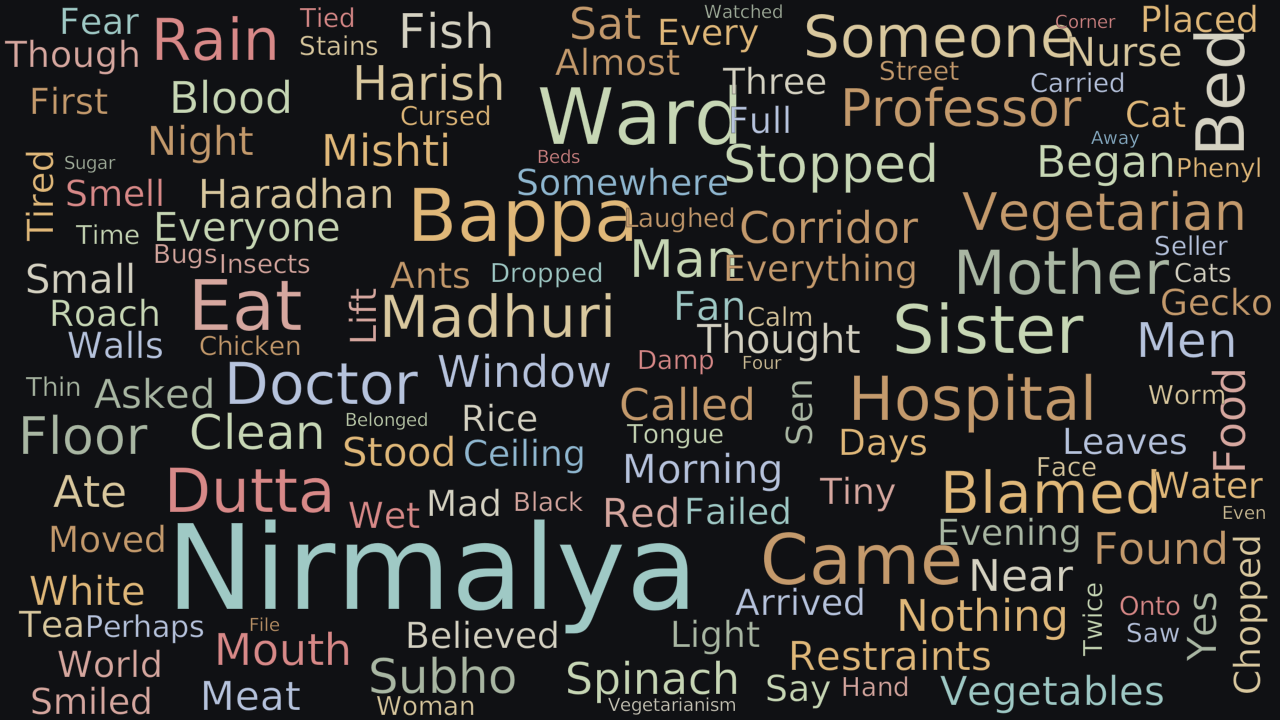
Word Cloud
Related reading
Selected by shared topics and section, with closer publication dates breaking ties.