Faces in the Municipal Water
Uses the speech voice supplied by your browser or device.

THIS IS A WORK OF FICTION
The first face came off at the tea stall beside the Kalighat Metro gate, not theatrically, not with a scream suitable for cinema, but with the embarrassed little sound of wet cloth being pulled from a bucket.
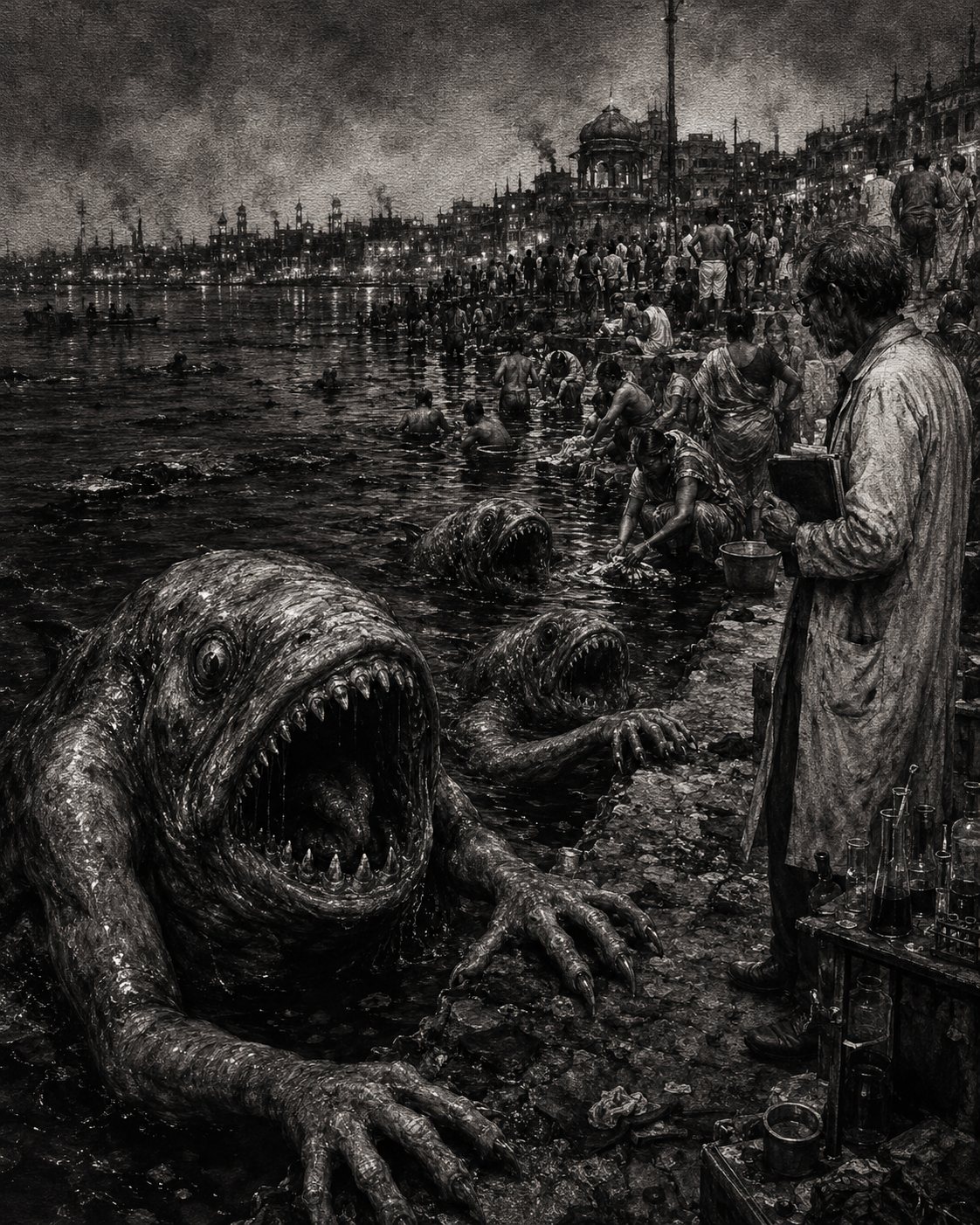
It was eight in the morning. Rain had fallen all night and left the city shining with that fraudulent cleanliness Calcutta sometimes wore for twenty minutes before the drains remembered their profession. Tram wires sagged over Rashbehari like tired handwriting. Buses coughed blackly. Two delivery riders in blue raincoats leaned against a shuttered coaching center, drinking tea from thick glasses and watching an old man argue with a fish seller about the spiritual difference between rohu and fraud.
Niloy Bhaduri stood under the plastic awning of Nirmal’s Tea Cabin, holding his earthen cup in both hands. He had not slept. His mother had been admitted again to SSKM the previous evening, and the private ward had required a deposit that turned his salary into a rumor. He was thirty-eight, a junior water-quality analyst with the Kolkata Municipal Corporation, which meant, in practice, that he stamped reports other people ignored and signed his name below numbers adjusted to make civilization look less like a leaking pipe.
The man beside him, a clerk from the LIC office judging by his lanyard, rubbed his cheek.
“Mosquito,” he said, irritated.
Then he rubbed harder.
His skin wrinkled under his fingers as if the cheek had become a loose sticker. He frowned, more annoyed than frightened, and tried to smooth it back. That was when the left side of his face slid downward from the bone.
Everyone paused.
Calcutta is not a city easily shocked. A man may collapse, a taxi may catch fire, a political procession may arrive like a migrating species with flags, and people will gather, assess, advise, blame, and continue chewing. But this was different. The clerk’s cheek hung from his jaw in a pale, trembling flap. Beneath it, the muscles were not muscles anymore but a pale-brown lace full of movement.
Tiny white worms threaded through him.
The clerk made no sound at first. His eyes rolled toward Niloy, wet and apologetic, as though he had committed a social mistake.
Then his lips dropped away.
The tea stall erupted. Glasses broke. Someone shouted, “Acid! Acid!” Someone else yelled for water, which, for the first time in the history of emergencies, seemed like a poor suggestion.
Niloy backed into the rain.
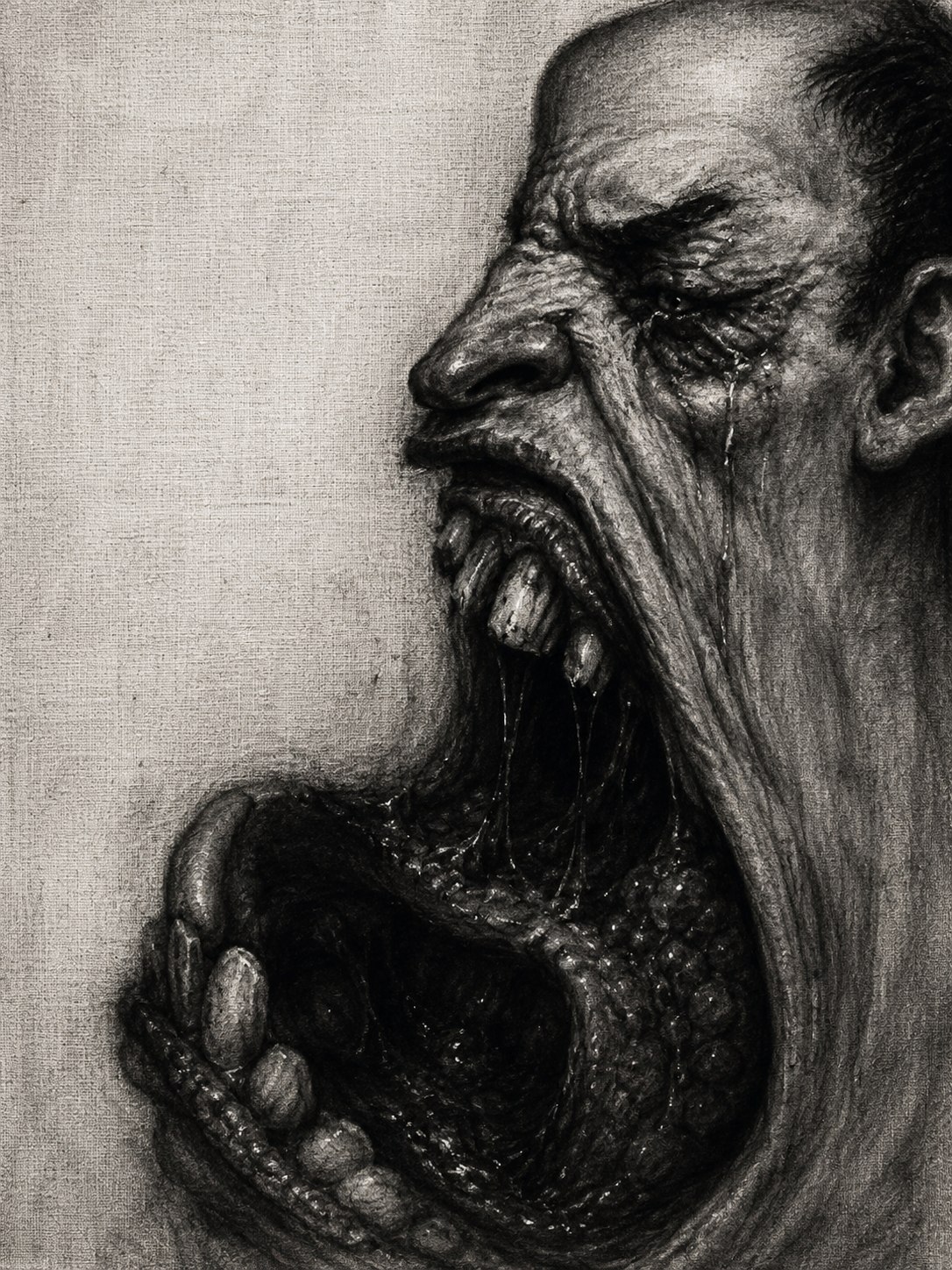
The clerk’s face continued loosening in sections. The nose collapsed, not falling exactly, but hollowing, thinning, becoming a small bridge of cartilage over a dark nest. His tongue tried to form words through exposed teeth. The worms moved with delicate appetite, as if reading him in Braille.
A constable arrived and beat the air with his lathi, furious at the lack of a familiar category.
Niloy’s phone vibrated.
UNKNOWN NUMBER.
He nearly dropped it.
“Bhaduri?” said a woman’s voice.
“Yes.”
“This is Dr. Mira Sen from Infectious Diseases, Beleghata. You work in municipal water testing?”
Niloy looked at the clerk, now sitting on the pavement because his legs had politely surrendered.
“Yes.”
“Did you submit Ward 82’s residual chlorine report yesterday?”
Niloy did not answer.
On the pavement, Nirmal the tea seller whispered, “Ma go.”
Dr. Sen said, “People are arriving without faces.”
By ten, the city had begun learning a new terror.
At first the news channels called it “mysterious facial necrosis.” Then “water-linked dermal syndrome.” Then, once enough videos leaked from emergency wards and apartment lifts and school gates, nobody bothered with soft language. Faces were coming off.
They came off in bathrooms, over basins while people brushed their teeth. They came off in offices under fluorescent lights. They came off inside app cabs on the EM Bypass and beside phuchka stalls in Gariahat, where a young woman spat out pani and then her lower lip with it. In Salt Lake, a retired professor livestreamed himself calmly explaining the civic failure until his jaw muscles dissolved mid-sentence and he became a clicking skull in a cotton kurta.
It began with itching. Then warmth. Then a pleasant numbness, reported by survivors with a guilt almost indecent. The parasite ate skin first, then fat, then the expressive muscles of the face—the little elevators of amusement, shame, irritation, flirtation, fatigue. It left the eyes. It left the tongue if it could. It left the skull wearing wet threads of meat and colonies of worms that pulsed in the cavities where cheeks had been.
It preferred faces.
That was the part that drove the doctors mad.
Hands remained intact. Bellies, thighs, backs, arms: untouched. It went for the human signboard, the passport, the family photograph, the item most heavily invested in by matrimonial websites and election posters and school prize ceremonies. A city that had survived famine, Partition, riots, strikes, flyovers, dengue, real estate, tuition culture, and the refined torture of relatives asking, “So what are you doing now?” found itself attacked at the exact point where respectability was usually displayed.
Niloy walked from Kalighat to SSKM because there were no buses. Halfway down Harish Mukherjee Road a boy in a yellow school shirt stood beside a puddle, staring at his reflection. His face was still whole. His mother dragged him away by the collar and slapped the water from his hands.
At SSKM, the corridors smelled of phenyl, fear, sweat, and wet clothes. Families clumped around doors, each group guarding its own disaster as if disease might be jealous. Niloy pushed toward the medicine ward.
His mother lay propped on pillows, small and offended by illness. Her face, thank God, was unchanged: narrow, papery, with the suspicious eyes of a woman who had survived widowhood, pension offices, and one disappointing son.
“You came late,” she said.
“The city is in trouble.”
“The city is always in trouble. Did you bring coconut water?”
He had not.
In the next bed, a woman with no mouth made a bubbling sound.
Niloy turned.
The woman’s face had been covered with gauze, but the gauze moved.
His mother followed his gaze. “They brought her at dawn. From Jadavpur. Her daughter keeps crying. As if crying helps.”
The daughter sat on the floor, both hands over her own face.
Niloy’s phone vibrated again.
This time it was his office supervisor, Deputy Chief Engineer Prabir Dutta.
“Where are you?” Dutta barked.
“Hospital.”
“Come to the lab. Now. Bring your laptop.”
“My mother—”
“Your mother drinks water, no? Then come.”
The municipal laboratory near Palmer Bazar had been built in an optimistic decade and maintained in a realistic one. Paint peeled from the walls in scrolls. A framed hygiene poster showed a smiling family washing vegetables under a tap, now possibly the most obscene image in Calcutta. Outside, a crowd had gathered at the gate, shouting for test results, compensation, resignations, revenge, God, and bottled water.
Inside, men who usually moved with the thoughtful pace of aquarium fish were running.
Dutta stood beside the main testing bench, sweating through his shirt. He was a heavy man with political connections and the moral agility of wet soap. Niloy had disliked him for years and obeyed him for nearly as long.
Dr. Mira Sen was already there.
She wore a mask and carried a steel specimen box. She was short, sharp-faced, with rain-dark hair tied at the neck and the expression of a person who had no time left for foolish men but expected to encounter them anyway.
“You altered yesterday’s Ward 82 reading,” she said.
Dutta said, “Doctor, this is not the time for accusations.”
“It is exactly the time. Residual chlorine was logged at 0.7 milligrams per liter. The sample we retained shows almost zero.”
Niloy looked at the floor.
Dutta stared at him.
“Bhaduri,” he said softly.
Niloy heard, under that softness, the whole machinery: the memo that would appear, the missing file, the hospital bills, the rented flat, his mother asking whether he had lost another job through stubbornness.
“It was a one-line correction,” Niloy said.
Mira’s eyes did not move.
“Why?”
Dutta said, “Because the automated dosing unit at the booster station was temporarily under maintenance, and panic helps nobody.”
Niloy almost laughed. Temporarily. Under maintenance. The grand language of Indian collapse, where bridges fell due to “technical issues,” hospitals burned due to “electrical incidents,” and poisoned water became a confidence problem.
“There was pressure loss after the pipe burst near the canal,” Niloy said. “Sewage intrusion was suspected. Sir told us bottled water distribution would create unnecessary alarm before Puja weekend.”
Dutta’s face reddened. “Mind your language.”
Mira opened the specimen box.
Inside were three vials. In each, suspended in cloudy water, floated pale threads.
“Not sewage alone,” she said. “Something living. Larval, maybe. Biofilm-associated. It survives ordinary filtration. Chlorine kills it if chlorine exists. Without it, it blooms.”
Niloy leaned closer despite himself. The threads moved toward the warmth of his breath.
Mira shut the lid.
“It enters through oral mucosa,” she said. “Maybe nostrils. Maybe broken skin. Incubation twelve to thirty-six hours. But there’s a pattern. It isn’t everyone exposed.”
“What pattern?” Dutta asked.
Mira looked at Niloy. “People with high use of piped tap water. Morning brushing, gargling, tea stalls using municipal supply, apartment tanks. Bottled-water households are mostly spared.”
Outside the gate, the crowd roared.
There it was, Niloy thought: class written biologically at last. The city had always known who drank from taps and who had twenty-liter jars delivered by boys with bent backs. Now the distinction had teeth.
By evening, the government declared a water emergency and asked citizens to remain calm, boil water, avoid rumors, report symptoms, trust authorities, and use helpline numbers that immediately stopped working.
Boiling helped, but too late.
The parasite had already climbed the city.
It moved through overhead tanks on crumbling rooftops, through illegal pump lines, through tea kettles, through school bottles, through the steel tumblers of old women who trusted municipal water because they had trusted it since 1969 and refused to believe the modern world could make even water ambitious. In Behala, whole families lost their faces sitting together before the television. In Dum Dum, a local train driver completed two stations after his eyelids vanished, guided by track memory and terror. In a gated tower off New Town, the residents’ WhatsApp group blamed domestic workers until the secretary’s imported Labrador began licking worms from his master’s cheek.
Niloy and Mira worked through the night.
They traced samples: Ward 82, then 88, then 94, then older neighborhoods along pressure-drop zones. The organism clustered wherever potable pipes ran close to drainage channels. But the highest counts came from one place: the disused colonial reservoir under Chhaya Bari, a collapsing mansion near Chetla, currently hidden behind blue tin sheets and a banner announcing luxury apartments: SKYLOTUS RESIDENCES—LIVE ABOVE THE OLD CITY.
Dutta arrived at midnight, smelling of whisky and sanitizer.
“Chhaya Bari reservoir was sealed,” he said.
“No,” Niloy said. “It was connected during the bypass work last month. Temporary feed.”
Dutta’s mouth tightened.
Mira looked between them. “Who approved that?”
Nobody spoke.
Rain struck the laboratory windows.
Finally Niloy said, “I signed the field clearance.”
“You inspected it?” Mira asked.
He remembered the day: the developer’s representative in sunglasses, the contractor smiling, Dutta calling twice, his mother’s biopsy estimate folded in his pocket. He had stood before a rusted iron hatch behind the mansion, smelled dampness rising like old breath, and decided that not looking inside was different from lying.
“No,” he said.
Mira closed her eyes for one second. Not in sorrow. In calculation.
“We go there now,” she said.
The city outside had changed.
At two in the morning, Calcutta was usually at its most truthful: stray dogs owning intersections, tea stalls glowing like small arguments against death, taxis asleep under trees, couples whispering in cheap cafés, hospital relatives carrying reports in plastic folders. That night, the roads were full of people carrying water.
Bottles, buckets, drums, pressure cookers, mineral-water jars, plastic paint containers. Some had faces. Some wore cloth. Some had no faces and moved with relatives guiding them by the elbow. App notifications kept screaming on phones: DO NOT PANIC. BOIL WATER. REPORT FACIAL ITCHING. CURFEW IN SELECT AREAS.
On a wall near Hazra, a political poster had softened in rain. The candidate’s smiling face hung in strips.
Chhaya Bari stood behind the tin sheets, a ruined mansion with balconies like broken teeth. Puja lights from a nearby pandal flickered beyond it, making the wet façade pulse red and gold. The developer had left one guard at the gate, an old man named Ashfaq who recognized Niloy from the inspection.
“You again,” Ashfaq said. He had tied a gamchha over his mouth. His eyes were frightened but friendly, which somehow made everything worse.
“We need the reservoir,” Niloy said.
“Don’t go down.”
Mira lifted her specimen box. “Why?”
Ashfaq glanced at Dutta, who had come despite declaring the visit unnecessary.
“Noise,” he said. “Like eating. All week.”
The hatch lay behind the mansion courtyard, beneath weeds and broken marble. Niloy remembered standing there a month earlier. Remembered the smell. Remembered Dutta’s message: Clear it today. Don’t create drama.
The lock was new.
Mira noticed. “Who sealed it?”
Ashfaq said, “Promoter people. Yesterday.”
Dutta said, “Open it.”
Ashfaq did not move.
Niloy took the crowbar from the guard’s shed and broke the lock himself.
The hatch opened upward with a gasp.
A warm, damp smell rose from below—not sewage, not rot exactly, but old pond water mixed with raw chicken and incense ash. Stairs descended into darkness.
Mira switched on her torch. “Masks. Gloves. Don’t touch water.”
They went down.
The reservoir chamber was vast, brick-lined, older than the neighborhood above it. Colonial engineers had loved underground spaces, Niloy thought; they had buried their confidence everywhere. Water covered the floor knee-deep, black and strangely still. Pipes entered through walls at different heights. Recent PVC couplings gleamed among century-old iron.
Then the torch beam found the faces.
Hundreds of them floated on the water.
Not skulls. Not bodies. Faces.
Thin masks of skin and fat, translucent, lipless, eyeless, drifting cheek to cheek like a drowned crowd listening. Worms seethed beneath them, stitching and unstitching the human pieces. Some faces had moustaches still attached. Some wore lipstick. One had a child’s dimple.
Ashfaq moaned behind his cloth.
Mira whispered, “This is not feeding.”
Niloy could barely speak. “What?”
“It’s storage.”
Dutta backed toward the stairs. “Enough. We inform higher authorities.”
Something moved in the far end of the reservoir.
The water bulged.
At first Niloy thought a body was rising. Then he understood there were too many faces on it. They covered a central mass like scales, overlapping, twitching, mouths opening where no lungs existed. A floating colony, perhaps five feet across, pale and brown and softly intelligent. The worms did not merely infest it. They organized it. They pulled faces into place, arranging human expression over themselves as camouflage, as memory, as feast.
One face near the top opened its stolen lips.
“Bhaduri,” it said.
Niloy’s bladder loosened a little. The voice was his mother’s.
Mira grabbed his arm. “Don’t answer.”
“Niloy,” said the face. It had his mother’s left eyebrow, her annoyed tenderness. “You came late.”
He staggered.
The colony drifted closer without ripples.
Other faces spoke now. Fragments of the city. A professor correcting pronunciation. A child asking for water. A woman bargaining for fish. A politician promising development. A delivery boy saying, “OTP bolun.” The reservoir filled with Calcutta talking through borrowed mouths, the grand old city reduced to its purest element: everyone speaking at once from a darkness nobody had inspected.
Dutta fell on the stairs.
A tendril of worms shot from the water and struck his cheek. He screamed and slapped at it. Skin came away under his hand. Another tendril climbed his neck. His face began loosening, fast, as if the parasite knew authority by taste and found it tender.
Mira pulled Niloy upward.
Ashfaq was already running.
They stumbled into rain and night and the obscene brightness of puja bulbs. Behind them, Dutta’s screams rose through the hatch, then became wet, then became articulate again in several voices.
At the gate, Mira bent double, coughing.
“We have to burn it,” Niloy said.
“With what? A matchbox? It’s already in the network.” She wiped rain from her face. “But that colony matters. It’s a reproductive node. Maybe if we isolate—”
Niloy’s phone rang.
SSKM.
He answered with shaking fingers.
A nurse said, “Your mother is asking for you.”
He closed his eyes.
“Is she all right?”
A pause.
“She has itching.”
The city’s lights went out.
Power cuts had always been part of Calcutta’s moral education. They reminded people that progress here arrived wearing borrowed shoes. The darkness fell not cleanly but in blocks: tower, lane, hospital, crossing, mall, para club. Generators coughed awake. Somewhere a crowd began chanting for water. Somewhere else, someone began chanting a prayer.
Mira’s torch lit Niloy’s face.
“You drank tea this morning,” she said.
“So did half the city.”
“Any itching?”
“No.”
She stared at him.
“What?” he said.
“Your cheek.”
He touched it.
Dry.
But under his fingertips something shifted—not on the skin. Under it. A tiny answering movement, like a thought turning in sleep.
He remembered the tea stall. The clerk. The warm breath over the vials. The reservoir voice wearing his mother’s words.
Mira stepped back.
“Niloy,” she said carefully. “Open your mouth.”
He did.
She shone the torch inside.
Her expression changed.
“What is it?”
“Nothing,” she lied badly.
He touched his tongue. Normal. Teeth normal. Gums normal.
Then, from the dark glass of the guard booth window, he saw his reflection.
His face was intact.
More than intact.
In the middle of rain, panic, infection, and civic ruin, Niloy Bhaduri looked strangely well. The tired hollows beneath his eyes were gone. His cheeks seemed fuller. His skin had the faint clean brightness of childhood fever after the fever breaks. He looked like an improved draft of himself.
Mira saw the reflection too.
The truth arrived without drama, the way many terrible truths do, simply taking the chair that had always been reserved for it.
“Why aren’t you affected?” she whispered.
Niloy thought of the altered chlorine report. His signature. His mother’s bills. The hatch he had refused to open. A month of small compromises laid one upon another until they became infrastructure.
The hatch behind them clanged.
Dutta climbed out.
Or what had been Dutta.
His body came first, heavy and stumbling. His skull gleamed in the rain. Worms filled the holes where his face had been, but over them, stretched freshly and imperfectly, was a new face.
Niloy’s.
Not copied. Not stolen entirely. Assembled.
Dutta’s skull smiled with Niloy’s mouth.
Mira raised the crowbar.
Dutta spoke in Niloy’s voice and in his mother’s voice and in the LIC clerk’s voice, all braided together.
“Don’t create drama,” it said.
The city groaned around them: pipes hammering, pumps failing, millions of taps sucking air and then something worse. In apartments from Chetla to Dum Dum, from Behala to Salt Lake, people leaned over basins and felt their faces begin to loosen. In hospitals, doctors tied cloth around patients and kept working because there was nothing else to do. In gated towers, residents discovered that stored water had memory. In tea stalls, kettles boiled what boiling could no longer forgive.
Niloy ran toward SSKM.
He ran through rainwater shining over tram tracks, past shuttered pharmacies, past political slogans peeling from walls, past people carrying buckets they no longer trusted. Behind him, Mira shouted his name once, then stopped.
At the hospital, the ward was dark except for emergency lamps. His mother’s bed was empty.
He found her in the bathroom, standing before the mirror.
For one insane second he thought she had been spared. Then she turned.
Her face was gone from the nose down. Worms moved where her mouth had scolded him all his life. Her eyes remained, bright and furious.
She lifted one hand.
On the basin lay her face, folded neatly like a wet handkerchief.
Beside it, written on the mirror in the brown water dripping from the tap, were words he had not seen since the inspection form a month earlier, words in his own handwriting.
CLEAR FOR TEMPORARY MUNICIPAL USE.
His mother’s skull clicked softly. He leaned close, because sons are trained to lean close even when love has become unbearable.
From inside the ruined mouth came his own voice, gentle and official.
“Safe to drink.”
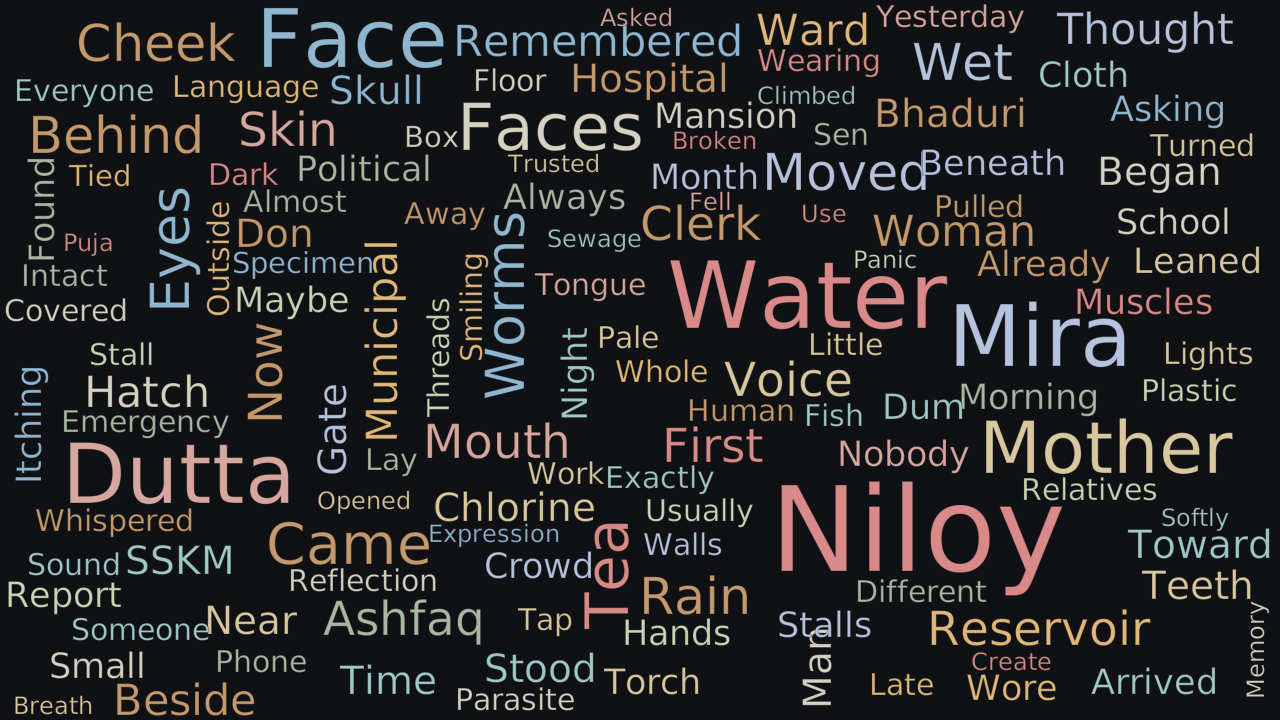
Word Cloud
Related reading
Selected by shared topics and section, with closer publication dates breaking ties.