Knife Bite
Uses the speech voice supplied by your browser or device.

THIS IS A WORK OF FICTION
By the time the first man bit his wife at Sovabazar Metro, everyone in Calcutta already knew the song.
It was not even a good song. That was the chief insult. Calcutta has forgiven many things—drains that rise like ancient curses during rain, trams reduced to memory and wire, political slogans painted over other political slogans until every wall looks like an argument with eczema—but it does not easily forgive a bad tune that succeeds.
The biscuit advertisement began three weeks before Rath Yatra, when the air had become a wet towel flung over the city’s face. At tea stalls, on buses, inside cheap cafés where ceiling fans stirred heat without reducing it, the jingle arrived from television screens, phone reels, mall speakers, FM radio, auto-rickshaw stickers with QR codes, and the impossible digestive system of app-based advertising.
“Khabo, khabo, aar ek bite,
Mithe rosh, dudher light,
Daat-e lege, mon-e jai,
Knife Bite, Knife Bite—aaro chai!”
People hated it immediately, which made them sing it.
At Gariahat crossing, under tram wires and banners advertising NEET coaching with smiling boys who looked as if they had never known sweat, the jingle leaked from a television in Paltu’s tea stall. A delivery rider in a green raincoat, helmet pushed up like a second head, hummed it while dipping Marie biscuit into overboiled tea. Two schoolgirls waiting beside a cart of wilting tuberoses sang “Knife Bite, Knife Bite” in a mock-opera voice until an old man with a newspaper told them to shut up.
“Ei shob ad agency people,” Paltu said, pouring tea into thick glass tumblers. “They should be punished by being made to listen to themselves.”
Ritwick Sen said nothing.
He had written the tune.
Not alone, of course. Nobody did anything alone anymore, not even foolishness. There had been a brand team, a digital retention consultant from Gurgaon with skin like polished office furniture, a neuromarketing deck, three AI-generated melodic options, and one long evening in a Salt Lake studio where Ritwick had drunk black coffee and adjusted the hook until it sat in the brain like a fishbone. But the final lift, the little upward turn on “aar chai,” was his. He had taken it from an old Rabindrasangeet phrase and bent it just enough to avoid litigation and invite sin.
He had not told anyone at home.
At home there was only his mother, Mira Sen, who slept in a narrow room off their balcony in a crumbling Jadavpur apartment building where the plaster bubbled after every monsoon and neighbors knew everybody’s tragedy by smell. Mira had cataracts, diabetes, a mild tremor, and the habit of asking Ritwick at ten-minute intervals whether he had eaten. She had once sung on All India Radio, not importantly, but enough for old para aunties to remember and say, “Your mother had a sweet voice,” as if sweetness were an ancestral flat lost to promoter greed.
Ritwick was forty-two, divorced, unemployed in the official sense, and employed in all the humiliating unofficial senses: jingles, voice edits, podcast noise clean-up, election campaign audio he pretended not to recognize later. He had unpaid credit card bills, a damp patch above his computer table shaped like Nepal, and a private terror of becoming one more educated Bengali man living on tea, adjectives, and resentment.
So when Knife Bite Biscuits paid promptly, he did not ask questions.
The first complaint came from Mira.
“Baba, why are there two of you?”
She said it one afternoon during a power cut. Rainwater ticked from the balcony grille into a plastic bucket. Somewhere below, a vegetable seller dragged out “lau, potol, jhinge” with the grief of a defeated opera singer. Ritwick was fanning his mother with an old bank calendar.
“Double vision?” he asked.
“Two Ritwicks,” she said. “Both thin. One more tired.”
He tried to laugh. “The second one sounds useful. Ask him to pay the electricity bill.”
But her eyelids looked swollen, heavy as if small coins had been sewn into them. Tears gathered and rolled sideways into her hair. He checked her blood sugar. It was high, but not astonishingly high. In Calcutta middle-class life, every number is a warning that has learned patience.
At night she hummed the jingle in her sleep.
“Khabo, khabo…”
He stood outside her door, shirt sticking to his back, listening.
The second complaint arrived from Nilanjana Dutta, the dentist downstairs. She came up without calling, which meant the matter was serious or she had run out of green chilies. Nilanjana was thirty-eight, sharp-faced, divorced like Ritwick, and had the professional calm of someone who earned money by putting fingers into other people’s fear.
“Your mother is having eye symptoms?” she asked.
“How do you know?”
“My patients. Three since morning. Double vision, watery eyes, eyelids drooping. One child from Bijoygarh bit through my mouth mirror.”
“Children bite.”
“Not like this.” She opened her phone and showed him a photograph.
Ritwick wished she had not.
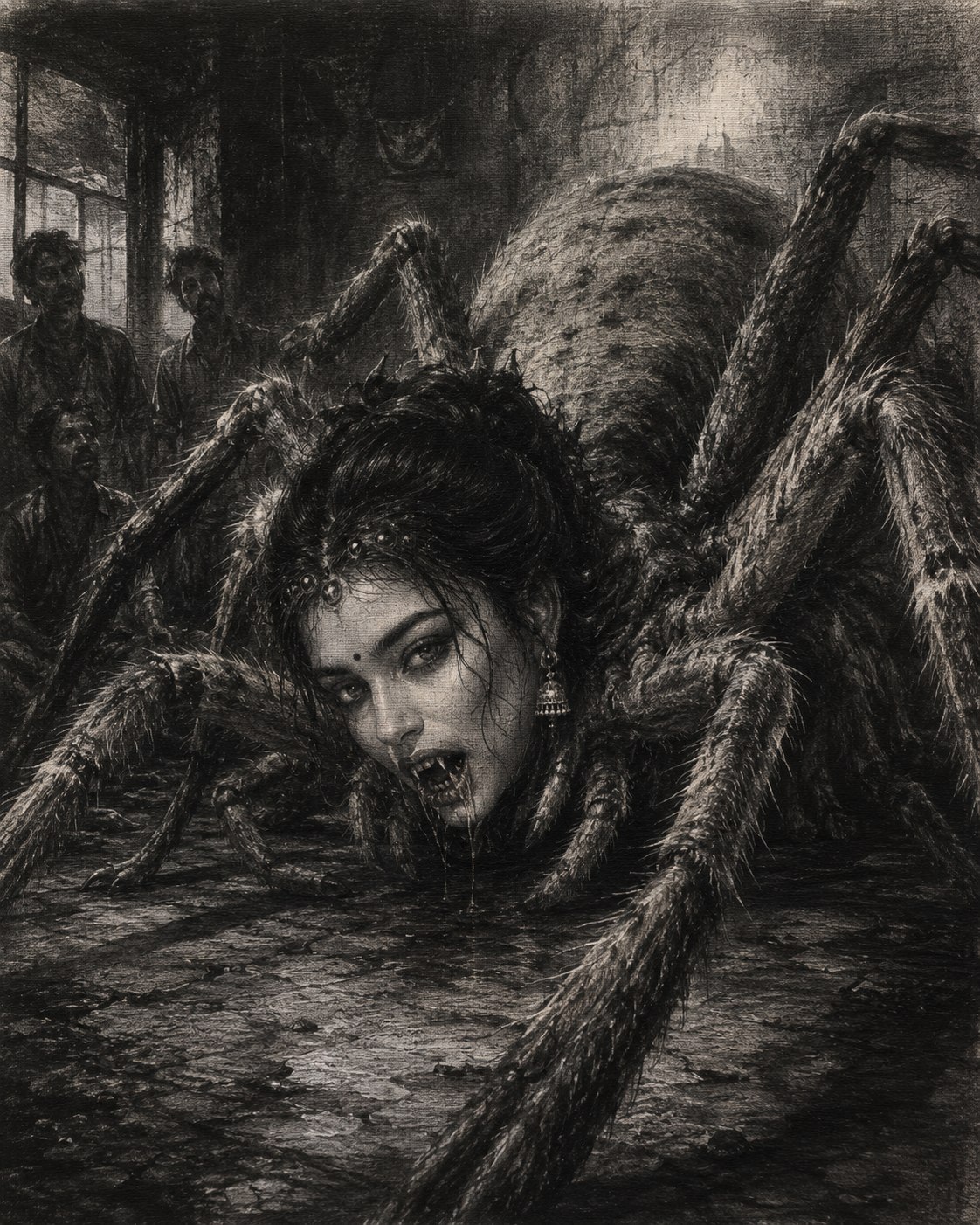
The boy’s lower incisors had lengthened into narrow white points, uneven but sharp, like broken porcelain filed by a patient criminal. His gums were inflamed. His lips were streaked with blood and biscuit crumbs.
“Congenital?” Ritwick said, because denial, when educated, often begins as vocabulary.
“Overnight?”
They looked at each other.
From Mira’s room came the soft, sleepy rise of the tune.
Nilanjana turned her head. “She’s singing it too.”
Everyone was singing it.
The city had become a throat for hire. In the mornings, cable news shouted about floods in North Bengal and a minister’s nephew’s procurement scandal; then came the advertisement, bright and idiotic, with animated biscuits marching across a cartoon Howrah Bridge. At lunch, office workers watched reels of cats, political fights, fake recipes, and the Knife Bite challenge, in which influencers snapped the biscuit between their teeth and rolled their eyes in exaggerated bliss. In the evening, gated towers along EM Bypass glowed with generator power while old lanes sat under power cuts, and from both kinds of darkness came the same tune.
Technology had made equality at last, Ritwick thought: the rich and poor could now be colonized by the same nonsense at the same time.
By the fourth day, hospitals noticed.
At MR Bangur, a junior doctor posted a warning on a private WhatsApp group: unusual cluster of ocular palsy-like symptoms with acute dental changes. At SSKM, a patient in the waiting area attacked a man eating egg roll. At a private hospital off Mukundapur, a nursing aide with tears running down her face leaned over an unconscious patient and bit his forearm before orderlies dragged her away.
The government said there was no cause for panic.
This caused panic.
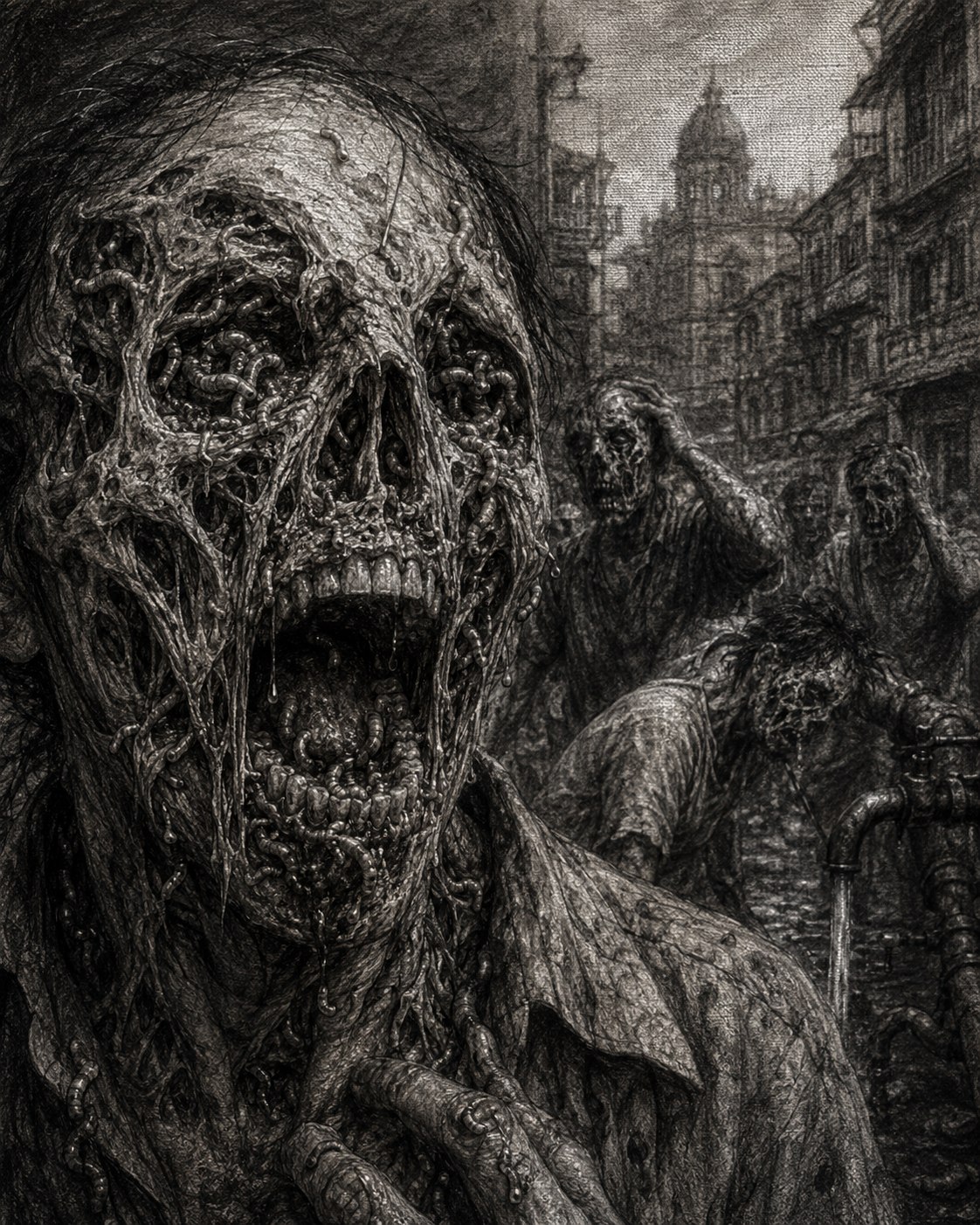
Videos multiplied. A man in a New Market shirt shop, eyelids drooping obscenely, gnawed at a mannequin arm. A tuition teacher in Dum Dum locked herself in a bathroom because her teeth had “become wrong.” In Sealdah, local train passengers beat a hawker nearly to death after he bit a sleeping laborer’s cheek. The hawker kept crying, “Khida peyeche, dada, khub khida,” with the puzzled shame of a man apologizing for poverty.
Nilanjana began keeping her clinic shutter half-down. Ritwick helped her carry boxes of gloves, gauze, and antiseptic upstairs because her landlord wanted the clinic closed. “Bad for building reputation,” he had said, as if reputation were a mosquito net and horror merely something that had flown in through carelessness.
“Look at this,” Nilanjana said that evening at Ritwick’s table.
She had spread patient notes beside his keyboard. Outside, rain hissed against balconies. Somewhere a generator coughed itself awake. Mira slept in the next room after a sedative prescribed over the phone by a doctor who sounded both busy and doomed.
Nilanjana had made columns: exposure, symptom onset, food eaten, dental change, aggression. Her handwriting was precise and irritated.
“Every patient remembers the ad,” she said.
“Everyone remembers the ad.”
“No. Not remembers. Hears. They say it continues after the TV stops. Some say it grows louder when they smell milk or sugar.”
Ritwick swallowed.
On his monitor lay the audio project file for the Knife Bite campaign. He had opened it that afternoon and stared at the waveforms like a murderer revisiting a lane. Nothing looked strange. Bass, claps, children’s chorus, his own synth line, the hook. He had soloed tracks. He had inverted channels. He had checked for hidden frequencies because online conspiracy had already blamed 5G, Bangladesh, China, one actress, three religions, and fluoride.
The file was ordinary.
That made it worse.
“I worked on it,” he said.
Nilanjana looked up.
“I mean—the jingle. Freelance.”
Her face changed with admirable restraint. “You wrote that thing?”
“Part of it.”
“Then unwrite it.”
“It’s not a spell.”
“Everything is a spell if enough people repeat it.”
He wanted to object, but the city itself had always understood this. Mantras, slogans, exam formulas, product names, party chants, coaching center promises, marriage biodata lies: repeat a thing enough and reality grows tired of resisting.
Nilanjana leaned closer to the screen. “Play it.”
“No.”
“Play it once.”
“It may be dangerous.”
“We are already in its mouth.”
He played the file.
The speakers released the bright little tune. In the next room, Mira made a sound in her sleep, not waking but answering. Nilanjana shut her eyes, then opened them quickly.
“My eyelids feel heavy,” she said.
Ritwick stopped the audio.
Silence returned, but not cleanly. In the silence was an aftertaste.
“Again,” Nilanjana said. “Lower. Only the children’s chorus.”
He isolated the track. The chorus was supposed to be six children from a Behala recording school. Their voices came thin and sweet, slightly auto-tuned.
Khabo, khabo, aar ek bite…
Nilanjana frowned. “There’s another voice.”
“There isn’t.”
“There. Under the children.”
Ritwick put on headphones.
At first he heard nothing but compression artifacts and the moist clicking of consonants. Then, beneath the chorus, tucked under “dudher light,” something breathed. Not words exactly. A wet instruction.
He magnified the waveform. There was a track he had not seen because it had been printed into the final stem sent by the agency. He found the Gurgaon consultant’s email. “Memory Enhancer Layer v2—approved by client.” He remembered now: they had spoken of sonic branding, retention, appetite priming. Everyone spoke in terms that removed human agency, like priests explaining plague as weather.
He extracted the layer and slowed it.
A voice emerged.
Mira’s voice.
Not as she sang now, cracked and elderly. Younger. Warm. The voice from his childhood, from winter afternoons when she practiced while pressure cooker whistles rose from neighboring kitchens. But the words were wrong.
Eat because you were eaten. Bite because they bit. Take back the flesh.
Ritwick pulled off the headphones.
“What?” Nilanjana asked.
He could not answer.
Because he knew where they had got it.
Years ago, before his father died, before Ritwick’s marriage collapsed, before the apartment began to peel in earnest, he had uploaded old cassette recordings of Mira to a restoration service. Later, short of money, he had sold voice samples to a data broker who promised anonymized use for “Indian language audio training.” It had been a small transaction, less than a decent dinner for two in Park Street. He had told himself a voice was not a body.
But capitalism, like certain gods, has a talent for incarnation.
Mira cried out from the bedroom.
They ran in.
She was sitting upright, eyes open but unfocused, tears shining on her cheeks. Her eyelids sagged. Her mouth worked around something too large. When Ritwick turned on the emergency lamp, he saw her teeth.
Not all. Not yet. The canines had lengthened, clean and white, pressing into her lower lip.
“Ma,” he whispered.
She looked at him with double pupils, or perhaps it was his own vision splitting.
“Baba,” she said, ashamed. “I am very hungry.”
The next two days narrowed.
Police vans moved through neighborhoods announcing that citizens should avoid unverified advertisements, report abnormal dental growth, and maintain calm. Maintaining calm became, as usual, the responsibility of people who had been given no useful information. Cable operators claimed they had pulled the ad, but it still appeared in pirated movie channels, phone games, old downloaded reels, mall display loops, and children’s memories. A jingle, once released, does not obey recall notices. It is not a medicine strip. It is a cockroach with melody.
Ritwick tried to contact the agency. The creative director’s phone was switched off. The Gurgaon consultant had deleted his LinkedIn profile. The biscuit company issued a statement expressing concern, denying causation, and wishing speedy recovery to affected consumers, three gestures so familiar that they seemed machine-translated from cowardice.
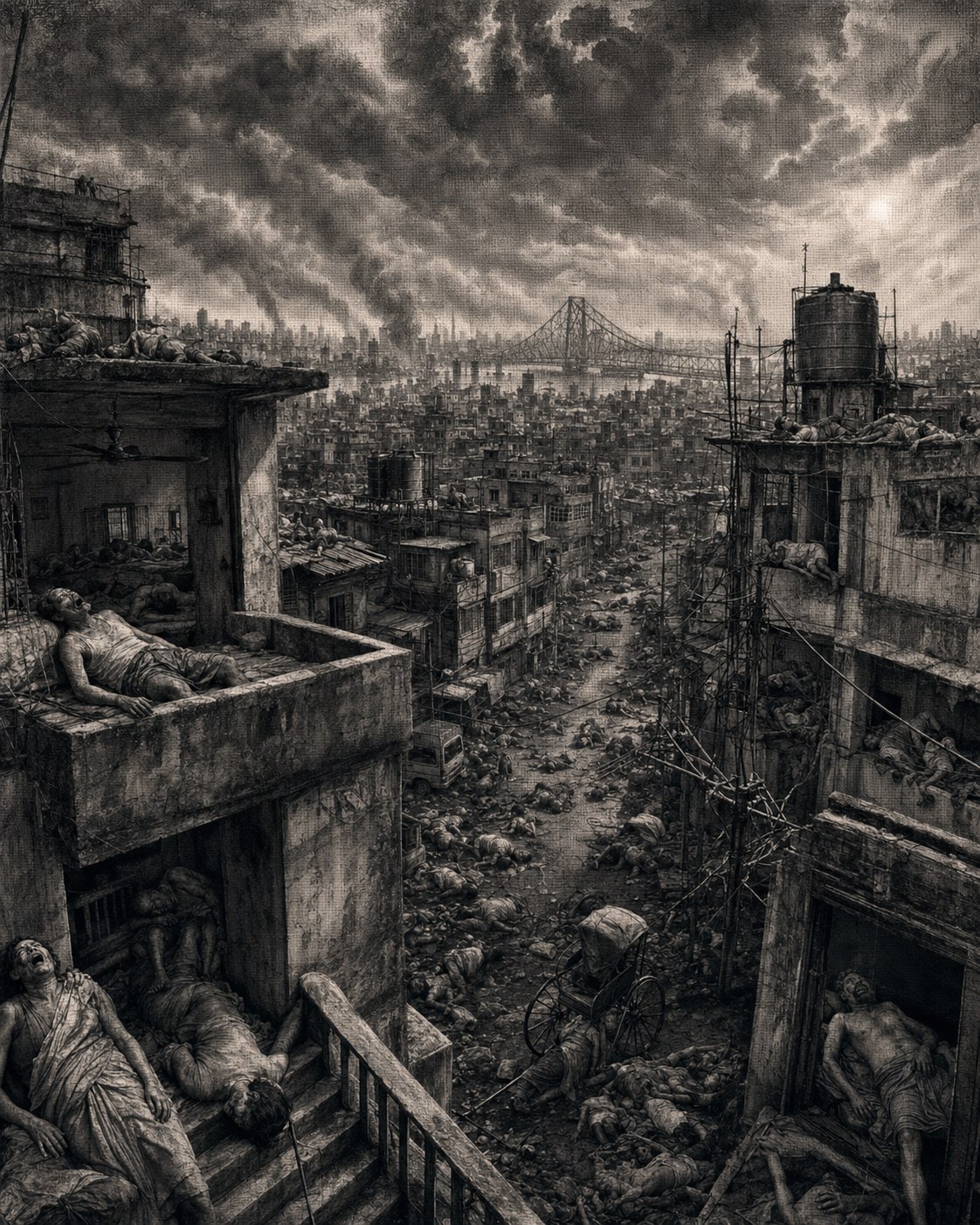
At night, the old apartment building listened to itself breathe. The Banerjees on the third floor had locked their son in a bedroom after he bit the maid. Someone’s grandmother kept singing from behind a closed door. In the lane below, men with bamboo sticks guarded the entrance, not against thieves, who were an old and manageable species, but against appetite. A political poster near the drain showed a smiling candidate promising dignity to all. Someone had written beneath it: FIRST GIVE TEETH.
Mira worsened.
Ritwick tied her wrists with dupattas, crying while he did it. She apologized after trying to bite him. Then she begged him not to come close. Then she sang. Her voice slid between the corrupted jingle and an old song he remembered from childhood. Sometimes she called him by his father’s name.
Nilanjana brought dental acrylic, sedatives, and two packets of ORS. Her own eyelids had begun to droop. She wore dark glasses though it was midnight.
“You heard it too much,” Ritwick said.
“So did you.”
“I don’t have symptoms.”
She looked at him then, not clinically. “Why not?”
That question sat in the room with them.
He had played the file dozens of times. He had heard the hidden layer. He had walked through lanes where children sang it and TVs screamed it. Yet his vision remained clear. His teeth stayed ordinary, tea-stained, slightly crowded. His hunger was normal, even poor.
“Maybe because I made it,” he said.
“Or because you already ate.”
The remark was cruel only because it landed.
They took Mira to a small diagnostic center near Prince Anwar Shah Road that had stayed open behind a locked grille. The waiting area smelled of phenyl, damp clothes, and terror. A boy with sharp teeth muzzled in a gamchha sat between his parents. A security guard wept silently while eating glucose powder from his palm. On the muted television, an anchor shouted above a red banner: JINGLE JIHAD? FOREIGN HAND IN BISCUIT HORROR?
Nobody had the strength to change the channel.
Mira’s scan showed nothing useful. Her bloodwork showed inflammation, dehydration, stress. Her mouth showed the truth.
Outside the center, rain flooded the street ankle-deep. Autos refused short distances. App cabs surged to prices that suggested entrepreneurship had discovered the apocalypse. Ritwick and Nilanjana carried Mira between them under a broken umbrella while puja pandal bamboo frames rose skeletal in the rain, months early, hopeful and absurd.
At a crossing, they saw a crowd around a sweet shop.
A man had fallen on the pavement. Another crouched over him, biting the soft place below his jaw. People shouted but did not approach. The attacker’s shoulders shook with sobs. On the sweet shop television, visible through the grille, animated biscuits marched across Howrah Bridge.
Khabo, khabo…
Ritwick left Mira with Nilanjana and ran inside. The shop owner swung a ladle at him, thinking he had come to loot. Ritwick slipped on spilled syrup, crawled behind the counter, and pulled the television plug.
The screen died.
The attacker looked up. Blood ran from his mouth. For one second he appeared almost relieved. Then from the phones held by the watching crowd, the jingle continued in a dozen tiny speakers.
A city used to be conquered by armies. Now it could be held hostage by autoplay.
That night, Ritwick returned to the audio file.
There had to be an inverse. Every hook had a release. Every melody made tension and resolved it. He worked with headphones clamped over his ears, not playing the jingle aloud. He isolated Mira’s stolen voice and built around it, reversing intervals, flattening the appetite cue, burying the command under a drone copied from an old ceiling fan recording. Nilanjana sat beside him, dark glasses off now, eyes leaking steadily, teeth beginning to ache in her jaw.
“What are you making?” she asked.
“An antidote.”
“Do you know that?”
“No.”
“Good. For a moment I thought optimism had entered the room.”
Near dawn, Mira stopped singing.
Ritwick found her staring at the balcony, where the city lay pale and soaked. Crows hopped along the railing, arrogant survivors. Her restraints were loose. She could have freed herself but had not.
“I know what you sold,” she said.
His mouth dried. “Ma?”
“My voice.” She touched her throat. “It went away years ago. I thought age took it. You took it first.”
He knelt beside her bed. “I was desperate.”
“Everyone is desperate. That is why the city is full of buyers.”
“I didn’t know—”
“You knew enough to accept money.”
The sentence had no anger in it. That made it impossible to defend against.
He played the antidote first through his small speakers.
Nothing happened.
Then Mira began to cry harder, but differently, with recognition rather than hunger. Nilanjana pressed a hand to her mouth. Her jaw stopped trembling.
“Again,” she said.
This time they heard Mira’s true voice inside the new track, not commanding, not selling, only holding a note until the bad tune lost its shape around it.
Ritwick uploaded the file everywhere he could: old musician groups, para WhatsApp chats, Telegram channels, Reddit forums, YouTube under a fake title, “Government Approved Cure Audio,” because in India even rebellion sometimes needs a stamp. Nilanjana sent it to doctors. Paltu played it at the tea stall. A pirate cable operator in Tollygunge put it between a devotional song and a dubbed action film. By evening, some people improved. Not all. The bitten remained bitten. The dead remained brutally unavailable. But eyelids lifted. Tears slowed. Teeth stopped growing in many mouths, though they did not shrink.
The city, having nearly eaten itself, began to argue about credit.
The government claimed timely intervention. The biscuit company announced an internal review. Influencers made apology videos with soft lighting. The ad agency vanished, then reappeared under a new name involving the word “human.” In the lanes, people spoke of ghosts in frequencies, corporate tantra, bad sugar, and judgment. At Paltu’s stall, men who had never refused a free biscuit now inspected packets as if each contained a legal notice from hell.
Mira survived, but her canines remained sharp. She learned to eat slowly.
Nilanjana’s teeth also kept their new points, smaller but visible when she smiled. “Could be useful with certain patients,” she said. She and Ritwick did not become lovers. Calcutta allows many disasters, but not always neat compensations.
A week later, Ritwick received an email.
No subject. No sender name. Only an attachment: a clean studio file labeled KB_RECOVERY_MASTER_FINAL.wav.
His antidote.
Beneath it was one line.
Excellent engagement during crisis phase. We would like to discuss licensing your counter-jingle for national rollout.
He stared at it until evening gathered in the room and the first mosquitoes began their delicate extortion.
From the balcony came the city’s damp chorus: pressure cooker whistles, metro announcements floating from far away, a mother scolding a child, rainwater dripping from a cracked pipe, a delivery rider singing half a line before catching himself. In Mira’s room, his mother slept with her mouth slightly open, her new teeth shining faintly in the dark.
Ritwick deleted the email.
Then he opened the trash folder.
The cursor waited beside Restore, patient as hunger.
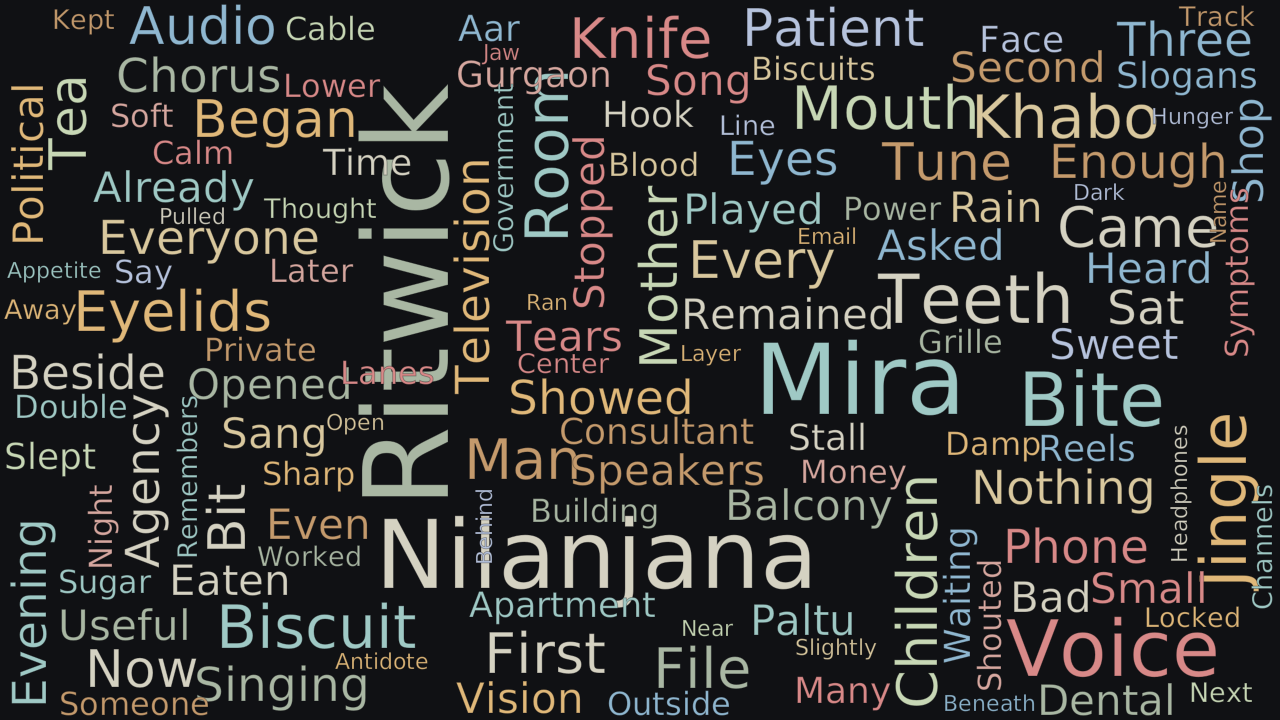
Word Cloud
Related reading
Selected by shared topics and section, with closer publication dates breaking ties.