The June That Stayed
Uses the speech voice supplied by your browser or device.

THIS IS A WORK OF FICTION
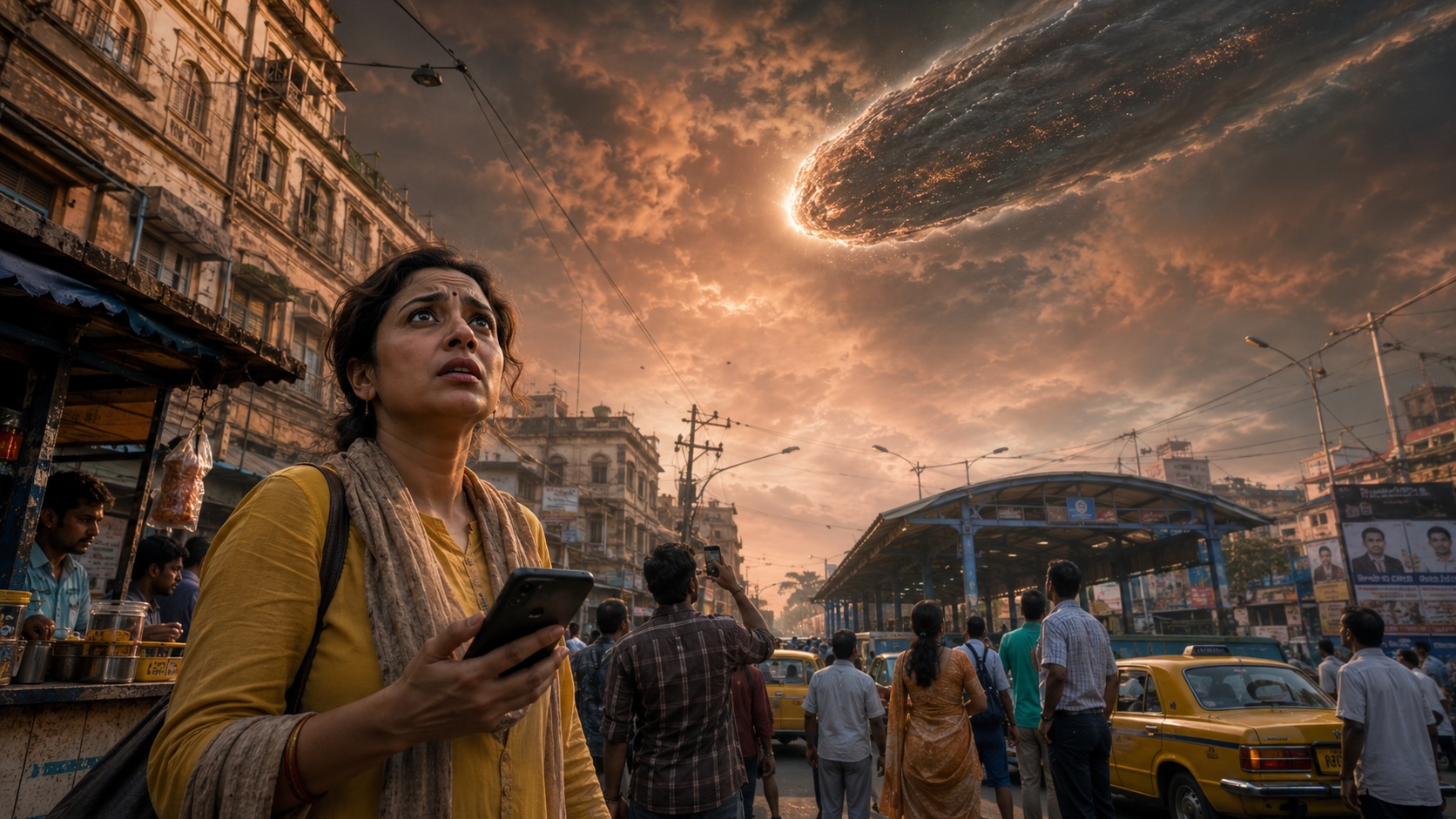
By the third morning of June, the tea stall at Sinthee More had stopped boiling water because the water boiled by itself.
This was not true in the scientific sense, of course. Science, that old clerk with spectacles, would have objected. Water did not boil at fifty degrees Celsius. Not in Calcutta, not beside the cracked footpath where men spat red paan into the drain and argued about politics with the confidence of emperors who could not pay their electricity bills.
But the kettles had begun to hiss before Haru lit the stove.
That was enough for the para.
“Gas leak,” said one man.
“Chinese weather weapon,” said another.
“Government will hide everything,” said a third, who had once failed geography but now spoke expertly about the jet stream.
Above them, tram wires hung over the road like tired black veins. Political posters, pasted in layers on the wall of a closed coaching center, had begun to curl at the edges. A film heroine’s face peeled off first, then a candidate’s forehead, then a slogan promising development with the expression of a man selling fish in yesterday’s market.
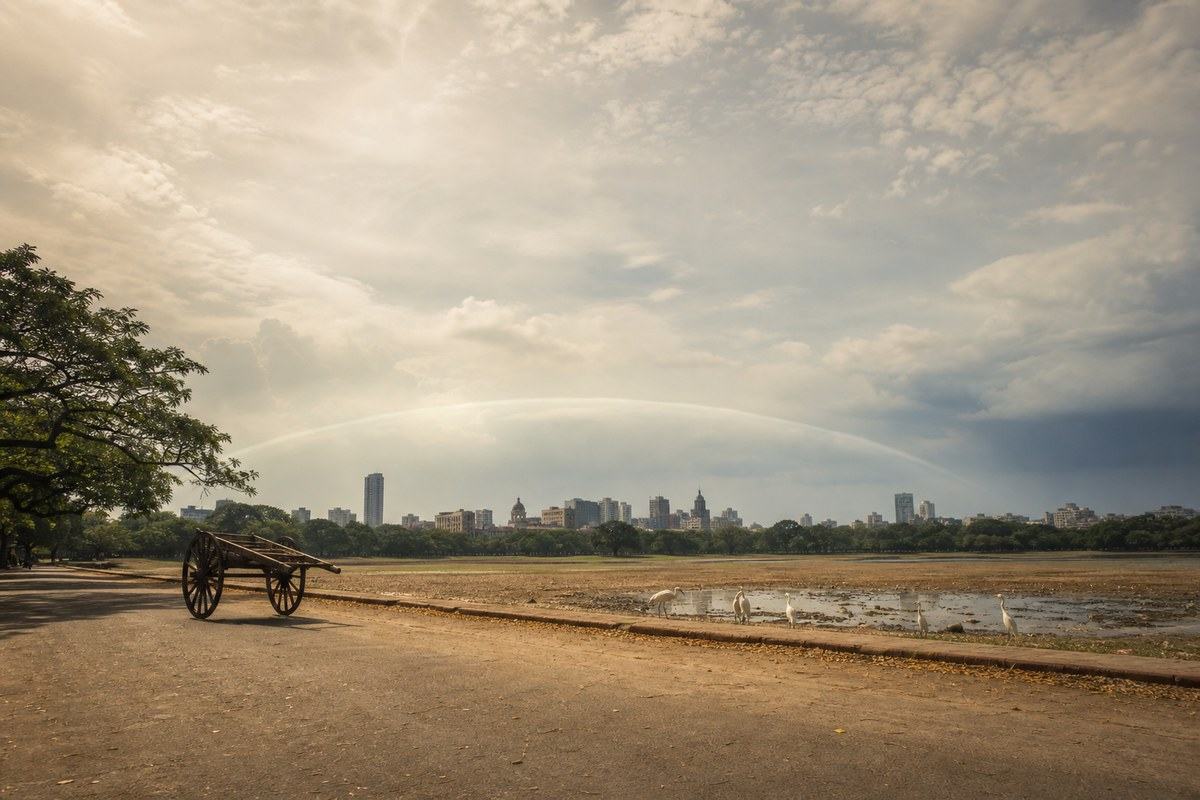
The morning had no breeze. That was what everyone noticed. Calcutta always moved a little, even while dying. A tram bell, a crow, a bus coughing, the slow argument of ceiling fans, the wet slap of slippers after rain. But that morning the city stood perfectly still, as if someone had put a glass cover over it.
In Flat 3B of a three-storied building off Dum Dum Road, Arindam Bose woke with his bedsheet stuck to his chest and his phone screaming.
EXTREME HEAT WARNING.
DRY BULB: 48.9°C.
WET BULB: 38.7°C.
FEELS LIKE: 61°C.
Then the numbers flickered.
WET BULB: 60°C.
For a moment the phone screen dimmed, recovered, and showed a government advisory asking citizens to avoid unnecessary exposure.
Arindam laughed once. It came out dry and unpleasant.
Outside, someone shouted for water.
His mother called from the next room. “Bapi?”
“I’m here,” he said.
“Fan ta cholchhe?”
“Yes.”
It was moving, technically. Three brown blades chopping the thick air into smaller pieces of thick air. The inverter had given up sometime after dawn. The building’s power had returned in a low, uncertain way, as if electricity itself had become ashamed. The fan rotated slowly, without conviction.
His mother, Mira Bose, lay on the cot beneath the framed photograph of his dead father. Her hair, thin and white, had stuck to her forehead in little commas. On ordinary days she complained about politics, television serials, the price of potatoes, and the moral decline of delivery boys who did not say “namaskar” properly. Today she said nothing after asking about the fan.
That frightened him more than the warning.
He wet a towel at the bathroom tap. The water came out warm.
In the lane below, a delivery rider in a yellow helmet had stopped his bike in the middle of the road. He sat astride it, both feet planted, head bowed as if praying to the speedometer. His thermal bag leaned on his back like a punishment. A woman from the first-floor balcony shouted, “Ei! Why standing there? Move!”
The rider looked up.
Arindam saw his face clearly.
The boy did not understand where he was.
Then he fell sideways with the bike.
Nobody went down at first. This is not cruelty. This is Calcutta arithmetic. First one calculates danger, then responsibility, then whether someone else is closer, younger, richer, poorer, connected to police, connected to the ruling party, or already wearing shoes. Compassion must pass through these tollbooths before entering the street.
Arindam went.
By the time he reached the rider, the tar had softened around the bike stand. His own sandals stuck slightly with each step. He touched the boy’s shoulder and pulled his hand back. The shirt was soaked, but the skin beneath had the wrong heat. Not fever. Not sunburn. Something like steam trapped in meat.
“Water,” the boy said.
Arindam lifted him under the arms. Another man came from the pharmacy. Together they dragged him into the narrow shade beside the shuttered stationery shop.
“What name?” Arindam asked.
“Rafiq.”
“How old?”
“Twenty-two.”
The pharmacist brought a bottle of cold water that was not cold. Rafiq tried to drink, coughed, and clutched Arindam’s wrist.
“Sir,” he whispered, “there is no wind anywhere.”
The sentence was childish and exact.
By noon the city had become a kiln with memories.
The power failed properly at 12:17.
Not a polite load-shedding. Not the old childhood darkness where cousins cheered, candles appeared, and someone told ghost stories while mosquitoes arranged a conference. This was a collapse. Phones lost signal. Lifts froze between floors in the new gated tower near the crossing, trapping a retired bank manager and his maid in a stainless-steel box that grew hotter by the minute. The metro slowed, stopped, and disgorged passengers into stations where the air-conditioning died with a sigh like a priest losing faith.
Hospitals sent out messages asking people not to come unless it was critical. Then everything became critical.
At 2 p.m., Arindam’s college friend Nandita called from Alipore Meteorological Office.
The call broke three times before her voice arrived, thin and far away.
“Are you inside?”
“Yes.”
“Stay there.”
“That is the official genius advice?”
“Don’t joke.”
“I’m not.”
“You remember 1998? You remember those hot loo winds in Delhi?”
“I remember not being in Delhi.”
“This is not that.”
“Then what is it?”
Silence, then a burst of static.
“Nandita?”
“The models are not moving,” she said.
“What models?”
“All of them. Wind shear, pressure gradients, monsoon onset, everything. The heat dome is stationary. Completely. Trade winds disrupted, Bay moisture feeding humidity from below, El Niño residue in the system, urban heat trapped from above. Like a lid.”
“A lid on what?”
“On us.”
Behind her, someone was shouting. A printer beeped uselessly.
“The government will say forty-nine point something,” she said. “Private stations are crossing fifty-one. Wet-bulb readings are impossible. Some sensors are showing numbers above dry bulb, which cannot happen. The instruments are either failing or…”
“Or?”
“Or the city is not exchanging heat with the atmosphere normally.”
“That sounds like a sentence made by a machine having a stroke.”
“It means don’t open windows after sunset expecting relief.”
At 4 p.m., the first bodies appeared on the road like abandoned luggage.
Not many at first. A man near the bus stop. An old woman outside a medicine shop. A rickshaw puller slumped under his own hood, his ribs moving fast until they stopped. People dragged some inside, covered some with bedsheets, walked around others. A municipal van came, then got stuck behind cars whose tires had softened. Dogs lay with their tongues out and did not bark.
In Flat 3B, Mira’s breathing grew shallow.
Arindam made a tent with wet saris and placed bowls of water beneath the cot, absurd village tricks borrowed from childhood and WhatsApp forwards. His mother looked at him with an expression he knew from hospital corridors—the offended patience of someone whose body had begun private negotiations with death.
“You should have married again,” she said.
“Now you start?”
“I am saying.”
“You chose fifty-one degrees to discuss my divorce?”
“You are alone.”
“So are most people.”
“No. Most people are surrounded and still alone. That is different.”
He wanted to snap at her. Instead he squeezed water from a towel over her arms.
Her skin trembled.
At 6:30, the sun remained high in the sky though it had no right to be. The light outside was copper-white, not sunset but interrogation. From balconies, people watched the lane with the solemn curiosity of neighbors who had spent years judging one another’s curtains and now faced a larger vulgarity.
Rafiq, the delivery rider, had recovered enough to sit in their doorway. Arindam had brought him upstairs because the boy’s rented room near Chiriamore had a tin roof and five other men in it.
“My app is still sending orders,” Rafiq said.
His phone, dimmed to save battery, showed three missed delivery assignments.
“Who is ordering?” Arindam asked.
“People in AC flats. They think restaurant open.”
“Are restaurants open?”
Rafiq smiled weakly. “Sir, in this country, hunger, greed, and EMI never close.”
Mira made a sound that might have been laughter.
Then the building groaned.
At first Arindam thought it was thunder. But the sky had no clouds, only a white glare pulsing behind the buildings. The groan came from inside the walls. Old concrete expanding. Metal rods remembering they were metal. Somewhere above, glass cracked.
Mrs. Chatterjee from 2A began banging on doors. “Water tank is boiling! Come see! Come see!”
Nobody wanted to see.
They saw anyway.
The black plastic tanks on the roof had swollen in the heat. One had split along the side. Water poured out steaming, ran across the roof, and vanished into the drain with a smell of plastic and iron. In the distance, Calcutta shimmered. Not romantically. Not the lovely shimmer of Park Street lights after rain or puja pandals reflected in puddles. The whole city wavered like a thing seen through breath.
From the roof they could see the new gated tower, its glass face reflecting the sun into the old neighborhood with bureaucratic cruelty. Beyond it, low houses, tar roofs, tangled cables, a mall sign blinking without power, and the thin silver line of metro tracks.
Then a sound rose from the south.
A chorus of car alarms.
One by one, as heat entered wiring and batteries failed, vehicles began to cry. Their alarms overlapped, a mechanical keening that traveled over the rooftops. It sounded almost human because the city had trained machines to imitate panic before teaching itself what to do with it.
Nandita called again near midnight.
Arindam had been wiping his mother’s face in the dark. Rafiq slept on the floor, twitching. Outside, the air had not cooled. It had thickened. Breath entered the lungs like wet cloth.
“Bapi,” Mira whispered.
“Sleep.”
“Light?”
“No light.”
“Your father came.”
“Ma.”
“He stood near the almirah.”
“You’re dehydrated.”
“He said the city is under a brass plate.”
The phone vibrated.
Nandita’s voice came without greeting.
“I found something.”
“What?”
“Old records. Not official. Observatory notes from 1877. Another heat dome. Shorter. Three days. British wrote nonsense about native hysteria. But there was a phrase in Bengali from a local paper. ‘Joishther dhakna.’ The June lid.”
“Fine. Old heat wave.”
“No. Listen. It happened again in 1943.”
“The famine year?”
“Yes. And 1979. And 1998, small anomaly. Always after a season of extreme pressure. Food disruption, migration, political violence, disease, debt. Heat comes when the city is already carrying too much.”
“You are describing weather like a ghost.”
“I am describing a pattern.”
“Nandita, people are dying.”
“I know.”
“No, you don’t. Not as data. Here. In the lane.”
She breathed hard. “Arindam, when did your building install the roof telecom repeater?”
He blinked. “What?”
“The illegal one. On your roof. I saw it when I visited last year. Small grey box. Three antennas. Who installed it?”
“Our secretary. Some private vendor. It gives rent to the association.”
“What company?”
“How does that matter?”
“Because those repeaters are everywhere. Heat-mapping trial, smart-city vendor, traffic prediction, delivery optimization, emergency surveillance, all the same hardware shell. They collect thermal data from dense neighborhoods. Unlicensed mesh. Most are not shielded. During grid stress they draw backup power from whatever line they can steal.”
“You’re saying antennas caused fifty degrees?”
“I’m saying they may be making pockets worse. Reflective surfaces, microwave leakage, bad wiring, heat exhaust from battery units. Multiply by thousands. Add glass towers, concrete, no trees, no wind, wet air, failed grid. A city can become an oven by committee.”
There it was, the social genius of modern life: nobody had murdered Calcutta; everyone had merely approved one small convenience at a time. One illegal floor. One filled pond. One cut tree. One glass façade. One generator. One app. One data box humming on a roof so a hungry man could order biryani during a catastrophe and a poorer man could die bringing it.
A scream rose from the stairwell.
Rafiq woke.
Mrs. Chatterjee’s husband had tried to come upstairs with a bucket and collapsed between the second and third floors. His body jerked when they touched him. He was alive, then not alive, then horribly undecided.
By morning there were no birds.
No crows, no pigeons, no black kites circling over garbage. The absence was indecent. Calcutta without crows felt forged, false, like a counterfeit note. The milk packets did not come. Newspapers did not come. Garbage remained exactly where it had been, but more fragrant, more confident. The lane had turned into a corridor of closed shutters and open mouths.
On the fourth day, people began moving at dawn toward the metro station because someone had said the underground platforms were cooler.
This was true for an hour.
Then the crowd arrived.
Arindam watched them from the balcony: families carrying bags, old men in vests, women holding babies wrapped in damp towels, office clerks still wearing ID cards as if the world might resume after lunch, boys dragging water jars, a priest, two nurses, three dogs, and a man pushing an empty wheelchair, perhaps out of habit, perhaps in hope.
The heat bent them. It did not attack dramatically. It subtracted. First posture. Then speech. Then shame. People who would never sit on the road sat on the road. People who would never remove shirts removed shirts. People who would never touch strangers leaned into strangers’ arms.
A police jeep came with a loudspeaker.
“Remain calm. Relief arrangements are being made. Stay indoors.”
The crowd stared at the jeep.
The loudspeaker crackled again. “Stay indoors.”
A woman laughed. She laughed so hard she fell.
That afternoon, Rafiq said he had to go.
“My cousin is near Belgachia. No phone. I should check.”
“You’ll die,” Arindam said.
“My cousin also may die.”
This was difficult to answer.
Mira called from the cot. “Take umbrella.”
Rafiq smiled. “Dida, umbrella will become papad.”
“Take anyway.”
He took it.
Before leaving, he handed Arindam his thermal delivery bag. “Keep water bottles in this. Insulation.”
“I thought these bags keep food hot.”
“They keep whatever is inside separate from outside.” He paused. “For some time.”
After he left, Arindam discovered the bag contained three undelivered orders from the first day. Mutton roll. Chicken biryani. One tub of mishti doi. The smell, trapped and intensified, made him gag.
The city outside was full of sealed containers failing.
On the fifth day, Nandita came.
Arindam did not recognize her at first. She stood in the doorway wearing sunglasses, a mask, and a wet towel around her neck. Her short hair was plastered to her scalp. She carried a canvas bag and a government ID, which had got her through two barricades before nobody cared anymore.
“You walked?”
“From Shyambazar.”
“That’s madness.”
“That is now a transport category.”
She examined Mira, gave her oral rehydration salts, checked the window gaps, the water, the roof access. Her manner was brisk until she saw the delivery bag.
“Good,” she said. “We may need it.”
“For what?”
“The repeater.”
On the roof, the grey box still hummed.
Everything else in the city seemed to be failing, but this little parasite remained alive. Its three antennas pointed in different directions, mild and businesslike. A black cable ran illegally into the staircase light line.
Nandita touched the outer casing and hissed.
“Still drawing power.”
Arindam found a rusted hammer in the caretaker’s cupboard. Breaking the box took longer than expected. Modern devices are built with tenderness only toward profit; they resist confession. When the casing cracked, a breath of hot chemical air came out. Inside were batteries, melted insulation, circuit boards, and something else: a small chamber packed with dark gel.
“What is that?” he asked.
Nandita stared.
The gel moved.
Not melted. Moved.
It contracted from the light and gathered itself into glossy beads.
“Don’t touch,” she said.
“I was not planning to taste it.”
She took out her phone, recorded video, then stopped. “No signal.”
The gel pulsed once. The air around them shimmered.
From the lane below came a long, low moan. Not one person. Many.
The heat intensified.
Nandita stepped back. “This isn’t battery gel.”
The beads crawled toward the broken circuit board, slow as spilled tar, and spread over the copper pathways. The board sparked. For one second the dead antenna lit up blue.
Then every phone in the building rang.
Not vibrated. Rang.
Old ringtones, alarm tones, devotional songs, default chimes, a baby’s laugh from someone’s message alert. The entire building erupted in summons. Arindam’s phone, dead for hours, glowed in his pocket.
On the screen was a notification from an unknown app.
THANK YOU FOR CONTRIBUTING TO URBAN RESILIENCE DATA.
Below it, a live map of Calcutta appeared. Red zones. Black zones. White zones. Millions of tiny dots, clustered by neighborhood, each pulsing faintly.
“Those are people,” Nandita whispered.
As they watched, dots went out.
Not randomly. In patterns.
First the slums with tin roofs. Then the old apartments with sick elderly. Then the footpaths. Then hospitals. Then traffic junctions. Then market lanes. Then high-rise flats after generator fuel ran out. The city was being measured while it died, each death making the map more precise.
Arindam understood with a coldness that almost relieved him.
The heat was not being caused by the device.
The device was feeding on the heat.
No. Worse.
It was learning where heat found weakness.
Every illegal repeater, every smart sensor, every delivery node and traffic camera and rooftop box had become a nervous system laid over the city’s suffering. Something had entered through convenience and found a banquet: bodies, batteries, humidity, fear, unplanned concrete, failed wind, sealed glass, social neglect. A creature without face or theology. Not a demon from cremation grounds. Not a ghost under a banyan tree. A modern thing. A thing born from data centers, procurement scams, climate breakdown, and the small daily lie that someone else would handle infrastructure.
Nandita lifted the hammer.
The gel rose.
It formed, briefly, a shape like a finger.
Pointing downward.
At Flat 3B.
Arindam ran.
His mother was sitting up when he entered.
This should have been impossible. She had not sat without help in months. Her face looked peaceful, almost young, damp hair combed back by sweat. The room was dim, but the dead phone in her lap glowed with the same map.
“Ma?”
She looked at him kindly.
“Your father was right,” she said. “The city is under a brass plate.”
He took the phone from her hand. Her fingers were cool.
Not cool with health. Cool like a clay cup after water evaporates from its sides.
“How?” he said.
She smiled. “I gave it heat.”
“What?”
“All night. It asked who should be cooled first.”
“Who asked?”
She looked toward the ceiling.
The building phones kept ringing. Outside, the city wailed, a sound so large it became weather.
“You were sleeping,” she said. “That girl was calling. The boy was on the floor. I heard the box. Like a mosquito. It said there was not enough cooling for everyone. It said choose priority household member.”
“No.”
“You think machines ask new questions? They ask old questions with better spelling.”
He looked at the map. Around their building, one small blue circle had appeared. Flat 3B. Inside it, three dots. One bright. One fading. One gone.
His mother touched his wrist.
“I chose my son.”
The room seemed to tilt. Not with heat. With a familiar childhood terror: the discovery that love could be both shelter and knife.
“No, Ma.”
“You would have done same.”
“I wouldn’t.”
“You would. Later you would hate yourself. I am old. I saved you the paperwork.”
He wanted to weep but his body had no water to spare.
On the phone, the unknown app opened a new message.
COOLING CREDIT TRANSFER COMPLETE.
DONOR BIOMASS ACCEPTED.
The final word sat there in official English, neat and bloodless, wearing a tie.
Mira lay back.
For a few minutes, perhaps five, perhaps twenty, the air in the room cooled. Truly cooled. The wet towel on the chair stopped steaming. Rafiq’s delivery bag lost its smell. Nandita entered and stood very still.
Outside, the lane had gone quiet.
Arindam went to the balcony.
Across Calcutta, as far as he could see through the copper-white glare, tiny blue circles were appearing in windows, towers, bustees, clinics, police quarters, malls, old houses, metro tunnels, wherever phones still had enough life to receive the offer. Here a mother for a child. There a servant for an employer. There perhaps the opposite. There strangers. There bargains. There mistakes. There all the old scriptures rewritten as push notifications.
Above the city, the heat dome did not move.
By the seventh day, the newspapers would call it the Great June Mortality, though newspapers would return only after men found strength to print them and other men found strength to pretend naming a thing was a form of control. They would write of El Niño, failed monsoon circulation, wet-bulb catastrophe, transformer collapse, illegal densification, urban heat islands, and administrative unreadiness. Committees would be formed. Compensation announced. Satellite images released. Death counts disputed downward with patriotic discipline.
Nobody would mention the app.
In Flat 3B, Arindam sat beside his mother’s body in the brief purchased coolness and listened as the phones in the building stopped ringing one by one.
When his own screen lit again, it did not show the map.
It showed a new message, polite as a bank loan.
WEEK TWO FORECAST: EXTREME.
WOULD YOU LIKE TO SAVE ANOTHER?
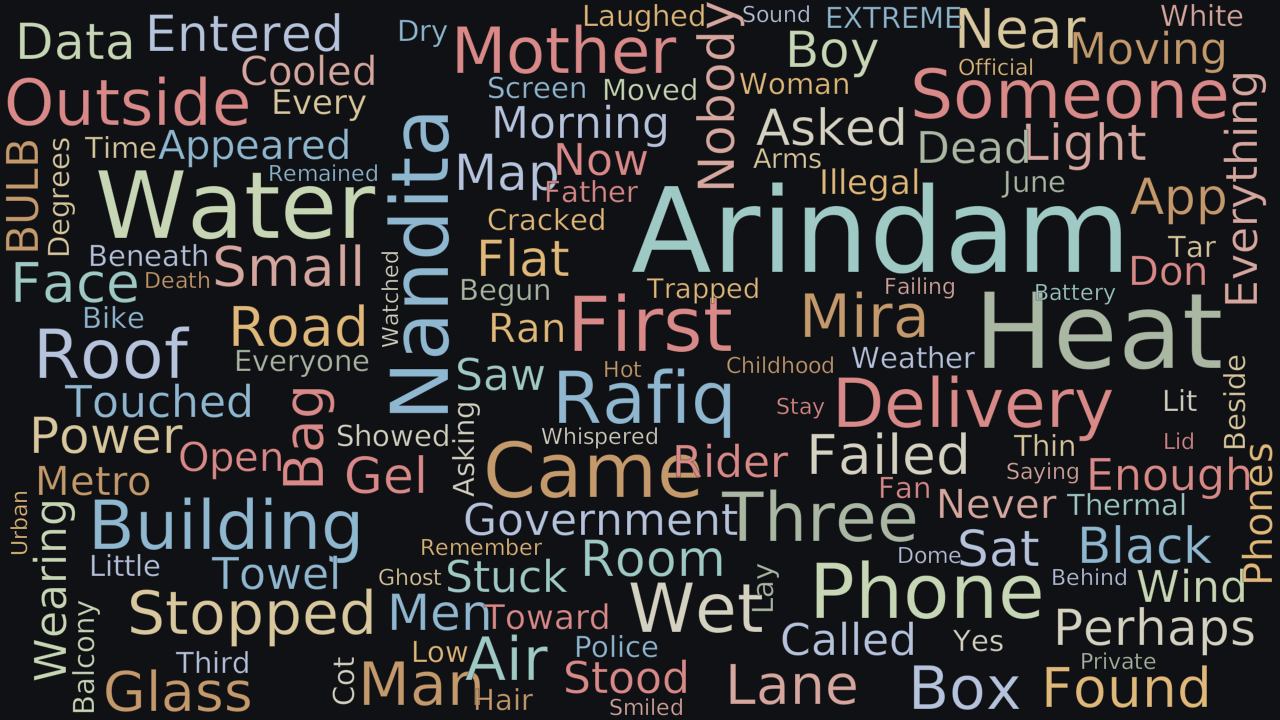
Word Cloud
Related reading
Selected by shared topics and section, with closer publication dates breaking ties.