The Last Notification
Uses the speech voice supplied by your browser or device.

THIS IS A WORK OF FICTION
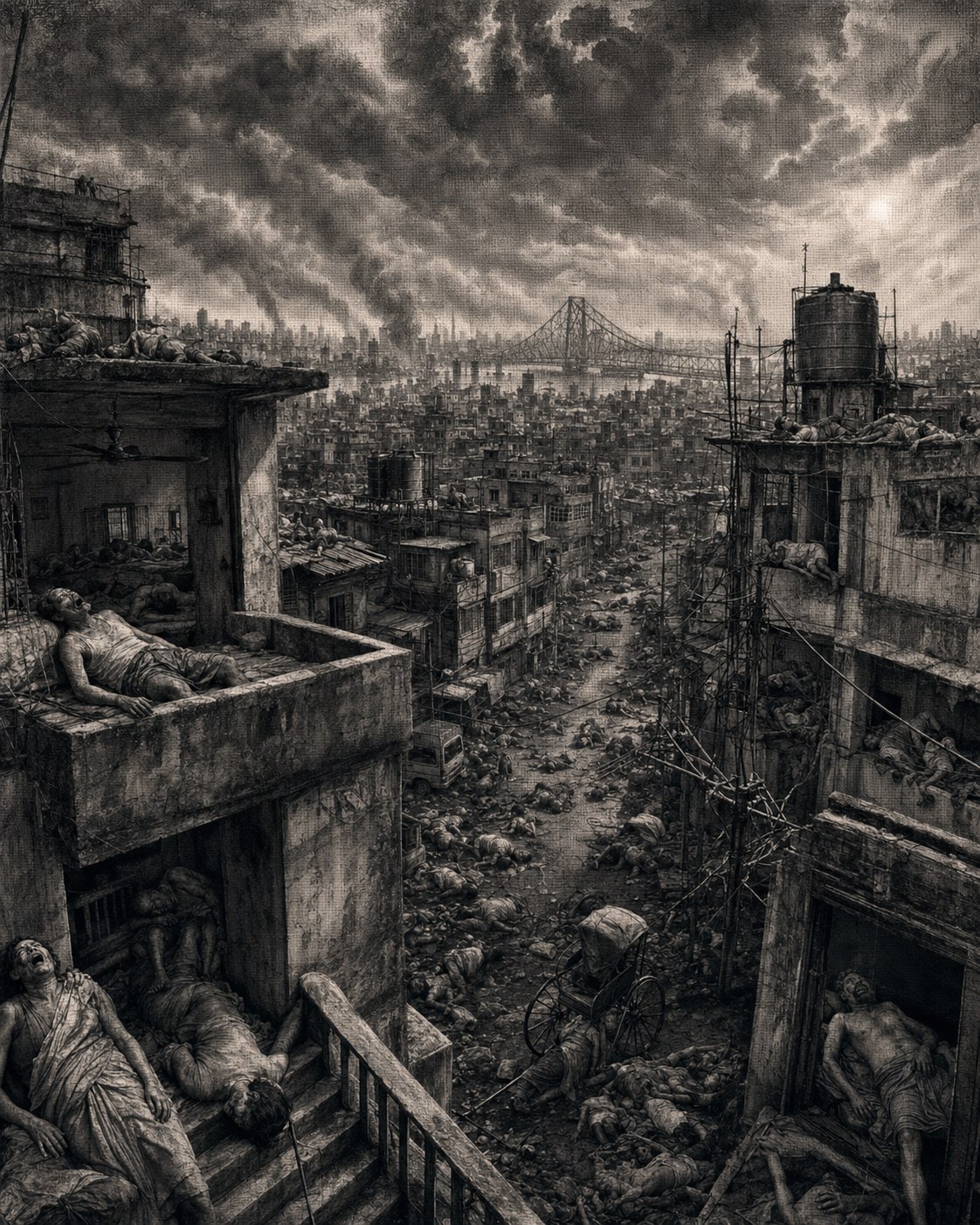
At 8:17 on a Tuesday morning, while Calcutta was performing its usual miracle of not collapsing, an asteroid named 2026 KA7 appeared on every phone in the city.
It arrived first as a notification.
Not a siren, not a government announcement, not a grave man in spectacles looking into the national camera with the burdened face of history. Just a soft little ping between a vegetable seller shouting “lau lau lau” and a tram bell coughing near Gariahat like an elderly schoolmaster clearing his throat.
LARGE NEAR-EARTH OBJECT ON COLLISION COURSE WITH EASTERN INDIA, said the alert, in English, Hindi, and Bengali, as if the asteroid might be persuaded by multilingual courtesy to reconsider.
By 8:20, the tea stall beside Kalighat metro had acquired seven experts.
“NASA bolechhe?” asked the tea seller, pouring milk from a height that suggested both art and negligence.
“NASA, ISRO, everyone,” said a man in a faded Argentina jersey, though his phone screen showed only a WhatsApp forward with a badly cropped picture of a burning rock over Dubai.
“Calcutta?” said another man.
“Kolkata,” corrected a girl from a coaching center, automatically, with the exhausted reflex of the educated unemployed.
“Same thing when dying,” said the tea seller.
Across the road, buses leaned into one another like gossiping buffaloes. Political posters flapped on a wall where three parties had promised three versions of dignity and delivered mostly rain stains. A delivery rider, his blue thermal bag strapped to his back like a turtle shell, rode with one hand and refreshed his phone with the other. Above him, tram wires cut the hot white sky into rectangles.
In the back of an app cab trapped near Rashbehari, Mira Sen read the notification three times and felt, to her annoyance, not fear but irritation.
Of course, she thought. Today.
Her father had a cardiology appointment at eleven. Her hospital contract renewal was due by five. The landlord had sent a message about the water pump. And now, because the universe had the dramatic instincts of a third-rate theatre director, a mountain of nickel and ice was descending upon the city where she had lived all her thirty-six years and failed, with remarkable consistency, to become the sort of woman other people could respect at weddings.
The driver looked at her in the rearview mirror.
“Didi, asteroid ta ki real?”
Mira lowered the window. The smell of diesel, wet garbage, frying kochuri, and old rain entered like an argument.
“As real as anything else on the internet,” she said.
The driver considered this. “Then fifty-fifty.”
Mira worked in the basement data office of Shantimoy Memorial Hospital, a private institution that had begun as a charitable clinic and now charged twelve thousand rupees for a room with a chair hard enough to cure sentimentality. Her job was not glamorous. She reconciled emergency registrations, bed transfers, billing codes, death summaries, diagnostic uploads, consent scans, and the thousand quiet clerical sins by which a hospital turned human panic into usable information.
She had once wanted to be a doctor. Then her mother got sick. Then her father retired. Then scholarships went elsewhere, as scholarships often did, with excellent manners. Mira studied statistics, learned databases, and entered healthcare through the back door, where the gods of paperwork sat chewing paan.
Her private shame was small and practical. Six months ago, she had altered a timestamp.
A politician’s nephew had arrived dead after a drunken crash near Science City. Officially, he had been admitted alive. Unofficially, the family required him to have died after admission, because insurance was a shy animal that emerged only when conditions were arranged correctly. The hospital administrator had not asked Mira directly. He had merely stood behind her chair, smelling of aftershave and fear, and said, “Madam, sometimes the data must reflect the treatment journey.”
She had changed 02:43 to 02:47.
For this four-minute adjustment, her father’s pending angioplasty file moved mysteriously upward, like a prayer promoted through the bureaucracy of heaven.
Since then, every date and time in the hospital system looked at her with accusation.
At 9:04, she reached Shantimoy. The lobby television showed a red graphic of Earth with a white streak aimed at Bengal. The anchor had the giddy solemnity of a man aware that catastrophe was excellent for ratings.
“—object estimated at 1.8 kilometers in diameter, projected atmospheric entry over the Bay of Bengal with possible impact zone including Kolkata Metropolitan Region—”
In the lobby, relatives stared upward. Nurses moved faster but not differently. Hospitals, Mira knew, did not panic like ordinary places. They had too much practice. Catastrophe arrived there daily wearing slippers, carrying scan reports in plastic folders.
In the basement, the air smelled of damp cables and phenyl. A single tube light flickered above the server rack. Her colleague Rafiq sat at his desk eating muri from a newspaper cone.
“World ending,” he said. “Still HR wants biometric attendance.”
Mira switched on her monitor. “Maybe the asteroid will hit HR first.”
“Too merciful.”
Rafiq was twenty-eight, clever, and permanently underpaid. He had a degree in computer applications, two sisters in college, and a talent for making grimness sound like stand-up comedy performed at a power cut. He wanted to leave for Bengaluru. He said this every week with the devotional intensity of someone describing Kailash.
By 9:30, the hospital emergency protocol had activated. Additional beds. Backup generators. Extra blood bank inventory. Oxygen cylinders counted twice. WhatsApp groups multiplied like fungus. Doctors who had ignored messages for years began replying with thumbs-up emojis, the modern equivalent of a last confession.
At 10:12, Mira noticed the first impossible thing.
The death registry for the day had forty-three entries.
It should have had six.
She opened the log. Names, ages, admission numbers, times of death, provisional causes. Polytrauma. Blast injury. Crush syndrome. Thermal burns. Unknown male. Unknown female. Unknown child.
All with timestamps after 7:40 p.m.
Mira sat very still.
The asteroid, according to the news, was projected to enter the atmosphere between 7:32 and 7:50 p.m.
“Rafiq,” she said.
He rolled his chair over. “If this is about the backup CSV, I swear on my mother’s pressure cooker—”
“Look.”
He leaned in. The joking went from his face so quickly it seemed unplugged.
“Test data?” he said.
“No test flag.”
“Someone imported tomorrow’s drill file?”
“There is no tomorrow’s drill file.”
Rafiq took the mouse and clicked through the audit trail. Each record had been created by different departments. Emergency. ICU. Billing. Radiology. Mortuary. Users who were at that very moment upstairs, alive and sweating, drinking tea, arguing with relatives, signing forms. The system showed they had entered data from the future.
At 10:29, the power failed.
The basement went black except for the server lights, which blinked red and green like patient monitors in a ward for machines. A second later the generator took over with a cough. The tube light returned, harsher than before.
Mira’s phone buzzed.
It was from her father.
Reached hospital? News saying stay indoors. Don’t worry about me. I am making tea.
He had written “don’t worry” all her life, usually when worry was the only sensible response.
She typed: Stay home. I’ll come by noon.
Then another notification slid down.
SHANTIMOY MEMORIAL: PATIENT STATUS UPDATED.
She opened it.
Patient: Debabrata Sen. Relationship: Father. Status: Admitted. Ward: Emergency overflow. Time: 19:58. Condition: Deceased on arrival.
Mira’s hands went cold.
Her father was at home in their old building near Lake Gardens, in a second-floor flat with cracked mosaic floors and a balcony where he grew tulsi though neither of them believed in anything useful. He was making tea. He had just texted her. He was not admitted. He was not dead.
Rafiq read over her shoulder and did not speak.
For a long minute there was only the generator and, faintly from above, the hospital loudspeaker announcing that outpatient appointments were suspended until further notice.
“This is some integration bug,” Rafiq said at last. He sounded like a priest discovering termites in the idol. “Some API pulling from disaster simulation.”
“Why my father?”
“Maybe same name.”
“There is his phone number. His ID.”
Rafiq swallowed. “Then we check source table.”
They checked. Then checked again.
The record had not come from Shantimoy. It had arrived through the citywide emergency health exchange, a platform assembled after the last cyclone and advertised by ministers as proof that Bengal had entered the future. In practice, it mostly failed to match duplicate patients and occasionally sent vaccination reminders to the dead.
But today it was sending death records from the evening.
By noon, there were 312.
By one, 909.
Each carried full identifiers. Each corresponded to a person alive in the city. They came from hospitals, clinics, ambulance services, diagnostic centers, police morgue placeholders, and one municipal crematorium database in Nimtala that had not successfully exported a file since 2019.
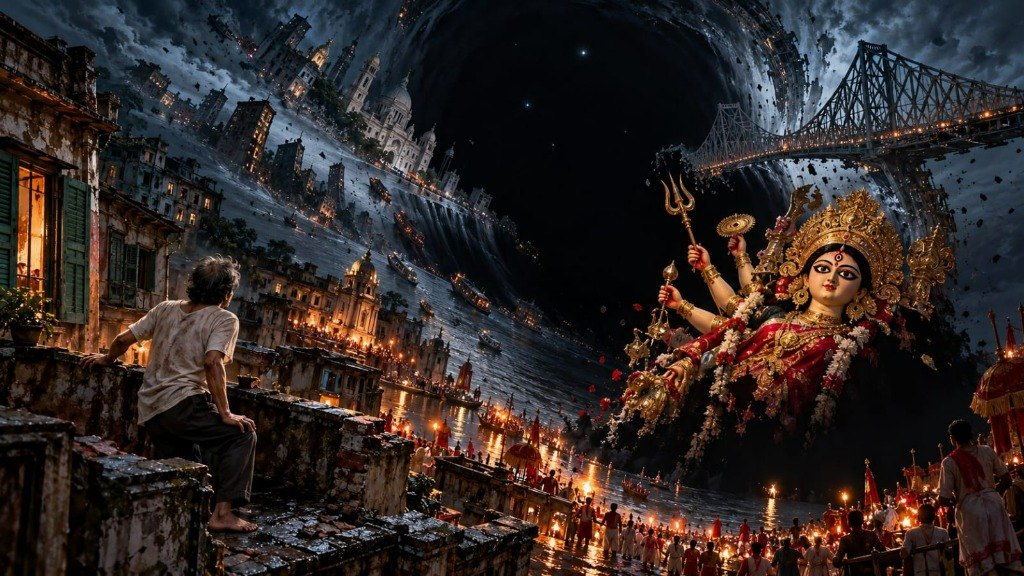
The city outside had shifted into a strange festival of dread. Shops were half-shuttered. Puja pandal bamboo frames stood unfinished in lanes, their goddess faces still wrapped in newspaper. At Gariahat market, fish sellers argued over whether hilsa prices should fall at the end of the world or rise because supply was now definitely limited. Metro announcements advised passengers to avoid unnecessary travel while the platforms grew packed with people trying to travel unnecessarily.
Mira called her father seven times. No answer.
She tried the neighbor, Mrs. Banerjee, who reported, after a long expedition across the landing, that Debabrata was not home. His slippers were gone. The teacup was in the sink.
“He said he was going to you,” Mrs. Banerjee added. “Men become children after seventy. Before that also, but after seventy officially.”
Mira closed her eyes.
Her father had come out during an asteroid warning because he did not want his daughter crossing the city alone to fetch him.
The stupidity of love. The magnificent, fatal stupidity.
At 1:40, the future record updated.
Debabrata Sen. Location found: Hazra crossing. Transported by: Civil volunteer vehicle. Status: Deceased on arrival.
Mira stood up.
Rafiq blocked her path. “Where will you go? Roads are mad.”
“To Hazra.”
“At 7:58 he is dead. It’s not 7:58.”
“That is exactly why I’m going.”
He looked at her with the irritation of someone whose affection had no legal place to stand. Then he grabbed his helmet.
“I know one shortcut through the lanes,” he said. “And if the asteroid falls before we reach, I will be very angry with you.”
They took Rafiq’s scooter into the afternoon, into a city that had begun showing its bones. Office workers walked home in formal shoes. Coaching center boys smoked openly before their teachers. A woman in a silk sari bought ten packets of incense and two bottles of mineral water, preparing with perfect Bengali balance for both ritual and dehydration. At a cheap café near Mudiali, a waiter carefully wrote unpaid bills in a notebook, because even apocalypse required accounts.
Near a petrol pump, a crowd had gathered around a man claiming the asteroid was punishment for immoral web series. A delivery rider shouted back that if God cared about web series, God had too much free time. No one laughed. Then everyone did.
They found Debabrata Sen near Hazra at 2:25.
He was sitting on a low wall beside a shuttered optical shop, looking embarrassed, with a small cloth bag on his lap. His white hair was damp. His shirt clung to him. He had brought Mira two guavas, her blood pressure medicine, and an umbrella.
“You forgot umbrella in morning,” he said.
Mira wanted to shout. She wanted to weep. Instead she said, “Baba, the sky is falling and you brought an umbrella?”
He looked upward, where the sun had become a white coin behind cloud. “Rain also may fall.”
They might have laughed, but just then Mira saw the poster behind him.
It was old, peeling, half-covered by a coaching center advertisement: a political rally from years ago. In the torn gap between two faces, someone had written in black marker:
DO NOT TAKE HIM TO SHANTIMOY.
The letters were fresh.
Rafiq saw it too.
“Who wrote that?” Mira asked.
Debabrata turned. “What?”
Before she could answer, every phone in the crossing screamed.
This time it was not a notification. It was the emergency siren tone, flat and official and inhuman.
IMPACT PROBABILITY REVISED: 99.94%. ESTIMATED LOCAL EFFECTS: EXTREME. SEEK SHELTER BELOW GROUND. AVOID GLASS. AWAIT FURTHER INSTRUCTIONS.
The crowd moved as crowds do when fear becomes permission. People ran toward the metro, toward basements, toward home, toward nothing. A bus driver abandoned his bus and then returned to lock it. Habit is stronger than terror; this is why civilizations last longer than they deserve.
Rafiq shouted, “Kalighat metro. Underground. Now.”
They pushed through lanes behind the temple, past goats, flower sellers, closed sweet shops, and men lifting gas cylinders into impossible places. The sky had darkened without becoming evening. Somewhere a conch blew. Somewhere someone played a devotional song from a phone speaker, tinny and defiant.
At the metro entrance, police were letting people in until the platform filled. Mira held her father’s wrist. His pulse fluttered like trapped paper.
Then her phone buzzed again.
SHANTIMOY MEMORIAL: PATIENT STATUS UPDATED.
Debabrata Sen. Arrival: 19:49. Brought by: Daughter. Time of death: 19:58. Certifying staff: Mira Sen.
The world seemed to tilt.
She read it once. Twice.
Brought by daughter.
Certifying staff.
Mira had no medical authority to certify a death. The system knew that. It should reject it. Unless someone used her credentials. Unless the system was not predicting death but constructing the path to it.
“Mira?” Rafiq said.
She looked at the metro stairs, packed with bodies descending into hot electric darkness. If she took her father there, perhaps he would live. If she took him to Shantimoy, the record would complete itself.
But why would she take him?
Another message arrived, not from the hospital, not from any known number.
You corrected four minutes once. Now the city corrects you.
Below it was a photograph.
The politician’s nephew on a stretcher. The emergency bay clock behind him. 02:43.
Her changed record had not merely saved a claim. It had placed a dead man inside the hospital’s official life. His family had used that four-minute ghost to file insurance, suppress alcohol reports, pressure police, and erase the other victim of the crash: a delivery rider named Prasenjit Das, whose death had been recorded as unknown male until a sister came three days later with his Aadhaar card and a plastic packet of his washed uniform.
Mira knew this. She had known it abstractly. Like one knows that drains carry filth beneath flower stalls.
Rafiq was staring at her. “What is it?”
She could not answer.
The asteroid crossed the sun at 6:11 p.m.
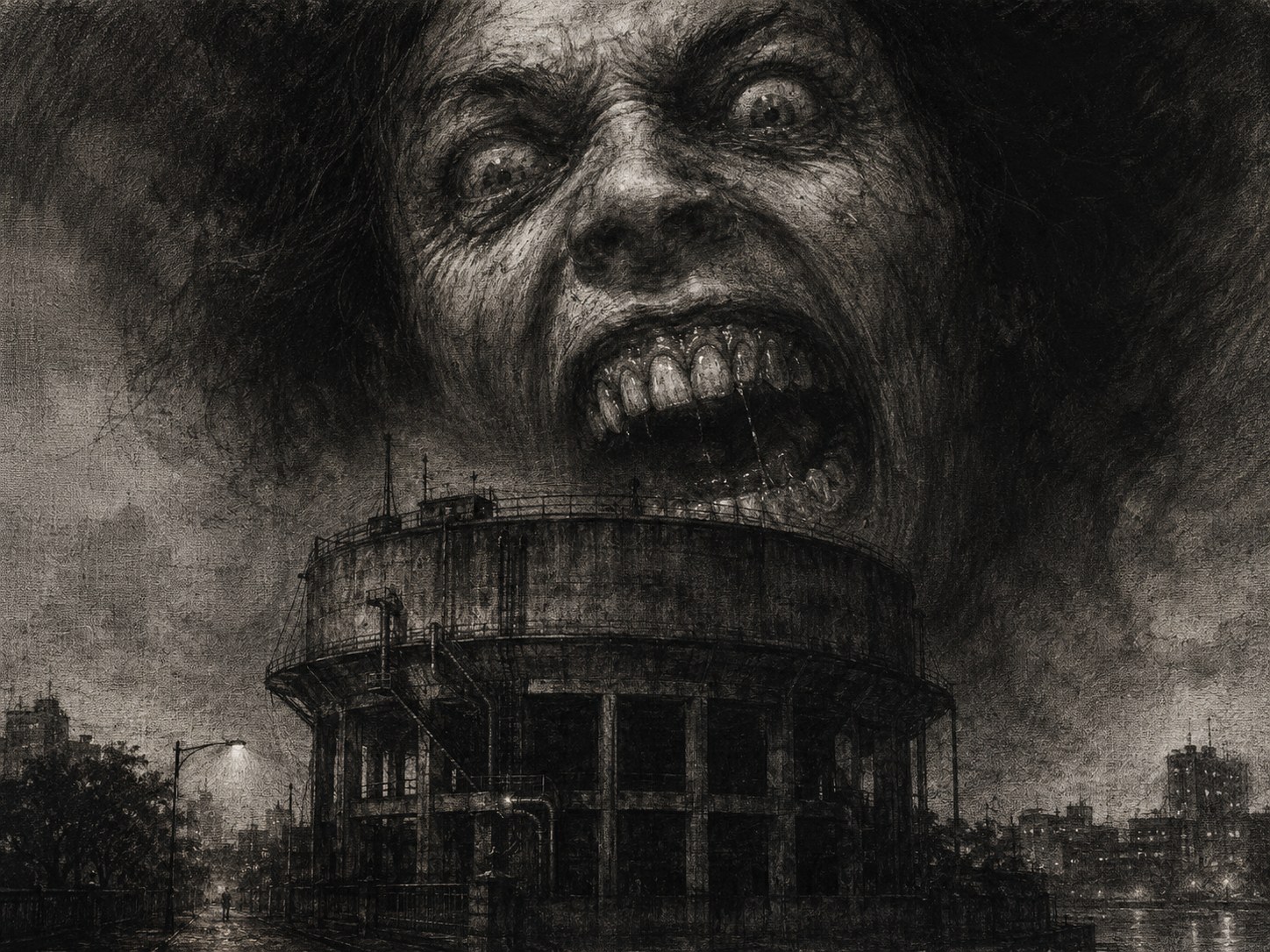
Not visibly, not like cinema, not as a flaming rock with a tail for children to draw later. The sky simply bruised. Clouds shone from within. The heat dropped. Birds made a wrong noise. All over Calcutta, people looked upward and became briefly equal, which is to say equally small, equally badly informed, equally loved by someone.
In the metro tunnel, the crowd sweated and prayed and cursed the network. A child asked if the asteroid would fit through the stairs. His mother said no with such confidence that even strangers believed her for a moment.
Mira sat on the platform floor with her father’s head in her lap. He had grown weak during the descent. His chest hurt. His breath came in small, apologetic portions.
“We need hospital,” Rafiq said quietly.
“No,” Mira said.
He understood enough not to argue at once. Then he argued anyway, because decency often looks like stupidity from a distance.
“He may die here.”
“He dies there too.”
“You don’t know that.”
“I know what the record said.”
“The record is broken.”
“Records break people first.”
At 7:28, the tunnel lights flickered. At 7:32, the city shook.
The sound came not as thunder but as weight. A tremendous hand placed upon the world. Dust fell from the ceiling. The crowd screamed, but briefly; breath was too valuable. Somewhere down the line metal shrieked. The platform went dark. Then emergency lights bloomed red, turning every face into a secret.
The asteroid did not hit Calcutta.
It struck the Bay of Bengal, south-east of the city, hard enough to lift the sea and bruise the coast, but not hard enough to erase the old, stubborn metropolis. Windows shattered across Salt Lake. Flyovers cracked. The airport closed. River water climbed ghats and entered temples, warehouses, basements, memories. In Tollygunge, a cinema hall lost its façade and revealed behind it an older poster for a film no one remembered.
Thousands were injured.
Hundreds died.
The city survived, which meant the bills would come due.
At 8:12, rescue volunteers began moving the sick from the metro to nearby hospitals. Debabrata was unconscious. Rafiq found a municipal van. Mira climbed in with her father before she asked where it was going.
“Shantimoy,” said the volunteer.
She almost laughed.
In the emergency overflow ward, amid blood, plaster dust, crying relatives, and the wet footprints of the rescued, Mira’s old username opened on a terminal without her touching it.
A junior doctor shouted for death forms. The system was down in half the wards, half-alive in the rest. Someone thrust a tablet into Mira’s hand.
“Madam, you are data office? Please help. Just enter. Later we fix.”
Debabrata lay on a trolley before her. No pulse. No breath. The monitor was blank because there were not enough monitors. The time was 7:58.
The junior doctor looked at her. “Name?”
Mira said nothing.
“Madam, name?”
Rafiq stood behind her, his face grey with dust.
The tablet screen waited. It had already filled the patient ID. It had already selected the cause. It had already placed her name in the certifying field, though it should not have been there, though it could not have been there, though it was.
Only the final button remained.
Mira looked at her father’s face, calm now in the insulting way of the dead, as if he had merely solved a problem before her and was too polite to boast.
She pressed Submit.
At once, every pending death record in the city stopped changing.
Not vanished. Not corrected. Stopped.
Later, commissions would blame software failure, cyberattack, corrupted time servers, emergency-mode data contamination, foreign interference, local negligence, and, in one memorable television debate, negative vibrations from illegal construction. The asteroid became an event. The records became a scandal. The scandal became a file. The file became a matter under review. Calcutta, which had buried plague, famine, empire, slogans, sons, daughters, and flyover concrete, learned to step around another crater.
Mira resigned before they could suspend her. Rafiq left for Bengaluru and sent one message after two months: Here also world ending, but salary better.
On certain evenings, when the power failed and the old apartment building breathed its damp breath through the cracks, Mira sat on the balcony beside her father’s tulsi plant and watched app notifications light up windows across the para. Groceries arriving. Bills due. Flash sales. Rain alerts. Lives converted into little bells.
She no longer trusted time, but time did not require trust. It came anyway.
One night, just before the first puja lights were strung across the lane, her phone pinged.
UNKNOWN NUMBER: Four minutes restored.
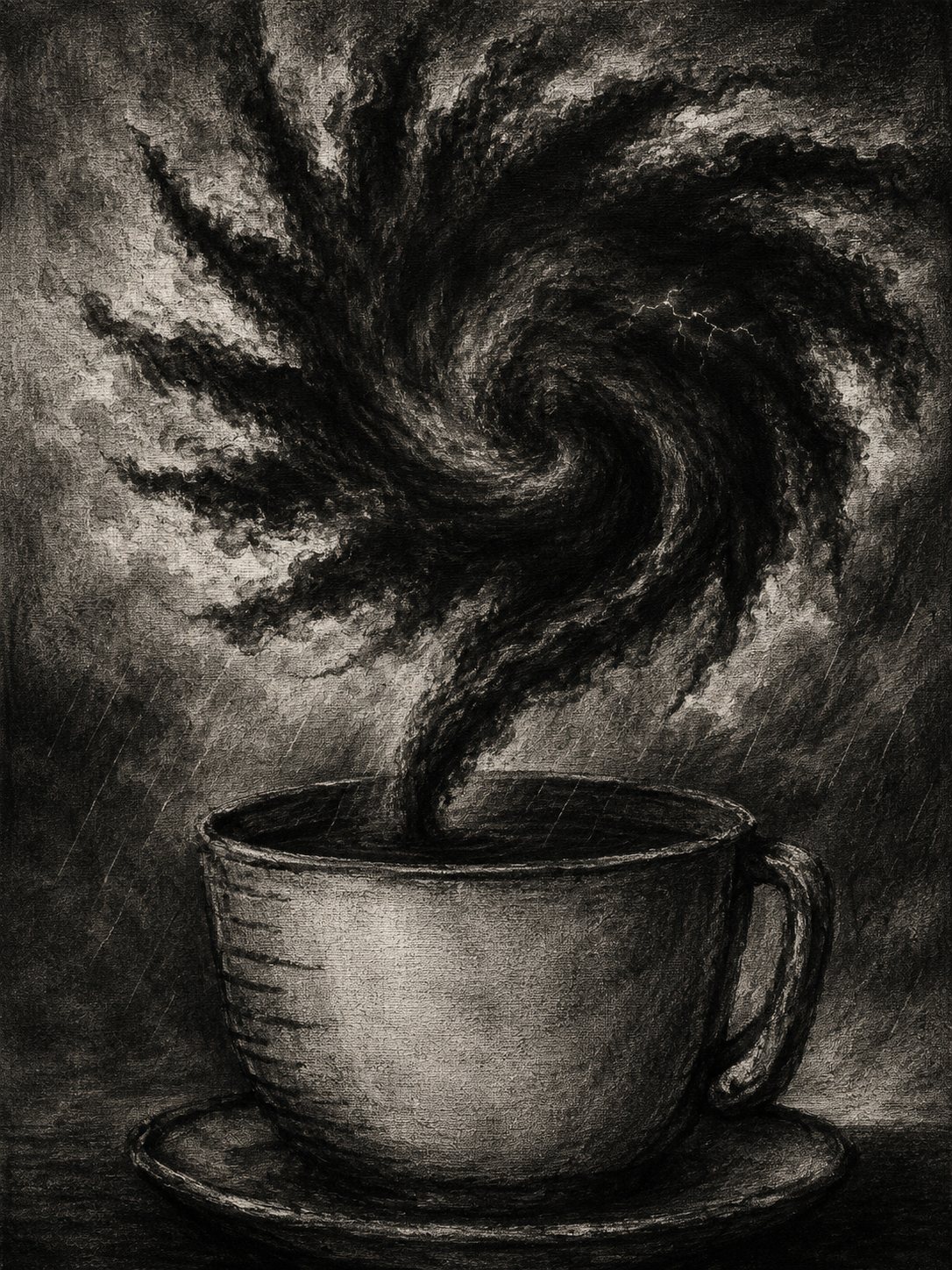
Mira looked at the message until the screen dimmed. Then, from the kitchen sink, came the small sound of a teacup being rinsed, careful and familiar, as if someone did not want to wake the house.
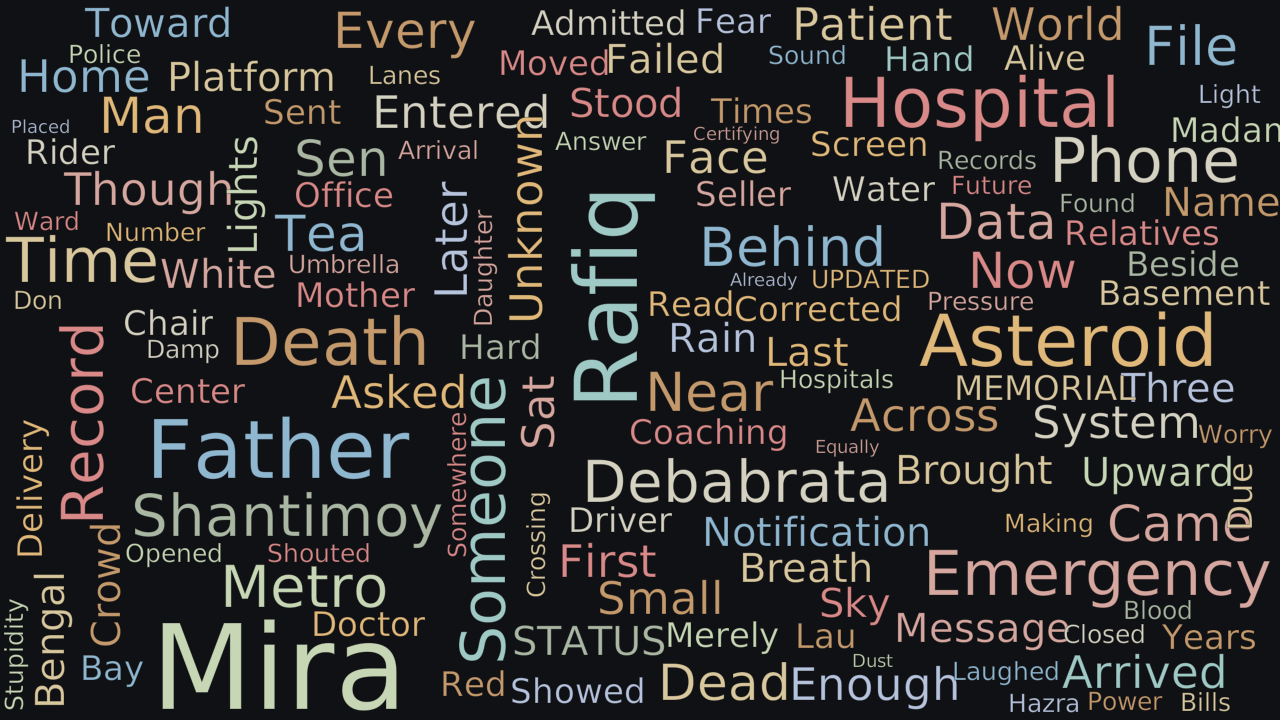
Word Cloud
Related reading
Selected by shared topics and section, with closer publication dates breaking ties.