The Weight of Wet Heat
Uses the speech voice supplied by your browser or device.

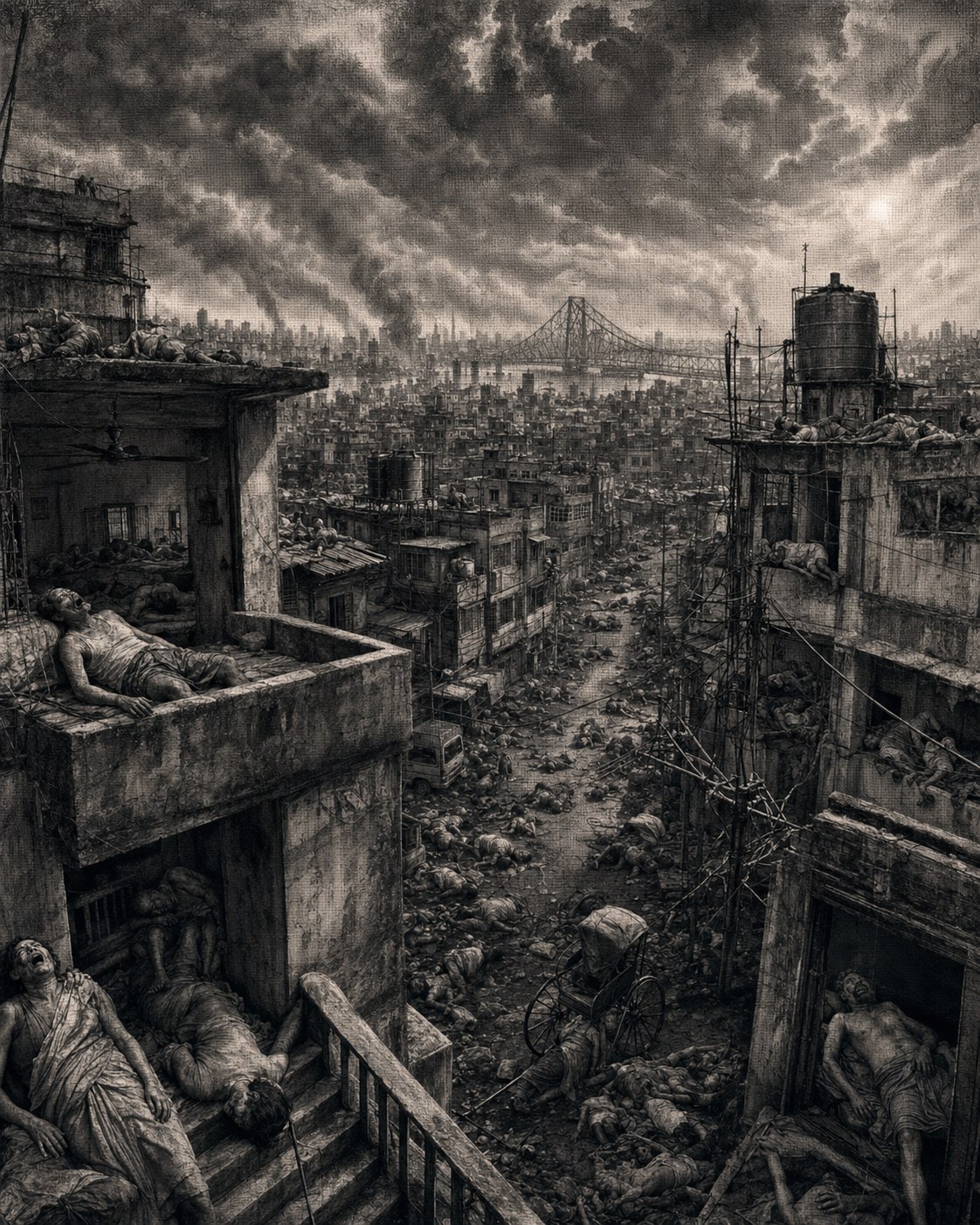
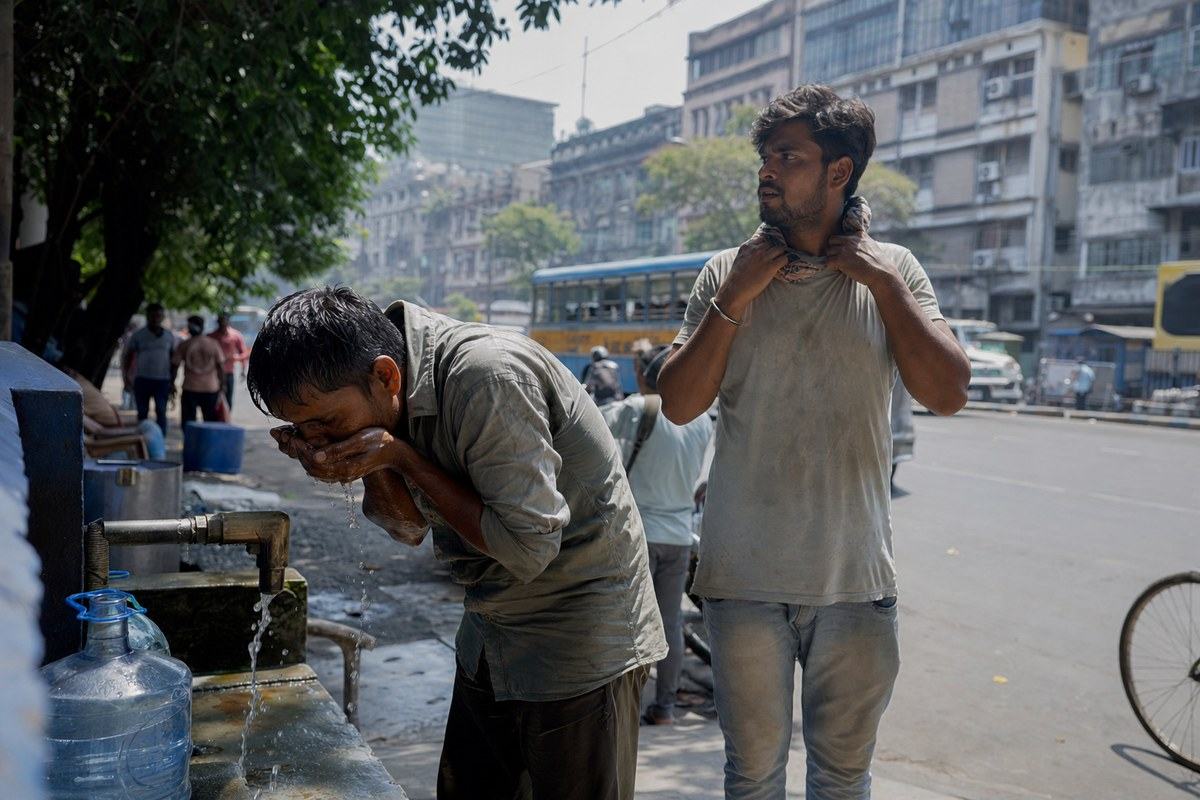
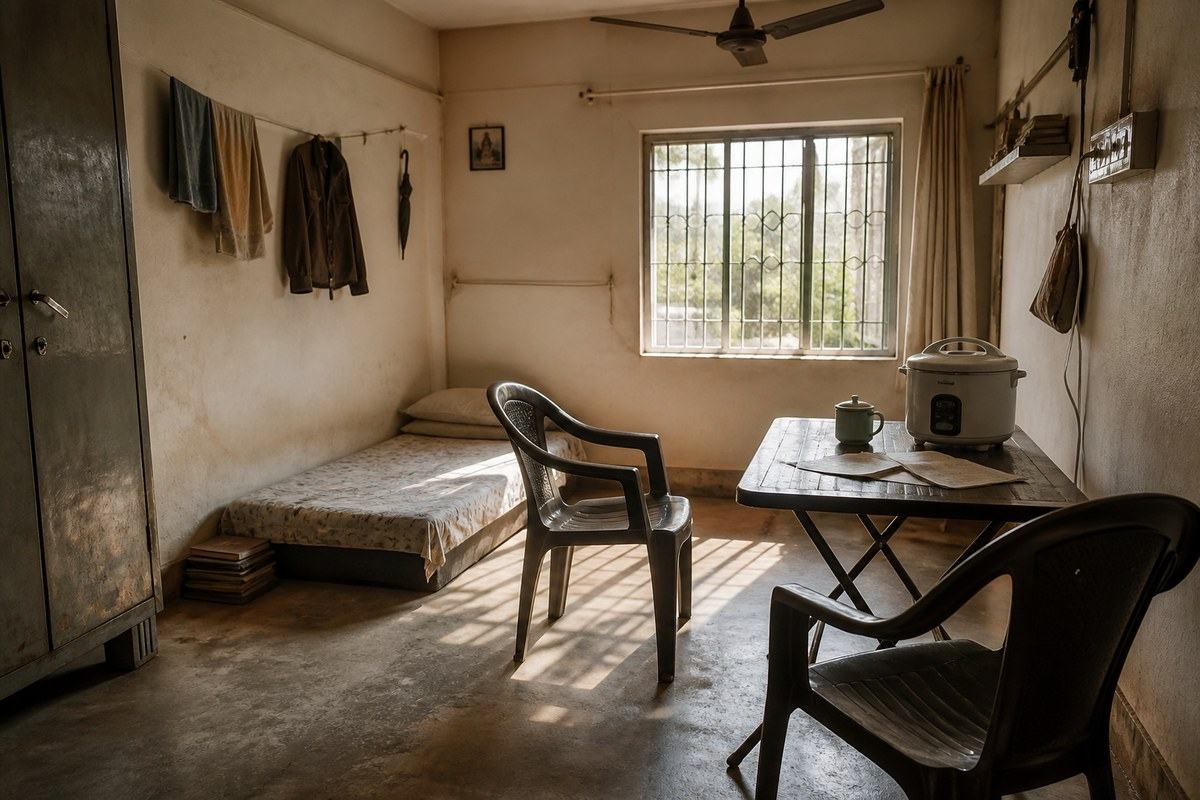
The fan in my bedroom is not moving the air so much as rearranging it, shuffling the same tepid, moisture-laden breath from one corner of the room to another with the resigned diligence of a clerk who knows the files will never be in order. I woke at four-thirty this morning, not from any alarm but because the back of my neck had begun to prickle with a sensation I can only describe as the tactile equivalent of a held breath, the skin anticipating sweat before the sweat itself had the courtesy to arrive. The thermometer on the window ledge, that small glass liar, reads thirty-four degrees Celsius, but the humidity, that invisible and omnipresent accomplice, has pushed the sensible heat into the mid-forties, and the body knows this even when the mind refuses to do the arithmetic. I stood for a while in the half-dark, watching the street below through the grimy louvers, where a man was already dragging a cart of green coconuts toward the junction at Ballygunge, his lungi dark with perspiration in patches that spread and merged like a topographical map of some drowning archipelago.
This is not the dry, declarative heat of Rajasthan, which announces itself with brassy confidence and leaves by evening. This is the wet, conspiratorial heat of the Gangetic delta, which settles into the upholstery, colonizes the spaces between books on the shelf, and makes the act of thinking feel like wading through warm gelatin. The Europeans are discovering it now, or a version of it. I read this morning, in the dispatches from London and Madrid, that the heat dome squatting over Western Europe has driven temperatures to forty degrees and beyond, and the commentary is breathless, as though this were some unprecedented rupture in the natural order, a meteorological scandal. I do not begrudge them their discomfort; suffering is not a competitive sport, and a heatstroke in Lyon is no less physiologically real than one in Howrah. But there is, I confess, a certain weary recognition in reading these accounts, a sense that the tropical world has been holding a conversation for decades to which the temperate latitudes are only now, belatedly and indignantly, tuning in. Their heat dome will break, eventually. The Atlantic will shift, a front will move through, and the cafes will reopen with their accustomed insouciance. Here, the heat is not an event. It is the medium. It is the water in which we swim, or more accurately, the thin, viscous broth in which we are slowly poached.
The science of it is not complicated, though the consequences are. A heat dome is, in essence, a vast, sluggish bubble of high-pressure air that traps heat beneath it like a lid on a pot, preventing convection, suppressing cloud formation, and turning the atmosphere into a closed system of accumulating thermal misery. The jet stream, that river of wind that once reliably shepherded weather systems across the continents, has grown erratic with the warming of the Arctic, meandering in great sine waves that stall these domes over unsuspecting regions for weeks at a time. It is, I suppose, a kind of atmospheric constipation, and the metaphor is not merely vulgar but accurate: the system has lost its peristalsis, its ability to move things along. I think of this sometimes when I am lying still at midnight, listening to the inverter hum its one-note lullaby, the battery backup that keeps the fan turning and the refrigerator preserving the milk against the souring embrace of the ambient air. Without it, without the diesel generator in my imagination or solar backup to fire up when the grid falters, the apartment would become uninhabitable in a matter of hours, not days. This is the unspoken arithmetic of our lives now, the calculation of watts and amperes against degrees and humidity percentages, and I am acutely aware that this arithmetic is a privilege. Most of Calcutta does not have an inverter. Most of Calcutta does not have a generator or solar even in its imagination. Most of Calcutta has a single ceiling fan, if that, and a body that must somehow metabolize the heat without the assistance of electromechanical intervention.
And then there is the El Niño, that mischievous child of the Pacific, whose name—“the little boy,” christened by Peruvian fishermen who noticed the warm current arriving around Christmas—belies the devastation it can unleash. The El Niño-Southern Oscillation, or ENSO, is a coupled ocean-atmosphere phenomenon in which the normally cold, nutrient-rich waters off the coast of South America warm dramatically, suppressing the upwelling that sustains marine ecosystems and, more consequentially for us, disrupting the Walker Circulation, the vast atmospheric loop that drives the trade winds and, by extension, the Asian monsoon. The mechanics are elegant in their cruelty: the warm Pacific pools the atmosphere with latent heat, shifting the rising branch of the tropical circulation eastward, and the monsoon trough, that elongated low-pressure belt that draws the southwest winds toward the subcontinent, weakens or wanders. The rains, when they come, may be tardy, meager, or misdirected, falling in torrents where they are not needed and withholding their benediction from the parched fields of the Deccan and the Gangetic plain.
This year, the meteorologists are murmuring about a developing El Niño event, and their models, those probabilistic oracles, suggest that the monsoon forecast may be less a science than a species of roadside palmistry, a reading of entrails dressed up in the language of ensemble means and standard deviations. The Indian Meteorological Department, that venerable institution founded in the high colonial era when the British first understood that the Empire’s fortunes were tied to the predictability of the rains, is issuing cautions with the careful hedging of a doctor delivering unwelcome news. The monsoon, they say, may be delayed. It may be deficient. The spatial distribution may be uneven. These are not predictions so much as admissions of uncertainty, and the uncertainty is the point. We are, it seems, entering a phase where the ancient rhythms that governed agricultural life on this subcontinent for millennia are becoming unreliable, where the very concept of a “normal” monsoon is beginning to feel like a nostalgic fiction.
I think of this in the context of history, because history is not a comfort but a calibration. In the year 1800, or thereabouts, the last major El Niño of the pre-instrumental era wrought consequences that were, by any measure, catastrophic. The drought of 1799-1800, linked to a powerful ENSO event, devastated the grain-producing regions of the subcontinent, and the colonial administration, still in the relatively early and rapacious phase of its extraction, was neither equipped nor inclined to mount an effective relief. The famine that followed was not merely a shortage of food but a collapse of the intricate, pre-colonial networks of redistribution and charity that had historically mitigated such failures, networks that the British, in their zeal for revenue and their contempt for indigenous institutions, had systematically dismantled. The mortality figures are disputed, as they always are when the dead are poor and illiterate, but the scale was immense, measured in the millions, and the trauma inscribed itself into the folk memory of the region in songs and stories without a precise provenance.
The Great Famine of 1876-1878, which followed another catastrophic El Niño and killed perhaps eight million people in India alone, is better documented, and its documentation is a literature of horror. The colonial response, under the influence of a particularly lethal combination of Malthusian ideology and fiscal austerity, was to export grain from the famine-struck regions even as the peasants starved, on the theory that the market, that invisible and unforgiving god, would allocate resources more efficiently than any state intervention. The theory failed, as theories do when they are applied to human bodies rather than abstractions, and the Famine Codes that eventually emerged from the scandal were a belated, grudging admission that the state bore some responsibility for the preservation of its subjects. But the codes were minimal, and the memory of that minimalism persists in the anxieties of a culture that has learned, at the cellular level, that the state is not a reliable provider of relief, that the weather is capricious, and that the margin between survival and catastrophe is narrower than the wealthy prefer to imagine.
I am not a farmer. I live in a flat in a city that has not grown its own food in generations, a city that imports its rice from Punjab and its vegetables from the wholesale markets of Howrah, and my relationship to the monsoon is largely aesthetic and somatic rather than economic. I feel it in the easing of the skin, in the sudden ability to draw a full breath without the air feeling like warm soup, in the smell of wet earth that rises from the courtyard after the first sustained downpour. But I am not naive enough to believe that my insulation is complete. The city is fed by a supply chain that is, in its way, as vulnerable to hydrological disruption as any medieval village. The thermal power plants that keep the grid alive require cooling water, and the rivers run low in drought years. The municipal water supply, already inadequate and erratic, becomes a fiction in the weeks before the monsoon arrives. The price of vegetables, those small daily negotiations at the vendor’s cart, spikes with every rumor of a failed crop in the hinterland. We are all connected, though the connections are obscured by the intervening layers of commerce and infrastructure, and the failure of the rains is not a pastoral tragedy but a metropolitan anxiety deferred by a few weeks and a few rupees.
The heat dome, the El Niño, the anthropogenic warming that loads the dice toward both—these are not separate phenomena but aspects of a single, systemic unravelling, a slow-motion crisis that we are learning to normalize because the alternative, which is to acknowledge its full dimensions, would require a level of political and economic transformation that no one in power seems willing to contemplate. I do not say this with the satisfaction of a prophet or the despair of a Cassandra. I say it as an observation, the same way I observe the man with the coconut cart, or the inverter’s hum, or the particular quality of the light at five in the afternoon when the humidity has reached its diurnal peak and the world seems to be sweating through its own skin. The observation does not imply a solution. I am not sure there is a solution, at least not on the scale and within the timeframe that would matter to the living. There are only adaptations, small and large, private and collective, and the quiet, persistent work of staying alive in conditions that are increasingly hostile to the fact of being alive.
I went out, compelled by some restlessness I could not name, and walked toward the lake at Rabindra Sarobar. The park was thinly populated, the usual evening crowd of walkers and gossipers diminished by the heat, and the water itself had a dull, metallic sheen, reflecting the sky without pleasure. A family of egrets stood in the shallows, motionless, their white feathers looking absurdly, almost insultingly, cool against the brown water. I stood for a while at the railing, watching them, and tried to feel something other than the oppressive, democratic fact of the temperature, which made no distinction between the egrets and the man watching them, between the water and the air above it, between the colonial dead and the living who had inherited their climate. The egrets, I noticed, had their beaks open, panting slightly, and this small detail, this avian admission of discomfort, gave me an odd, perverse comfort. We are all, it seems, reduced to the same elementary physics, the same struggle to dissipate heat into an atmosphere that has grown stingy with its capacity to absorb it.
I walked home as the light faded, not because I had resolved anything, but because standing still had become its own form of exhaustion. The streetlights were coming on, or rather flickering into a sickly half-life, the LEDs that replaced the sodium vapor lamps casting a pale, clinical glow that made the sweating faces of the passersby look slightly alien, slightly medical. A man at the tea stall was fanning his coal stove with a piece of cardboard, an act of apparent futility that was, I realized, precisely calibrated: the fanning increased the airflow to the coals, raising the temperature of the fire, which brought the water to boil faster, which allowed him to serve tea to the customers who were waiting despite the heat, because the ritual of tea is not negotiable, because the body craves heat even when it is drowning in it, because we are contradictory creatures who cannot be relied upon to act in our own physiological best interest. I bought a cup, because it seemed rude not to, and because I wanted to feel the burn of it on my tongue, a small, controlled pain that was at least a sensation I could name.
The monsoon will come, or it will not. The El Niño will intensify, or it will dissipate. The heat dome over Europe will break, and the journalists will move on to the next story, and the coconuts will continue to be sold on the street below my window, and the man will continue to drag his cart, and the inverter will continue to hum, and I will continue to wake at four-thirty in the morning with the prickling of sweat on the back of my neck. None of this is a conclusion. It is only a description of the present, which is the only time we are given, and which is, in its way, sufficient. The night has not cooled. The fan continues its clerkish work. Somewhere in the Pacific, a vast body of water is warming by a fraction of a degree, and the consequences of that warming are already moving toward us across the curvature of the earth, invisible, patient, and entirely indifferent to whether we have understood their names.
Word Cloud
Related reading
Selected by shared topics and section, with closer publication dates breaking ties.