Silk Season
Uses the speech voice supplied by your browser or device.

THIS IS A WORK OF FICTION
By the time the first spider woman was seen on the balcony of Nirmal Bhavan, the pesticide had already sold out from Gariahat to Shyambazar.
It came in a red plastic canister with a smiling cockroach on the label, as if death itself had passed the Madhyamik, learned some English, and joined marketing. SHUDDHO-HOME TOTAL DEFENCE, it said. Kills roaches, ants, mosquitoes, termites, spiders, silverfish, and other unwanted guests.
In Calcutta, where guests were never unwanted until they began asking for money, this seemed ambitious.
Ritwick Dutta sold the spray from a folding table beside Kalighat metro, between a tea stall and a man repairing phone screens under a blue tarpaulin. Morning rain had left the pavement shining with mud, paan spit, and crushed marigold petals from some puja offering. Tram wires drooped overhead like tired veins. Buses coughed black smoke. Delivery riders leaned on their bikes, thumbs tapping, waiting for the city’s appetite to summon them. Political posters peeled from walls in damp strips: promises, faces, slogans, all losing glue.
“Dada, one spray and your kitchen becomes Singapore,” Ritwick told customers.
Nobody in Calcutta had seen enough of Singapore to dispute him.
He was thirty-nine, unmarried, and handsome only in dim stairwells. He had once worked in medical equipment sales, had worn tucked-in shirts and spoken of procurement cycles. Then his father’s stroke came, then the nursing home bill, then the small humiliations that gather like ants around spilled sugar. Now he sold pesticide on commission and lied with the tired fluency of a man who had learned that truth did not pay rent in Behala.
The spray smelled faintly of jasmine and hospital corridors.
That was the cleverness of it. People did not want their homes smelling of poison. They wanted murder with fragrance. A clean house was no longer a house without insects; it was a performance of class, misted into corners before guests came and mothers-in-law inspected.
“Safe for children?” asked a woman in a synthetic sari, holding the can away from her body.
“Completely,” Ritwick said.
“Safe for pets?”
“Absolutely.”
“Safe for gods?”
He looked at her.
“I keep Thakur in the kitchen.”
“Then extra safe,” he said.
By evening he had sold forty-three cans.
At nine, when the power cut came, he carried the remaining stock to his third-floor rented room in a crumbling house off Rashbehari Avenue. The landlord’s family lived downstairs behind a collapsible gate. The staircase smelled of damp socks, incense, and old wood. A huntsman spider sat above the landing, flat and alert, its legs spread like a secret map.
Ritwick stopped.
He had never feared spiders. Cockroaches had vulgar confidence. Mosquitoes were politicians. Spiders, at least, had craft. They waited, calculated, made architecture from hunger.
This one watched him.
“Go eat something useful,” he said, and climbed past it.
In his room, the ceiling fan moved like a lazy witness. His phone showed three missed calls from his mother in Konnagar and one message from Mala.
Did you sell that new spray today?
Mala Sen lived in the next building, though “next” in that lane meant a negotiated intimacy of balconies, clotheslines, leaking pipes, and gossip. She was thirty-seven, a biology teacher at a coaching center, and had the dry, amused eyes of someone who had spent too much time explaining reproduction to boys who giggled at the word pollen. She and Ritwick had once almost become something. Almost was the most crowded place in Calcutta.
He typed: Yes. Why?
Her reply came after a minute.
Don’t use it in your room.
Why?
I’ll tell you tomorrow. Don’t use it.
He looked at the six canisters stacked beside his mattress.
Then a cockroach appeared near the rice cooker, prehistoric and insulting.
Ritwick picked up a canister and sprayed.
The mist came out cold and white. Jasmine filled the room, followed by a sharper note, metallic, almost like blood on a coin. The cockroach ran in a mad circle and died under yesterday’s newspaper.
Above the window, in the cracked plaster near the curtain rod, a small huntsman spider moved once, very slowly.
Then it vanished into the wall.
The first disappearance was a retired bank clerk named Prabir Babu from Nirmal Bhavan. His wife said he had gone to the balcony after dinner to smoke, though the doctor had forbidden it and their daughter in Salt Lake had installed an app on his phone to shame him with health notifications. At 10:16 p.m. he was there. At 10:23 p.m. his cigarette lay burning on the mosaic floor. The balcony grill was locked from inside.
His wife told the police she had heard a woman laughing softly.
“What kind of woman?” the sub-inspector asked.
“Beautiful,” she said, with the bitterness of a wife who knew the precise shape of insult. “Too beautiful to be from this building.”
The next night, a coaching-center owner in Jadavpur vanished from his office. CCTV showed him walking toward the storeroom with a cup of tea and an expression his employees later described, with embarrassment, as romantic. The camera did not show anyone entering. It did show, at 11:48 p.m., a long pale hand reaching from the darkness and touching the doorframe.
Then a taxi driver in Shyambazar. Then a software engineer in New Town who had come home to his parents because remote work had become another name for being watched in one’s childhood bedroom. Then two young men from a gym near Lake Market.
Men began returning late from errands with dreamy faces, or not returning at all.
The rumor arrived before the news, as it always did. WhatsApp bloomed with warnings. Don’t spray Shuddho-Home. Don’t look at balconies after dark. Don’t follow the fair woman. Don’t answer if a girl calls your name from a wall.
Every para developed its expert. Tea stalls became laboratories of certainty.
“It is Chinese chemical.”
“No, no, American.”
“Government experiment.”
“Love jihad.”
“Arrey, idiot, spider jihad?”
“Everything is possible now.”
On the fourth day, Mala came to Ritwick’s room carrying a plastic folder and a face like unpaid electricity.
“You sprayed it,” she said.
“No good morning?”
“You sprayed it.”
“One cockroach died. Should I perform shraddha?”
She did not smile. That frightened him more than anything.
She opened the folder on his table. Inside were photographs printed from a phone: a dead huntsman spider split open, its body swollen strangely; a pale membrane like wet silk; a close-up of an eye that looked almost human.
“One of my students brought it,” Mala said. “From her bathroom. Her father sprayed Shuddho-Home. This came out from behind the mirror next morning.”
Ritwick leaned closer, then wished he had not.
“What is that?”
“I don’t know. That is the honest answer. Something in the spray is not killing them. It is forcing a growth cascade. Like every developmental instruction in the body has been shouted awake at once.”
“Spiders don’t become women.”
“No. They also don’t become wall-sized and learn to imitate voices, but Calcutta has been educational this week.”
The fan ticked overhead.
“You sold it,” she said.
“I sell what the distributor gives.”
“You didn’t ask what was in it?”
He laughed once. “Mala, people here don’t ask what is in their cooking oil, their antibiotics, their coaching-center promises, their election manifestos. You think they ask the pesticide man for toxicology?”
She looked at him, and he felt the small cheapness of the joke collapse.
“There was an additive,” he said finally. “The distributor gave us unlabelled sachets. Said mix before demo. Stronger smell, better knockdown. Imported enzyme. I didn’t ask.”
“Because asking reduces income.”
“Yes.”
There it was, sitting between them, ugly and practical.
In the lane below, a vegetable seller shouted begun, potol, lau. Somewhere pressure cookers whistled in separate kitchens, each family sealed in its own steam. A metro announcement drifted faintly from the main road, a woman’s voice calm as anesthesia.
Mala closed the folder.
“I need one unopened can.”
“Why?”
“To test it.”
“At your coaching center?”
“At the university lab. I still know people.”
“You think they’ll help?”
“They’ll first ask if my paperwork is proper. Then they’ll ask if media is involved. Then they’ll ask who funds the company. So perhaps no.”
He gave her a can.
Their fingers touched around the plastic handle.
For one second the old almost-place opened again: College Street coffee, rain on her glasses, her telling him spiders were not insects and him pretending he had known. The life where he had not become this. The life where she had not married a man in Pune, then quietly unmarried him without telling the para for six months. The life where everything had not gone from bad to worse with such administrative efficiency.
That evening the government issued an advisory. Citizens were requested not to panic. The pesticide batch was being examined. Any abnormal arachnid activity should be reported to local authorities.
Abnormal arachnid activity entered Bengali speech instantly and began a second life as comedy.
But after dark, balconies emptied.
The first time Ritwick saw her, he was carrying rice and eggs up the stairs.
She stood on the landing above him, where the huntsman had been.
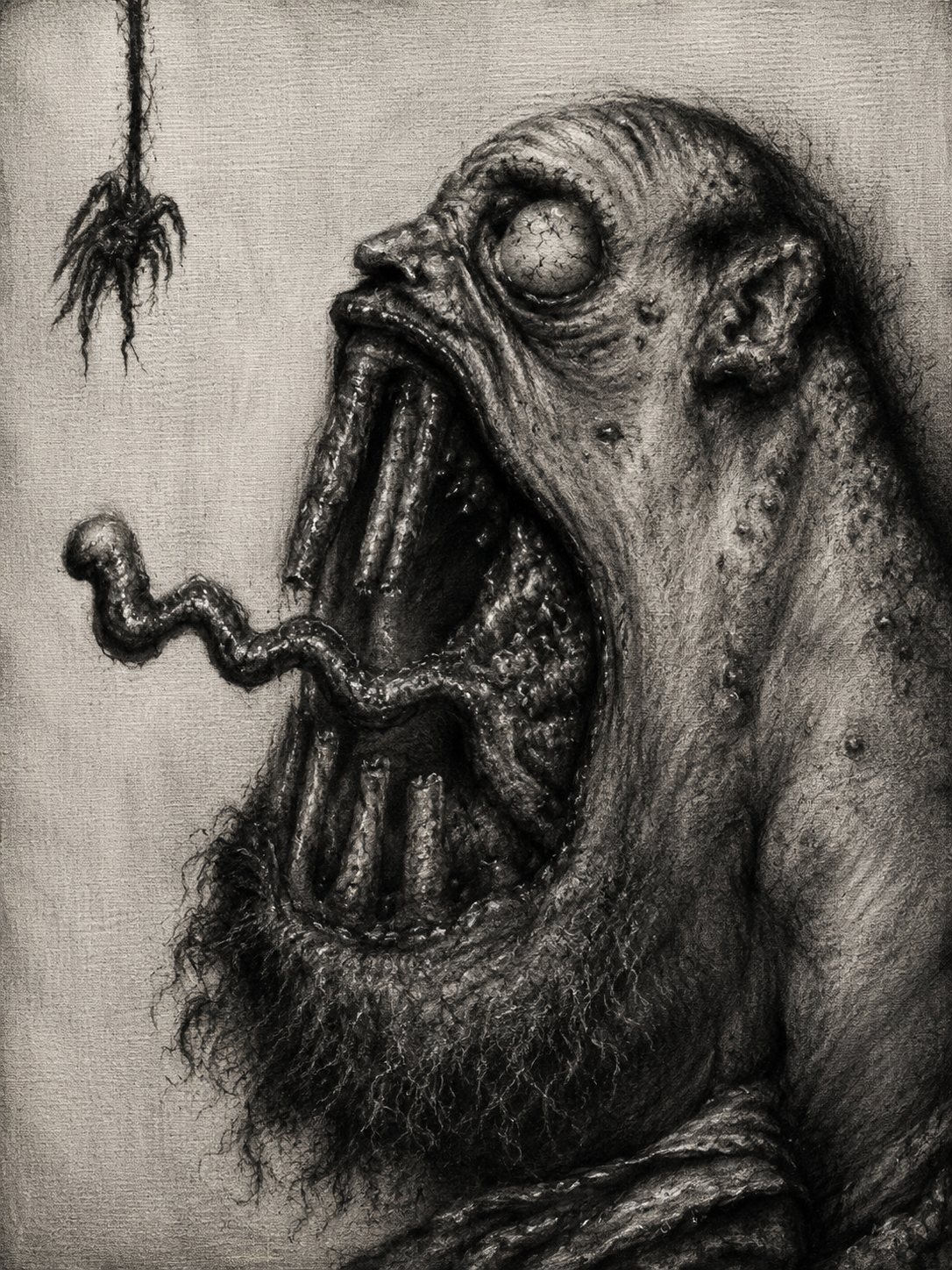
Woman-sized, yes, but not exactly a woman. Her body was too still. Her limbs, folded close, suggested extra possibilities. She wore no clothing, yet her surface was not naked skin but something finer, matte, pale as the underside of a mushroom. Her face was the horror. It was beautiful in the way fairness-cream advertisements had trained generations of men to misunderstand beauty: luminous, delicate, faintly pink at the lips, eyes large and dark and patient. Not human. Worse. Human as imagined by hunger.
“Ritwick,” she said.
His name, in Mala’s voice.
The rice packet slipped from his hand.
She smiled.
From the lane came the honk of an auto, the bark of a dog, the ordinary rude music of survival. Up here, the air smelled of jasmine and dust.
“Come,” she said.
He did not move.
The face changed slightly. Became someone from an old film poster. Became a girl from his school bus whom he had adored at thirteen without ever speaking. Became Mala at twenty-two, then Mala now, tired and sharper and real.
That saved him.
“Wrong,” he whispered.
Her smile thinned.
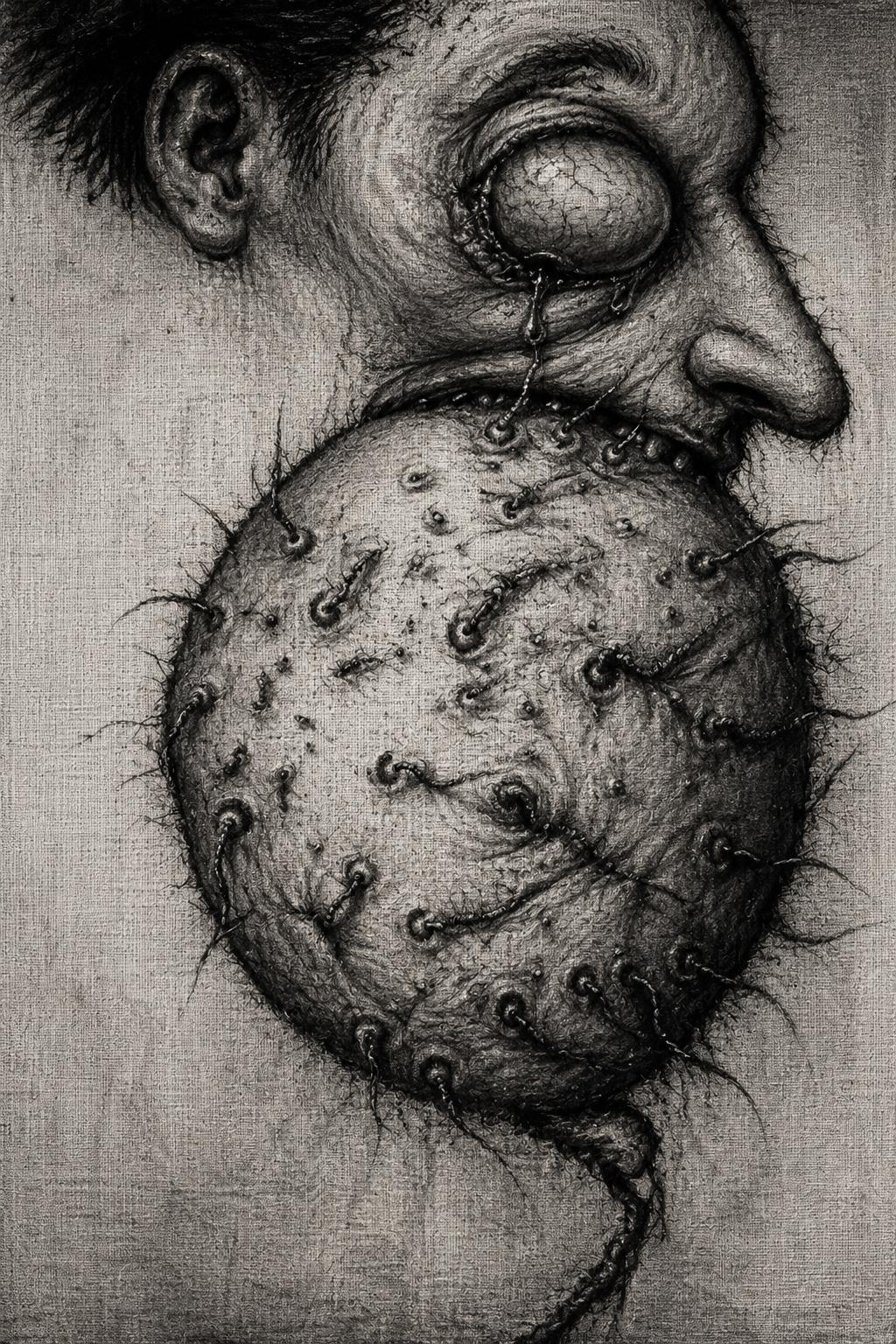
A line opened beneath her chin. Not a mouth. Something vertical, wet, threaded with silk.
Ritwick ran.
He fell down half a flight, scraped his elbow, reached his room, bolted the door, and pushed the rice cooker against it, an offering of engineering from a civilization in decline.
His phone rang.
Mala.
“Don’t answer any voice you hear outside,” she said.
“Too late.”
“You saw one?”
“Yes.”
“Did it touch you?”
“No.”
A pause.
“Good. Listen carefully. They are not randomly hunting. They are responding to male attention. Pheromonal, visual, maybe auditory mimicry. The spray didn’t just enlarge them. It altered their signaling.”
“Why men?”
“Because men are easier.”
Despite everything, he almost laughed.
She continued. “I tested residue from the can. There’s a hormone analog, some illegal growth promoter, and compounds used in cosmetic fragrance. Also something I can’t identify. But the spiders are adapting around desire. Like they found the cheapest door into us.”
Below his window, a woman began singing an old Rabindra Sangeet badly, sweetly. Then the song stopped mid-line.
“Mala,” Ritwick said, “where are you?”
“In my flat.”
“Stay inside.”
“I am not the one they are calling.”
The line went dead.
The city tightened.
By the seventh day, Shuddho-Home had vanished from shops, which meant only that it now cost triple in the black market. Some men wanted to destroy the spider women. Some wanted to see them. Some declared the whole thing fake and went out at night to prove bravery to other fools online. One influencer livestreamed from an old mansion in Bhowanipore and was last seen whispering, “Guys, she is actually here.”
His follower count tripled after his disappearance.
Respectability, Ritwick thought, had always been Calcutta’s finest insecticide. It did not remove desire. It drove it into cracks.
The missing men were discussed as victims in public and as idiots in private. Wives became suspicious of balconies. Mothers locked adult sons indoors. Priests offered protection threads. Start-ups announced ultrasonic spider-repellent devices. A dermatologist on television explained that fairness had nothing to do with beauty while sitting beneath a clinic advertisement promising bridal brightening.
Ritwick stopped going to Kalighat. He ignored the distributor’s calls. At night he heard movement in the walls: a soft, busy stitching.
On the tenth night, Mala knocked.
He opened the door too quickly and raised the iron pan in his hand.
She looked at it. “Good. Very masculine. Planning to make omelette or save civilization?”
Her face was pale with exhaustion. She carried a backpack and a coil of copper wire.
“I found where they are nesting,” she said.
“Please say not here.”
“Not here.”
“Thank God.”
“In your building.”
There had been a sealed apartment on the second floor since before Ritwick moved in. The owner lived in Bangalore and spoke annually of renovation. The door was swollen from damp. Old newspapers had been stuffed under it to keep out dust.
Now silk showed through the cracks.
Mala had brought headlamps, masks, a bottle of solvent, and a small device she had assembled from a broken induction stove and copper winding.
“What is that?”
“Heat pulse. Maybe it disrupts their sensory hairs. Maybe it catches fire and kills us. Science is often a ladder made of maybe.”
“Why not call police?”
“I did. They asked if the spider ladies were currently present and whether I had video proof. Then one constable asked privately if they were truly beautiful.”
The staircase light flickered. Somewhere behind the second-floor door, something dragged across wood.
Ritwick wanted to leave. He wanted to go to his mother’s house, sit under the slow fan, and be scolded for not eating enough. He wanted, more shamefully, to see the spider woman again. Not because he loved her. Because she had looked at him as if he were the answer to an ancient hunger. Loneliness makes a man ridiculous first, then edible.
They broke the lock with a hammer wrapped in cloth.
The apartment breathed out.
It smelled of jasmine, damp plaster, and raw fish. Their headlamps found furniture under sheets, family portraits furred with dust, a calendar from 2018, and silk everywhere. It curtained the ceiling, thickened in corners, veiled the windows from inside so the streetlights became dull amber moons.
And there were the men.
Not dead.
Wrapped.
Prabir Babu hung near the showcase, his eyes open, mouth covered in silk. The coaching-center owner twitched beside a Godrej almirah. The software engineer’s phone still glowed faintly in his pocket, notifications arriving with the devotion of machines.
Ritwick stepped forward.
Mala grabbed him.
“Don’t touch the web.”
In the largest room, the spider women clung to the walls.
Six of them. Eight. More folded in shadow. Their faces turned toward the headlamps, each one different, each one impossibly lovely, each one borrowed from some private museum of longing. A first crush. A film star. A bride glimpsed once at a cousin’s wedding. A nurse who had smiled during a blood test. Desire, catalogued and weaponized.
Then one face became Mala’s.
Not the Mala beside him, sweating under a mask, hair coming loose. A perfected Mala, softened, brightened, made obedient by beauty’s cruel grammar.
Ritwick heard himself make a sound.
The real Mala said, very quietly, “Look at me.”
He did.
Her face was ordinary in the only way that mattered: inhabited. Pores, anger, fear, intelligence, one small scar near the eyebrow from a childhood fall. No advertisement had ever wanted that face. The world had spent decades telling women to erase themselves into fairness and men to reward the erasure. Now something from the walls had taken the instruction literally.
“Switch it on,” she said.
He lifted the copper device.
The nearest spider woman opened her mouth and spoke in his mother’s voice.
“Baba, come here. I fell.”
His heart lurched so violently he nearly dropped the machine.
Mala slapped him.
The sound cracked the room.
“Your mother is in Konnagar.”
“Yes,” he gasped.
“Switch it on.”
He did.
The device whined. Heat shimmered through the silk. The spider women convulsed, limbs unfolding with obscene speed. One dropped from the ceiling, struck the floor, and skittered toward them, face flickering through a dozen beauties before settling on nothing at all: black eyes, split mouth, hunger without decoration.
Mala sprayed solvent. Ritwick swung the hammer. The creature screamed, not like a woman but like furniture being dragged across a grave.
The web caught fire.
For a few minutes the apartment became a private hell of smoke, silk, limbs, and human coughing. Ritwick cut through strands with a kitchen knife while Mala dragged men free by their collars. Some were light as laundry. Some sobbed behind sealed mouths. One tried to crawl back toward the wall, eyes shining with devotion.
“Leave me,” he mumbled when Ritwick tore the silk from his lips. “She understands.”
“No, dada,” Ritwick said. “She digests.”
The fire spread to the curtains. Someone downstairs began shouting. Water came in buckets. The landlord’s son called the fire brigade, then recorded video because history now required vertical framing.
They saved five men.
Prabir Babu died before dawn.
The newspapers called it the Rashbehari Arachnid Incident, which made it sound smaller and better organized than it had been. Officials denied mutation and confirmed abnormal biological response. The pesticide company expressed sorrow and blamed counterfeit supply chains. The distributor disappeared. Ritwick expected police, prison, perhaps a beating. Instead he received two calls from journalists, one from a lawyer, and seven from men asking whether he had any remaining cans.
Mala’s lab report circulated online for six hours before being buried under cricket news and a minister’s scandal.
By then the rains had properly arrived.
Calcutta became a city of wet cables, swollen doors, black umbrellas, and drains coughing up ancestral filth. Puja pandal bamboo frames rose in neighborhoods where last week men had vanished, because terror and festivity must share space like everyone else. Ritwick returned to selling nothing. He sat at the tea stall near Kalighat, watching people step around puddles with the concentration of philosophers.
Mala came on the third afternoon.
She ordered tea. They stood under the tarpaulin while rain stitched the road silver.
“You should leave the building,” she said.
“I know.”
“Will you?”
“I have paid deposit.”
She gave him a look.
“Fine. I will.”
They drank tea from small glasses too hot to hold.
After a while he said, “That thing used your face.”
“I know.”
“It was not you.”
“I know that also.”
He wanted to say something large and repairing. Instead he said, “Your face is better.”
She looked at him, suspicious.
“Because it is yours,” he added.
The rain hammered the plastic roof. A bus went past, throwing brown water over a man who responded with language too rich for polite literature.
Mala smiled despite herself.
That night Ritwick packed. Two shirts, documents, his father’s old watch, a pressure cooker, the remaining money in a biscuit tin. From the stack of Shuddho-Home canisters he had kept as evidence, one was missing. He searched under the bed, behind the rice cooker, in the bathroom.
Then he heard the soft hiss.
Not outside.
Inside the wall.
A white mist seeped from the crack near the curtain rod. Jasmine filled the room, tender as a false memory.
“Ritwick,” said a voice.
It was not Mala this time. Not his mother. Not any woman he had known.
It was his own voice, younger, hopeful, before compromise had taught it to bend.
“Come,” it said gently. “I know what you wanted to become.”
He stood in the wet dark, suitcase in hand, while the plaster opened like an eyelid.
Word Cloud
Related reading
Selected by shared topics and section, with closer publication dates breaking ties.