English Is Not a Subject. It Is a Passport.
Uses the speech voice supplied by your browser or device.

Acronyms and terms used in this post:
AI: Artificial Intelligence, meaning computer systems that can perform tasks normally associated with human intelligence, such as language generation, image recognition, translation, summarization, coding assistance, and pattern detection.
STEM: Science, Technology, Engineering, and Mathematics, the broad group of fields where English now acts as one of the main working languages for papers, books, software, research, manuals, and global collaboration.
Sapir-Whorf hypothesis: The idea, in its careful form, that the language we use can influence how we notice, classify, imagine, and think about the world. It does not mean language imprisons the mind. It means language leaves fingerprints on thought.
Corpus: A large collection of written or spoken material used for study, search, translation, machine learning, or AI training.
English is no longer just a school subject with a red-inked teacher, a terrifying grammar book, and one boy in the front row saying “myself Rakesh” with the confidence of a minor emperor. English has become a passport. Not the leather kind. The other kind. The invisible one.
You do not show it at the airport. You show it when you read a science article without sweating. You show it when you write an email that does not look like it was assembled during a power cut by three frightened goats. You show it when a software manual opens its mouth and you understand what it wants. You show it when the world says, “Here is the knowledge. Come and take it,” and you do not stand outside the shop window like a hungry man admiring biryani through glass.
This is the point students in India must understand early, preferably while there is still hair on the head and some bounce left in the knees. All roads do not lead to Rome anymore. They lead to English. Or, more precisely, they pass through English, get stamped by English, indexed by English, searched in English, summarized by English, and then delivered back to you by a glowing screen that has the bedside manners of a railway booking clerk.
This does not mean Bengali is small. It does not mean Hindi, Tamil, Malayalam, Marathi, Odia, Assamese, Punjabi, Urdu, or any other Indian language is useless. That is the usual stupid quarrel, and India has a genius for stupid quarrels. A mother tongue is not a broken umbrella. Bengali can hold grief, gossip, poetry, fish-market arithmetic, political betrayal, a grandmother’s sigh, and the exact emotional condition of overboiled tea at 6:40 in the morning.
A mother tongue is home.
But home and passport are not the same object.
You may love your home. You must. You may sleep there, dream there, quarrel there, grow old there, and keep your old exercise books in a damp wooden cupboard there. But when the ship is leaving, you need a ticket. English is that ticket for much of the modern world.
That is the irritating part. The world did not hold a polite referendum in Behala, Barasat, Salt Lake, or Sonarpur before deciding this. History happened. Empire happened. Trade happened. Science happened. The printing press, the steamship, the telegraph, the university, the laboratory, the corporation, the computer, the internet, and now AI all formed a long queue and quietly pushed English forward like an overfed uncle at a wedding buffet.
Was this fair? Not particularly.
Is it useful to know? Absolutely.
The British did not spread English because they were running a charity for future Indian software engineers. They conquered, administered, traded, extracted, catalogued, and governed. Not a charming story. But history has a bad habit of leaving useful debris behind. Railways, legal vocabulary, university systems, bureaucratic habits, cricket, and English all came bundled in that large imperial suitcase, along with arrogance, famine, and a talent for drawing borders with a ruler and no conscience.
Now here we are.
The English language has eaten half the library.
Science speaks heavily in English. Software speaks heavily in English. Aviation, medicine, finance, diplomacy, research, higher education, coding forums, product manuals, legal contracts, startup pitch decks, journal articles, and most of the useful shouting on the internet all lean toward English. Not entirely. Never entirely. But enough.
Enough to matter.
A language becomes powerful when powerful things keep happening inside it. That is the simple rule. English has accumulated papers, textbooks, patents, documentation, lectures, court judgments, standards, tutorials, essays, manuals, arguments, corrections, jokes, insults, and error messages. Especially error messages. Half of modern civilization is someone somewhere trying to understand why the thing is not compiling.
Knowledge is not floating in the air like incense from a puja shelf. It sits in sentences.
If the sentences are in English, then English becomes an access road.
This is why reading English is not a hobby for polished people with bookmarks and opinions about cheese. Reading English is a survival skill. A student who reads English badly does not merely miss novels. He misses the machinery of the world. He cannot follow how an idea is born, challenged, repaired, improved, criticized, and reused. He waits for a guide, a coaching note, a YouTube explanation, a cousin from Bangalore, or a suspiciously confident tuition master with a whiteboard marker that has been dead since 2019.
By the time the knowledge reaches him, it may be simplified, delayed, distorted, or marinated in motivational nonsense.
And writing?
Writing is where the mind is caught in public.
Inside the head, every thought looks handsome. It walks about like a film hero. Then you write it down, and suddenly it resembles a wet packet of muri. This is not failure. This is the beginning of education. Writing shows you where the thought has no bones. It tells you, with magnificent cruelty, “My friend, you have feelings here, not an argument.”
Good.
Now you can fix it.
That is why English writing matters. Not fancy writing. Not perfume-sprayed writing. Not “I hereby wish to bring to your kind perusal” writing, which should be taken behind Writers’ Building and quietly retired. I mean clear writing. Working writing. The kind that lets you explain what you mean without making the reader feel he has been locked inside a cupboard with a government circular.
A student who can write one clean paragraph has already defeated a small demon.
A student who can write ten clean paragraphs can build a career.
A student who can read deeply and write clearly can travel without moving. From a small room in Calcutta, with a table fan making helicopter noises and the neighbor’s pressure cooker going off like artillery, he can enter physics, economics, biology, software, history, philosophy, climate science, robotics, medicine, and any number of worlds that would otherwise stand outside his door and not ring the bell.
This is where the Sapir-Whorf idea enters, wearing sensible shoes.
Language does not trap thought. That is too dramatic. A Bengali mind can understand quantum mechanics. A Tamil mind can understand AI. A Hindi mind can understand molecular biology. Of course. The human brain is not a municipal ward office. It is capable of more than one file format.
But the language you practice thinking in shapes the habits of your thought.
English, when learned properly, gives you access not just to words but to distinctions. “May” is not “must.” “Suggests” is not “proves.” “Associated with” is not “caused by.” “Risk” is not “certainty.” “Hypothesis” is not “truth.” These small differences matter. They are the brakes and steering wheel of serious thought.
Without them, the mind becomes a bus in monsoon traffic. The horn works. Direction is a separate matter.
Now add AI to the mixture, and the curry becomes hotter.
Many people think translation tools will make English unnecessary. This is a comforting thought, like believing a cheap umbrella will save you in a Calcutta storm when the rain is coming sideways and the drain has achieved political independence.
Translation will help. It already helps. It will get better.
But the person who knows English well will still have an advantage, because AI itself is deeply soaked in English. The prompts, manuals, code examples, research papers, model behavior, documentation, business workflows, user communities, and training material are heavily English. When you talk to AI in strong English, you are not merely speaking a language. You are operating the machine closer to its richest control surface.
That sounds grand, so let us bring it down to the street.
Imagine two students asking AI for help.
One says, “Make project on pollution good points.”
The other says, “Create a 900-word school-level explanation of air pollution in Kolkata, with causes, health effects, two local examples, and three practical solutions, written in clear English for Class 10 students.”
These are not the same request.
The first student gets soup.
The second gets a meal.
AI rewards precision. English helps precision. Therefore English becomes not only a language skill but a machine-handling skill. In the coming years, the ability to ask clearly, doubt intelligently, revise sharply, and detect nonsense will matter more than the ability to merely press buttons. Buttons are cheap. Judgment is expensive.
And judgment needs language.
Here is the catch, because there is always a catch hiding behind the curtain like an unpaid electricity bill.
English is still treated in India as a class marker. A convent-school polish. A way to sound less local. A way for one Indian to look at another Indian and silently ask, “Which school?” This is ugly. Also boring. Accent has been worshipped like a false idol in a blazer.
Accent is not intelligence.
A Bengali accent is not a crime. A Tamil accent is not a disability. A Punjabi rhythm is not a defect. A Malayali cadence is not a software bug. The world is full of people who speak English in different music and still do serious work. What matters is clarity, accuracy, range, and confidence.
Do not try to become English.
Become dangerous with English.
Dangerous means you can read a contract before signing your weekends away. Dangerous means you can challenge a bad chart. Dangerous means you can write a scholarship email, a project note, a research summary, a complaint, a proposal, a resume, a product description, a blog post, or a letter that does not crawl on the floor apologizing for being alive.
Dangerous means nobody can easily fool you with decorative language.
This matters especially for the Indian middle class, which has always lived between ambition and shortage. We have parents who say “study hard” as if that sentence alone can defeat inflation, unemployment, bad schools, bad roads, corruption, weak institutions, exam madness, and the great national sport of queue-jumping. We have students preparing for a future that keeps changing costume. We have graduates with degrees but no usable skills. We have coaching centers glowing at night like small factories of anxiety.
In such a world, English is not everything.
But it is a lever.
A lever does not lift the world by itself. You still need strength. You still need discipline. You still need curiosity. You still need luck, and sometimes so much luck that one feels the universe should at least send tea. But without the lever, the load becomes unnecessarily cruel.
I say this not from a hilltop but from a rented-room sort of life in Calcutta, where the day can begin with a weak cup of tea, a headache, a laptop, a ceiling fan, and the knowledge that the world has not arranged itself for your convenience. I have lived in the United States, worked in technical systems, read documentation till the eyes became two boiled peas, and returned to India with enough realism to know one thing: nobody is coming to translate the future for you properly.
You must learn to read it yourself.
And then write back.
That is the part many people miss. English is not only for consuming the world. It is for answering it. If you only read, you remain a passenger. When you write, you become a participant. A small participant perhaps. A tired participant. A participant with unpaid bills and a plastic chair. But still a participant.
The habit is simple, which is not the same as easy.
Read a little every day. Real English. Not only social media crumbs. Read essays, science explainers, biographies, manuals, histories, interviews, good fiction, technical guides, even product instructions if nothing else is available. Read with a pencil in the mind. Notice how sentences move. Notice how a good writer says a hard thing without putting a pillow over your face.
Write a little every day. One paragraph. One observation. One explanation. One complaint. One memory. One summary of something you learned. Do not wait to become fluent before writing. That is like waiting to become strong before lifting a dumbbell.
Make mistakes.
Then repair them.
That is the whole game.
The mother tongue should stay close. Always. It carries childhood, jokes, abuses we shall politely not print, lullabies, food memories, street names, family ghosts, and the private weather of the heart. But English must stay close too, not as a master, not as a colonial hangover, not as a party trick, but as a tool.
One language keeps you rooted.
The other gives you reach.
A tree needs both root and branch. Too much root without branch, and it remains a stump with sentimental value. Too much branch without root, and the first storm teaches botany.
So yes, English is now more important than ever. Not because it is prettier. Not because it is purer. Not because Shakespeare personally blesses your LinkedIn profile from the clouds. English matters because the modern world has become textual, technical, searchable, programmable, machine-assisted, and globally tangled.
The future will not ask whether this arrangement is fair.
It will ask whether you can read the instructions.
Then it will ask whether you can question them.
Then, if you are lucky and stubborn, it may ask whether you can write better ones.
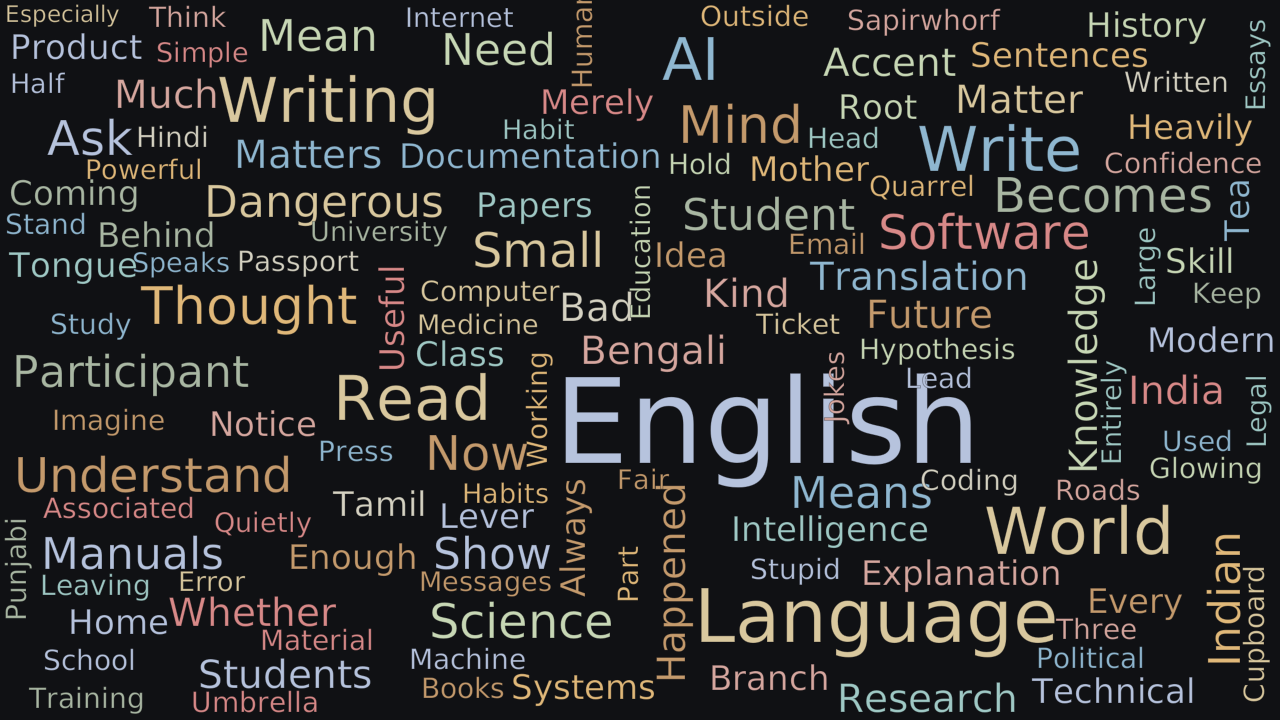
Word Cloud
Related reading
Selected by shared topics and section, with closer publication dates breaking ties.