Writing Nothing From the Edge of Calcutta
Uses the speech voice supplied by your browser or device.

Acronyms used in this post:
AI — Artificial Intelligence, the new machine intelligence now being advertised as the answer to everything from office work to loneliness, though it still cannot fix a leaking tap.
EMI — Equated Monthly Installment, the fixed monthly payment for a loan, also known in ordinary life as the small domestic tiger that returns every month to bite your ankle.
UPI — Unified Payments Interface, India’s instant digital payment system, useful for tea, medicine, groceries, and the modern miracle of becoming poor at tremendous speed.
Some days the topic does not arrive.
It does not even send a polite message saying, “Running late, stuck near Garia, terrible traffic.” It simply fails to appear. I sit with the phone in my hand, thumb above the blank editor, looking like a man trying to remember why he entered a room. The page glows. I glow less.
This is not writer’s block.
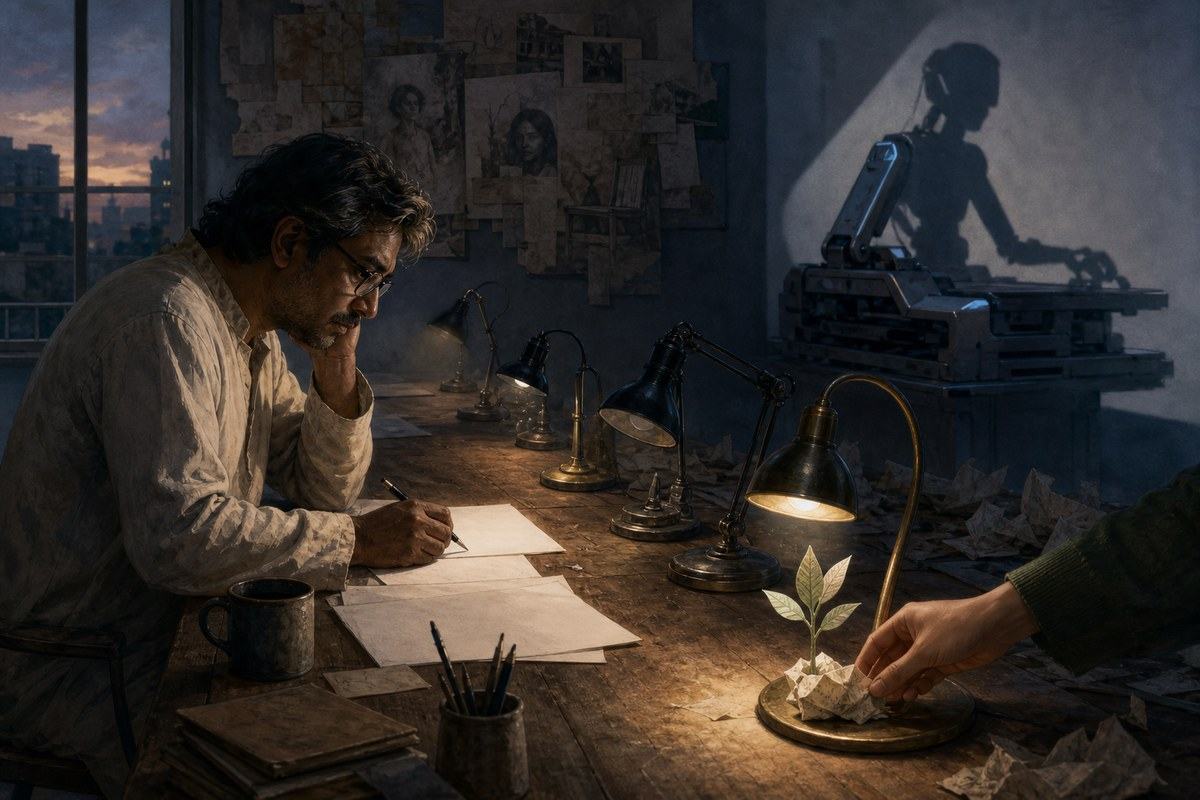
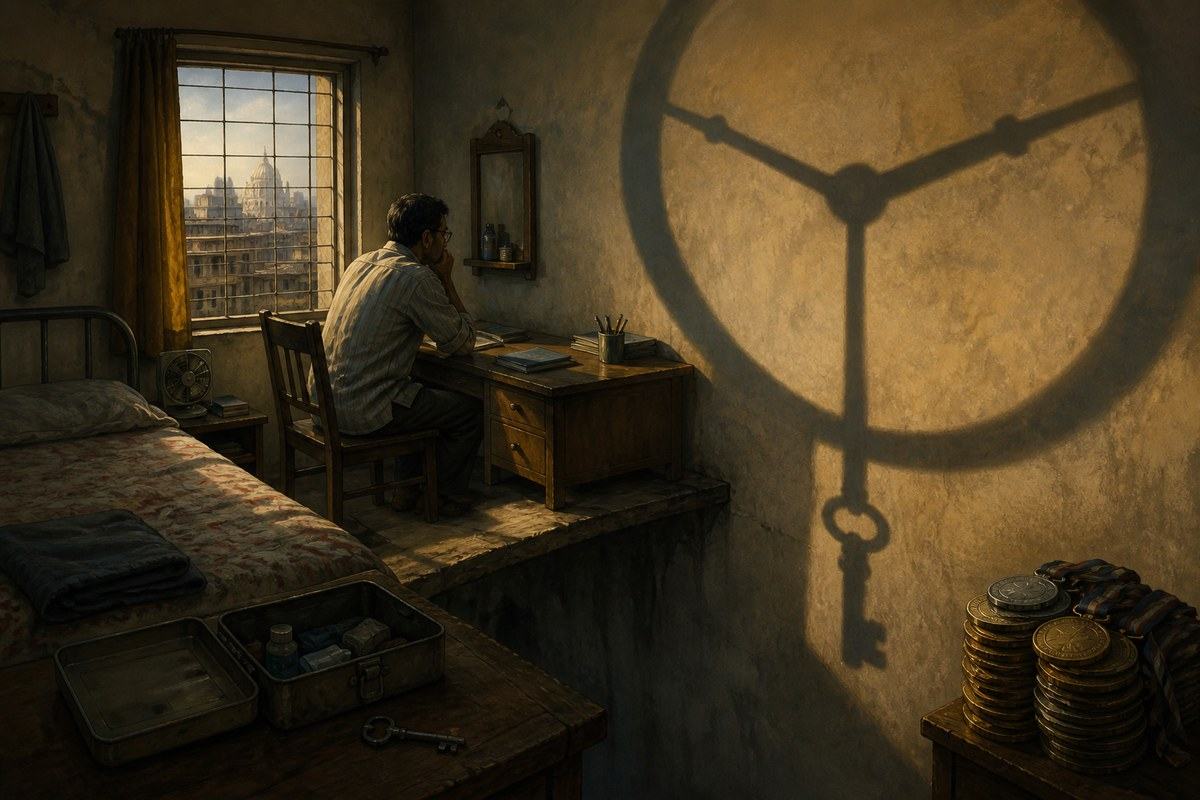
Writer’s block sounds too aristocratic, like something that happens to a novelist in a cottage with rain on the window and a Labrador sighing beside the fireplace. My version is smaller and stickier. It happens under a ceiling fan that moves the hot air around like a lazy municipal employee moving a file from one table to another. It happens with tea cooling beside me, dust gathering in the corner, and the day outside making that familiar Calcutta noise: horns, crows, pressure cookers, vegetable sellers, and somebody drilling into a wall as if the building owes him money.
I often have nothing to say because, frankly, not much happens.
A single, bankrupt, middle-aged Bengali man living on the shanty edge of the city does not wake up every morning surrounded by thunderbolts of inspiration. He wakes up with his back slightly stiff, his wallet slightly frightened, and his brain already holding a morning meeting without his permission.
Item one: money.
Item two: work.
Item three: the strange silence of being fifty-one and still not having become the impressive person once vaguely imagined by relatives, teachers, enemies, and the foolish younger self who believed life would unfold like a well-printed railway timetable.
It did not.
Life unfolded more like a bedsheet dried in a hurry during monsoon: crumpled, damp in places, and somehow smelling faintly of old rain.
So I stare.
At the page.
At the phone.
At the wall.
At the lizard, who appears to have a clearer career strategy than I do.
You may think writing needs a subject. That is the trap. We are trained to believe every piece must carry a grand basket on its head: politics, AI, civilization, health, corruption, climate, history, mathematics, the collapse of public taste, the rise of machines, the fall of manners, the price of fish. Something with muscle. Something with a headline.
But most of life is not a headline.
Most of life is waiting for the kettle. Most of life is checking whether the UPI payment went through. Most of life is wondering whether the fan is making a new sound or whether the old sound has merely become more philosophical. Most of life is small enough to be missed and heavy enough to bend your spine.
That is where the blank page begins to change its character.
It is not empty. Not really.
It is packed.
It contains the unpaid bill. The unanswered message. The old American hospital corridors where I once understood complicated systems and felt useful. The databases, the meetings, the long fluorescent afternoons, the polite professional voice one develops abroad, which is not exactly fake but is certainly ironed better than the inner man. It contains the return to Calcutta. The failed plans. The consulting income that arrives like a shy guest and leaves like a thief. The chronic suspicion that the world moved on while I was busy surviving.
The blank page contains all this, but it wears white.
Very clever.
Nothingness is rarely nothing. It is usually too much, folded very tightly.
That is why I write. Not because I am always full of ideas. Half the time I am full of static. But static also needs a wire. Otherwise it crackles inside the skull and begins doing electrical work for which it has no license.
Writing is my way of opening a window before the room starts arguing with me.
Not a grand window. Not French windows opening into a garden. More like one of those stubborn iron-grill windows in an old Calcutta house, where you push, curse inwardly, push again, and finally a little air enters carrying the smell of frying oil, wet dust, and somebody else’s lunch.
That little air matters.
A sentence appears.
Usually a bad one.
It lies there like an overcooked potato. I inspect it. I mistrust it. I move a comma. The comma does not improve civilization. Still, something has happened. The page is no longer pure accusation. It has a mark on it. A tiny footprint. A cough in the dark.
Then another sentence arrives, slightly ashamed of itself.
Then a third, wearing cheap sandals.
Soon there is a paragraph. Not a magnificent paragraph. Not the sort that makes critics lean back and say, “Ah.” More like a para lane after rain: broken, muddy, alive, with one child running through it, one dog sleeping in it, one scooter leaning at an angle that suggests moral exhaustion.
But alive.
That is the point.
Writing nothing is not nothing. It is reporting from the interior weather office. Today: low pressure over the chest. Visibility poor near memory. Sudden gusts of irritation after lunch. Chance of despair toward evening. Relief possible if tea is strong.
This sounds comic, but it is not only comic.
Silence has teeth.
Leave it alone long enough and it starts chewing. It chews the day first. Then the week. Then the soft inner parts of a man’s confidence. Soon you are not merely quiet. You are sealed. You become a jar with the lid screwed too tight. Inside, something ferments.
Writing loosens the lid.
A little.
Not enough to solve life. Let us not become motivational speakers in synthetic blazers. A blog post will not pay the EMI, cure depression, repair the economy, reverse aging, or persuade the landlord that spiritual growth is a valid form of rent. It will not make the phone ring with a large consulting contract from a sensible person with a generous budget and no committee.
But it can stop the day from disappearing without testimony.
That is no small thing.
There is a particular humiliation in ordinary suffering because it lacks drama. If a tiger chases you down Southern Avenue, at least you have a story. People will listen. But if the day merely sits on your chest like a damp towel, what do you say? “Today I was defeated by nothing in particular”? It sounds ridiculous.
And yet that is how many people are defeated.
Not by catastrophe.
By accumulation.
A bill here. A silence there. One bad night of sleep. One unanswered email. One tiny rejection. One more day when the body is present but the spirit has taken casual leave. No trumpet. No villain. No courtroom scene. Just slow subtraction.
So I write the subtraction down.
I write the blankness before it becomes muteness.
I write the muteness before it becomes vacuum.
I write the vacuum before it starts pulling the last levers and turning the whole internal machine into a traveling circus of bad thoughts.
And because I am Bengali, naturally I add commentary. We cannot even suffer without footnotes. A Bengali man alone in a room will explain his despair to the wall, then disagree with the explanation, then revise it, then blame history, then make tea.
Meanwhile the world outside continues with obscene confidence.
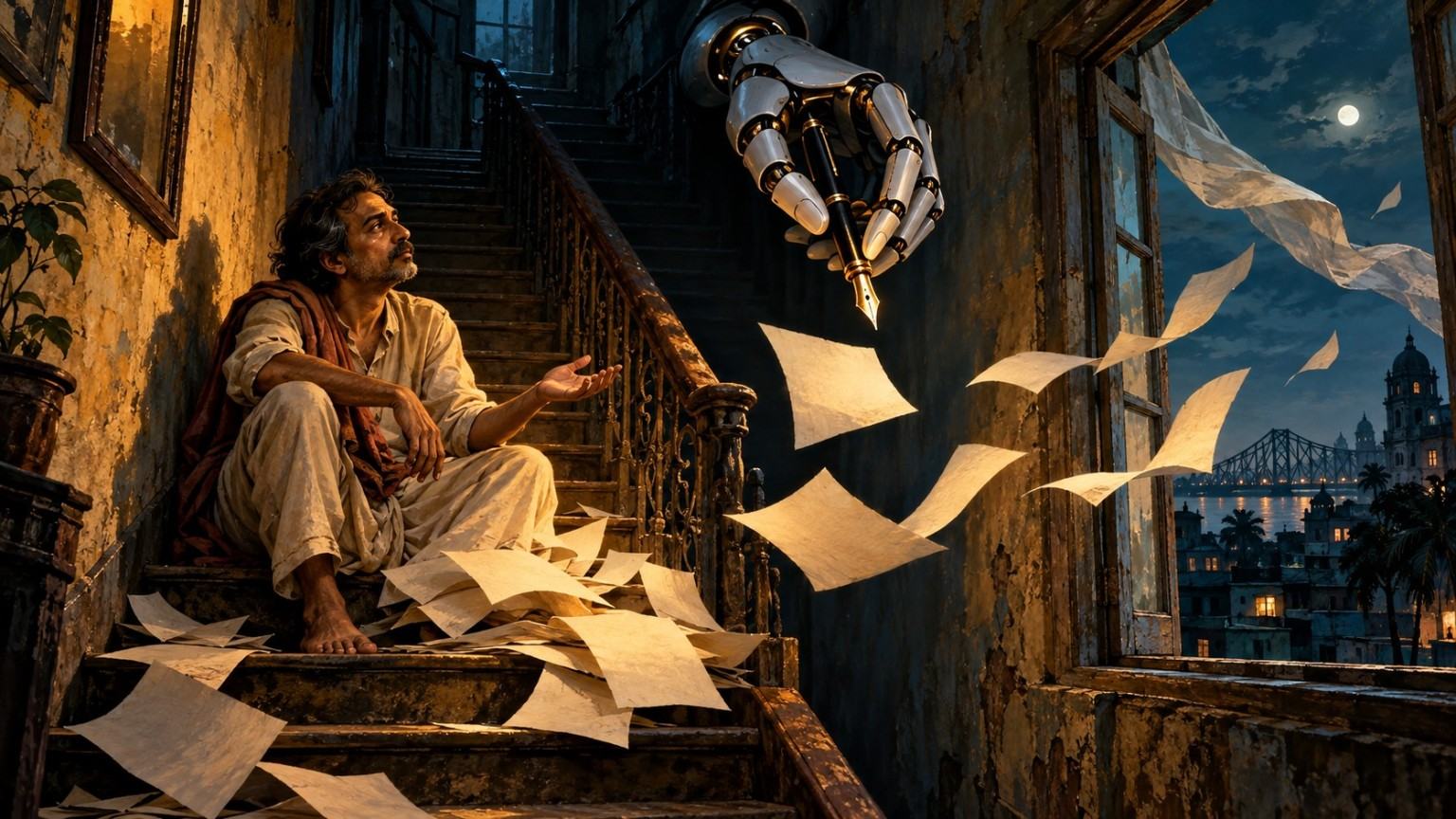
Some new AI miracle is announced. Some politician discovers the poor again just before an election. Some billionaire explains discipline from a chair that costs more than my monthly groceries. Somewhere a young person says, “Content is king,” and I feel a sudden desire to lie down under the bed and become luggage.
Still, I write.
Because the alternative is to let the blank page win.
And the blank page is a bully.
It stands there in its spotless shirt saying, “Well? What have you got?” It knows my life is not glamorous. It knows I did not attend a literary festival in Jaipur wearing a scarf of strategic seriousness. It knows I am typing with my thumb on a phone in a room where the fan is making a noise like a tired pigeon. It knows I have no topic.
That is when one must be rude to it.
One must say, “Fine. I will write about having no topic.”
This is the secret door.
You think nothing is a wall.
Actually, nothing is sometimes a trapdoor.
Fall through it and you find the real subject underneath: fear, loneliness, absurdity, memory, heat, money, aging, the need to speak, the shame of needing to speak, the small stubborn wish to remain human in a world that keeps asking for output, proof, success, metrics, invoices, passwords, and updated apps.
The nothing was never empty.
It was crowded.
It was just waiting for a chair.
So I give it one.
I let the nothing sit. I ask it what it wants. It first pretends to be dignified. Then it starts muttering. Soon it is telling me about the morning, the dust, the tea, the unpaid bill, the sadness that came without knocking, the old life in America, the present life in Calcutta, the ridiculous hope that a few paragraphs may still make a little bridge across the swamp.
That bridge may be narrow.
So what?
A narrow bridge is still better than standing forever on the wrong bank, waving at yourself through fog.
This is why I write on days when nothing happens. Especially then. A dramatic day can almost write itself. A blank day has to be trapped gently, like a nervous cat. You do not chase it. You sit quietly. You make a small sound. You wait.
Then, at some point, it comes out from under the bed.
And there it is.
Not genius.
Not revelation.
Just a sentence with dust on its knees.
I take it.
Word Cloud
Related reading
Selected by shared topics and section, with closer publication dates breaking ties.