Shallow Water, Loud Television
Uses the speech voice supplied by your browser or device.

TRP means Television Rating Point, the crude little number by which television attention is measured and sold to advertisers.
Amrit Kaal is a political phrase meaning a supposedly golden or auspicious national period, though in ordinary lanes it often arrives disguised as a broken drain.
Hyperlocal forecast means a weather warning precise enough to tell you what may happen in your own neighborhood, not merely in the large decorative word “Kolkata.”
Atmospheric river means a long, narrow band of heavy moisture in the sky that can dump astonishing rain when conditions turn nasty.
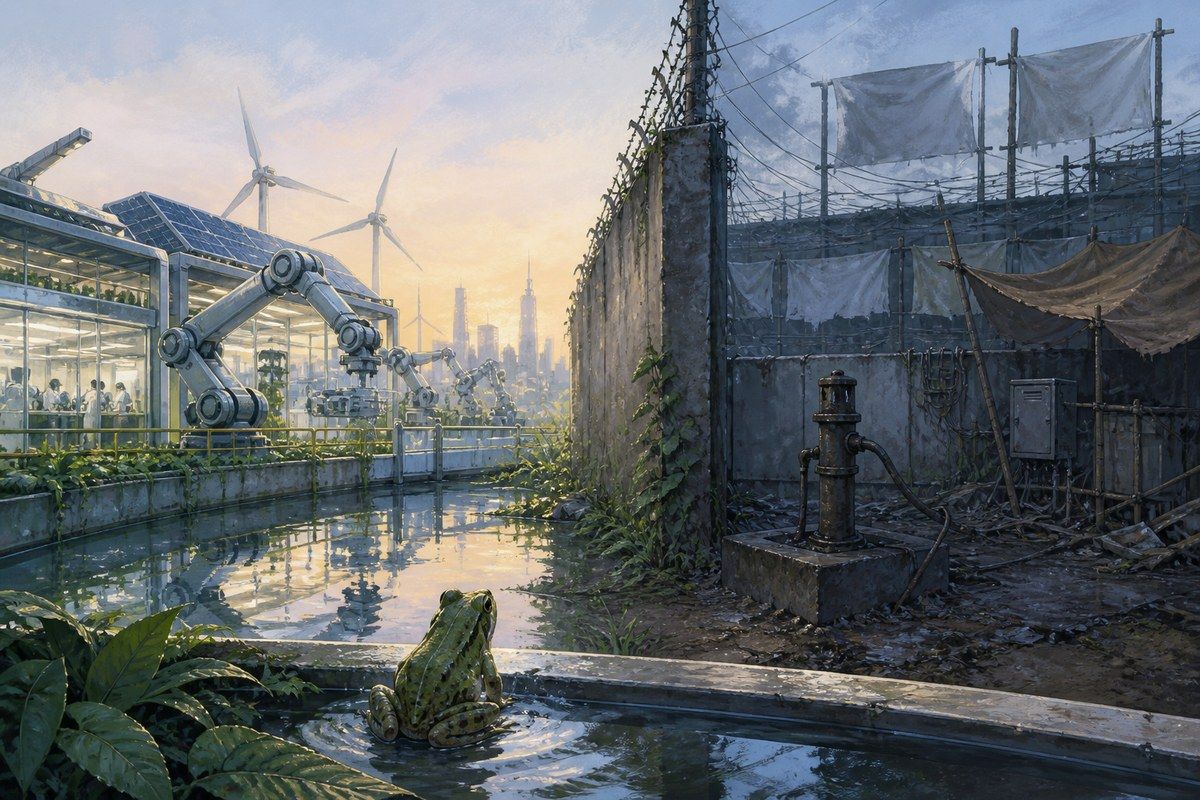
Calcutta does not flood all at once. It rehearses first. A puddle appears near the tea stall. Then the puddle grows philosophical. Then one missing brick vanishes beneath brown water, waiting for the next ankle like a small municipal crocodile.
By evening the whole lane is thinking about sewage.
This is where I must confess my annual monsoon weakness. Some people hear rain and think of poetry, romance, Tagore, hot tea, khichuri, fried hilsa, and looking moodily through the window like a man whose soul has just returned from Darjeeling. I hear rain and think of my stomach. This is not elegant, but it is accurate. For years, every monsoon in Calcutta seemed to send an advance party of germs through the water supply straight into my digestive system, where they conducted conferences, passed resolutions, and overthrew the government.
Then I installed a water filter.
This was not a spiritual moment. I did not see light. I did not hear celestial music. I merely stopped spending certain rainy afternoons negotiating with my intestines like a defeated ambassador. So this year, when the rain came, my body remained mostly peaceful.
The news channels did not.
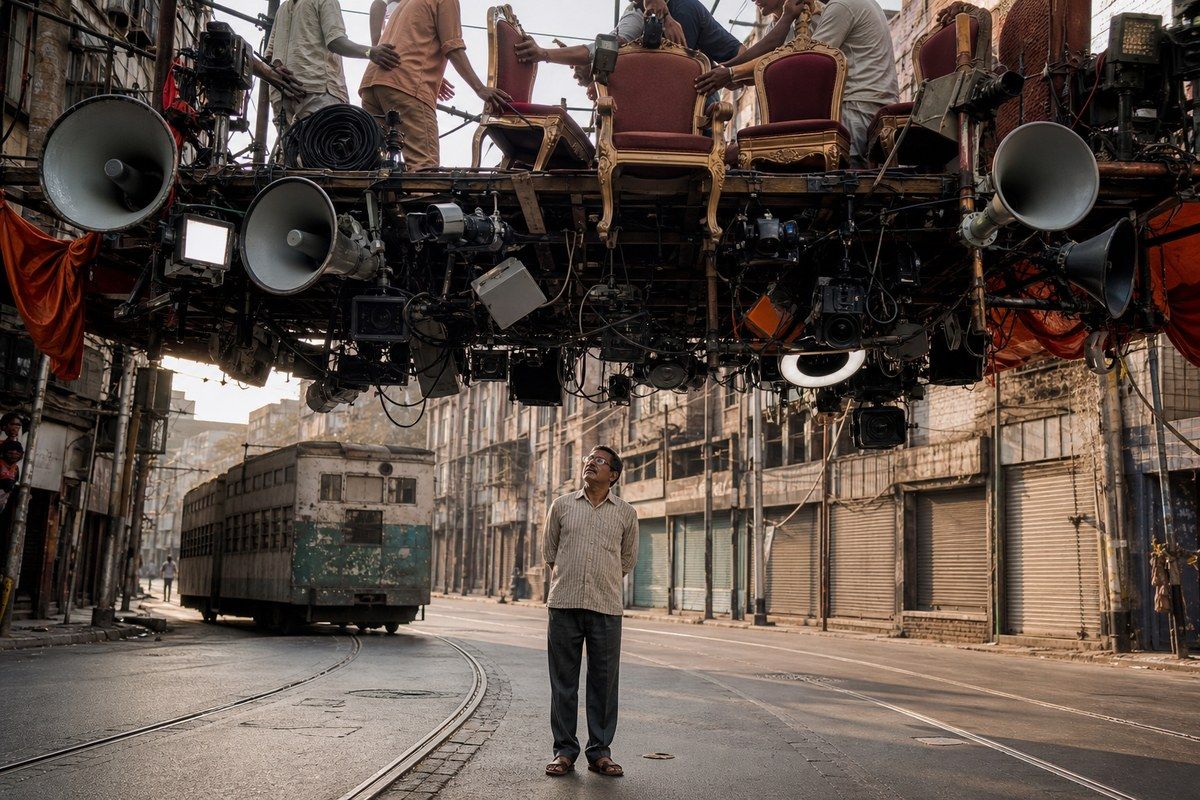
I opened YouTube, which is how a modern man invites half the country to shout inside his bedroom, and there they were: the usual studio warriors. The screen was split into boxes, and each box contained a person with the blood pressure of a pressure cooker. At the bottom, a ticker crawled. At the top, another banner screamed. On the side, a logo blinked. Somewhere in the middle, behind three watermarks and a graphic shaped like national emergency, there was probably a flooded street.
I could not be sure.
My laptop is fourteen inches. It was not built for Indian television news. Indian television news now requires a screen roughly the size of a modest cinema hall, preferably with stadium lighting and a retired air traffic controller sitting beside you. On my little machine, the anchor’s face took up one district, the reporter’s raincoat another, the word BREAKING occupied three municipalities, and the actual suffering citizen was visible only as a damp pixel.
The anchor shouted as if the Hooghly had personally insulted her.
The field reporter stood in water up to his knees and asked a man, “How bad is the situation?” This is the kind of question that makes you admire human restraint. The man was standing in a lane that had become soup. His slippers were missing. A plastic bottle floated past with the slow dignity of a state funeral. Behind him, a dog looked at the water, looked at the reporter, and made the sensible decision to leave public life.
The man said the situation was bad.
The reporter turned to the camera with the solemn satisfaction of a detective who has discovered that fire is warm.
This is our disaster grammar now. First, find water. Then find a citizen. Then ask the citizen whether water is wet. Then return to the studio, where a panel of four people will explain that this is due to climate change, illegal construction, administrative failure, opposition conspiracy, ruling-party negligence, public apathy, colonial drainage design, and possibly jeans worn by young people.
All may be true.
That is the problem. In India, even nonsense sometimes travels with truth as a pillion rider.
But the show must continue. The anchor interrupts the reporter just when he is about to say something useful. There is an advertisement. The advertisement is for a life insurance policy, fairness serum, digestive tablet, or some optimistic product for the middle-aged male body, which, if my own experience is anything to go by, deserves not marketing but a written apology.
Then the same footage returns.
Again the bus pushes through the water. Again the man slips. Again the same wave enters the same shop. Again the same child is carried across the same crossing. News television has discovered the loop, and the loop has discovered immortality. A ten-second clip can now live longer than some governments.
After the ninth replay, pity becomes fatigue. After the twelfth, fatigue becomes irritation. After the fifteenth, you begin to resent the victim for not varying his performance.
That is the moral damage of this kind of coverage. It does not merely inform badly. It trains the viewer to feel badly. It turns suffering into wallpaper. Flood, landslide, bridge collapse, heatwave, train accident, hospital fire—each arrives dressed in identical graphics, shouted into the same furnace of attention, then packed away for the next commercial break. Disaster becomes a stationery item. Keep one template. Change the district name.
And yet the water is real.
In Calcutta, our version is often not heroic disaster but shabby nuisance. We do not always get the grand catastrophe, the Himalayan roar, the bridge washed away, the entire hillside moving like a punishment from geology. We get the smaller insult. The lane fills. The drain belches. The taxi refuses. The app cab cancels. The electricity flickers like a nervous eyelid. The shopkeeper raises his biscuit jars. The old man at the medicine shop puts one foot on a stool and continues selling blood pressure tablets above the floodline.
This is not nothing.
That is the trick.
Because when a disaster is not large enough to terrify the nation, it becomes local habit. When a pothole does not kill you, you learn its outline. When a drain overflows every monsoon, someone says, “It happens every year,” as if repetition were an explanation. When a lane floods just below the knee, the city does not ask why. It rolls up its trousers.
We are famous for adjustment. Adjustment is our national yoga. We adjust to heat, noise, corruption, queue-jumping, broken footpaths, weak tea, late trains, office politics, bad roads, worse manners, and relatives who visit without warning. But adjustment has a dark cousin. Its name is surrender.
You think you are being practical.
Actually, you are being slowly trained.
The water outside your house is not just rainwater. It is memory. It remembers where the pond used to be. It remembers the wetland buried under an apartment block with a hopeful name like Lake View Residency, though the only lake now is in the parking lot. It remembers the drain narrowed by construction debris, the garbage pushed into the corner, the illegal extension blessed by silence, the municipal file asleep under another file, the contractor who vanished, the official who transferred, the citizen who complained twice and then gave up.
Rain is merely the visiting examiner.
It arrives with one question: where will the water go?
The city usually fails.
This is not because the problem is mysterious. The problem is painfully plain. Water needs a path. If you block the path, water makes a new path. If you build over the new path, water enters your ground floor and inspects your furniture. It is not ideological. It does not care for party flags, building brochures, neighborhood pride, or the uncle who says he has lived here since 1974 and never seen such rain. Water is a strict accountant. It keeps books.
We, on the other hand, keep excuses.
Unplanned construction. Choked drains. Filled ponds. Vanishing wetlands. Weak pumping capacity. Bad solid waste management. Poor maintenance. Weather warnings too broad to help the man who must decide whether to take his daughter to school through a lane that may become brown tea by 10 a.m. Compensation that arrives late, small, and wrapped in paperwork. Relief that photographs well but repairs little.
And over all of this, television shouting like a man selling socks in a local train.
There was a terrible landslide in Wayanad in Kerala in 2024, and for a brief while the cameras looked south with grief, alarm, and that special hunger which only television can bring to tragedy. Some disasters get national attention because they are visually enormous. Some because famous people are connected to the place. Some because they can be folded into politics before the evening debate. The rest wait their turn in the dark.
This is not a criticism of one party, one state, or one channel. That would be too easy, and also too flattering to the villains. The deeper machinery is older and duller. It is made of incentives. Prevention is invisible. Relief is visible. Maintenance earns no applause. Rescue earns garlands. A working drain has no ribbon-cutting ceremony. A flooded road has camera crews. So we underfund the boring thing and overperform the dramatic thing.
Human civilization, after ten thousand years, still struggles with the concept of cleaning before guests arrive.
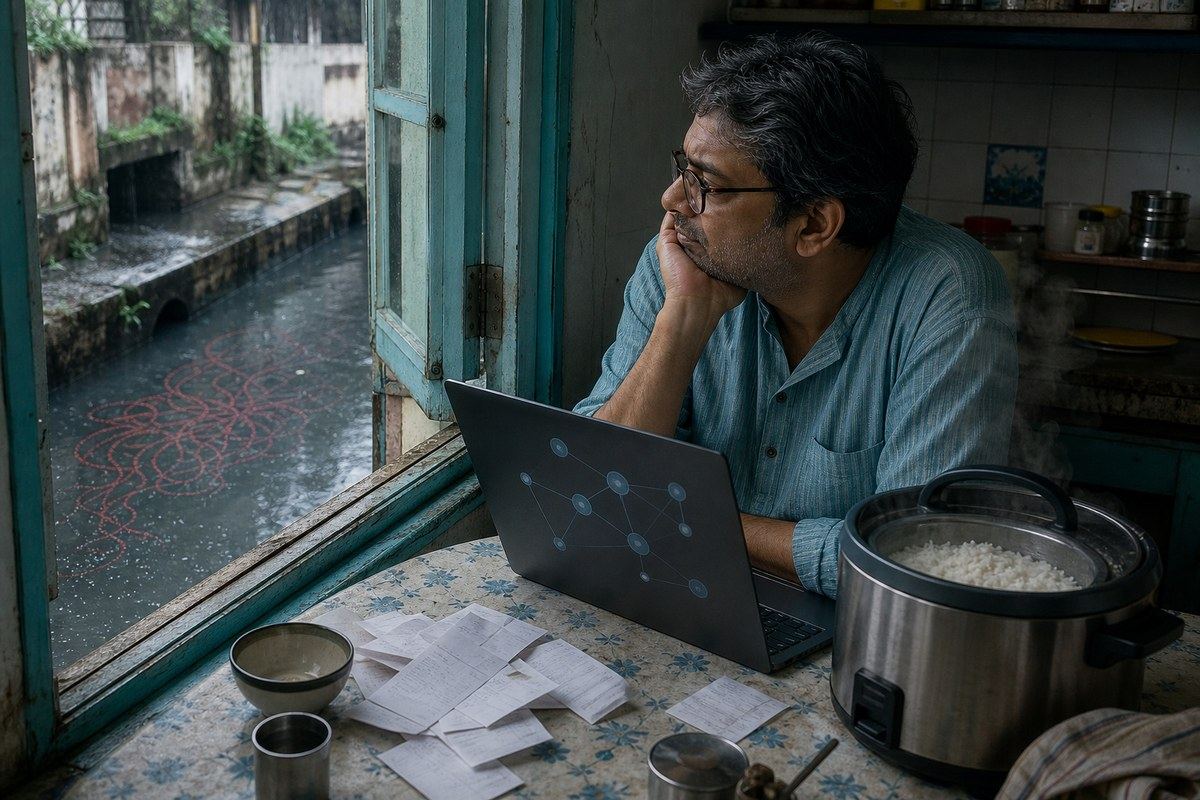
My own day is smaller. I wake up in the southern fringe, where Calcutta begins to lose confidence and the lanes start behaving like unfinished sentences. I check the sky. I check the water pressure. I check whether the tea leaves are enough. I look at my bank balance with the expression of a man reading a medical report in a language he does not trust. Then I work, or try to work, because consulting income is not a salary; it is a nervous pigeon. Sometimes it comes. Sometimes it sits on another balcony.
Rain makes everything slower.
The towel does not dry. The floor smells faintly of old walls. The inverter becomes a family deity without the theology. The internet coughs. A scooter passes through the lane with a sound like wet cardboard being torn. Somewhere a pressure cooker whistles. Somewhere a mother shouts at a child not to step in the water. Somewhere a man like me, fifty-one, single, educated enough to know better and broke enough to keep going, watches the pothole opposite the house fill up again.
That pothole has character.
It is not a large pothole. It will not trend. No anchor will send a reporter. No minister will inspect it wearing white. But it has depth, mystery, and a talent for surprise. In the morning it looks harmless. By afternoon it becomes a small republic of brown water. By evening it has swallowed two sandals, one bicycle wheel, and the remaining dignity of a delivery boy.
I understand this pothole.
We are both irregular. We both collect rain. We both have structural weaknesses not visible in dry weather. We both become difficult when pressure gathers.
That is perhaps why the city irritates me so intimately. Its failures are not abstract. They resemble private failures enlarged into public works. Deferred repair. Cosmetic patching. Grand talk. Hidden cracks. Sudden collapse after one good downpour. I know this architecture from inside my own skull.
Still, I do not hate Calcutta. Hatred would be too clean. I am tied to it by tea, language, irritation, memory, cheap vegetables, broken roads, old books, political noise, and the peculiar afternoon light that makes even a damp wall look as if it has a past. Calcutta can be funny in the middle of decay, which is dangerous because charm is often used here as a disinfectant. It kills nothing. It only improves the smell for a while.
A tea seller raising his stove on bricks during waterlogging is charming.
It is also an infrastructure report.
A child laughing through dirty water is charming.
It is also an indictment.
An old tram line shining after rain is charming.
It is also surrounded by a city that cannot decide whether it wants nostalgia, development, or simply a dry pair of feet.
We should be careful with charm. Charm can turn civic neglect into tourism. It can turn suffering into flavor. It can make people say, “This is Calcutta,” when what they mean is, “This should have been fixed.”
The rain will come again. It always does. The anchors will shout again. They always do. A reporter will stand in water and ask a man whether he is inconvenienced by living temporarily in a drain. A panel will argue. A politician will promise. A municipal statement will mention exceptional rainfall. Someone will blame plastic. Someone will blame climate change. Someone will blame citizens. Someone will blame the previous administration, which is the most durable drainage system in India because blame flows through it forever.
But here is the small, unpleasant truth.
The rain is not the story.
The story is what the rain reveals.
It reveals the city under the city: the blocked channels, the buried ponds, the lazy files, the crooked permissions, the missing maintenance, the poor made to absorb risk, the lower middle class made to absorb cost, and the great Indian talent for surviving what should have been prevented.
Survival is admirable. It is also overrated.
A city should not ask its citizens to become amphibians every July. A citizen should not need military instincts to buy coriander. A schoolchild should not need to identify safe pavement by studying the ripple pattern of drain water. A middle-aged man should not have to look at a pothole and recognize a cousin.
Yet here we are.
The pothole outside is full again. On the screen, someone is shouting BREAKING. In the kitchen, the kettle begins to tremble. The rain keeps falling with perfect innocence, as if it had nothing to do with us.
Maybe it does not.
Maybe the rain is only knocking.
We are the ones who forgot to build a door.
Word Cloud
Related reading
Selected by shared topics and section, with closer publication dates breaking ties.