The Fat Animal in the Mirror
Uses the speech voice supplied by your browser or device.

Calcutta borrows the Royal Bengal tiger the way a slightly broke uncle borrows a silk panjabi for a wedding: proudly, loudly, and with no plan to return it in good condition.
We love the tiger as emblem. Tiger on badge. Tiger on speech. Tiger on school essay. Tiger on tourist poster. Tiger in that swollen Bengali chest where everything becomes either heritage or insult. We say Royal Bengal tiger and feel taller by two inches, as if the poor animal has signed some family document in our favor.
But the first proper healthy tiger I saw was not in the Sundarbans.
It was in San Antonio.
In a zoo.
Not one tiger. Tigers. Big, glossy, well-fed fellows, lying around with the bored confidence of retired zamindars who have never had to cross a saline creek, dodge a cyclone, share a shrinking forest with hungry men, or wait for some committee in an air-conditioned room to decide whether mud should continue existing.
That stayed with me.
Because back home, the tiger had become a symbol before it could remain an animal. Symbols are easy. Animals are inconvenient. Symbols do not need deer, mangroves, clean water, territory, silence, or the right to be left alone. Symbols can be fed speeches.
Animals need a world.
And we have been eating that world with both hands.
When I was growing up in South Sinthee, Calcutta was not exactly a postcard of pastoral innocence. Let us not suddenly make it Switzerland with tramlines. There were drains. There were quarrels. There were mosquitoes with the moral confidence of hereditary landlords. There were buses that sounded as if somebody had locked a rhinoceros inside a tin trunk.
But there were fields.
There was one right beside our house. A real field. Not “open space” in developer language, which means land waiting to be strangled. A field-field. Grass, mud, children, argument, goats, bits of brick, the occasional kite string, and a khatal. I would come home after playing coated in dung, smelling like a rural policy failure, and nobody treated this as a nature experience. It was just childhood. Dirty, available, democratic.
Nobody had to teach us “biodiversity.” We were wearing it on our knees.
A little farther out, the city loosened. There were patches of green where the suburbs began, the kind of tree-shadowed places where afternoon became slower and the air had not yet been fully murdered. Crows were everywhere. Sparrows too. The crow was not a bird then. It was a civic institution. It inspected fish bones, supervised rooftops, shouted at cats, audited your leftovers, and generally behaved like a black-feathered ward councillor.
Now, in this shanty flat where I sit like a half-retired, half-bankrupt, fully bewildered middle-aged man of fifty-one, I notice absence.
That is the part people miss.
Loss is not always dramatic. It does not always arrive with a burning forest, a dead tiger, a breaking embankment, a newspaper photograph with a tragic caption. Sometimes loss arrives as a quieter morning. One day the crow does not come. Then another. Then a week. The sparrows become fewer. Then they become a memory with wings. The lane remains. The tea stall remains. The cement walls remain. The mobile tower remains, standing like a skinny, successful villain.
But the small life has slipped out.
You think the city changed because buildings came up.
Not quite.
The city changed because the ordinary living things stopped feeling invited.
A sparrow does not disappear because it has become modern and bought a flat in New Town. A crow does not vanish because it has taken early retirement in Puri. They disappear because food changes, nesting places vanish, trees go, insects thin out, poison enters quietly, heat gathers, water turns bad, and the city becomes too smooth, too hard, too bright, too hungry. We make the place unlivable in a thousand little installments and then act surprised when life stops paying rent.
The tiger in the Sundarbans is part of the same story, only larger and striped.
The song composed sees this very clearly. “সুন্দরবনে বাঘ / হাড়গিলে ভুঁকো / মানুষ মোটা জানোয়ার.” That line has more environmental honesty than most official reports, because it does not start by flattering us. The tiger is hungry. The human being is fat. Not always fat in the stomach. Many poor people near the forest are thin as bamboo splinters. The fatness is elsewhere. In appetite. In entitlement. In the smooth round belly of civilization saying, this river, mine; this forest, mine; this fish, mine; this road, mine; this land, mine; this future, also mine, please stamp here.
The tiger kills a man, and the paper says man-eater.
Man eats the mangrove, the river, the fish, the mud, the crab, the island, the air, the wetland, the village, the city, and finally his own afternoon nap, and we call it growth.
Very respectable word, growth.
A tumor also grows. So does mold on forgotten rice.
Of course the poor man entering the forest is not the villain. That is too easy, and easy explanations are usually lies wearing clean shirts. The honey collector, the fisherman, the crab catcher, the man who steps into the mangrove knowing the tiger may be near—he is not going there because he has read a motivational quote about risk-taking. He is going because hunger is behind him with a stick. At home there may be debt, illness, school fees, a leaking roof, a mother coughing, a child wanting an egg. The forest is dangerous, yes. But so is an empty kitchen.
Then the tiger comes.
Or the man comes too close.
Or the river has changed the route.
Or the deer are fewer.
Or the boundary that looks clear on a map becomes nonsense in mud.
A man dies. A family collapses. A tiger is blamed. A government file wakes up, yawns, moves from one table to another. A compensation form begins its pilgrimage. Someone in a meeting says conservation. Someone else says livelihood. Someone says balance. Everyone nods, because balance is a very pleasing word when you are not the one balancing on a leaking boat.
Meanwhile, the big animal keeps eating.
Not the tiger.
Us.
We eat ponds and call it housing.
We eat trees and call it widening.
We eat wetlands and call it planning.
We eat village edges and call it connectivity.
We eat silence and call it development.
We eat the night with lights, the morning with engines, the afternoon with cement dust. Then, when the heat becomes unbearable, we buy another fan, another cooler, another machine to survive the world we have made unkind. This is like burning your own umbrella for warmth and then complaining about the rain. Not a very advanced species, when observed without poetry.
The funniest part, if your humor has already suffered some structural damage, is that we are never more innocent than after we have destroyed something.
Who removed the trees?
Difficult to say.
Who filled the pond?
Complicated matter.
Who allowed the building?
Process was followed.
Who killed the river?
No single agency responsible.
But who is dangerous?
The tiger.
There. Solved.
Put the striped fellow in a cage. Put his photograph in a campaign. Put his roar in a school function. Put his name on a team. The animal itself can manage somehow, poor chap. After all, it is royal.
This is the lie hidden inside the word Royal.
The Sundarbans tiger is not royal in the way we imagine royalty. It is not sitting on a velvet cushion eating mutton. It is a hard, hungry, weather-beaten creature living in a difficult place where land and water keep changing their minds. Its kingdom is mud, salt, roots, tides, mosquitoes, deer, fear, and patience. If that is royalty, then royalty has a very bad ration card.
My song’s barroom woman understands this better than the polished gentlemen.
She says she has seen the city’s stomach. It eats air. It eats metro gates. It eats land. It eats houses. It eats the last salty voice of the river. That cracked female voice, a little drunk, a little husky, a little cheap-glitter brave, is not decorative. She is the witness. She has watched the city after dark, when the slogans go home and the real appetite comes out like a rat behind the kitchen tin.
There is a truth only tired people know.
A tired man at a tea stall knows more about the city than a brochure. A woman returning from a cheap bar at morning knows more about hunger than a conference banner. A child who once played beside a khatal knows that land is not an abstract asset. Land has smell. It has flies. It has weeds. It has cow dung, broken glass, dragonflies, boys shouting, mothers calling from balconies, and that one uncle who always says the ball has hit his window even when it has not.
When that land goes, a whole dictionary goes with it.
That is why I do not trust shiny words. Smart city. Green initiative. Riverfront development. Eco-tourism. Sustainable corridor. These words often arrive like polite burglars. They wipe their shoes before entering and leave with the furniture. The old words were rougher but more honest. Field. Pond. Tree. Crow. Mud. Shade. Fish. Breath.
You knew what they meant.
A child who has never seen a sparrow does not miss the sparrow.
That sentence frightens me more than a tiger.
Because the final theft is not of land. It is of imagination. Once the bird is gone long enough, the silence becomes normal. Once the field is gone long enough, childhood becomes indoor by default. Once the tiger is reduced to a logo, its hunger becomes theatrical. The living creature is replaced by a cultural souvenir. Then we can love it safely. We can admire it without making room for it. We can roar in stadiums and remain perfectly comfortable with dead rivers.
This is how a civilization becomes sentimental and cruel at the same time.
It cries for the symbol.
It evicts the animal.
I sit in my shanty corner of Calcutta, looking at the day’s small evidence. The damp wall. The half-broken chair. The tea going cold. A phone full of news, most of it either catastrophe or advertisement, and sometimes one disguised as the other. Outside, someone is arguing. Somewhere a pressure cooker whistles. Somewhere a child is memorizing facts for an exam in a world that is busy deleting the living examples.
The crow does not come.
Once, this would have been impossible to notice because crows were everywhere. That is the joke. Abundance makes us blind. Loss makes us philosophers.
But philosophy will not grow a mangrove.
What remains is less grand and more difficult. Stop treating the tiger as a decorative ancestor. Stop pretending the poor are the main threat when the large appetite sits in offices, markets, real estate maps, contracts, and our own daily convenience. Stop calling every representation of destruction development. Stop blaming animals for crossing boundaries after we have spent a century redrawing the boundaries under their feet.
And remember the mirror.
That is the uncomfortable object in this whole story. Not the tiger’s tooth. Not the claw. Not the forest. The mirror.
Because if one day a tiger walks into the city, if Park Street freezes, if neon signs blink over a striped back, if the gentleman with the shopping bag suddenly discovers ecology at close range, we will say civilization is under attack.
But perhaps civilization was the attacker all along.
The tiger does not eat the country.
Man eats everything.
Then he wipes his mouth, prints a poster, and asks why the forest looks thin.
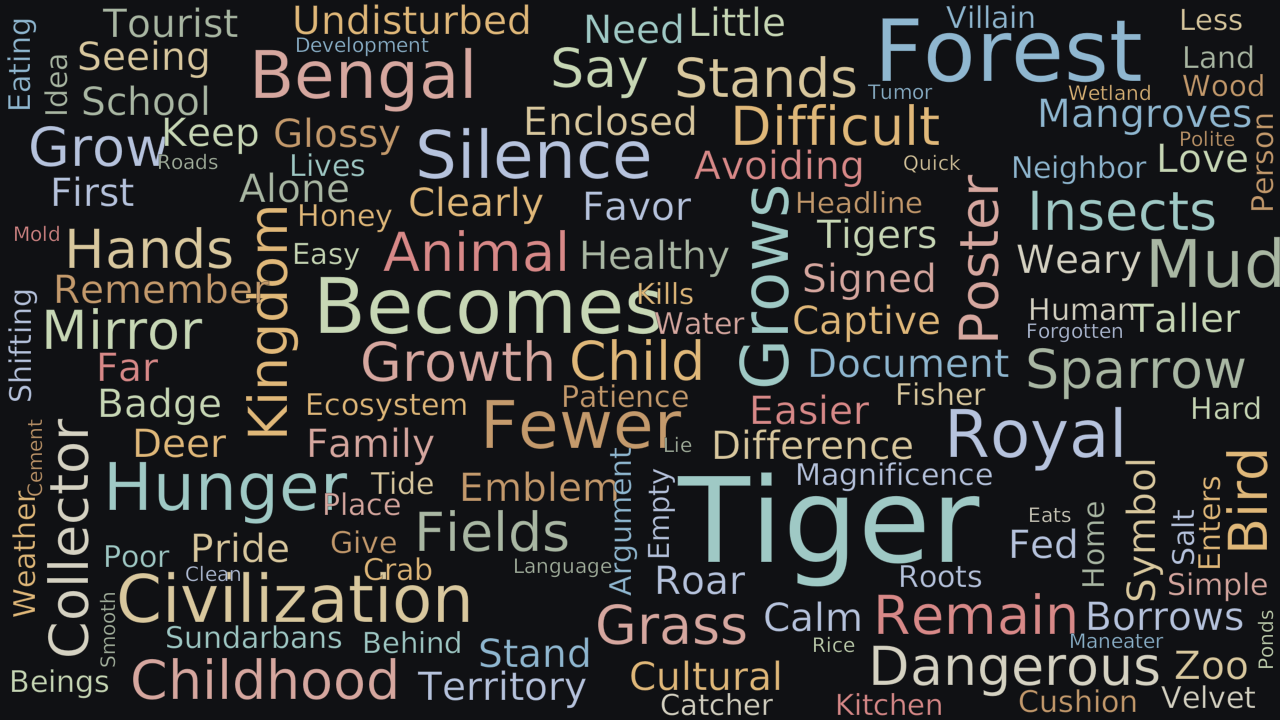
Word Cloud
Related reading
Selected by shared topics and section, with closer publication dates breaking ties.