Election Puja And The Common Eye
Uses the speech voice supplied by your browser or device.

Acronyms used: BJP [Bharatiya Janata Party, the national political party that has made major electoral promises in Bengal]; TMC [Trinamool Congress, the party that ruled West Bengal before the recent change]; EC [Election Commission, the body that conducts elections]; CAA [Citizenship Amendment Act, a citizenship law that often enters political arguments about identity and eligibility]; SIR [Special Intensive Revision, a large-scale voter-list verification exercise]; MLA [Member of Legislative Assembly, an elected state-level representative].
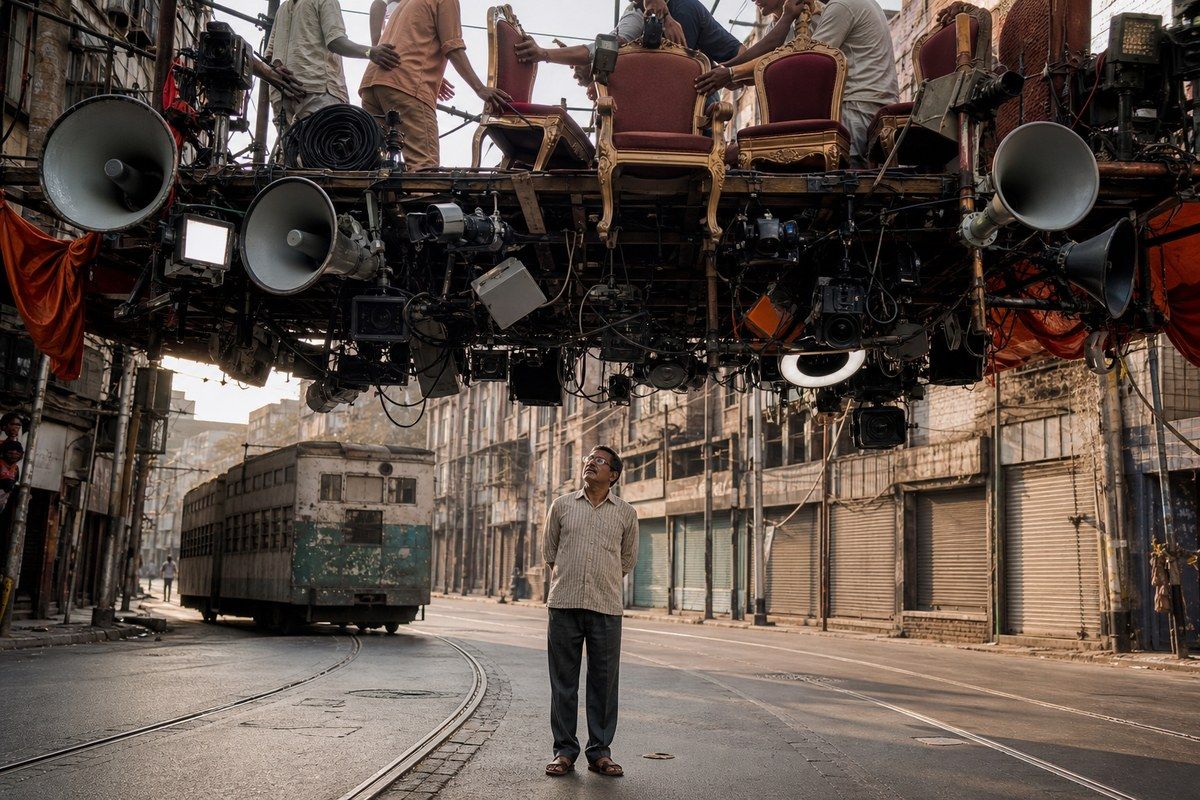
For most ordinary people in Calcutta, election time is Durga Puja with fewer lights and more lies. The pandal goes up. The loudspeaker clears its throat. Men who cannot fix a drain begin explaining constitutional destiny. Women are called mothers. Youth are called the future. Farmers become the nation’s backbone. Workers become the nation’s soul. Then, after the result, the bamboo skeleton lies by the road, the posters peel, and the same tea stall starts selling the same watery tea to the same unpaid citizens.
Whether an election is subverted or merely performed with the usual Indian mixture of ink, suspicion, queue, police van, whisper, rumor, and television graphics, I do not know. I am not inside the counting room. I am not an EC officer. I am not a polling agent with a plastic chair and a packet of muri. I am a broke, middle-aged, single man in the damp boondocks of Calcutta, old enough to have watched many moral revolutions arrive in freshly washed kurta and leave in an air-conditioned car.
But I know the smell of promise.
Promise has a smell. It is not always false. That would be too generous to reality. A clean lie is easy to catch. A promise is cleverer. It arrives half-funded, half-named, half-explained, wrapped in a banner, carrying a microphone, and smiling like a groom’s uncle who has misplaced the caterer’s number but is still saying, “Everything is under control.”
Now the BJP has come with promises. Women will get money. Farmers will get money. Youth will get opportunity. Corruption will be crushed. Roads will improve. Welfare will continue. The poor will be protected. Bengal will be restored. Bengal will be cleaned. Bengal will be made golden, as if the state were an old brass lota waiting in the kitchen for one vigorous scrub.
The common person hears all this and does not faint from gratitude. He has heard music before.
The first trick is renaming. India loves renaming. We rename roads, schemes, buildings, failures, committees, and occasionally common sense. Yesterday’s dole becomes today’s dignity. Yesterday’s political bribery becomes today’s targeted social protection. Yesterday’s bad economics becomes today’s motherly care. Lakshmir Bhandar wears one color. Annapurna Bhandar wears another. The poor woman standing in line does not care which goddess has been printed on the file. She wants to know whether the money will come, whether her name will remain, whether the bank will behave, and whether the local operator will ask for a small “service charge” with the face of a man doing national duty.
There is the catch.
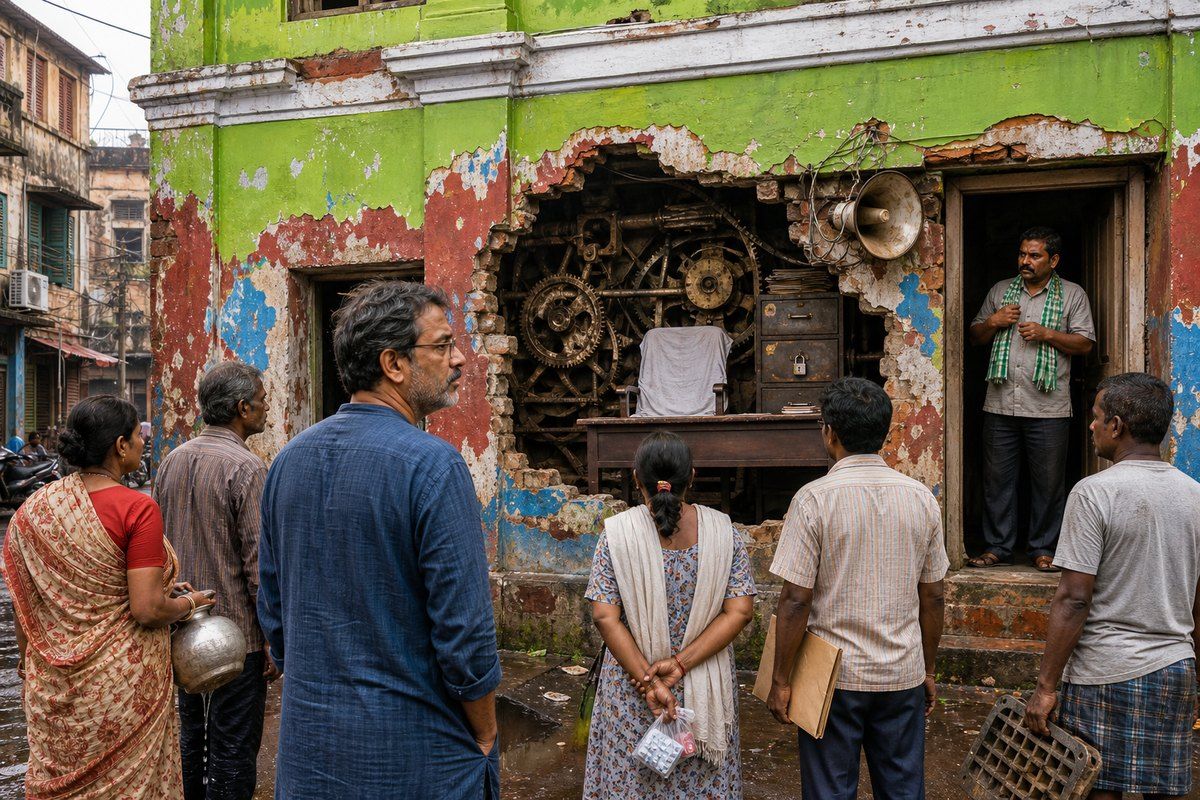
Before voting, a welfare promise is a river. After voting, it becomes a narrow pipe with six valves, three clerks, one printer shop, two rumors, and a man near the counter who says, “Come tomorrow.”
Eligibility is where the wool begins to fall over the common eye.
You will get the benefit, certainly. Provided your name is correct. Provided your document is correct. Provided your category is correct. Provided you are alive in the right database. Provided your bank account is not sleeping. Provided your citizenship is not under suspicion. Provided your appeal is pending in the proper cosmic posture. Provided the computer is working. Provided the server has not gone to lunch. Provided the person behind the desk has not decided that today is not a day for human dignity.
This is not an argument against verification. A state cannot pay ghosts, duplicates, frauds, and imaginary uncles from Murshidabad who exist only in a spreadsheet. Fine. Check. Audit. Clean the list. But in India, verification is rarely a clean broom. It is often a broom with a political handle. It sweeps some rooms thoroughly and some rooms ceremonially. It hits the poor on the ankle.
A rich man’s paper problem is called restructuring. A poor woman’s paper problem is called non-compliance.
That is the country in one sentence.
The second trick is corruption talk. Every new government declares war on corruption as if corruption were a gang of thieves hiding behind a banyan tree. This is charming. It is like a mosquito announcing a campaign against stagnant water.
Corruption is not only cash in envelopes. That is the village-school version. Real corruption is delay without punishment. It is discretion without transparency. It is a file that moves when pushed by the right elbow. It is a police diary that depends on party weather. It is a contract that smells cooked before the tender is boiled. It is a welfare list that becomes a loyalty test. It is a club, a committee, a permit, a transfer, a construction material supplier, a sand truck, a municipal whisper, a call from someone’s cousin.
No party invented this entire machine. But every party, once seated, discovers the cushion is surprisingly comfortable.
The Left had its committees and cadres. The TMC had its clubs, local bosses, welfare networks, cut-money stories, syndicates, and neighborhood theater. The BJP now comes with national machinery, ideological thunder, disciplined messaging, and a very modern talent for turning every local grievance into a civilizational drumbeat. The flags change. The appetite remains.
And then there is the chair.
Never underestimate the chair.
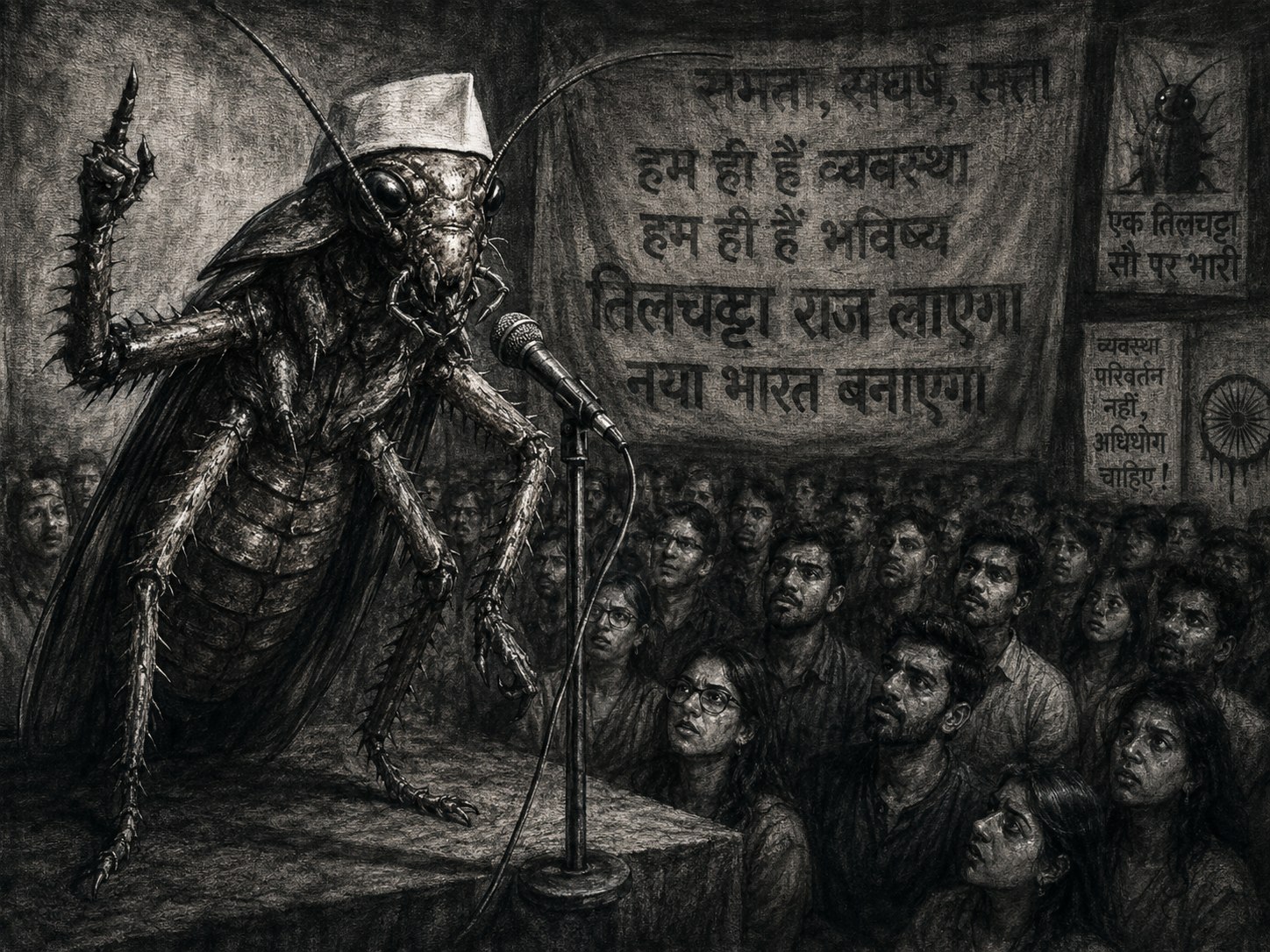
Indian democracy is musical chairs played by people who insist the music is sacred. While the music plays, everyone dances for the poor. Mothers, sisters, youth, farmers, workers, teachers, refugees, minorities, majorities, small traders, unemployed graduates, tea sellers, fish sellers, rickshaw pullers, priests, atheists, patriots, pensioners—everybody is loved. Then the music stops. Someone sits. Someone else is left standing. The public is told to maintain peace because development has started.
I am not saying welfare money is useless. That would be the cruelty of a man who has never counted coins before buying medicine.
A few thousand rupees can be rice. It can be cooking oil. It can be a school fee. It can be a blood test. It can be one month of not borrowing from the neighbor with the sharp tongue. In a poor society, cash is not automatically bribery. Sometimes it is civilization arriving late and slightly embarrassed.
But cash without repair is political glucose. It gives the body a little lift while the disease sits inside, legs crossed, reading the newspaper.
Bengal does not only need monthly transfers. Bengal needs jobs that do not require a party uncle. Bengal needs hiring that does not smell of sealed rooms. Bengal needs drains that drain, hospitals that treat, schools that teach, police stations that record complaints, roads that survive rain, and offices where a citizen can enter without feeling like a goat at a butcher’s shop.
This is where most promises become useless. Not because nothing will be delivered. Something may be delivered. Some money may come. Some old corrupt channel may be broken. Some visible improvements may appear, because every new tenant paints the front wall before the relatives visit.
But the deeper machine remains.
The common person knows this. Do not insult him by calling him fooled. The tea stall knows. The bus conductor knows. The woman at the ration shop knows. The para electrician knows. The old man reading a newspaper three days late knows. Even the cow standing near the garbage heap, chewing with the calm of a retired judge, knows something is off.
Power in India is not merely authority. It is access.
Access to land. Access to police behavior. Access to contracts. Access to licenses. Access to school committees. Access to local clubs. Access to health purchases. Access to festival permissions. Access to real estate whispers. Access to the small invisible economy of “arrangement,” that magical Indian word that can mean help, theft, pressure, jugaad, fraud, kindness, blackmail, and tea money, depending on lighting.
A party wins. Suddenly thousands of tiny doors open.
Yesterday’s ordinary man becomes today’s coordinator. Yesterday’s slogan-shouter becomes tomorrow’s advisor. Cousins become contractors. Loyalists become social workers. Cars acquire flags. Flags acquire stomachs.
And the poor citizen watches the feast from outside the tent.
Meanwhile life goes on in its small insulting way. The ceiling fan turns like a tired philosopher. The water comes late. The pharmacy bill sits on the table looking more confident than the patient. Somewhere in the world leaders discuss war, ports, oil routes, artificial intelligence, and the price of everything. In the lane, a man argues over ten rupees of fish. In the tea shop, someone says Bengal will now change completely. Someone else says, “Yes, yes, first let them repair this open drain.” A train horn comes from far away, thin and metallic, as if even the train is skeptical.
This is not cynicism. This is weather knowledge.
A poor city learns to smell rain before the cloud arrives.
The greatest uselessness in these new promises is not that they are all false. Some may be partly true. That is the annoying part. A clean villain is easy. A partly useful promise is harder to fight because it comes carrying one bag of rice and one hidden leash.
The real question is not, “Will the money come?”
The real question is, “What will the citizen become in exchange?”
A beneficiary? A voter? A dependent? A data entry? A grateful mouth? A person who must prove loyalty before getting what was promised as a right?
This is the quiet trick. In a serious democracy, welfare should make a citizen stand straighter. In our musical-chair democracy, welfare often makes him bend toward the local chair-holder.
The public becomes trained to expect leakage instead of justice. Not water supply. Leakage. Not healthcare. Leakage. Not employment. Leakage. Not public service. Leakage. A little money here. A small favor there. A corrected form if you know someone. A hospital bed if someone calls. A police response if someone mentions the right name. A road repaired before a visit. A light installed before a rally.
Leakage is not governance. It is governance after termites.
And yet the poor cannot reject leakage, because thirst is real. This is the trap. The man who has a full tank can lecture about pipelines. The man with a dry bucket waits under the crack in the wall.
So yes, people will take the cash. They should. It is public money, not party charity. They will fill the forms. They will stand in line. They will mutter. They will curse the previous government and the current government in the same breath, which is one of Bengal’s few remaining renewable resources. They will ask whether Annapurna is better than Lakshmi, whether the BJP is stricter than the TMC, whether the old local strongman has changed shirt, whether the new man is worse, whether the list will be cut, whether the money will come before Puja.
This is politics at street level. Not ideology. Month-end arithmetic.
The unemployed young man does not need another slogan about demographic dividend. He needs work that does not require crawling. The middle-aged poor man does not need a speech about cultural glory while he wonders whether he can afford medicine next month. The woman running a household does not need to be worshipped. She needs the gas cylinder, the rice, the school fee, the bus fare, and a state that does not treat every application like a moral interrogation.
Worship is cheap. Service is expensive.
That is why worship is so popular in politics.
A serious government would do boring things. Boring, beautiful things. Publish budgets clearly. Show who gets what and why. Make appeals easy. Keep welfare delivery away from booth-level muscle. Put procurement where citizens can see it. Punish delay. Protect complaint filing. Make hiring transparent. Stop making every government office feel like a haunted house where the ghost asks for photocopies.
But boring governance does not win applause like thunder. It creates receipts. It creates audit trails. It creates citizens who ask questions. No ruler enjoys citizens with questions. Questions are like ants in the sugar tin. Small, numerous, and very bad for the household mood.
That is why spectacle wins.
A convoy is reduced. A slogan is sharpened. A scheme is renamed. A corrupt rival is chased. A press conference is held. A photograph is taken. The public is told a new dawn has arrived. In Calcutta, dawn often arrives over a blocked drain, with a crow shouting on a cable and a milk packet leaking near the door.
Still, people hope. Of course they do. Hope is not stupidity. Hope is what remains when policy has failed but the stomach has not stopped asking.
I have seen enough cycles to distrust the perfume of victory. I have seen men speak of civilization and behave like ticketless passengers in the pantry car. I have seen clean-language revolutions become real-estate discussions. I have seen moral speeches used as scaffolding for ordinary greed. The new rulers may say they are different. Everyone says that before the chair recognizes the shape of their backside.
Maybe something will improve. Let us be fair. Some illegal tolls may go. Some old networks may tremble. Some benefits may expand. Some officials may work faster for a while. Fear can temporarily imitate reform. Fresh paint can temporarily imitate architecture.
But then comes the old test.
Who gets protected when the cameras leave?
Who gets a hearing without party recommendation?
Who gets welfare without humiliation?
Who gets a job without a hidden price?
Who gets police help without a phone call from above?
Who gets to remain a citizen after the voting is done?
Until those questions are answered, the promises are mostly festival lighting. Bright, noisy, temporary, and paid for by people who still walk home through darkness.
So let the drums beat. Let the flags fly. Let the new rulers announce the new Bengal. Let the old rulers discover democracy again from the opposition bench. Let the television anchors foam like badly poured beer. Let the tea stall parliament sit in permanent session.
The commoner will watch.
He will take what is given.
He will believe a little.
He will doubt more.
He will keep his documents in a plastic folder, because in India even hope must be laminated.
And when the loudspeaker finally sleeps, when the last banner curls at the edge, when the chair has been captured and the music has stopped, he will ask the only question that ever mattered.
Not who won.
Who will come when the drain overflows?
Word Cloud
Related reading
Selected by shared topics and section, with closer publication dates breaking ties.