AQI 420 and the Great Indian Snot Mine
Uses the speech voice supplied by your browser or device.

Acronyms used: AQI — Air Quality Index, the public number that tells you whether the air is friendly, suspicious, hostile, or trying to finish what your enemies started. PM2.5 — particulate matter smaller than 2.5 micrometers, tiny enough to enter deep into the lungs like an uninvited relative who has found the spare key. PM10 — particulate matter smaller than 10 micrometers, still small enough to make the nose and throat complain like old men at a ration shop. GDP — Gross Domestic Product, the national money scoreboard that counts many things and understands very few of them. AI — Artificial Intelligence, software that now appears everywhere, including places where ordinary intelligence has not yet been tried.
The first sign that civilization has gone slightly wrong is when your nose starts producing geology.
Not mucus. Not phlegm. Not the humble childhood material one wiped on sleeves while pretending to be innocent. Geology. Layers. Sediment. Sparkle. A little black-grey-golden archaeological packet from the upper respiratory district, delivered fresh at 7:10 in the morning while the kettle refuses to boil and the neighbor’s pressure cooker whistles like a small angry train.
I woke up choking on something behind the throat that felt less like biology and more like a broken piece of clay cup from a tea stall. You know that little hanging thing at the back of the throat, the uvula, bobbing there like a scared pigeon? Mine had apparently spent the night supervising a construction site.
One cough.
Then another.
Then the grand excavation.
The tissue came away with a shine.
Not a healthy shine. Not “morning sunlight on the Hooghly” shine. A worrying shine. A tiny metallic wink. The sort of shine that makes a man pause, inspect the evidence, and wonder whether he has caught a cold or discovered a new mining belt somewhere between Dum Dum and the left nostril.
This is what bad air does after a while. It stops being weather and becomes furniture. It sits in the room. It enters your bedsheet. It powders your window grill. It writes its name on the ceiling fan. It settles on the rice cooker, on the mobile charger, on the unpaid electricity bill, on the old book you swear you will read after life becomes slightly less absurd.
Life does not become less absurd.
It sends AQI 420.
What a number. Four hundred and twenty. In India the number already arrives with comic baggage. It has the smell of fraud, mischief, and that fellow from the para who borrowed money in 1998 and still says, “Next week, dada, definitely.” Now attach it to air and the joke becomes perfect. The atmosphere itself has become a small-time conman.
At AQI 420, one does not breathe. One negotiates.
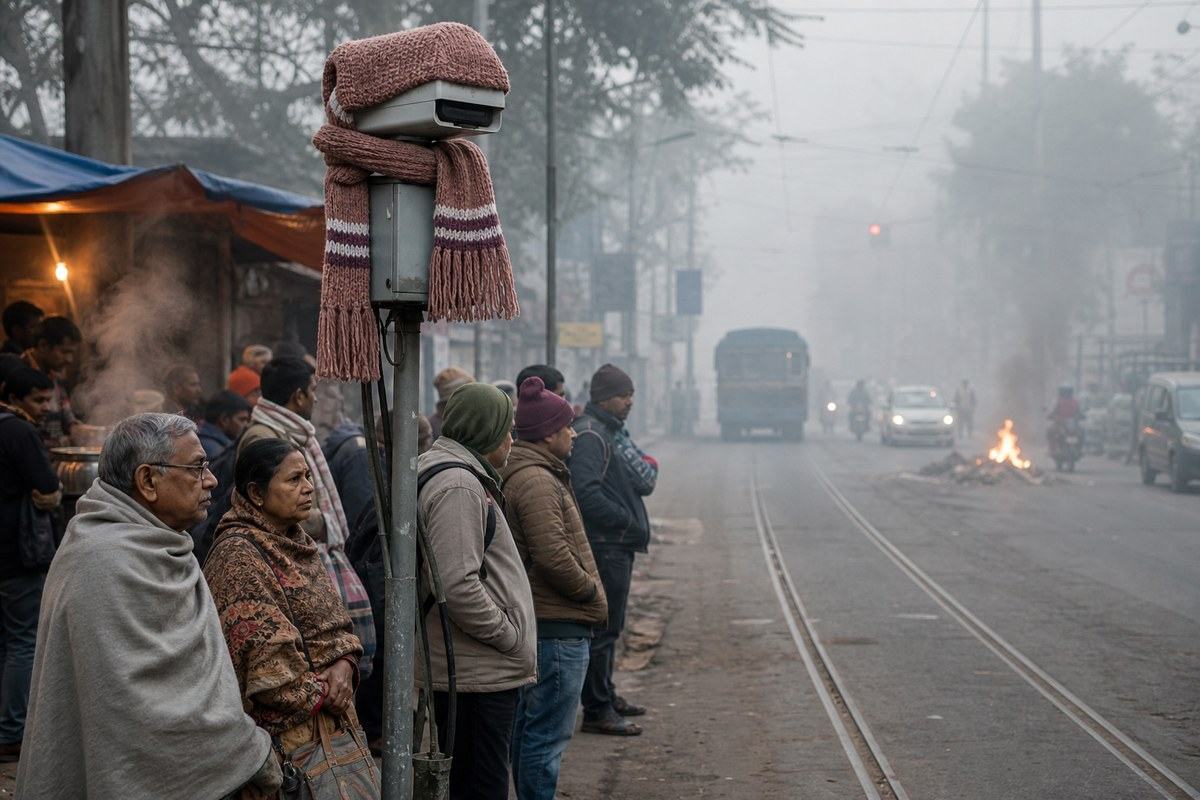
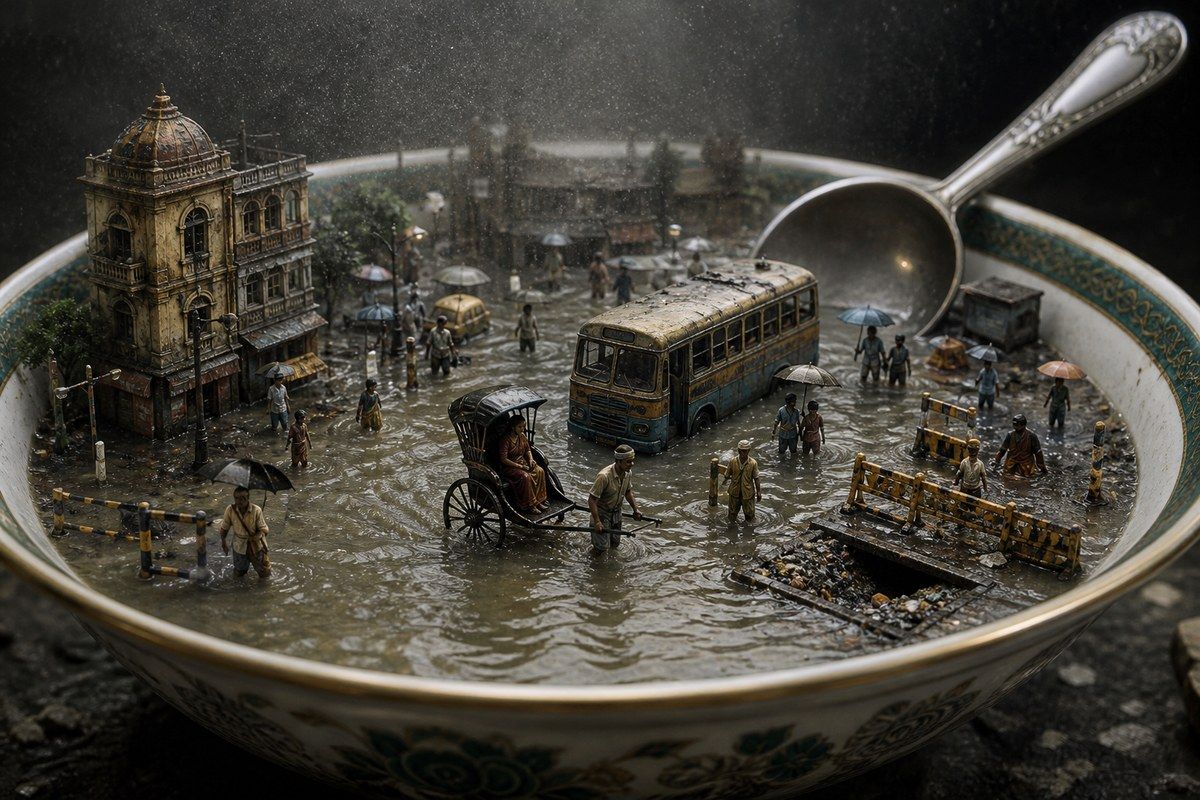
You open the window and the outside comes in like a committee. Dust, smoke, old diesel, burnt plastic, construction powder, winter fog, frying oil, and the tired breath of a city that has been running without maintenance since perhaps the Battle of Plassey. Close the window and the room becomes a pressure cooker full of yesterday’s exhalation. Open it and the lungs file a protest.
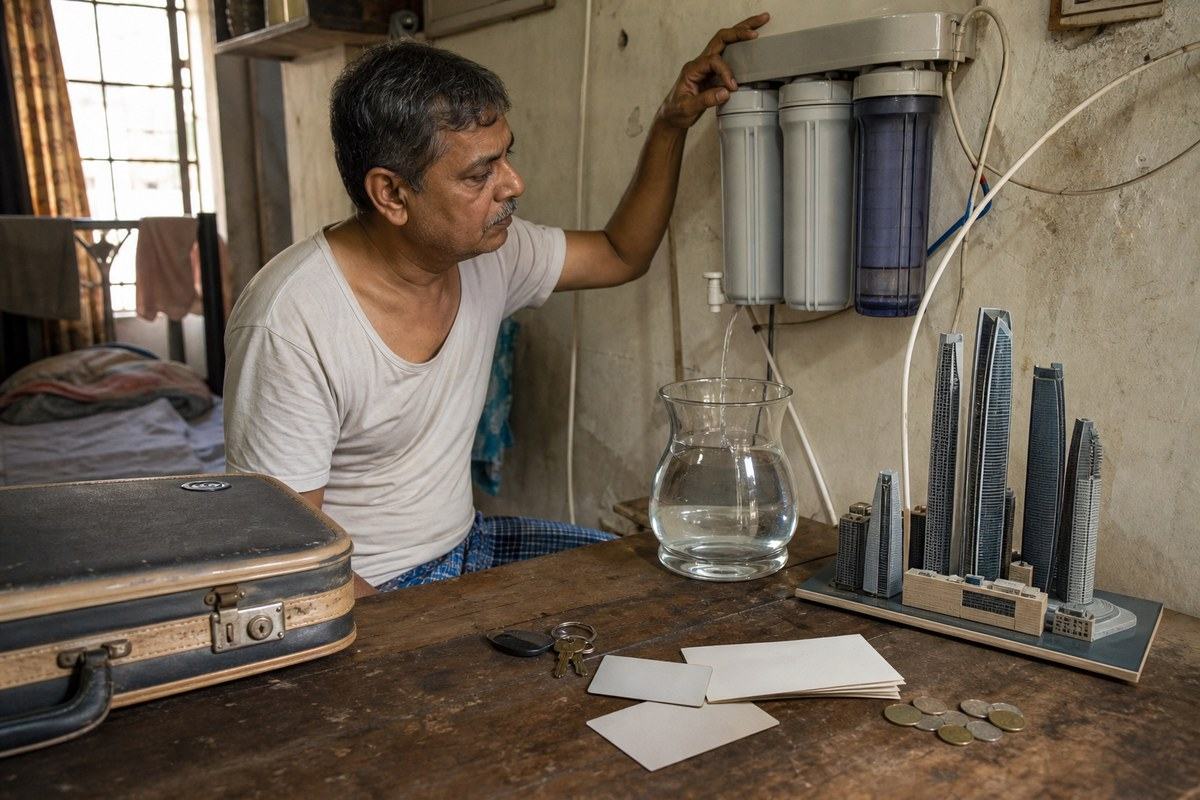
I sit in my lower-middle-class corner of Calcutta, fifty-one years old, single, overqualified for despair and underfunded for optimism, trying to make tea with the solemn dignity of a man who has known American office coffee and still returned to powdered milk. Outside, a scooter coughs. Inside, I cough back. We are two machines of uncertain resale value.
The city has many sounds in the morning. Vegetable sellers. Crows. Pumps. School vans. A dog arguing with destiny. Somewhere a television news anchor is already shouting as if the stock market personally insulted his mother. The world is discussing elections, AI, cricket auctions, wars, billionaires, and whether some new phone can fold without becoming a wallet for idiots.
Meanwhile, my nose has produced a sample.
This is the real current affair.
Not breaking news. Crusting news.
And because the Indian mind cannot leave suffering alone, it immediately asks: can this be monetized?
That is where the Great Indian Snot Mine enters the story.
Imagine, only for a moment, a government circular. Not an actual one, though give us time. A neat notice, printed badly, with three seals and four spelling mistakes, announcing a pilot program for “bio-particulate mineral recovery from urban respiratory discharge.” Beautiful phrase. The kind that could pass through a ministry, a consultancy, a start-up pitch deck, and a television debate without one person saying, “Excuse me, are we collecting snot?”
The citizen is now a resource.
Your lung is an air filter.
Your nose is a collection tray.
Your handkerchief is a national asset.
Every sneeze is a small act of mineral diplomacy.
There would be forms, naturally. India without forms is like fish curry without fish, possible only in theory and during budget cuts. Name. Age. Ward number. AQI exposure window. Sample type. Right nostril, left nostril, mixed, uncertain. Tick here if the discharge contains visible particulate sparkle. Tick here if you consent to patriotic processing.
A collection van would come once a week. It would play a tune, because humiliation in India is never complete without music. Residents would come down with jars. Aunties would compare yield. Uncles would discuss technique. Someone would claim steam inhalation improves mineral density. Someone else would say his cousin in Dubai has a machine. A YouTube doctor would warn against low-grade mucus. A WhatsApp message would announce that adding turmeric increases scandium content.
By the second month, coaching centers would appear.
“Crack the National Nasal Productivity Test.”
“Weekend batch for children.”
“Guaranteed improvement in respiratory output.”
A start-up in Bengaluru would launch an app. You upload a photo of your tissue, and AI estimates the market value of your congestion. There will be a premium plan, of course. There is always a premium plan. For ₹299 per month you can track trends, compare with neighbors, and receive motivational notifications like: “Congratulations, your left nostril outperformed 82% of your district.”
This is how satire dies in India. Not because it becomes too wild. Because reality catches up wearing bathroom slippers.
Now, rare earths are funny things. They sound like buried treasure, but mostly they are troublesome metals used in the clean modern world: phones, batteries, screens, magnets, speakers, electric vehicles, and other objects that allow rich people to feel green while poor people inhale the supply chain. They are not all rare, and they are not especially earthy in the village sense. They are just hard to separate, expensive to process, and fond of arriving with environmental headaches.
Which is why the mucus economy, though ridiculous, has a certain wicked poetry.
Why dig mountains when citizens are already breathing them?
Why import minerals when every city dweller is quietly running a filtration plant between his nostrils?
Why call pollution a failure when you can call it raw material?
There it is, the little trapdoor under the joke.
Because this is how bad systems survive. They rename pain. Dust becomes development. Smoke becomes winter condition. Illness becomes individual weakness. Clean air becomes lifestyle choice. The rich buy purifiers. The poor buy cough syrup. The lower middle class buys nothing immediately, only checks the price online, closes the tab, opens it again at night, and wonders whether breathing is now a subscription service.
My room is small enough that one mosquito can feel like an aviation event. The plastic stool has one doubtful leg. The rice cooker sparks occasionally, not dramatically, just enough to remind me that electricity too has a sense of humor. On the table: laptop, tea stain, old prescription, half a packet of biscuits gone soft from humidity, and one tissue folded like evidence in a crime drama.
I am supposed to work.
Work requires mind.
Mind requires air.
Air has arrived with accessories.
So instead of working, I inspect my own respiratory output like a bankrupt scientist. I hold it near the sunlight. It glints. Perhaps it is just dust. Perhaps construction sand. Perhaps carbon. Perhaps a microscopic piece of some flyover that was inaugurated before it was completed, as is our national custom. Perhaps it is nothing.
But the body knows before the report does.
The throat burns. The eyes water. The head feels stuffed with wet newspaper. You become slow in a way that looks like laziness from the outside and feels like being wrapped in old carpet from the inside. This is one of the cruel jokes of pollution. It does not always arrive as drama. It arrives as dullness. As fatigue. As a mood. As the inability to think clearly at 11:30 in the morning when you had promised yourself, with great ceremony, that today would be different.
Today is different.
The tissue sparkles.
When I was young, nobody said AQI. We said dust. Dust was not a crisis. Dust was practically a family member. It sat on the showcase, on the radio, on framed gods, on the school shoes. Mothers wiped it. It returned. Fathers ignored it. It thickened. Children drew lines through it with fingers and were shouted at for making things dirty, which is one of the great philosophical jokes of childhood.
We had Vicks. We had steam. We had the old instruction: don’t make a fuss.
That instruction has governed half the subcontinent.
Don’t make a fuss about the drain.
Don’t make a fuss about the smoke.
Don’t make a fuss about the cough.
Don’t make a fuss about the room, the salary, the job market, the broken pavement, the burning garbage, the school fees, the medicine bill, the loneliness, the headache, the fact that your morning begins with your own nose handing you a geological warning.
But a fuss is sometimes just information with a pulse.
And this is the information: bad air is not just outside. It becomes inside. Inside the room, inside the curtain, inside the mattress, inside the chest, inside the day’s ambition. It takes a man’s already fragile morning and adds sand to the gears.
The newspaper will talk about growth.
The television will talk about pride.
The app will show a number.
The body will show the invoice.
Of course, I still laugh. What else is there? Revolution requires organization, and I have misplaced my socks. So I imagine my future as a respiratory entrepreneur. “Suvro Ghosh, founder of Nostril Minerals Private Limited. Urban extraction. Human-scale supply chain. Calcutta-origin artisanal particulate concentrate.” We will have a logo: two lungs holding a pickaxe. Tagline: Breathe Local, Mine Global.
Investors will love it until they meet me.
I will arrive late, coughing, with tea on my shirt, and explain that the business model depends on everyone continuing to suffer. They will say, “Excellent scalability.” I will say, “That was criticism.” They will say, “We hear you.” That is corporate language for not hearing anything.
By evening the city turns orange-grey, the way old ceiling bulbs used to glow in rooms where nobody had money for tube lights. The crows return. The frying begins. The buses snort. Somewhere a child laughs, because children are unreasonable and therefore civilization’s last defense. I make tea again. It tastes faintly of metal, dust, and stubbornness.
I blow my nose once more.
Another sample.
Less sparkle this time, more ash. A modest yield. Not export grade.
I fold it carefully before throwing it away, as if it deserves ceremony. Perhaps it does. It has done the work of a small filter. It has caught what the city sent. It has carried, in one damp little scrap, the whole argument: development without breath is not development, comfort without public air is only private escape, and a nation that makes its citizens filter the sky through their bodies should at least have the decency to say thank you.
No one says thank you.
The rice burns.
The eye waters.
The news anchor shouts.
The city enters through the window again, confident as a landlord.
And I, loyal citizen, unpaid miner, exhausted filter, sit with my cup of tea and continue the national duty.
I breathe.
Word Cloud
Related reading
Selected by shared topics and section, with closer publication dates breaking ties.