The Boy Inside the Broken House
Uses the speech voice supplied by your browser or device.

AI — Artificial Intelligence: machines and software that can write, code, summarize, draw, classify, predict, imitate, and compete with human work at terrifying speed.
BD — Bipolar Disorder: a mood disorder where depression, energy, sleep, irritability, impulse, and motivation can move like badly wired weather.
SEO — Search Engine Optimization: the practice of making writing easier for search engines and readers to find.
Some mornings do not begin; they merely squat on the chest like a fat municipal babu who has mislaid your file and now expects tea.
That is the honest shape of it.
Not sorrow with violins. Not noble suffering with a soft-focus window and one photogenic tear. This is the other kind. The unmarketable kind. The kind where a 51-year-old man in the shanty boondocks of Calcutta lies in bed and looks at the ceiling fan as if it is the only witness left in the case. Outside, someone is arguing about fish prices. A pressure cooker whistles. A stray dog gives a short lecture on civic failure. Somewhere a scooter coughs itself awake. The city has started its day, wearing a torn vest and supreme confidence.
And I have not.
That is the first humiliation. The world keeps moving even when your inner machinery has declared bandh.
Get up, the world says.
Take a bath.
Make tea.
Open the laptop.
Do some work.
Send one email.
Repair your life.
Such modest little orders. On paper they look harmless, like a packet of Marie biscuits. But inside a depressive low they become the Himalayas wearing bathroom slippers. The toothbrush becomes a project. The kettle becomes a negotiation. The laptop becomes a court summons.
You think laziness looks like lying down.
Not quite.
Sometimes lying down is not laziness. Sometimes it is a nervous system that has pulled the emergency brake so hard the handle has come off.
And then there is the second humiliation, which has arrived recently wearing a clean shirt and no pity: AI.
Once, at least, if a man felt left behind, he could imagine being overtaken by another man. Some younger fellow, perhaps. Better teeth. Better posture. A fresh degree. A motivational LinkedIn smile. The sort of person who says “excited to announce” without first needing two cups of tea and a minor resurrection.
But now the competitor is not even properly human.
It does not wake with dread.
It does not lie staring at the wall.
It does not have a mood episode.
It does not avoid bathing because the distance from bed to bathroom feels like a foreign posting.
It does not age, blush, panic, forget, ruminate, or wonder where the sunny boy went.
AI sits there like a tireless clerk from some impossible office. Give it a task and it begins. No coughing. No shame. No childhood. No unpaid emotional electricity bill. It writes, rewrites, codes, draws, summarizes, translates, explains, and returns with something polished enough to make an ordinary human feel like an old fountain pen in a touchscreen showroom.
This is where the joke becomes cruel.
Because even the fast now face something faster. Even the smart face something that can imitate smartness in bulk. Even the young face a machine that does not need youth. Even the handsome, the fluent, the gym-fit, the globally employable, the people who drink green things in glass bottles and call it discipline, now have a competitor available in all sizes, all time zones, all moods, which is to say no mood at all.
So I am not alone.
That should comfort me.
It does not comfort me very much.
A flood in the whole neighborhood does not make the water under your bed less wet.
My own difficulties remain my own. My illness is not a metaphor. My stuckness is not a LinkedIn post. My exhaustion is not a personal branding opportunity. I cannot repaint it in cheerful colors and call it reinvention. Some days it is only a man, middle-aged and ashamed, lying prostrate, angry at his own impotence to bring even one decent change into his life.
There is a particular anger in knowing what is wrong and still not being able to move.
Ignorance has an excuse. Confusion can at least look innocent. But knowledge without action is a special insult. I know that movement helps. I know sleep matters. I know structure matters. I know one small step is better than one grand collapse. I know shame eats energy. I know anger burns the same house it tries to defend.
Wonderful.
The professor has spoken.
Meanwhile the student is still under the blanket.
This is the part many people do not understand. They think depression is a lack of information. As if one more sensible suggestion will fix the wiring. “Go for a walk,” they say, with the sunny cruelty of people whose legs report to them on time. “Think positive.” “Be grateful.” “Do yoga.” “Make a routine.”
Yes, certainly. And while I am at it, I shall also rebuild the tram system, teach the crows table manners, and persuade the Kolkata humidity to behave like Switzerland.
The problem is not that these suggestions are always wrong. Often they are right. That is what makes them unbearable. A good suggestion given to a frozen man can feel like someone handing a violin to a drowning swimmer.
In my fifty-first year, the lows have changed texture.
Earlier, sadness had weather. It rained, it cleared, it returned, it made a nuisance of itself. But this new low is not weather. It is a basement. You go down one step, then another, and then the door above you closes with the soft confidence of a bank locker. No drama. No thunder. Just darkness with paperwork.
Once inside, it is hard to explain the depth to someone standing in daylight.
They will ask, “But what happened?”
A fair question.
Also useless.
Nothing happened and everything happened. Years happened. Work happened. America happened. Calcutta happened. Age happened. Illness happened. Missed chances happened. AI happened. Markets happened. Family expectations happened. The ridiculous theatre of masculine competence happened, where a man is expected to produce money, certainty, emotional restraint, career progress, and plumbing solutions even when his own mind has become a leaking tap at 3 a.m.
A single event did not knock the building down.
Termites did.
Rain did.
Neglect did.
Bad repairs did.
And yes, perhaps the building was never as strong as it looked from the street.
This is where I keep returning to the same question, like a man checking an old drawer for a document he knows may no longer exist.
Where is that sunny boy of childhood?
That boy was not rich. He did not have much. But he had brightness, which is a different currency. He could look at a pencil, a tram ticket, a science book, a cricket ball, and feel the world opening like a tin box full of forbidden sweets. He had not yet learned how much of life is waiting, rejection, bargaining, illness, humiliation, and pretending to be fine because the shopkeeper has asked “Dada, aar kichu?”
And where is the ambitious youth?
Ah, that fellow. Dangerous creature. Full of plans. Full of electricity. He believed effort and talent had a clean exchange rate. Put in work, receive future. Study hard, cross oceans, learn systems, build expertise, become useful, become safe. He did not yet know that life keeps hidden charges. Age surcharge. Visa surcharge. Mood surcharge. Market surcharge. Returning-home surcharge. Being-too-old-for-some-doors-and-too-broke-for-others surcharge.
He thought the road would remain a road.
Then the road became a maze.
Then the maze got an app.
Then the app got AI.
I sometimes suspect the boy and the youth are both dead. Not dramatically dead, not with garlands and speeches, but dead in the way old houses die in Calcutta. They remain standing, but inside them the beams have surrendered. The balcony still has ironwork. The nameplate remains. A passerby may even say, “Nice old house.” But one day a chunk of plaster falls, and you realize the house has been negotiating secretly with gravity for years.
That house is me.
A facade with weather stains.
A respectable ruin.
A man-shaped arrangement of memory, manners, unpaid bills, old knowledge, and one stubborn bamboo pole holding up the roof.
I do not say this to harvest pity. Pity is cheap and often poorly cooked. I say it because false cheerfulness has become a kind of social tax. Everyone must convert pain into content, failure into lessons, depression into “my journey,” and unemployment into “a season of growth.” Even despair is expected to arrive with a caption, three bullet points, and a sunset.
No.
Some days are just bad.
Some months are worse.
Some years arrive with a crowbar.
If there is a lesson here, it is hiding under the bed and refusing to come out.
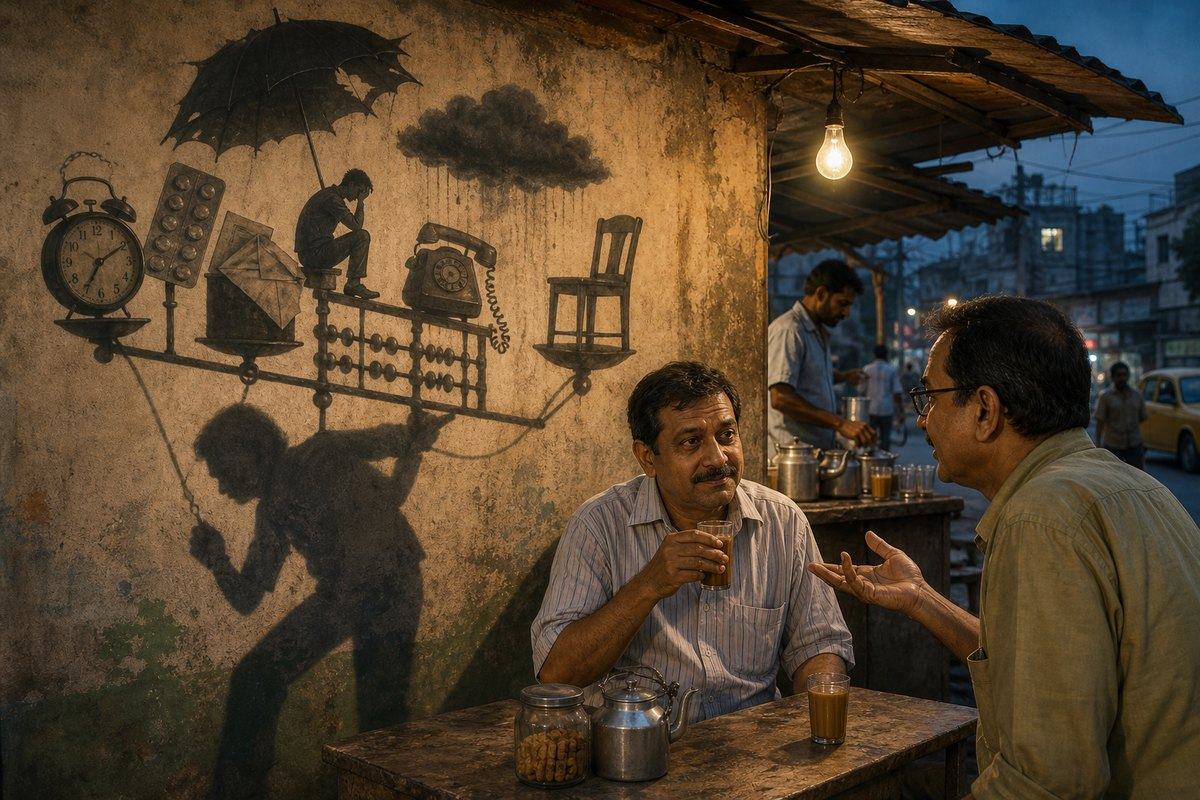
Meanwhile the world outside is absurdly alive. The tea stall still performs its daily parliament. Someone knows exactly what the Prime Minister should do, what the Chief Minister should do, what the cricket selectors should do, what America should do, what China should do, and what the neighbor’s son should have done in his marriage. Every morning, the news app coughs up layoffs, elections, wars, markets, scandals, heat, floods, rockets, billionaires, and new devices that promise to simplify life by adding one more password.
History is galloping.
My tea is getting cold.
This is the comic mismatch of the age. Civilization is discussing AGI, chips, space missions, climate, markets, and the future of work. I am negotiating with my towel.
One must admire the scale.
And yet even here, in this undignified little corner, there is a hard truth worth keeping. The machine may be faster, but it does not suffer the meaning of speed. It can produce language, but it does not remember the smell of a damp room in May. It can describe loneliness, but it has never eaten alone while pretending not to mind. It can imitate confession, but it has no old self buried inside it. It can generate a boy, but it has never lost one.
This does not make AI harmless.
Let us not become silly.
The market often pays for output, not wounds. Employers do not generally say, “Please send us your childhood radiance and evidence of existential depth.” They want deliverables. Fast. Clean. Cheap. Preferably by yesterday. AI will change work. It will squeeze some people, enrich some people, confuse most people, and allow a great many fools to speak with the borrowed confidence of machines. The old ladder is wobbling. The new ladder may have missing rungs. And some of us are standing below, looking up, already tired.
But perhaps the contest cannot be only speed.
If the race is against a machine that does not sleep, I lose before putting on shoes.
So the question must shrink.
Not “How do I defeat the future?”
Not “How do I become young again?”
Not “How do I produce a grand comeback acceptable to relatives, recruiters, and invisible spectators?”
A smaller question.
What can I do today without lying?
That question is not glamorous. It will not trend. It will not bring applause from Silicon Valley or Salt Lake or Sector V. But it has the advantage of being real.
Can I sit up?
Can I wash my face?
Can I make tea?
Can I open the laptop for ten minutes without demanding that those ten minutes justify my entire existence?
Can I write one paragraph?
Can I answer one message?
Can I refuse, for one hour, to conduct a full criminal trial against myself?
This is not optimism. It is maintenance.
And maintenance is underrated because it has no fireworks. Nobody claps when a bridge does not fall. Nobody writes poetry about a drain that works. Nobody congratulates the old ceiling fan for turning one more summer. But much of life is maintenance. Holding. Patching. Cleaning. Returning. Restarting. Not because the future is guaranteed, but because collapse is also work, and I am tired of donating my labor to it.
Maybe the boy is not a corpse.
Maybe the youth is not either.
Maybe they are buried, yes, but buried is not the same as erased. Seeds are buried. Wires are buried. Old coins are buried. Whole cities are buried and later found by patient people with brushes. Perhaps inside this facade, under the broken plaster, there is still some small room where the boy sits with his knees up, annoyed but alive. Perhaps the ambitious youth is not marching anymore, but sitting in a corner with dusty shoes, waiting to be spoken to without contempt.
I cannot promise them victory.
I cannot even promise them punctual bathing.
But I can perhaps stop calling them dead every day.
That may be the first repair. A small one. Almost laughably small. Like putting a mug under a leak and calling it engineering. But many houses survive that way for longer than experts expect.
A mug here.
A rope there.
A nail.
A prayer.
A joke.
Tea.
Then another morning.
For now I remain tired, left behind, often angry, often ashamed, often afraid that the best parts of me have become archaeological remains under a failing structure. But remains are not nothing. A broken cup means someone once drank water. A cracked step means someone climbed. A ruined courtyard means there was once a house where light entered.
The darkness may be telling the truth about today.
It is not qualified to write the whole biography.
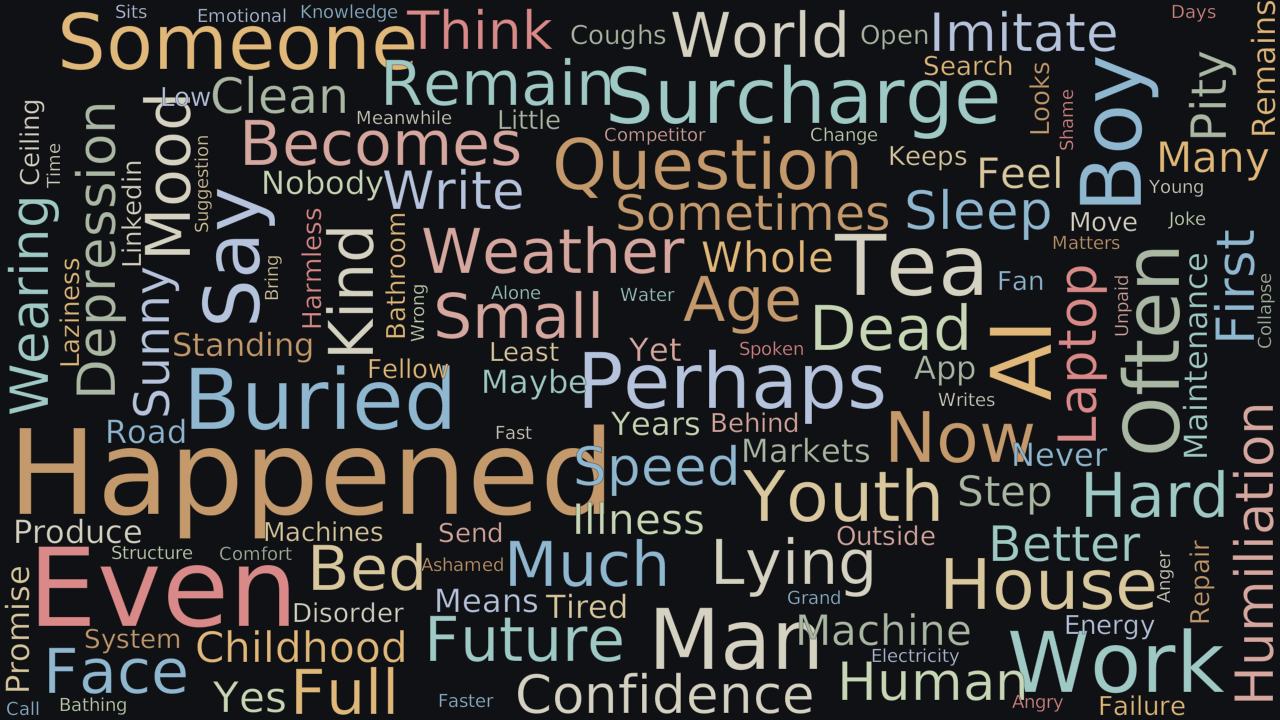
Word Cloud
Related reading
Selected by shared topics and section, with closer publication dates breaking ties.