Dead Body in Stagnant Water
Uses the speech voice supplied by your browser or device.

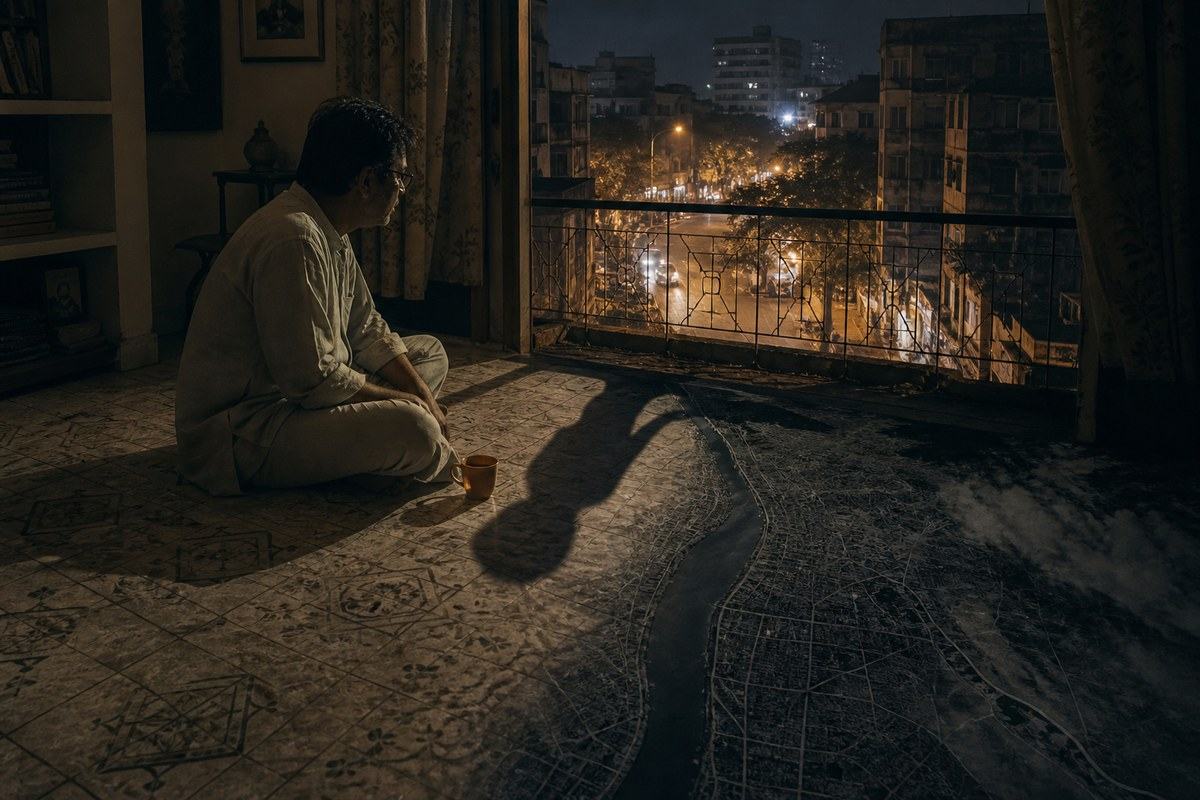
Some mornings I wake up in Calcutta and feel not like a man, but like something the city forgot to dispose of properly.
Not a tragic hero. Not a fallen prince. Nothing so grand. More like a dead body in stagnant landfill water, swollen with old rain, plastic packets, mosquito larvae, paan spit, political posters, and the exhausted perfume of civilization after it has removed its shirt and given up.
Then the phone lights up.
Someone has sent a good morning message with a rose.
This is how the day begins.
A 51-year-old unemployed lower-middle-class Bengali man does not collapse dramatically. He does not fall in slow motion while violins behave like widowed relatives. He lies in bed and calculates tea. Tea should be simple. Water, leaf, milk, sugar, flame. Four or five ordinary nouns. But depression can turn tea into the Konark Sun Temple. Magnificent, ancient, impossible to assemble before noon.
You think the problem is sadness.
No.
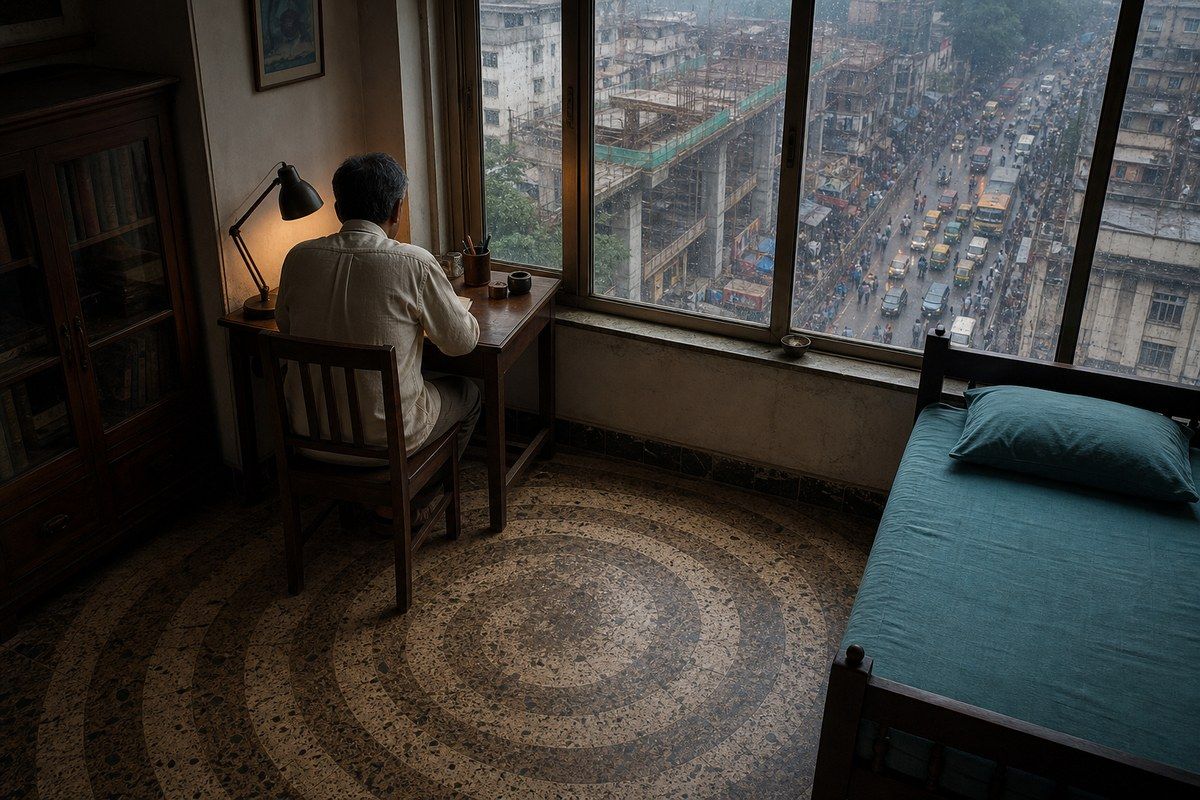
Sadness has manners. Sadness can sit by a window and look at rain. Sadness can be written in a notebook with a fountain pen by someone who still has the decency to bathe. Depression is different. Depression is a damp government file tied with red ribbon. It smells faintly of mildew and defeat. It says, “Application pending.” It never says which application.
Bipolar depression is worse because it comes with its own circus troupe. One day the mind is a marching band. Next day it is a locked bathroom. Some days anger comes first, wearing cheap sandals and carrying a stick. Then shame comes behind it, like a clerk with a receipt book. Anger breaks the cup. Shame charges interest. By evening the man is not merely tired. He is morally exhausted, as if he has committed a crime by existing in a bad mood.
And unemployment sits nearby, chewing betel nut.
Nobody tells you how unemployment enters the body. It does not remain on paper. It gets into the shoulders. The jaw. The stomach. The way you answer the phone. The way you avoid neighbors. The way you look at a shirt and wonder whether it is still “interview worthy,” as if cotton itself has lost faith in you.
In Calcutta, a jobless middle-aged man becomes a small social puzzle. Too old for cheerful advice. Too young for retirement sympathy. Too educated for simple pity. Too broke for respect. Too experienced to start again at the bottom without rage rising like sewer gas. People ask, “So what are you doing now?” with the innocent cruelty of people asking a fish about mountaineering.
You say, “Consulting.”
This is not entirely false.
It is also not entirely food.
The world likes men in neat categories. Employed. Retired. Successful. Failed. Stable. Troubled. Productive. Lazy. A man with bipolar depression and a broken career line is none of these clean things. He is a paragraph with too many commas. Society prefers bullet points.
Here is the catch. The man may still be intelligent. This offends everyone, including the man.
If I were stupid, things would be easier. One could blame the machinery. But I have studied. I have worked. I have lived in America. I have sat in offices where the air-conditioning behaved like a colonial power. I have understood systems, databases, hospitals, research, rules, maps, broken workflows, human panic hidden under professional vocabulary. I know how complicated things work.
And yet some mornings I cannot begin.
There is a special humiliation in being able to explain a large system but unable to brush your teeth without negotiation.
The healthy world does not understand this because the healthy world imagines action as a straight line. Decide, rise, do. Like a good schoolchild in a moral science book. But the depressed brain is not a straight line. It is Ultadanga traffic after a political rally. Horns, heat, exhaust, one goat, three buses angled like wounded ships, and somewhere a policeman waving with philosophical resignation.
You do not “just do it” in that traffic.
You survive it one inch at a time.
This is not an excuse. Excuses are usually lighter. This thing is heavy. It has the weight of wet bedding.
The brain is an organ, not a motivational poster. It runs on chemistry, rhythm, memory, sleep, fear, reward, habit, and the small daily electricity of hope. When bipolar depression tampers with those circuits, ordinary tasks become oddly tall. A bath becomes a campaign. Opening the laptop becomes a court appearance. Updating the résumé becomes an autopsy performed by the patient.
Then comes the nasty little voice.
It says, “You are lazy.”
A beautiful lie. Very popular. Easy to pronounce.
But laziness has pleasure in it. Laziness eats jilipi and stretches in the afternoon. Depression has no pleasure. Depression does not say, “Ah, delightful, let me ruin my life today.” Depression is not rest. It is unpaid labor inside a locked room. You are lifting invisible sacks while the world accuses you of lying down.
This distinction matters.
Because if you call a wound a character flaw, you will treat it with hatred. And hatred is a terrible doctor. Very confident. Very badly trained.
Still, the rice must be bought. The electricity bill does not care about neurotransmitters. The medicine shop does not accept elegant metaphors. The landlord, will not say, “Take your time, my son, late capitalism has wounded your prefrontal cortex.” He will ask for money. Correctly. Brutally. As civilization has arranged.
So one must be practical.
But not cruel.
The cruel version says, “Get up, you useless man.”
The practical version says, “Sit up first.”
That is the whole revolution. Sit up first. Feet on floor. Drink water. Wash face. Do not solve life before tea. Life is too large before tea. Even the British needed tea before conquering half the planet, and look what a mess they made.
A lower-middle-class Calcutta day has no cinematic mercy. The lane is damp. Someone is arguing about a parked scooter. A pressure cooker whistles in a nearby flat with the authority of a minor dictator. A child recites multiplication tables. A dog sleeps in the exact philosophical posture of a retired judge. The news shouts about elections, heatwaves, markets, cricket, corruption, some billionaire buying something unnecessary, some minister denying something obvious. The world continues.
This is both insulting and helpful.
Insulting because your private disaster has not stopped the tramlines of existence. Helpful because perhaps disaster is not the whole story. Perhaps the day is not asking for a grand resurrection. Perhaps it is asking for one small act of maintenance.
Maintenance is underrated because it is not glamorous. Nobody claps because you washed a cup. No one gives an award because you took a bath after three days of negotiating with the towel. LinkedIn has no badge for “Did Not Completely Surrender Today.” It should. It would be more honest than half the leadership certificates floating around like decorative papad.
Maintenance is civilization.
A city survives by drains being cleared, wires being repaired, rice being cooked, medicines being taken, passwords being remembered, old parents being called, small lies being avoided, and one man, somewhere in the shanty edge of Calcutta, washing his face though his mind has declared him already dead.
That washing matters.
Not spiritually. Not poetically. Mechanically. It changes the next minute. The next minute is where life hides.
Depression wants to discuss the whole future at once. It drags in career, age, money, marriage, regret, lost years, missed chances, medical bills, dignity, status, America, India, old friends, younger men earning more, relatives asking questions, and the terrifying arithmetic of time. It dumps all this on the bed at 9:17 in the morning and says, “Now get up.”
No sane creature can get up under that pile.
So the trick is not to win the whole case. The trick is to object to the evidence.
Not all of it belongs in this morning.
This morning only needs tea.
Then perhaps a bath.
Then perhaps one page.
Then perhaps one ugly paragraph.
Ugly paragraphs are important. A polished paragraph is an upper-class thing. It arrives bathed and perfumed. An ugly paragraph comes like a fish seller before sunrise, loud, necessary, smelling of work. Many good essays begin as ugly paragraphs that refused to die.
The same is true of men.
A man may look finished long before he is finished. A career may look like a landfill before someone finds metal in the trash. Calcutta itself is an expert in this department. It looks permanently on the verge of collapse, then produces a poet, a physicist, a football argument, a political slogan, a plate of biryani, and a grandmother who can destroy your entire worldview with one sentence from a cane chair.
Decay and life live very close here. Sometimes in the same drain.
That is why the stagnant-water image is powerful. It is disgusting, yes. But it is not empty. Things breed there. Mosquitoes, fever, smell, yes. But also reflection. Sky appears in dirty water. A bird lands on a dead head, mine, in this thought. A ragpicker finds value where polite society sees only disposal. This is not romance. This is field observation.
The mind says, “You are dumped.”
The eye says, “Look again.”
The danger is believing the first sentence is the whole book.
“I feel like a dead body” is a sentence from pain. It deserves respect. It should not be dismissed with cheerful nonsense. But it is still a sentence, not a court order. The feeling is real. The conclusion may be false.
This is where a little skepticism saves the soul. Not optimism. Optimism is often a salesman with shiny teeth. Skepticism is better. Skepticism says, “Are we sure?” Are we sure this man is useless? Are we sure this day is gone? Are we sure the future has closed? Are we sure the brain, currently behaving like a wet matchbox, is a reliable judge of destiny?
Not quite.
The brain in depression is a biased narrator. A gifted one, unfortunately. It writes dark prose with excellent lighting. It selects memories like a crooked editor. It finds every failure, enlarges it, frames it, and hangs it in the central hall. Then it hides the evidence of endurance in a back drawer.
But the evidence exists.
The years survived exist. The work done exists. The migrations survived exist. The knowledge earned exists. The tenderness, even if buried under irritability, exists. The fact that a man can describe his own despair with such precision means there is still a witness inside him. The witness is not dead. Bruised, yes. Underpaid, certainly. Wearing a faded vest, possibly. But alive.
This is not a happy ending.
Good. Happy endings are often dishonest. What we need is a usable ending.
A usable ending says: today may remain difficult, but it need not become a total loss. The body in the water can become the man at the basin. The man at the basin can become the man with tea. The man with tea can become the man who opens the laptop. The man who opens the laptop can become the man who writes badly for twenty minutes. Twenty bad minutes can become one tolerable paragraph. One tolerable paragraph can become a post. A post can become a signal. A signal can become work. Work can become money. Money can become breathing room.
Not guaranteed.
Possible.
That small word is not small.
Possible is the crack in the wall where the plant begins.
So no, I will not say I am fine. Fine is a word people use when they want the conversation to leave quickly. I am not fine. I am 51, Bengali, unemployed in a brutal market, carrying bipolar weather in the head and lower-middle-class arithmetic in the pocket. Some days I am ashamed of my anger. Some days I am ashamed of my need. Some days I am ashamed of being ashamed, which is a very Bengali achievement, like making chutney out of the peel of the fruit after already eating the fruit.
But I am not garbage.
I am not landfill.
I am not stagnant water.
I am a man having a hard day inside a hard life in a hard city that somehow, rudely, magnificently, continues.
And tomorrow morning, if the mind again files its false death certificate, I will not argue with the whole department.
I will sit up.
I will put my feet on the floor.
I will make tea.
Let the resurrection start badly. Most honest things do.
Word Cloud
Related reading
Selected by shared topics and section, with closer publication dates breaking ties.