Why I am Misunderstood as a Blogger

Uses the speech voice supplied by your browser or device.
Acronyms used in this post:
Healthcare IT [Information Technology used in hospitals, clinics, insurance, research, and healthcare operations]
FHIR [Fast Healthcare Interoperability Resources, a modern standard for exchanging healthcare data between systems]
HL7 [Health Level Seven, a family of healthcare messaging standards used by hospitals]
VA [Veterans Affairs, the large United States healthcare system serving military veterans]
Sometimes I wonder what people think when they read this blog.
Probably something between “this fellow talks too much” and “this man clearly needs either a vacation or a psychiatrist.” Fair enough. Kolkata itself sounds like that these days. Every para has one uncle shouting at television news channels as if the anchor can hear him personally.
But there is one thing I quietly worry about.
Some readers may think I am useless.
You know the typecasting. Middle-aged Bengali man. No stable senior corporate designation attached to his name. No startup exit. No TED Talk. No smiling LinkedIn photograph holding a coffee mug beside the words “Honored and humbled to announce…”
That sentence alone can raise my blood sugar.
So maybe I should explain a few things before history appoints the wrong stenographer.
I did not spend the last decade sleeping under a tree eating chanachur and composing philosophical WhatsApp forwards.
I burned through almost everything I had trying to build something meaningful in healthcare.
Money first. Then patience. Then confidence. Then sleep. Sleep goes quietly, by the way. One day you are solving architecture diagrams at 2 AM because of excitement. A few years later you are awake at 2 AM because your brain has become an unpaid night security guard.
And trying to build a healthcare venture in India without connections is a bit like trying to open a five-star restaurant inside Sealdah station while goats are walking through the kitchen.
You think I am exaggerating. I am reducing.
People imagine corruption as dramatic cinema corruption. Fat politicians. Briefcases. Ceiling fans. Somebody whispering “deal ho jayega.” No. Modern corruption is often softer and much more exhausting. It is relationship fog. Invisible gatekeeping. Endless polite delays. People who smile warmly while quietly burying your proposal under seventeen committees and one nephew.
In India, many systems do not run on process. They run on social gravity.
And healthcare? Ah. Healthcare is special.
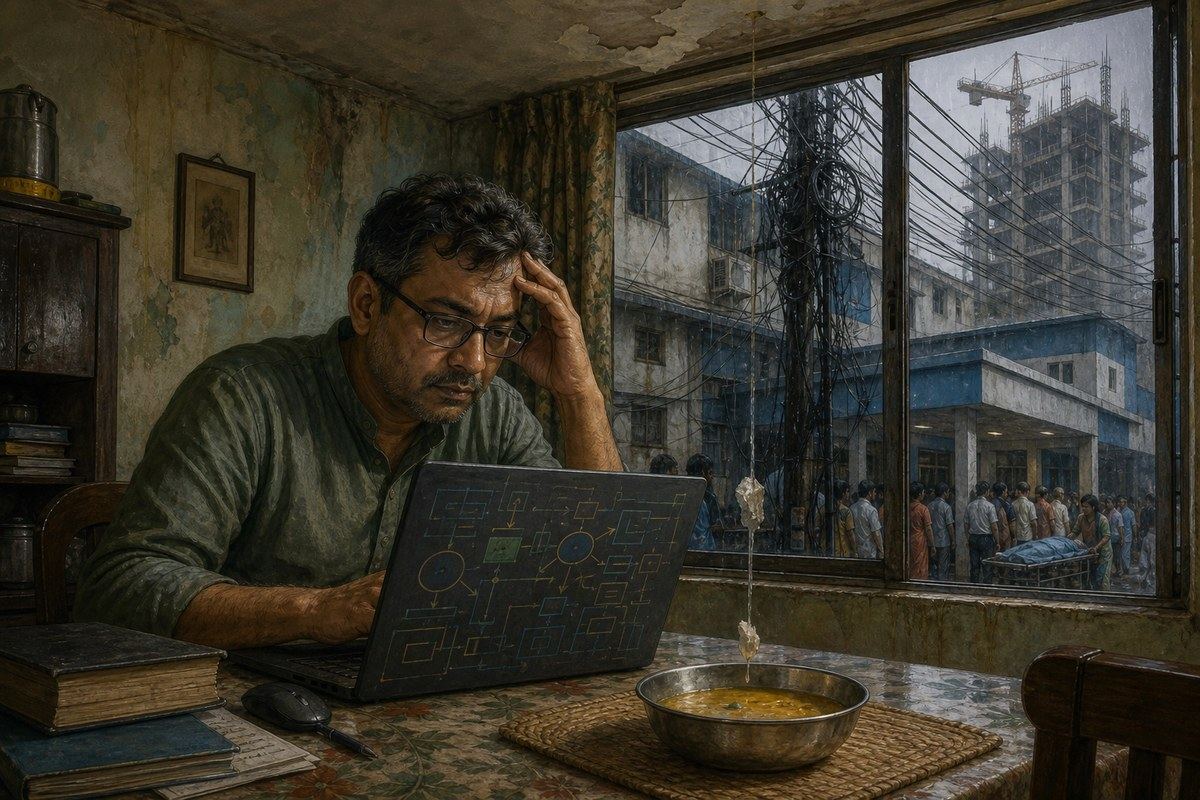
A hospital can have three backup generators, robotic surgery, imported marble flooring, and a reception desk looking like Dubai airport, yet inside the data systems two departments are still emailing Excel files to each other like divorced parents exchanging custody paperwork.
Meanwhile every second person is shouting “AI! AI!” as if artificial intelligence is coriander leaves you sprinkle on top of rotten curry.
You sit in meetings hearing words like innovation and transformation while somebody in the background is manually copying patient IDs from PDF files because two systems refuse to speak properly.
That was my world for years.
And here is the uncomfortable part.
I am not good at corporate theater.
This is not virtue. It is actually professionally damaging.
I cannot grin continuously. I cannot flatter mediocre people with dangerous confidence. I cannot attend networking sessions where everyone speaks like motivational fridge magnets.
Some people are naturally gifted at professional charm. They glide through rooms. They know when to laugh, when to nod, when to say “absolutely.” They survive organizations the way fish survive rivers.
I am more like a goat on wet marble flooring.
The older I became, the worse this mismatch got.
Senior healthcare roles now increasingly demand performance in both senses of the word. You must know the technology, yes, but you must also perform certainty. Perform optimism. Perform leadership energy. Perform resilience. Even your suffering must arrive neatly packaged with inspirational lessons.
Meanwhile inside many organizations everybody is terrified.
Budgets shrinking. Outsourcing expanding. Younger workers cheaper. Executives talking about AI replacing jobs they themselves barely understand. Entire departments living one restructuring away from extinction like nervous dinosaurs checking the sky for meteors.
And age in technology is a strange thing.
At twenty-eight, staying awake all night fixing production interfaces makes you “hungry.”
At fifty-one, it makes management wonder whether you are “still current.”
Same exhaustion. Different branding.
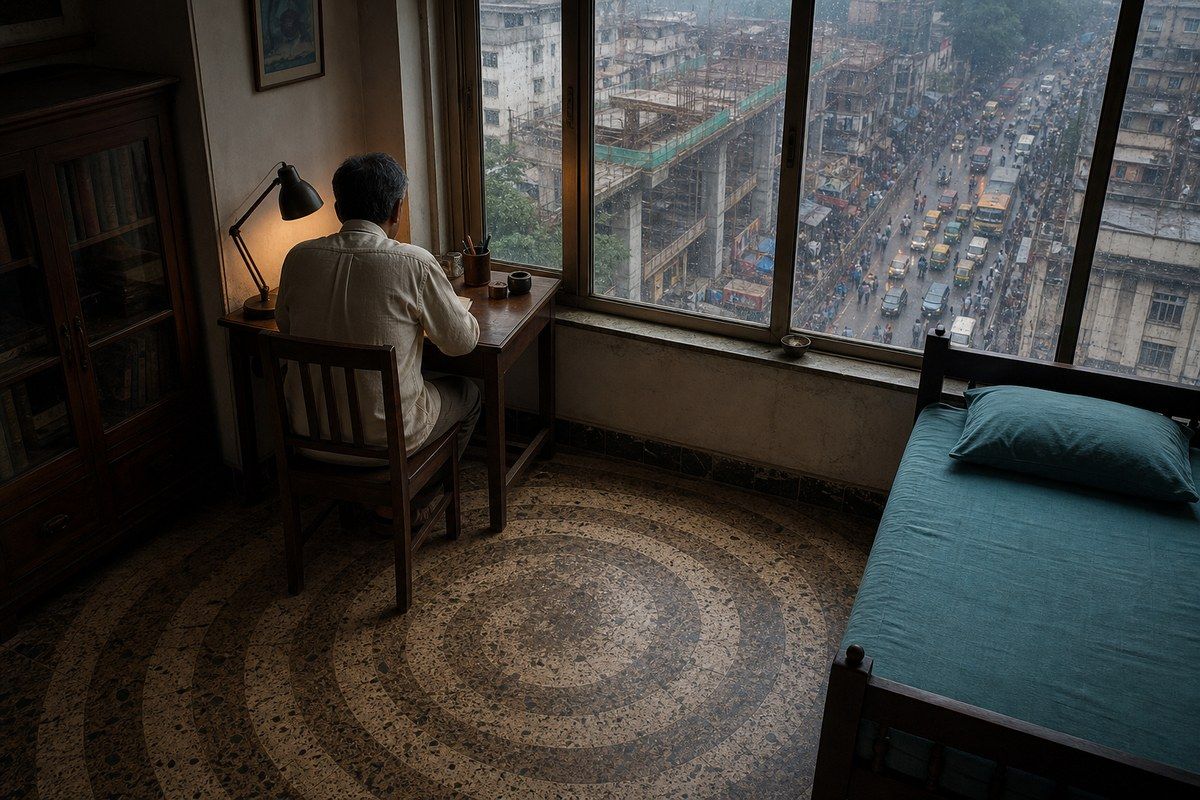
These days I wake up in my small Kolkata neighborhood hearing crows screaming like unpaid political protesters. Somebody nearby is frying luchis in old oil. The milk packet man arrives looking personally betrayed by life. A scooter coughs itself awake like a tuberculosis patient.
Then the day begins.
Electricity fluctuations. Humidity thick enough to chew. Consulting work if lucky. Anxiety if not. Sometimes both simultaneously.
And people say, “Why not just go back abroad?”
That question lands heavily.
Because I am afraid.
There. I said it plainly.
Not afraid of work. I worked in brutal environments before. Real healthcare systems. Real pressure. Real consequences.
I am afraid of returning and discovering the world I loved no longer exists.
America gave me some of the best years of my life. Intellectually especially. For a middle-class Bengali boy who grew up counting coins before buying books from College Street, walking into large healthcare systems there felt extraordinary. I learned systems thinking there. I learned scale there. I learned what competent infrastructure feels like when it works.
Not perfectly. America has its own madness. Their healthcare billing system alone looks like something designed by Kafka after a nervous breakdown.
But professionally, there was oxygen.
Now the atmosphere feels different.
The job market is colder. Immigration conversations have hardened. Foreign workers are tolerated less gracefully during economic anxiety. Especially brown foreigners. Especially aging brown foreigners.
Nobody needs to scream slurs at you. Modern exclusion is subtler. Rooms become slightly colder. Patience shortens. You begin sensing that your margin for error is thinner than everybody else’s.
And I do not know if I can emotionally survive watching my happiest memories slowly become contaminated.
People underestimate this fear.
Memory is fragile furniture.
A city can remain beautiful inside your head for twenty years. Then one bad season there can smash the entire thing like a cheap plastic chair.
So I remain here. Suspended.
Not fully belonging in India anymore. Not fully brave enough to return abroad either.
That in-between condition is becoming increasingly common, actually. There are thousands of us now. Educated migrants floating psychologically between countries like old satellites that lost orbit but did not completely crash.
And meanwhile the internet continues its circus.
One fellow becomes millionaire explaining productivity while clearly sleeping four hours and frightening his pancreas daily.
Another shouts about hustle culture from a rented Lamborghini.
A third posts “Monday motivation” while his employees are probably hiding in office bathrooms crying.
The world rewards performance heavily now.
Depth? Not always.
Still, I write.
Because despite everything, I know things. Real things. Difficult things. I understand why large systems fail quietly before they fail loudly. I understand why “data quality problems” are often really human workflow problems wearing fake moustaches. I understand how organizations slowly become prisoners of their own paperwork.
And maybe more importantly, I understand ordinary defeat.
Not cinematic defeat. Not movie defeat where violins play and life lessons arrive glowing in golden light.
I mean the slow boring defeat of middle age. The kind where your ceiling fan rattles all night while you calculate bank balances and wonder whether your best years are behind you or merely hiding.
But here is the strange thing.
I no longer feel ashamed of surviving.
That took time.
The world trains men especially to measure themselves using salary, title, property, wife, children, promotion, car, square footage. Like a human being is a refrigerator specification sheet.
But survival itself is not small work.
Remaining decent while disappointed is not small work either.
And remaining honest in a civilization increasingly addicted to performance may be one of the hardest jobs left.
Word Cloud
Related reading
Selected by shared topics and section, with closer publication dates breaking ties.