The Empty Room Inside Loneliness
Uses the speech voice supplied by your browser or device.

Loneliness is not an empty chair beside you. That is the tourist version. The postcard version. The one people understand quickly, nodding with the grave sympathy of someone who has located your suffering, put it in a box, labeled it, and gone home for lunch.
Real loneliness is more cunning. It arrives like a house hidden inside another house. First you notice the outside gate. Then the courtyard. Then the narrow passage. Then a smaller room. Then a cupboard. Then a locked tin trunk. Then, at the bottom, wrapped in yesterday’s newspaper, one small terrifying thing.
The missing person is not always someone else.
Sometimes it is you.
This is what bipolar depression has taught me, though taught is too polite a word. It has not taught like a professor. It has taught like a bus conductor in Kolkata during office time, pushing the lesson into your ribs and shouting, “Move, move, move,” while there is clearly nowhere to move.
The most visible loneliness is social loneliness. That one wears a name tag. Single man. Divorced man. Middle-aged man. Lives alone. No wife. No girlfriend visible to the public. No gang of friends shouting from downstairs. No one coming in the evening with a packet of singara and useless advice. In a Bengali neighborhood, this is not privacy. This is an unsolved case.
The neighbors may not ask directly. We are not barbarians. We are civilized people who ask indirectly with eyes, pauses, throat-clearing, and sentences that begin with “So, these days…” A man alone becomes a small municipal concern. Like a broken streetlight. Like a pond being filled illegally. Like a strange smell from the drain that everyone pretends not to notice while noticing with full concentration.
My mother worries. Of course she worries. Mothers do not require broadband to monitor their sons. They came preloaded with worry before the rest of civilization invented software. In her mind, and not wrongly, a man alone is a man without a railing beside the stairs. He may not fall today. But the architecture is suspicious.
Bengali society understands crowdedness better than loneliness. We know how to live with too many people in too little space. We know how to share walls, smells, opinions, festivals, pressure cooker whistles, and other people’s arguments. A family can discuss your digestion with the seriousness of a cabinet meeting. A neighbor can know who visited you last Thursday and still not know what grief is doing inside your skull.
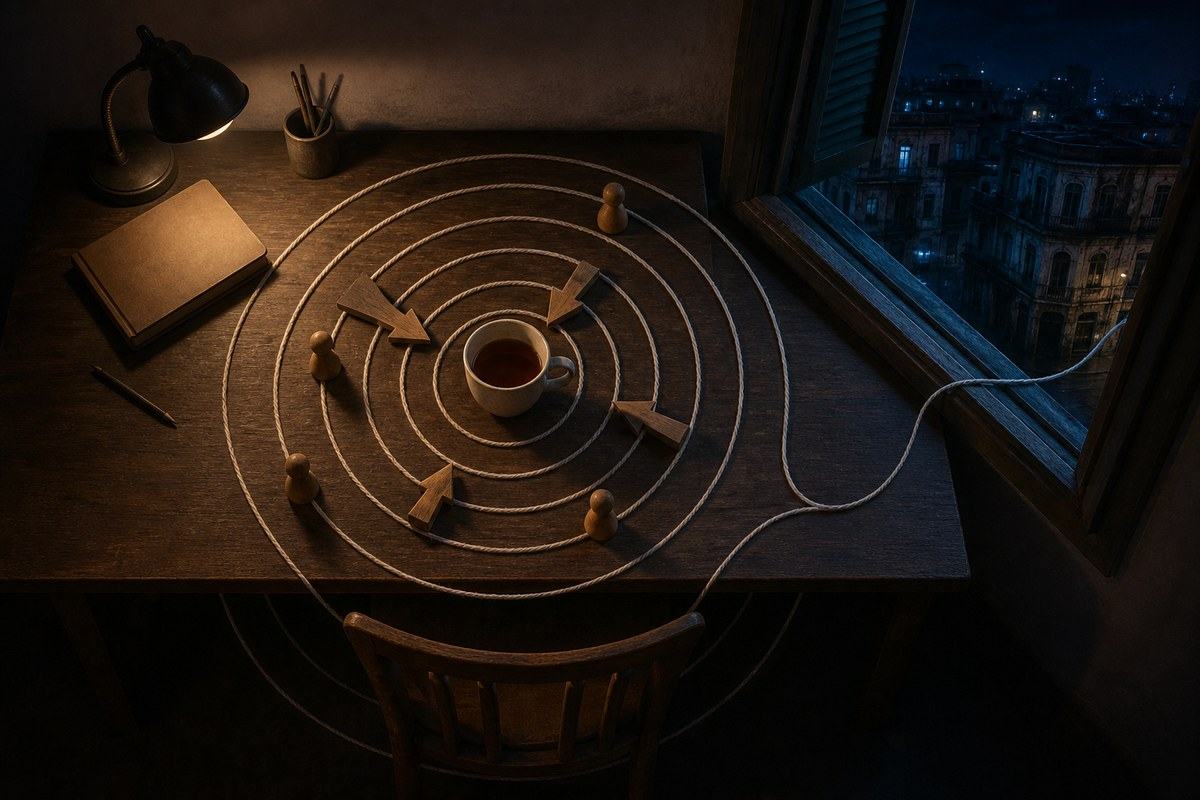
This is the first circle.
It is real.
But it is not the center.
Go one circle deeper and the problem changes. You may not be asking for a crowd. You may not even be asking for love in the grand cinematic sense, with rain, violin, and a man running after a train in shoes unsuitable for public transport. You may only want a friendly voice.
Not a lecture. Not a motivational speech. Not someone saying, “Think positive,” which is among the most useless sentences ever manufactured, right up there with “The cheque is in the mail” and “This will only take five minutes.”
A friendly voice.
Someone to whom you can say the small stupid thing before it becomes a big tragic thing. Someone who does not require you to polish your misery and present it in acceptable language. Someone who can hear, “I am not doing well today,” without immediately turning into a doctor, judge, priest, human resources department, or WhatsApp philosopher.
But then comes the slyer loneliness.
What if the friendly voice you are missing is not outside?
What if it used to be inside?
There was a time when my own mind could keep me company. Not always happily, not always wisely, but sufficiently. It could notice a stray dog sleeping like a retired zamindar in the lane. It could make a joke about the price of fish. It could look at a broken plastic chair and construct a theory of civilization from it. The mind, when reasonably healthy, is not only a machine for thinking. It is a small tea stall. It serves commentary. It overhears the world. It says, “Look at that fellow. There is a full novel in his walk.”
Depression shuts the tea stall.
Or worse, it keeps it open and changes the staff.
Now the voice behind the counter is not friendly. It is tired, sarcastic, prosecutorial. It remembers every failure with excellent indexing. It brings up old files. It has receipts. It says: you are fifty-one. You are divorced. Your money is uncertain. Your career went sideways. Your education was real but did not save you. You worked in America and came back to Calcutta, and now look, the ceiling fan is making that wobbling sound again and even the fan seems to have more momentum than your life.
This is where loneliness becomes dangerous. Not because no one is in the room, but because someone is in the room and he is not kind.
And he is you.
Or he is wearing your face.
Then, as if this were not enough, the mind grows philosophical. A healthy mind uses philosophy the way a cook uses salt. A depressed mind uses philosophy the way a drunk man uses kerosene near a stove. Suddenly you are not merely lonely. You are thinking about loneliness. Then you are thinking about why you are thinking about loneliness. Then you are ashamed of being lonely. Then you examine the shame. Then you distrust the examination. Then you become a committee investigating a committee that was formed because the first committee lost the minutes.
This is the hall of mirrors.
You enter looking for one missing companion and find reflections multiplying like cheap plastic buckets in a wholesale market. Social loneliness. Emotional loneliness. Intellectual loneliness. Bodily loneliness. Historical loneliness. The loneliness of not being touched. The loneliness of not being understood. The loneliness of not being useful. The loneliness of having lived too many lives to fit into one neat biography.
The American life. The Kolkata life. The married life. The divorced life. The employed life. The consulting life. The bright student. The tired man. The person people thought would do well. The person checking whether there is enough money for the month.
They all stand there, these versions of the self, like passengers at Sealdah station after an announcement nobody can hear properly.
One of them is missing.
That is the real discovery.
People think loneliness means there is no one to talk to. But sometimes the deeper loneliness is that the person who would have understood you best has vanished from inside you. The younger self. The brave self. The curious self. The fellow who believed that intelligence, effort, and decency had some kind of working relationship with outcome. The boy who liked books and circuits and ideas. The man who could sit in front of a problem and feel not dread but appetite.
Where did he go?
No, really.
Where?
This is the question that sits in the middle of the room, not crying, not shouting, just sitting there like an unpaid electricity bill.
There is a cheap answer, and therefore a popular one. Life happened. Marriage failed. Work became uncertain. The brain chemistry misbehaved. The economy did not arrange itself around your needs, which was inconsiderate of it. Friends scattered. Age arrived with its little toolbox and began making repairs nobody requested.
All true.
Not enough.
Because the worst loneliness is not caused only by events. It is caused by discontinuity. The thread breaks. You wake up one day and cannot quite connect the person brushing his teeth under the yellow bathroom light with the person who once had plans, momentum, and that foolish but necessary confidence that the next chapter would be better written.
In middle age, especially lower-middle-class middle age, this discontinuity becomes physical. It is not an idea floating in the clouds. It is in the price of medicine. It is in the phone you hesitate to replace. It is in the shirt you keep wearing because it is still “good enough.” It is in the way you calculate tea, electricity, internet, groceries, and dignity in the same tired arithmetic. It is in the afternoon, the most dangerous time of day, when the lane outside goes quiet, the world seems employed elsewhere, and the mind begins opening drawers.
The news outside does not help. Every day the world behaves like a badly managed circus with nuclear weapons, artificial intelligence, elections, heat waves, billionaires, wars, markets, and men on television shouting as if shouting were evidence. Everyone is predicting the future. Nobody can fix the present. Somewhere a machine is learning to write poems. Somewhere a child cannot get clean air. Somewhere a minister is explaining progress while a road collapses behind him. Meanwhile, in the southern fringe of Kolkata, a man is wondering whether loneliness has a bottom.
It does.
But the bottom is strange.
At the center of all the circles there is not always a wound. Sometimes there is an empty room.
That is the part nobody advertises.
You expect to find the great hidden pain, the secret heartbreak, the original cause. You expect a dramatic figure in the middle, perhaps a lost love, a lost father, a lost career, a lost country, a lost God. You expect, at least, something with cinematic lighting.
Instead: a room.
No furniture.
No witness.
No one sitting cross-legged saying, “At last, you have found me.”
This is terrifying at first. The empty room feels like proof that the self was a rumor. That all your life you were a procession of tasks, roles, reactions, illnesses, hopes, and social paperwork. Son. Husband. Ex-husband. Student. Worker. Patient. Consultant. Bengali. Returnee. Failure. Survivor. Comic narrator of his own slow disaster.
But maybe the empty room is not proof of nothingness.
Maybe it is proof that the self is not a statue. It is not a hard idol hidden inside, waiting to be dusted. The self is more like a lamp. It has to be fed. By sleep. By work. By food. By sunlight. By conversation. By touch. By money enough to breathe. By small successes. By the feeling that tomorrow is not merely today wearing a different shirt.
Take those away, one by one, and the lamp does not reveal its eternal essence.
It flickers.
That is not moral failure.
It is physics with a Bengali accent.
This matters because we often prescribe the wrong cure. Society sees a lonely man and says, meet people. Sometimes this is good advice. Human beings are not pressure cookers. We should not be sealed indefinitely. A man needs witnesses. He needs friction. He needs someone to say, “You are repeating yourself,” or “Eat before the medicine,” or “That joke is not as good as you think.”
But meeting people cannot fully solve the loneliness of self-estrangement. If you must perform cheerfulness to be acceptable, the company becomes another room in the same labyrinth. If you must hide the actual weather inside you, then the conversation is not companionship. It is acting. And acting is tiring when the salary is zero.
The trick, if there is a trick, is not to solve loneliness like a puzzle in a school exam. It is to stop treating it as one thing.
The outer loneliness may need people.
The next loneliness may need honesty.
The next may need treatment, routine, medicine, therapy, work, sunlight, less doom-scrolling, and fewer late-night negotiations with despair.
The deeper loneliness may need the slow rebuilding of a friendly inner voice.
And the deepest loneliness may need patience with the empty room.
That last one is hard. We are not trained for emptiness. We are trained for noise. Notifications, opinions, family advice, television debates, religious slogans, market alerts, neighborhood gossip, the endless ding-dong of modern life. Silence feels like something has gone wrong, like a fridge stopping at night.
But the empty room is not always an enemy. Sometimes it is the place where rebuilding begins. Not with a trumpet. Not with a revelation. With smaller things. Almost insultingly small things.
Make tea properly.
Open the window.
Write one honest paragraph.
Walk before the mind becomes sticky.
Call one person without performing success.
Wash the cup.
Pay the bill.
Laugh at one ridiculous thing.
Do not believe every sentence produced by the brain after midnight.
Keep the chair ready.
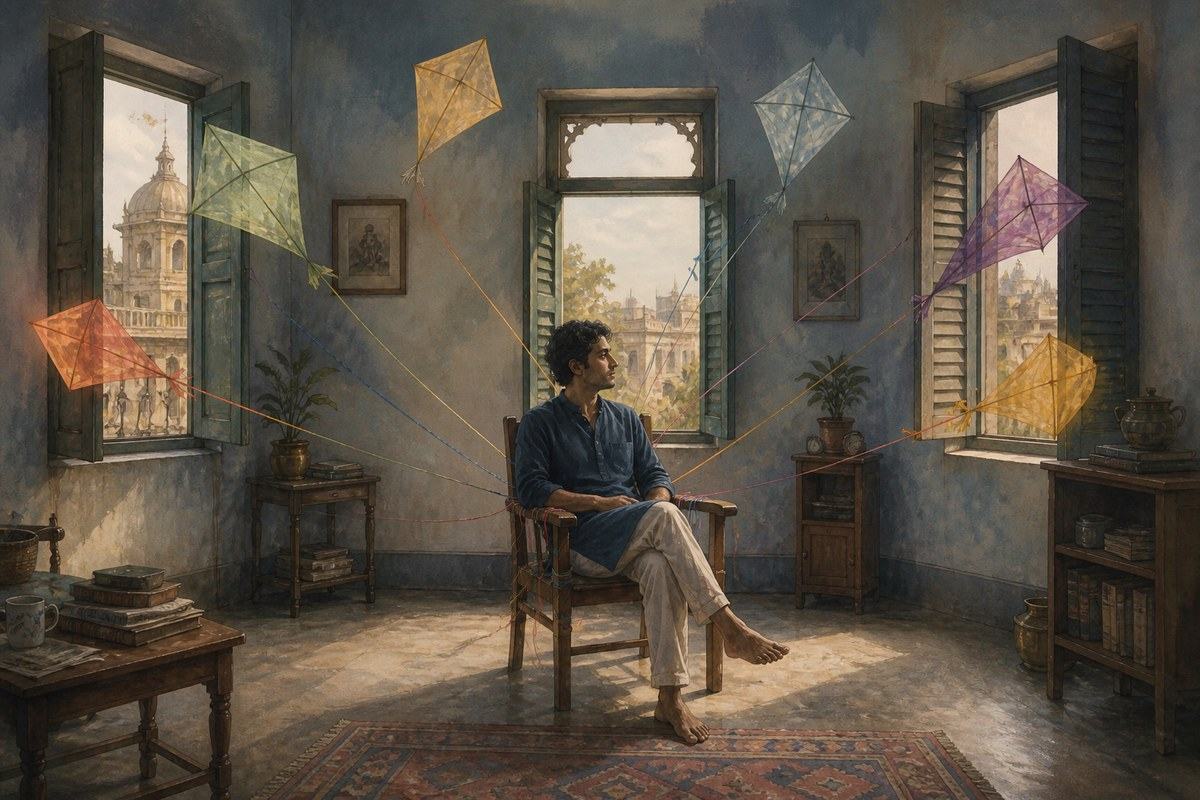
That last image matters to me. A chair. Not a throne. Not a therapist’s couch. Not a holy seat under a banyan tree. Just a chair in an ordinary room, in an ordinary flat, in an ordinary part of Kolkata where the walls sweat in summer and the fan sounds like an old helicopter reconsidering its career.
Keep one chair ready for the missing self.
Not because he will return dramatically. He may not. Not all at once. No background music. No airport reunion. He may come back in pieces. A sentence today. A joke next week. A clean shirt. A repaired sleep cycle. A morning when the chest feels two inches less heavy. A small interest in something useless and therefore holy.
A bird on the railing.
A headline too absurd not to laugh at.
The smell of frying onions from a neighbor’s kitchen.
A paragraph that sounds like you.
And then one day, perhaps, you enter the central room again and notice it is not entirely empty. There is a little dust, yes. There is damage. There are unpaid bills on the table. But there is also a chair pulled slightly away from the wall, as if someone had been sitting there recently and had just stepped out for tea.
That may be enough.
For one day, enough is not a small word. It is a bridge.
Word Cloud
Related reading
Selected by shared topics and section, with closer publication dates breaking ties.